AI API Gateway Architecture: One Key, Model Routing, and the End of Provider Account Sprawl
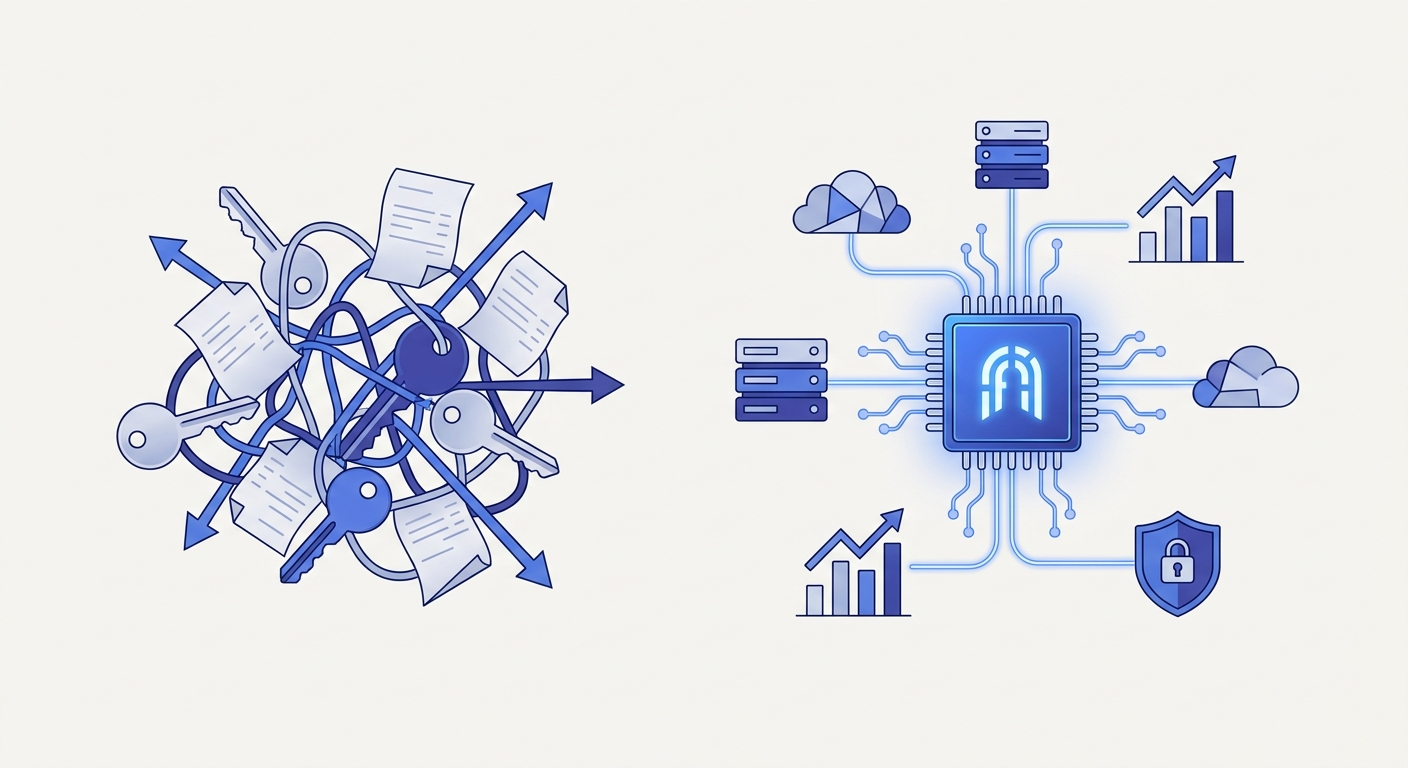
The first provider account usually feels manageable. The second still looks temporary. The third is when teams discover that AI integration pain is not only about prompts and model quality. It is about keys, balances, billing, routing rules, and the awkward question of who is actually responsible when one workflow silently changes providers.
That is the practical reason AI API gateway architecture becomes important long before a team looks “large.” Small teams feel the pain first because the same people often own product delivery, provider setup, cost review, and incident response at the same time.
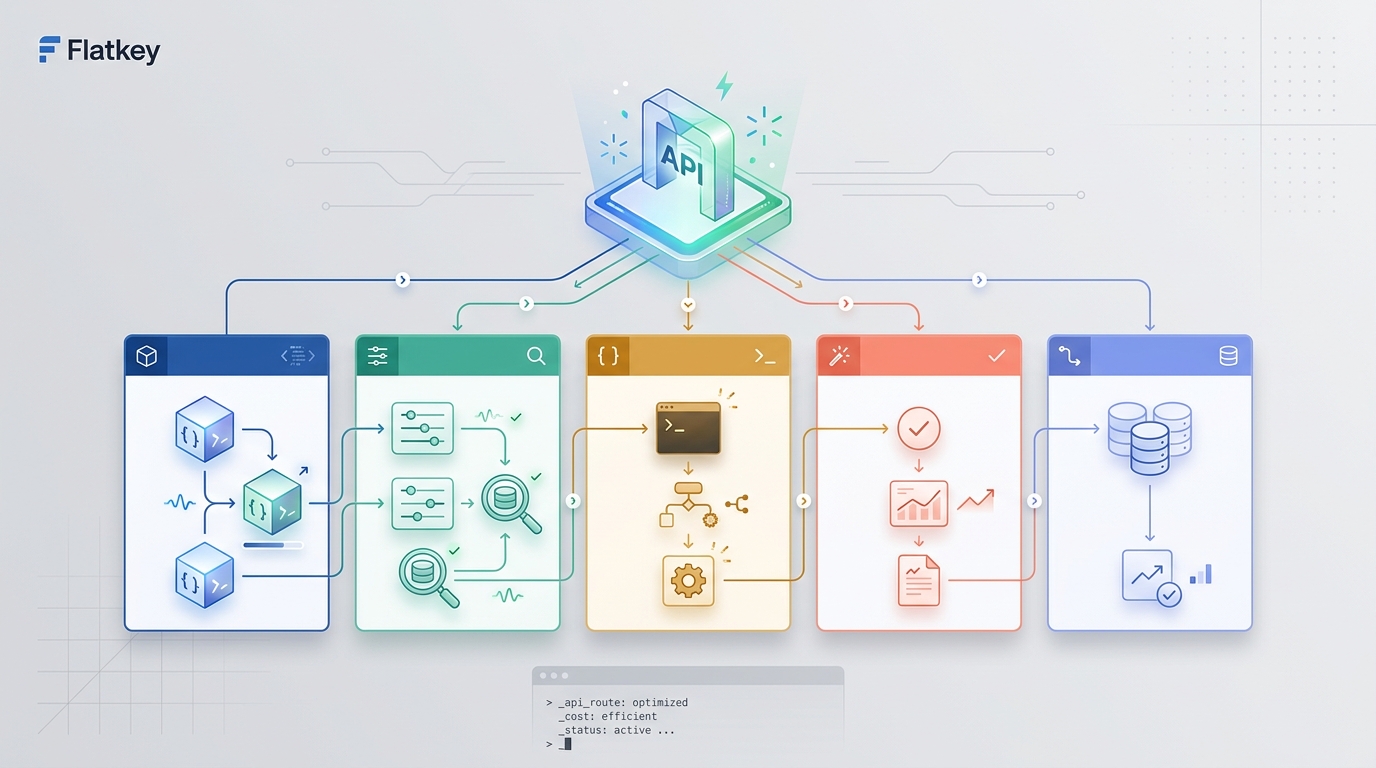
On Monday, July 20, 2026, Flatkey’s live homepage still positioned the product around every official model, one key, with a public description that says Flatkey routes requests to official GPT, Claude, Gemini, DeepSeek, Qwen, and GLM APIs with 160+ frontier models behind one key and verified hourly. The same homepage also still says developers can change one line, keep your SDK, and describes the gateway as OpenAI-compatible while also supporting an Anthropic-shaped path for Claude-oriented workflows. Flatkey’s live public pricing feed checked the same day returned 500 model rows, 210 rows currently available, and supported endpoint families across openai, openai-response, anthropic, gemini, image-generation, and openai-video.
That is useful context because it shifts the gateway conversation away from generic “proxy” language and toward the actual operating problem: how one key and model routing help a team stop juggling separate provider accounts before the sprawl becomes expensive.
The short answer
If your team already has more than one provider account, AI API gateway architecture stops being an infrastructure preference and starts becoming an operations decision.
Use a gateway when you need:
| Problem | What breaks without a gateway | What one key and model routing improve |
|---|---|---|
| Scattered API keys | Each app, environment, or engineer ends up tracking a different provider credential | One access layer replaces multiple provider-specific keys in app code |
| Fragmented billing | Spend is split across providers, prepaid balances, and dashboards | A shared route can centralize cost review and usage visibility |
| Inconsistent routing rules | Fallback and model changes happen ad hoc inside individual services | Routing policy moves into one reviewable layer |
| Provider-specific setup drift | Every new model family brings another SDK or endpoint assumption | One base URL and one integration pattern reduce setup churn |
| No clear owner for model changes | Product, engineering, and finance each see a different slice of the system | One route layer makes model choice and usage review easier to govern |
This is the real appeal of AI API gateway architecture. It is not novelty. It is relief from separate-provider operational drag.
Why small teams feel the problem earlier than they expect
The failure pattern is usually predictable:
- One workflow starts on one provider.
- Another feature needs a different model family.
- A second account, second API key, and second billing surface appear.
- Someone wants one spend view and one policy for model changes.
- Nobody can answer which routes are live, which keys are active, or which balance paid for what.
That is account sprawl. It does not require huge scale. It only requires more than one provider and no shared control layer.
This is also why “we are still a small team” is not a strong reason to delay AI API gateway architecture. Small teams often have less slack for manual billing review, duplicated setup, and routing ambiguity.
What one key actually solves
Most gateway articles stop at “one key, one endpoint.” That is too shallow.
One key matters because it changes the operating model:
| Workflow question | Separate provider accounts | One-key gateway architecture |
|---|---|---|
| Where do credentials live? | In multiple provider dashboards and secrets | In one shared access layer |
| How do apps connect? | Different base URLs and setup assumptions per provider | One integration surface, often one OpenAI-compatible path |
| How is spend reviewed? | Across several dashboards and invoices | In one route-aware usage view |
| How are model changes approved? | Inside individual services or team-specific scripts | In a shared routing policy |
| How does a new team onboard? | Repeats provider setup and billing context | Reuses the same route and key pattern |
That is the core of AI API gateway architecture. One key is not the feature by itself. It is the mechanism that makes routing, billing, and governance easier to unify.
Why model routing becomes a team problem
Routing sounds technical, but the pain is organizational.
Without a gateway, routing decisions tend to live in too many places:
- hard-coded model names inside application code
- provider-specific environment variables
- one-off failover logic in background jobs
- undocumented assumptions about which team owns which provider account
- separate cost decisions made by engineering and finance with no shared ledger
Model routing becomes a team problem because the route is no longer just “which model should answer this prompt?” It is also:
- which provider account is paying for it
- which environment owns the key
- which fallback is acceptable
- which model changes need review
- which logs prove what actually ran
That is where AI API gateway architecture becomes operationally useful even for modest traffic.
Current provider docs still reinforce the sprawl problem
The sprawl is not imaginary. Current official docs still teach provider-by-provider setup, because that is their job.
On Monday, July 20, 2026:
- Google’s official Gemini API page titled OpenAI compatibility still documented Gemini access through an OpenAI-style integration path.
- Anthropic’s official Get started with Claude page still framed setup around Anthropic’s own platform and Messages API flow.
- DeepSeek’s official Your First API Call page still said the DeepSeek API uses a format compatible with OpenAI and Anthropic, while publishing distinct
base_urlvalues forhttps://api.deepseek.comandhttps://api.deepseek.com/anthropic.
Those docs are not a problem by themselves. They become a team problem when a small product group needs to support several of them at once.
That is the hidden cost of not investing in AI API gateway architecture: each provider can be reasonable on its own while the combined setup becomes unreasonable for the team.
The moment fragmented billing becomes more expensive than the gateway
Many teams wait to think about a gateway until request volume is large. That misses the more common trigger.
The earlier tipping point is usually fragmented billing:
- prepaid balances on multiple providers
- no single place to review usage across model families
- finance asking which requests belonged to which team
- engineering trying to reconcile model changes with provider invoices
- product wanting cost visibility before approving new model experiments
Flatkey’s live pricing page on Monday, July 20, 2026 still stated that:
- one balance can route across GPT, Claude, Gemini, DeepSeek, image, audio, and video models through one OpenAI-compatible gateway
- usage is metered by model, token type, and request logs
- Enterprise is the fit for larger monthly usage, invoicing, procurement, custom routing discounts, or team-level controls
Those are exactly the kinds of needs that appear before “massive scale.” They appear when a team is tired of stitching together cost review from several providers.
What a practical gateway architecture should include
A useful AI API gateway architecture is not just a reverse proxy. It should make these five things easier:
1. One integration path
Your application should not need to remember a different setup contract for every provider. A stable base URL and stable client pattern matter more than teams admit.
2. Route policy outside product code
Model selection and fallback should not be scattered across services. If routing lives everywhere, nobody owns it.
3. Usage visibility tied to the route
A route without usable logs is just another hidden dependency. Teams need to see which model ran, where cost went, and what changed.
4. Access control that matches team structure
Sub-keys, model allowlists, and caps matter because “one key” for a company should not mean “one uncontrolled key” for every workflow.
5. A sane billing surface
The more model families a team uses, the more billing and procurement stop being secondary concerns.
This is where Flatkey’s current homepage language is relevant. The page still publicly highlighted sub-key caps, model allowlists, a per-request ledger API, invoices in 48h, and zero retention alongside the routing story. That is materially different from a bare proxy framing.
When direct provider accounts are still enough
Not every team needs a gateway immediately. Separate provider accounts can still be fine when:
- you use only one provider
- one engineer owns the whole workflow
- spend review is simple and not shared
- model changes are rare
- no other team depends on the same route
In that case, delaying AI API gateway architecture can be reasonable.
The mistake is assuming that adding a second or third provider is only a technical change. It usually changes governance and cost review too.
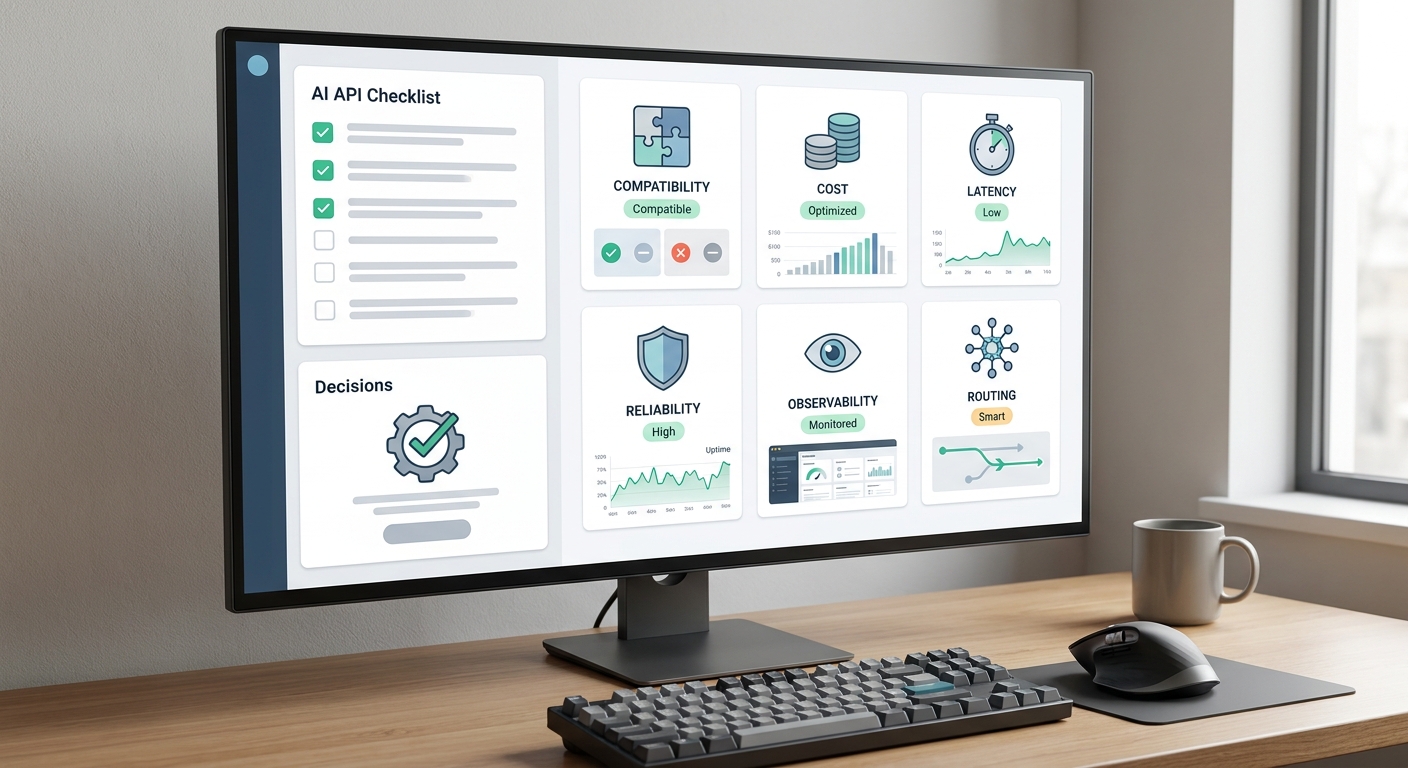
A simple decision framework
Use this to decide whether your team is already past the “direct only” stage:
| If this is true today... | Direct accounts may still be enough | Gateway architecture is probably the better move |
|---|---|---|
| One provider only | Yes | No |
| Multiple providers already active | Sometimes | Usually yes |
| One person can still explain all keys and balances | Yes | Not yet urgent |
| Product, engineering, and finance all need usage visibility | No | Yes |
| Model fallback is already inconsistent across services | No | Yes |
| The team wants one key and one route pattern for future models | Sometimes | Yes |
If your team already wants one reviewable route layer, the gateway decision has effectively been made. The only question left is whether you keep rebuilding that layer internally or adopt one that already exposes the controls you need.
What this means for Flatkey buyers
For Flatkey, the strongest argument is not “many models.” It is the narrower and more practical promise:
- one key
- one base URL
- route-aware usage review
- official-model positioning
- model routing outside scattered application logic
That is why this topic belongs near the top of the funnel. Teams looking at AI API gateway architecture are often not searching for a finished procurement answer yet. They are trying to understand why account sprawl feels harder than it should.
If that pain is already visible, the next useful steps are:
- Review the live pricing page to see how the one-balance model changes billing review.
- Read AI API Gateway Requirements: What Production Teams Need Beyond a Proxy to pressure-test whether your team needs more than a bare proxy.
- Compare your current setup against the “one key, one route, one review surface” standard before adding another provider account.
FAQ
What is AI API gateway architecture in practical terms?
In practice, AI API gateway architecture means a shared access layer that centralizes keys, routing, usage visibility, and model selection instead of leaving them scattered across provider accounts and product code.
Why does one key matter so much?
One key matters because it reduces provider-specific secret sprawl and makes it easier to standardize how teams connect to multiple model families.
When does model routing become a business problem, not just an engineering problem?
It becomes a business problem when billing, usage review, fallback rules, and model changes affect more than one person or one workflow.
Is an OpenAI-compatible route enough by itself?
Not always. A stable client pattern helps, but teams still need usable logs, route policy, billing visibility, and access controls.
What is the earliest sign that a team should look at a gateway?
Usually it is not traffic volume. It is the moment nobody can confidently explain which provider keys, balances, and routing rules are actually live.
Conclusion
The best reason to care about AI API gateway architecture is not scale theater. It is that scattered keys, fragmented billing, and inconsistent routing turn into a team problem sooner than most product groups expect.
One key and model routing do not just make integration tidier. They make ownership clearer. For small teams already feeling provider-account sprawl, that is often the difference between a manageable multi-model setup and a stack that keeps getting harder to explain.