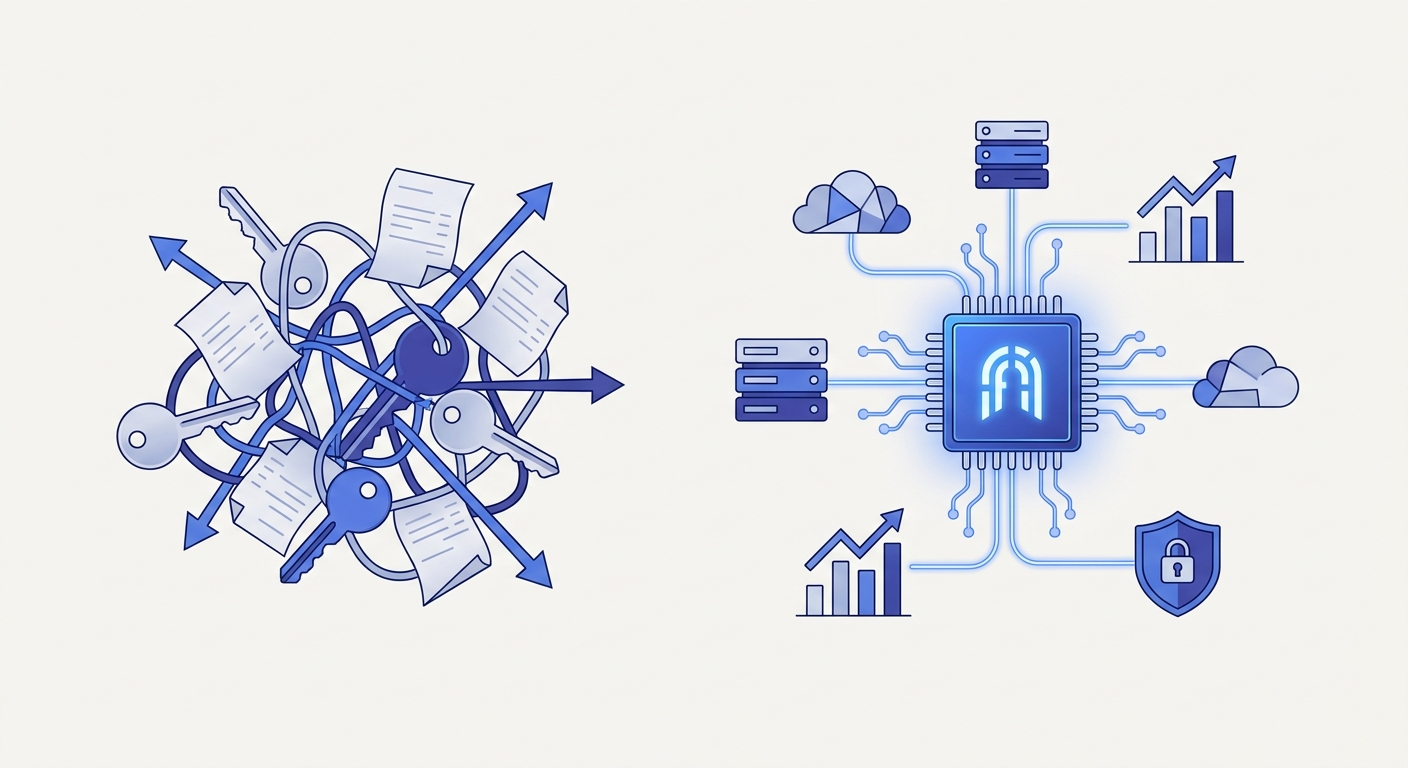
A unified API (often called a unified AI API) gives a product team one key, one endpoint pattern, and one control surface for multiple model providers. In practice, that means fewer provider dashboards, fewer scattered API keys, and fewer one-off integrations when a team needs Claude for reasoning, GPT for broad compatibility, Gemini for multimodal work, DeepSeek for cost-sensitive flows, or Qwen for regional or workflow-specific coverage.
That definition is the easy part. The harder question is whether a unified ai api is actually better than keeping separate provider accounts. For many product teams, the answer is yes, but not for every workflow. A unified layer is strongest when the problem is operational sprawl. Direct-provider accounts are still strongest when a team needs provider-native controls before anything else.
As of July 15, 2026, Flatkey's public homepage positions the product around official GPT, Claude, and Gemini access through one key, “as low as 50% off,” live 30-day model health, and zero retention of request content. The live public pricing feed checked for this draft returned 170 model rows with endpoint families for openai, openai-response, anthropic, gemini, image-generation, and openai-video. This article uses those current public signals to explain where a unified ai api fits in the developer workflow without treating the category as magic.
Quick answer: what a unified ai api actually changes
A unified ai api changes operations more than it changes prompts.
| Question | Separate provider accounts | Unified ai api layer |
|---|---|---|
| Keys | One key per provider, team, or environment | One access layer for supported models |
| Base URLs and request shapes | Each provider keeps its own onboarding path and compatibility rules | One reviewable integration surface, often with OpenAI-compatible migration paths where supported |
| Billing review | Spend is fragmented across vendors | Usage and spend can be reviewed from one place |
| Model switching | Swapping providers usually means dashboard, key, and config work | Model changes can happen inside one routing layer |
| Failure handling | Each provider's fallback logic is separate | Fallback and policy can be centralized |
| Best fit | Teams that need provider-native controls first | Teams that need faster multi-model operations |
That is why the best buying question is not “Do I want more models?” The better question is “Where is my current model sprawl slowing shipping, review, or budget control?”
Why product teams start looking for a unified ai api
Most product teams do not search for a unified ai api on day one. They start searching after the second or third provider integration.
The pattern is predictable:
- A team ships the first model feature with one provider.
- A second workflow needs a different price, latency, modality, or quality profile.
- Another team adds its own API keys, dashboards, and retry logic.
- Finance asks for one spend view.
- Platform asks who owns fallback, quotas, and production model changes.
That is the moment the category becomes useful. A unified ai api is not mainly about avoiding one signup form. It is about stopping provider-by-provider drift once real product usage starts.
Current provider docs make this fragmentation visible. Anthropic's current getting-started flow still centers on ANTHROPIC_API_KEY and the Messages API. Google's current Gemini docs say Gemini models can be used through OpenAI libraries with configuration changes and a Gemini API key. DeepSeek's current docs say its API is compatible with OpenAI and Anthropic formats, but still uses DeepSeek-specific base URLs and keys. None of that is wrong. It simply means the product team still owns multiple provider contracts unless it adds a shared control layer.
When a unified ai api beats separate provider accounts
A unified ai api wins when the bottleneck is coordination.
1. You need multi-model access without multi-dashboard sprawl
If one workflow uses Claude, another uses Gemini, and another uses GPT or DeepSeek, separate accounts create repeated setup and review work. A unified ai api is useful when the team wants multi-model access without repeated onboarding, separate key rotation rituals, and fragmented cost readouts.
2. Your application can keep an OpenAI-compatible API flow
Many teams already use an OpenAI-compatible API client shape. That makes a unified layer much easier to test because the migration can start with a base URL and model-ID change instead of a rewrite. Flatkey's current public migration article is built around that exact motion: keep the client pattern, switch the base URL, verify logs, quotas, and billing, then expand.
3. Product, platform, and finance all need the same answer
The engineering team may care about routing and fallback. Product may care about launch speed. Finance may care about one spend view and fewer billing surprises. A unified ai api becomes compelling when those three groups need one shared operating surface instead of three separate systems of record.
4. You expect model switching to be normal, not exceptional
If the team already knows it will compare models, rotate routes, or add new providers, a unified ai api reduces the cost of each change. The value is not only model access. The value is faster approved change management around model access.
When direct provider accounts still win
A unified ai api should not be framed as the right answer for every team.
Direct-provider accounts still make sense when:
- a workflow depends on provider-native features that the shared layer does not expose yet
- legal or procurement policy requires direct commercial relationship with a specific provider
- the team only uses one provider and has no near-term reason to add another
- deep provider-specific observability or fine-grained controls matter more than cross-provider convenience
- model switching is rare enough that an extra control layer adds more process than value
That is the right tradeoff discipline. A unified ai api is strongest when it removes repeated operational work. It is weaker when the team mainly needs the full native feature surface of one provider.
Use this decision matrix before you choose
The practical way to evaluate a unified ai api is to compare your real bottleneck, not the category tagline.
| If your team mainly needs... | Direct provider accounts are usually better | Unified ai api is usually better |
|---|---|---|
| One provider's newest native feature first | Yes | No |
| One spend view across several providers | No | Yes |
| Fast OpenAI-compatible API migration path | Sometimes | Yes |
| Central routing, fallback, and quota review | No | Yes |
| Single-provider deep optimization | Yes | Sometimes |
| Model comparison and switching as a normal workflow | No | Yes |
| Lower admin overhead for keys and access | No | Yes |
This is the missing step in many category pages. A unified ai api is not just “more convenient.” It is a choice about which team owns model operations and how often you expect model changes.
How Flatkey fits the unified ai api workflow
Flatkey fits the unified ai api category because its current public positioning matches the operating problem product teams are trying to solve.
The public site currently states:
- one API key
- one base URL
- one pricing and usage surface
- live model health visibility
- one dashboard for keys, usage, and routing
- zero retention messaging on request content
The live public pricing feed checked on July 15, 2026 also reinforces that this is not only a text-model story. It returned 170 model rows and endpoint families across chat-style, responses-style, Anthropic, Gemini, image-generation, and video-generation routes. That does not remove the need to verify the exact publish-day model row. It does show why Flatkey is relevant when a product team wants one unified ai api layer across several workflow classes.
This is also where Flatkey differs from a generic category explanation. The current homepage promise is not only “many models.” It is “official models,” price compression, live health visibility, and one access layer that still fits existing developer tooling.
A simple rollout path for product teams
If a unified ai api looks directionally right, the safest rollout is still small.
- Pick one existing workflow that already uses an OpenAI-compatible API pattern.
- Confirm the exact target model in the live catalog and pricing surface.
- Switch the base URL in staging.
- Validate logs, cost, quota behavior, and fallback before production.
- Add a second provider-backed workflow only after the first one is reviewable.
That sequence matters because the category can be oversold. A unified ai api helps when it improves control and review. It does not remove the need for publish-day model validation, quota policy, or owner assignment.
What to check before you approve any unified ai api
Before procurement or platform approves a unified ai api, confirm these five items:
- Model coverage is current: verify the exact model rows you intend to use today, not a screenshot from a past launch.
- The migration path is real: confirm whether your current client can keep an OpenAI-compatible API shape or needs a provider-specific rewrite.
- Spend review is centralized: make sure product and finance can see the same usage and billing story.
- Fallback ownership is explicit: decide who can change routes and what counts as an approved backup model.
- Direct-provider exceptions stay allowed: keep room for provider-native paths when a workflow genuinely needs them.
That checklist is what turns a unified ai api from a nice category phrase into a credible platform decision.
Conclusion
A unified ai api is worth it when your team is already paying the tax of separate provider accounts, scattered keys, fragmented spend review, and repeated model-migration work. It is less valuable when one provider's native feature set still dominates the roadmap.
That is the frame product teams need. Start with the operational problem, not the slogan. If the pain is multi-model coordination, a unified ai api can compress access, review, and routing into one layer. If the pain is provider-specific feature depth, direct accounts may still be the better first choice.
If you want to evaluate the category against Flatkey's live public surface, start with the pricing page and current model catalog before you change a single production route.
Try a unified API with one reversible workload
Choose one non-critical workload, verify the model and price on the live Flatkey model catalog and pricing page, then create a key and test it through the OpenAI-compatible base URL. Keep the direct-provider route available until output quality, latency, errors, token usage, and cost all match the acceptance criteria.
New to the basics? Our LLM API guide explains how requests, tokens, and pricing work.