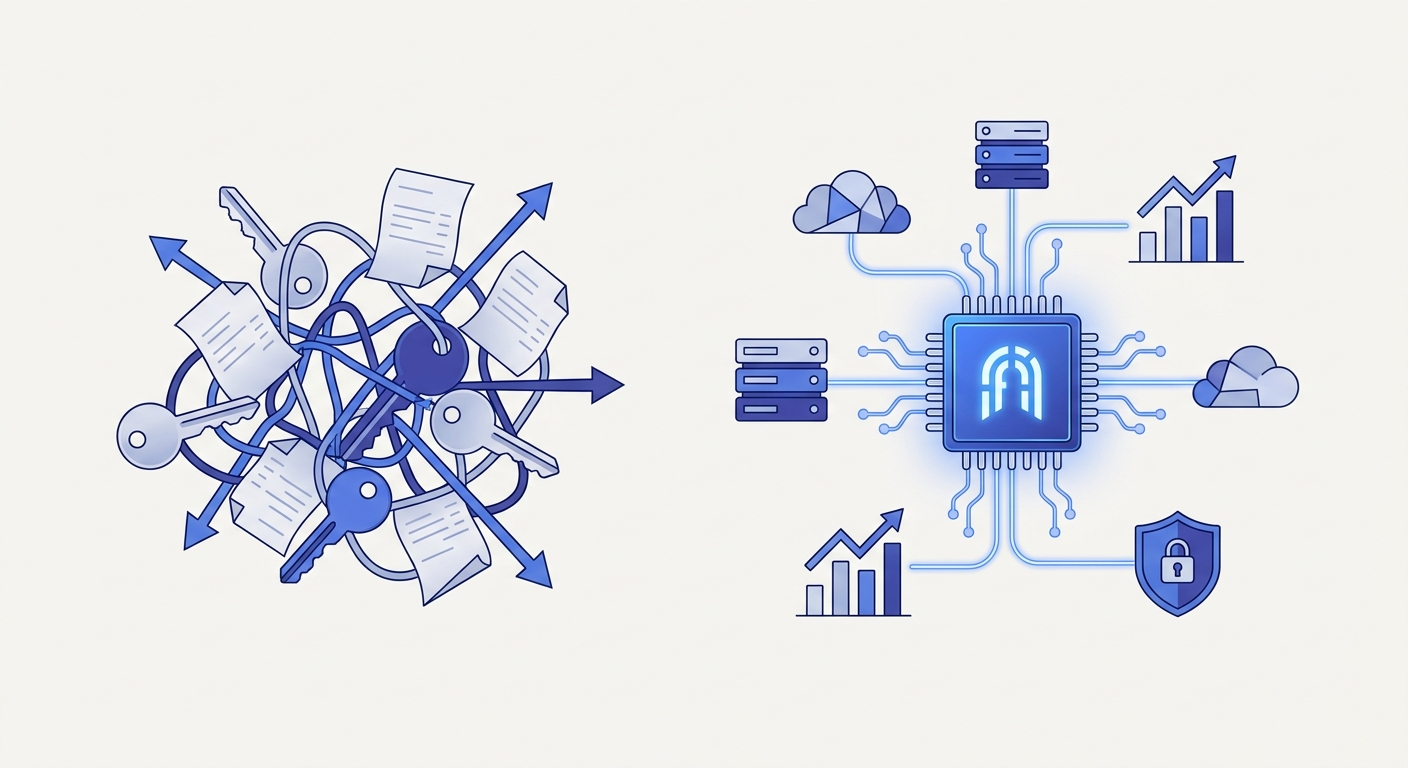
If your product already depends on more than one model family, the real decision is not “gateway or no gateway” in the abstract. The real decision is whether direct provider accounts are still simple enough, or whether the access, billing, routing, and governance overhead now justifies a shared layer like Flatkey.
That is why ai api gateway vs direct providers is a useful framing for a BOFU reader. The first provider usually feels cheap. The second provider adds another key, another billing surface, another fallback path, and another owner. By the third provider, many teams are no longer comparing model quality alone. They are comparing operating models.
As of July 15, 2026, Flatkey's public homepage positions the product around official GPT, Claude, and Gemini access through one key, price compression as low as 50% off, live 30-day model health, one dashboard for keys, usage, and routing, and zero retention of request content. The live public pricing feed checked for this page returned 170 model rows, 95 rows currently marked available, and supported endpoint families across openai, openai-response, anthropic, gemini, image-generation, and openai-video. That makes this comparison timely for any team deciding whether direct provider accounts are still good enough.
Quick answer
Use direct provider accounts when your roadmap is still mostly single-provider, provider-native features matter more than standardization, and nobody is yet feeling pain from scattered keys or fragmented billing.
Use Flatkey when your product already behaves like a multi-model system and the bigger problem is coordination: too many keys, too many dashboards, unclear fallback ownership, or no single spend and routing view. That is the core tradeoff inside ai api gateway vs direct providers.
Flatkey vs direct provider accounts at a glance
| Decision area | Direct provider accounts | Flatkey |
|---|---|---|
| Access | Separate provider signups, keys, and dashboards per vendor | One key and one shared access layer for supported models |
| Endpoint workflow | Different base URLs, account setup, and request rules by provider | One reviewable integration surface and an OpenAI-compatible API migration path where supported |
| Billing | Invoices and usage views stay split by provider | Unified billing and usage review are easier to centralize |
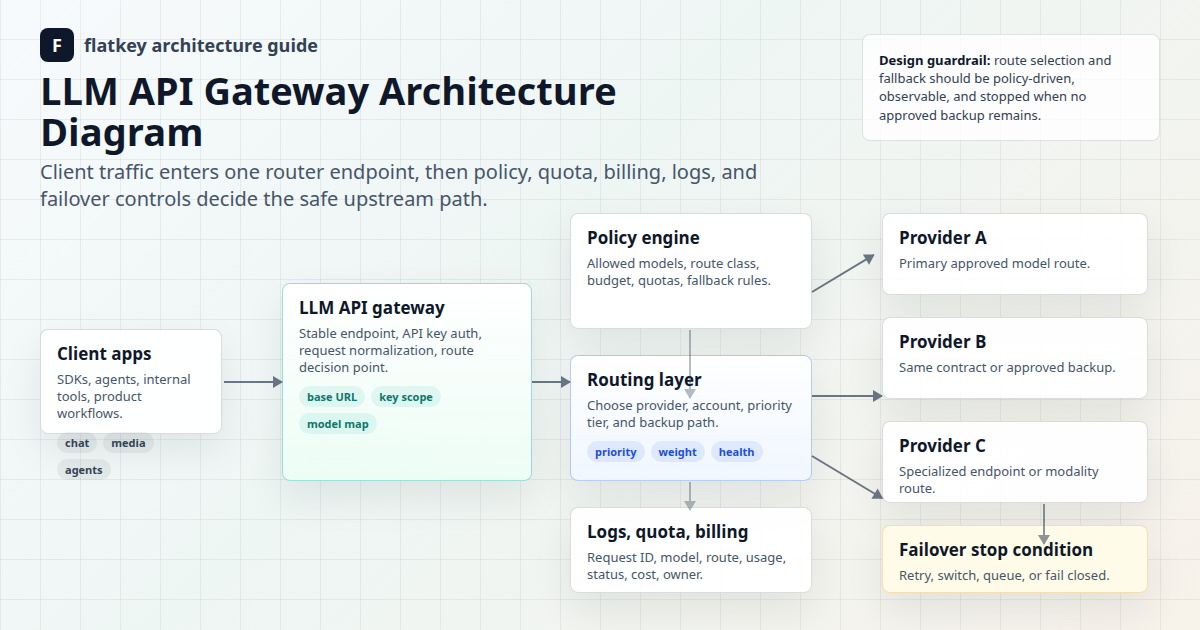
| Model routing | Each app or team owns fallback logic separately | Model routing and switching can be reviewed in one place |
| Governance | Quotas, approvals, and key rotation drift across teams | One dashboard helps centralize keys, usage, and routing ownership |
| Best fit | Single-provider or provider-native-first workflows | Multi-model products where operational sprawl is already visible |
This table is the simplest way to read ai api gateway vs direct providers. Direct accounts optimize for native control. Flatkey optimizes for one operating layer across supported models.
Where direct provider accounts stay better
Direct provider accounts still win when the product needs the full native surface of one provider and the team is not yet paying a heavy operations tax.
Keep direct provider accounts when:
- one provider still covers nearly all production traffic
- your team needs the newest provider-native feature before any shared layer exposes it
- procurement or compliance requires a direct commercial relationship with a specific vendor
- model switching is rare enough that repeated setup and billing review are still manageable
- deep provider-specific tuning matters more than a cleaner shared workflow
This matters because a credible ai api gateway vs direct providers page cannot pretend every workload belongs behind one layer.
Where Flatkey becomes the better operating model
Flatkey becomes stronger when the product is already multi-model in practice, not just in ambition.
1. Access sprawl is growing
The first sign is too many provider accounts. One team has an OpenAI project, another has Anthropic keys, another is testing Gemini or DeepSeek, and nobody wants to own the long-term key map. Flatkey simplifies that by moving supported model access behind one shared layer.
2. Billing review is fragmented
The second sign is spend visibility. Direct provider accounts split usage and invoices across vendors. Product, platform, and finance stop looking at the same numbers. Flatkey is stronger here because unified billing is part of the operating promise, not an afterthought.
3. Routing policy is inconsistent
The third sign is fallback drift. One app retries quietly. Another fails closed. Another switches models without a documented rule. That is where model routing matters. A gateway layer is useful when routing needs review, not just code.
4. Migration work is repeating
Provider docs have become more compatible, but not interchangeable. On July 15, 2026, Google's Gemini docs still required Gemini-specific configuration even when using OpenAI libraries. Anthropic's docs still started with Anthropic account and key setup. DeepSeek's docs still described OpenAI/Anthropic-compatible access through DeepSeek-specific keys and base URLs. Compatibility lowers friction, but it does not remove separate account ownership. This is one of the clearest practical differences inside ai api gateway vs direct providers.
A practical decision checklist
Before choosing between Flatkey and direct provider accounts, answer these five questions:
- How many provider accounts are already active in staging and production?
- Can the first migrated workflow keep an OpenAI-compatible API shape?
- Do platform and finance both need one shared usage and billing view?
- Do fallback and model-approval rules already vary across teams?
- Are provider-native exceptions clearly smaller than the shared operating pain?
If most answers are “no,” direct provider accounts are probably still enough.
If most answers are “yes,” Flatkey is likely the better fit because the team is already living the problem behind ai api gateway vs direct providers.
Flatkey vs direct provider accounts by team concern
| If your team mainly cares about... | Direct provider accounts are usually better | Flatkey is usually better |
|---|---|---|
| Newest provider-native features first | Yes | No |
| One OpenAI-compatible API path across providers | Sometimes | Yes |
| One view of usage and spend | No | Yes |
| Shared model routing policy | No | Yes |
| Lower admin overhead for keys and quotas | No | Yes |
| Provider-specific control above all else | Yes | Sometimes |
This is the high-signal version of ai api gateway vs direct providers for startup engineering leads. It is less about category language and more about who owns the complexity.
What Flatkey can safely claim in this comparison
For this comparison page, these current public claims are safe:
- one API key for supported model access
- one base URL pattern through
https://router.flatkey.ai/v1 - one dashboard for keys, usage, and routing
- live model-health visibility on the public site
- current public pricing language around lower cost versus official rates
- zero retention messaging on request content
The live pricing feed checked on July 15, 2026 also supports the comparison with concrete public evidence: 170 total model rows, 95 currently available rows, and endpoint families across chat, responses, Anthropic, Gemini, image-generation, and video routes. That is enough to support the BOFU decision page without promising that every provider-native feature belongs behind Flatkey immediately.
Where direct provider accounts should remain even after adopting Flatkey
The strongest version of Flatkey is not “centralize everything blindly.” It is “centralize what benefits from shared access, billing, and routing, while leaving true provider-native exceptions direct.”
Keep direct provider accounts for workflows that:
- rely on provider-native features not exposed in the shared layer yet
- require direct vendor-specific procurement or compliance handling
- need deeper provider-native observability than the shared layer currently provides
- are too sensitive for silent fallback or route switching
That exception discipline makes the ai api gateway vs direct providers comparison more useful and more credible.
Recommended rollout if Flatkey looks like the better choice
If Flatkey looks directionally right, avoid a full migration in one step.
- Choose one workflow that already uses or can adopt an OpenAI-compatible API pattern.
- Verify the exact target model in the live catalog and pricing surface.
- Switch staging traffic first.
- Review unified billing, logs, quota behavior, and model routing before production.
- Leave provider-native exceptions direct until they are worth centralizing.
This is the cleanest way to resolve ai api gateway vs direct providers without turning the comparison into a faith-based architecture decision.
Conclusion
The right answer to ai api gateway vs direct providers depends on which cost is bigger today. If your team still values native control more than standardization, direct provider accounts are still the cleaner path. If the team is already fighting access sprawl, fragmented invoices, repeated migration work, and inconsistent fallback ownership, Flatkey is the better operating model.
For Flatkey, the comparison should stay simple: one key, one access layer, one billing and usage view, and one place to review routing. That is the benefit multi-model products feel first. Everything else is secondary.