AI Gateway for Automation Builders: Fallback Routing, Cost Visibility, and One Base URL
If you run AI inside n8n, Make, Zapier, or custom scripts, the problem is usually not "how do I call one model?" It is how to keep hundreds or thousands of AI steps moving when one route degrades, a fallback changes output quality, or a workflow owner has to explain where spend went.
That is why an AI gateway for automation builders should be judged on three operational questions first:
- Can you keep one stable base URL while swapping models or routes?
- Can you review failures, cost, and routing without digging across separate provider consoles?
- Can you add fallback logic without rewriting every automation step?
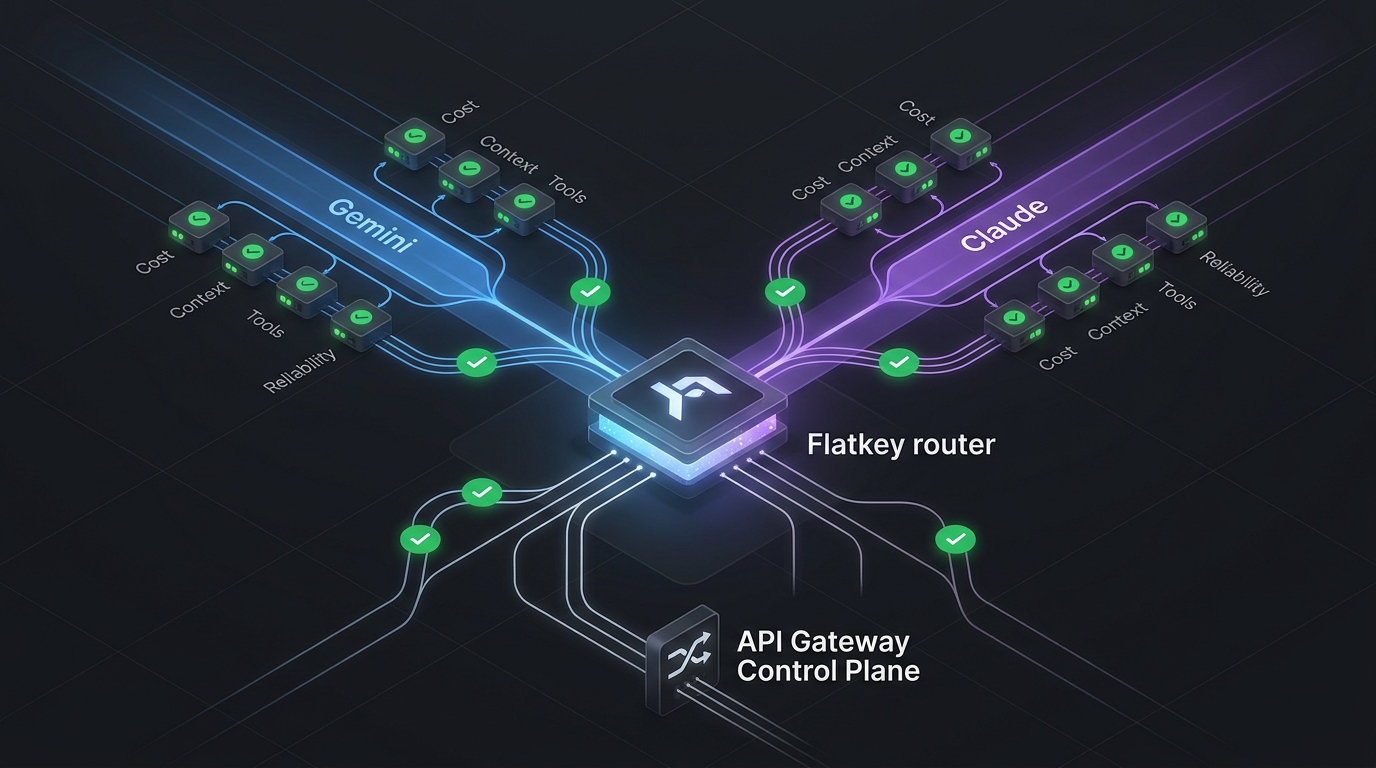
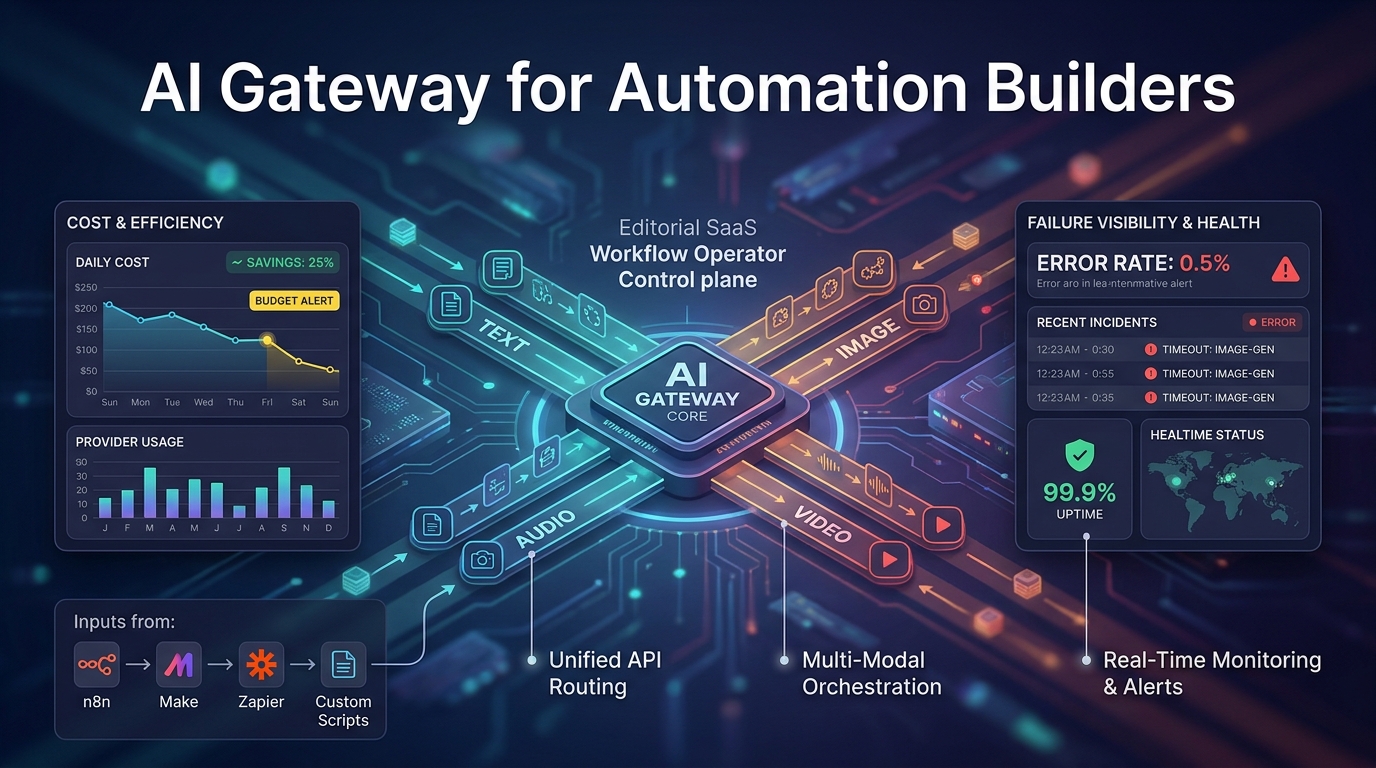
As of Tuesday, July 21, 2026, Flatkey's public homepage still explicitly says it is built for automation builders and that they can "route high-volume workflows to suitable models while keeping failures and cost easier to review." The same public surface still positions Flatkey around one API key, one router, and one dashboard for usage and routing. The live docs page still presents https://router.flatkey.ai/v1 as the OpenAI-compatible endpoint, and the pricing FAQ still says one balance can route across GPT, Claude, Gemini, DeepSeek, image, audio, and video models through one OpenAI-compatible gateway.
For automation operators, that is the real value proposition: fewer broken steps when model choices change, and less manual review when billing questions appear.
Why automation workflows break faster than app-side AI features
A product team can sometimes absorb a provider change inside application code. Automation builders usually cannot.
In workflow tools, one AI call is often connected to:
- webhooks
- retries
- branching logic
- structured fields
- CRM updates
- support queues
- content review steps
When the model route changes, the breakage is not just "the answer was worse." It can be:
- a parser failure in the next node
- a slower branch that misses an SLA
- a more expensive fallback that burns through prepaid credit
- an output format that no longer fits the approval path
That is why an AI gateway for automation builders should reduce routing friction and improve operator visibility, not just aggregate model names.
Start with one base URL, then keep routing decisions outside each workflow
The fastest way to create long-term workflow debt is to hardcode provider-specific setup in every automation.
Flatkey's public docs currently describe the Router API as an OpenAI-compatible endpoint at router.flatkey.ai/v1 where you change the base_url and keep your SDK. For automation builders, that matters because the safest migration path is usually:
- keep the node or client shape the same
- point the workflow to one stable gateway URL
- move model selection and route changes into configuration
That approach is useful in three common cases:
| Workflow situation | What usually goes wrong without a gateway | What a stable gateway helps with |
|---|---|---|
| High-volume classification | Every branch depends on one provider's uptime and schema behavior | You can keep the same workflow shape while changing route policy |
| Content pipelines | Different steps need different models, but billing is split across accounts | One review surface is easier for the operator to audit |
| Fallback-heavy automations | Retry logic spreads across nodes and scripts | Route changes can happen without editing every automation path |
For n8n, Make, Zapier, and script-based builders, that is often more valuable than adding yet another direct provider credential.
Fallback routing should protect the workflow, not just the request
Automation builders often say they want fallback routing, but the real need is narrower: they want the workflow to finish without creating cleanup work later.
That means fallback policy should answer four questions:
- What output contract must stay stable?
- Which failures can be retried automatically?
- Which cost ceiling should stop the workflow from escalating?
- Which outputs still require human review before downstream actions continue?
For example:
| Workflow class | Safe automation default | Safer fallback rule |
|---|---|---|
| Structured text extraction | Use a route that preserves schema behavior | Fail over only to another route that keeps the same field contract |
| Lead enrichment or summarization | Optimize for predictable output plus reasonable cost | Allow fallback, but log route changes for later review |
| Image generation in a content workflow | Keep dimensions and review steps explicit | Fallback only to approved image routes, not any available model |
| Audio or video tasks | Treat queue time and review cost as part of the workflow | Escalate more cautiously, often with manual approval |
This is where an AI gateway for automation builders becomes operationally useful. The fallback path should preserve workflow behavior, not just return any valid API response.
Cost visibility matters more in automations because spend compounds quietly
In application code, one expensive request is noticeable. In automations, a small overage can repeat across a schedule, queue, or bulk import.
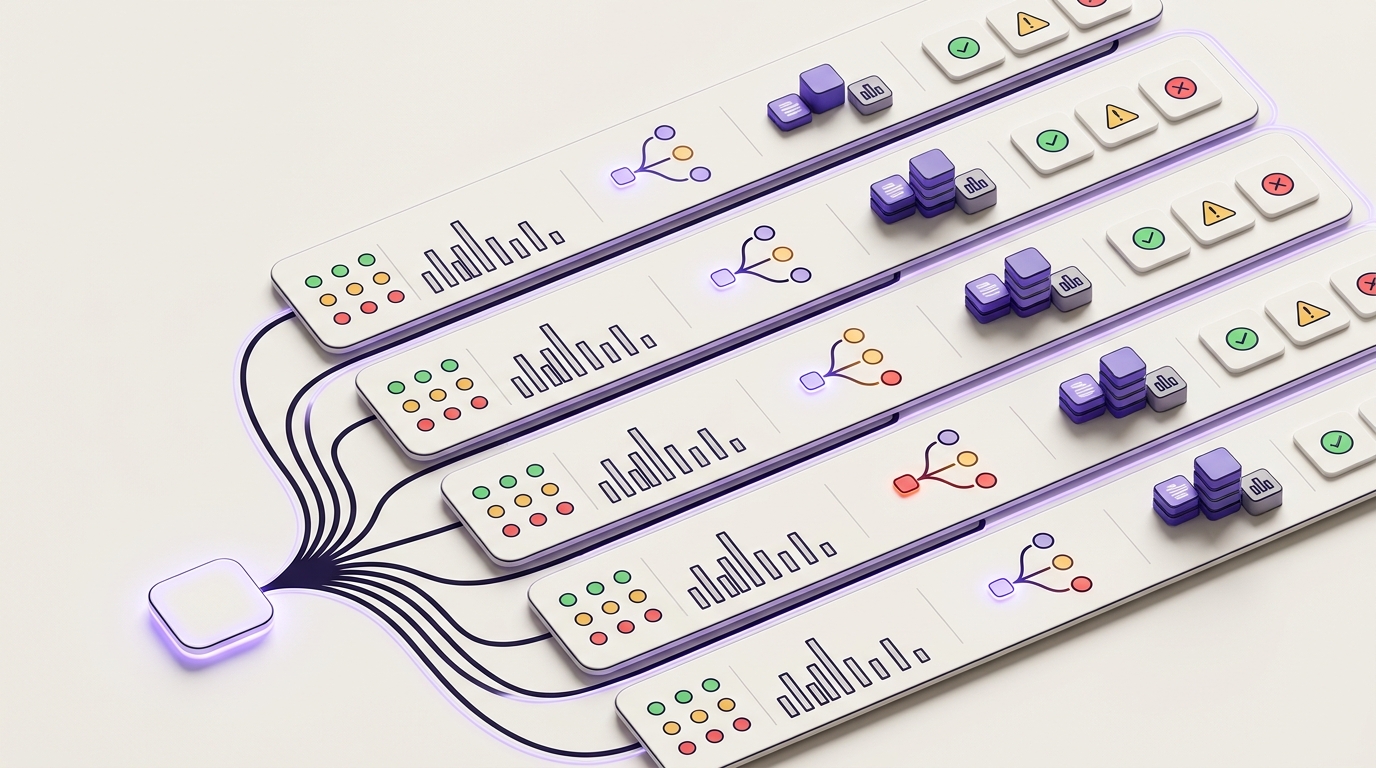
Flatkey's live homepage currently says operators can review usage, cost, routing, and errors from the same dashboard and describes visibility at the level of model, token, and request. The live pricing FAQ also says one balance can route across text, image, audio, and video models through the same gateway.
That combination is especially relevant for workflow operators because it reduces three common finance and ops problems:
- Hidden retry cost when fallback routes are more expensive than the primary path
- Fragmented billing review when separate provider accounts hide total workflow spend
- Slow debugging when an operator can see the failure but not the route that caused it
If your team runs batch jobs, support automations, internal copilots, or scheduled content workflows, spend review is not a separate concern from routing. It is part of the routing design.
What Flatkey can support publicly and safely today
Based on Flatkey's public pages checked on Tuesday, July 21, 2026, the following claims are review-safe:
- The homepage says Flatkey is built for developers, AI product teams, automation builders, and operations teams.
- The homepage says automation builders can route high-volume workflows to suitable models while keeping failures and cost easier to review.
- The docs page describes an OpenAI-compatible Router API at
https://router.flatkey.ai/v1. - The pricing FAQ says one balance can route across GPT, Claude, Gemini, DeepSeek, image, audio, and video models through one OpenAI-compatible gateway.
- The public models page describes a live catalog of 160+ official models with transparent per-token pricing and hourly health checks.
Those points are enough to support a practical automation-builder buying decision without over-claiming internal routing behavior that is not documented publicly.
A rollout checklist for automation builders
Before you standardize on an AI gateway for automation builders, confirm these five things:
- One stable endpoint is enough for your workflow stack. Your node templates or scripts should not need provider-specific rewrites for every route change.
- Fallback rules are tied to output contracts. A backup route is only useful if the next automation step can still trust the output.
- Cost review is visible to operators. Finance should not need three separate dashboards to explain one workflow run.
- Route changes are reviewable. The team should be able to see when a request moved to another route.
- The workflow owner can keep iterating without replacing every integration. That is the point of the gateway layer.
If those five are true, you are evaluating a control plane instead of just another model endpoint.
When Flatkey is a good fit for automation-led teams
Flatkey is a good fit when your team wants:
- one API key instead of separate provider onboarding for every route
- one OpenAI-compatible base URL for existing workflow clients
- one balance across multiple model classes
- one place to review usage, routing, cost, and errors while automation volume grows
If that matches your workflow stack, the next step is not another architecture debate. It is checking the live model and pricing surface, then testing one real automation against the Router API.
Review the live pricing page, compare the current model catalog guide, and use the public docs to wire one automation path to https://router.flatkey.ai/v1.
FAQ
What is an AI gateway for automation builders?
An AI gateway for automation builders is a routing layer that lets workflow tools and scripts call multiple AI models through one stable API surface while keeping model changes, fallback policy, and spend review easier to manage.
Why does fallback routing matter more in n8n, Make, or Zapier workflows?
Because one failed or degraded AI step can break the next node, parser, approval stage, or scheduled job. The risk is workflow failure, not just model failure.
Why is one base URL useful for automation teams?
Because it reduces per-workflow rewrite work. You can keep the same client shape and move routing changes into configuration or gateway policy.
Does Flatkey publicly support multimodal routing claims?
Yes, conservatively. On July 21, 2026, Flatkey's public pricing FAQ still said one balance can route across text, image, audio, and video model classes through one OpenAI-compatible gateway.
What should operators inspect before migrating automations?
Inspect the live pricing surface, current model catalog, route review visibility, fallback policy, and whether your downstream workflow steps still trust the output contract after a route change.