LLM API Fallback Routing: A Production Failover Playbook
Fallback routing for LLM APIs sounds simple until the first real incident: catch an error, switch models, and try again. In production, that rule can turn one provider problem into duplicate tool calls, broken JSON, mixed streaming output, runaway retry traffic, or a response that is technically successful but no longer satisfies the product contract.
A safer design treats fallback as a bounded state machine, not a list of backup model names. Every request moves through a small set of decisions:
- Is the failure retryable?
- Is it safe to repeat this request?
- Should the next attempt use the same target or a different one?
- Can the fallback preserve the required contract?
- Has the request already produced output or side effects?
- Has the end-to-end latency and attempt budget been exhausted?
This playbook turns those questions into an error matrix, routing policy, TypeScript controller, test plan, and rollout checklist for multi-provider LLM applications.
The four actions behind reliable LLM API fallback routing
Do not send every error into the same retry loop. A production router needs four distinct actions.
| Action | Use it when | Typical examples |
|---|---|---|
| Retry the same target | The failure looks transient and the current deployment may recover within the request deadline | Connection reset before headers, isolated timeout, short rate-limit wait |
| Fail over to an equivalent target | The provider, region, deployment, or account is unhealthy but the same model contract is available elsewhere | Regional outage, exhausted deployment quota, repeated 5xx responses |
| Fall back to another model | An evaluated alternate model can preserve the application's minimum capability and output contract | Primary model unavailable and a tested secondary model supports the same tools and schema |
| Stop and surface the error | Repeating the request will not fix it, may create side effects, or cannot preserve the contract | Invalid authentication, malformed request, unsupported parameter, policy block, partial stream |
The distinction between failover and fallback matters. Failover keeps the logical model contract and changes infrastructure. Fallback changes the model or capability tier. Failover is usually the lower-risk move.
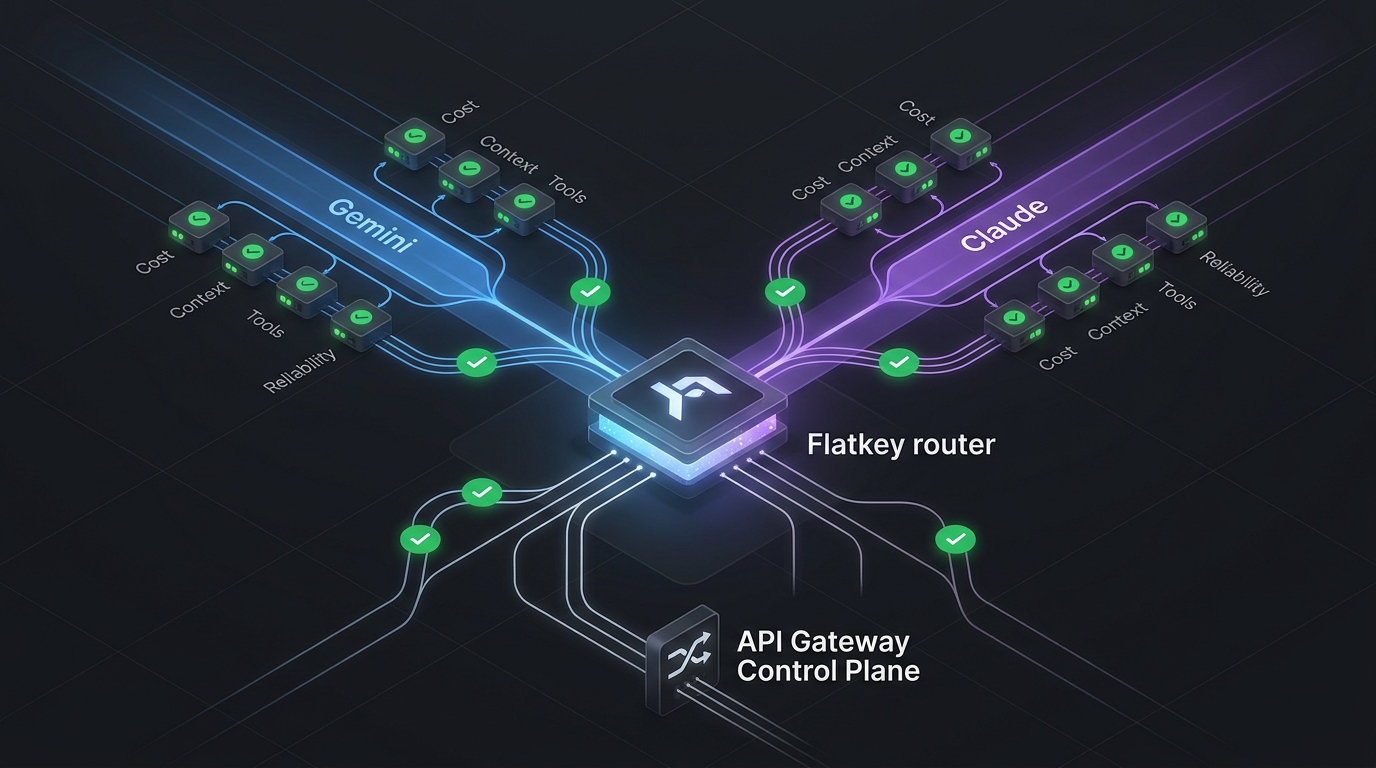
If you need the broader request-path design around aliases, health scoring, billing, and observability, start with the AI API gateway architecture guide. This article focuses on the controller that runs after a target has been selected.
Build an error-to-action matrix before writing retry code
Provider SDKs expose different exception classes and response bodies, but the router should normalize them into a small internal taxonomy.
| Normalized failure | Retry same target? | Equivalent failover? | Cross-model fallback? | Notes |
|---|---|---|---|---|
| Connect failure before request acceptance | Yes, once | Yes | Maybe | Stay inside one end-to-end deadline |
| Timeout before response headers | Maybe | Yes | Maybe | Only repeat requests that are safe to replay |
429 rate limit |
After bounded delay | Yes | Maybe | Respect server guidance when available; do not create a retry storm |
Provider 5xx or overload |
Once at most | Yes | Maybe | Open the circuit after a defined failure threshold |
| Authentication or permission error | No | No | No | Fix credentials or policy; model switching does not help |
| Malformed request or unsupported parameter | No | No | No | Correct the client contract |
| Context length exceeded | No blind retry | No | Only with an explicit adaptation | Truncation, summarization, or a larger-context route changes the request |
| Safety or policy rejection | No blind retry | No | Usually no | Switching providers to evade a policy decision is not a reliability strategy |
| Output-schema validation failure | Maybe with repair | No | Only if evaluated | Keep schema repair separate from transport retries |
| Stream fails before first token | Maybe | Yes | Maybe | No user-visible output exists yet |
| Stream fails after output begins | No automatic switch | No | No automatic switch | Do not splice two model responses together |
| Tool call may already have executed | No blind retry | No | No blind retry | Require idempotency keys or tool-level deduplication |
Official provider documentation reinforces why normalization is necessary. Anthropic documents distinct rate-limit, API, and overload errors and notes that a streaming request can still fail after an initial successful response. OpenAI likewise separates invalid requests, rate limits, and server-side failures. Your application should translate provider-specific signals into stable internal decisions instead of embedding provider names throughout business logic.
Put one retry budget around the whole request
Retries often exist in several places at once: the HTTP client, provider SDK, gateway, background job, and application service. If each layer performs three attempts, a single user action can multiply into far more upstream calls than the team intended.
The safer pattern is:
- Choose one layer to own LLM retries and fallback.
- Set one end-to-end deadline for the user request or job.
- Set a maximum number of upstream attempts.
- Reserve part of the deadline for the fallback target.
- Use exponential backoff with jitter for transient failures.
- Stop when the remaining time cannot support another meaningful attempt.
AWS's guidance on timeouts, retries, backoff, and jitter describes how retries can amplify overload and recommends bounded behavior rather than constant immediate repetition. The same principle applies to model APIs, where a provider under load is least able to absorb synchronized retry traffic.
A practical interactive budget might be expressed as policy rather than hard-coded sleeps:
type RetryBudget = {
  deadlineMs: number;
  maxAttempts: number;
  maxSameTargetAttempts: number;
  reserveForFallbackMs: number;
};
The exact values depend on the product. A chat interface, coding agent, batch evaluator, and asynchronous video workflow should not share the same budget.
Use circuit breakers to stop routing into known failures
A circuit breaker prevents every new request from rediscovering the same outage.
The standard states are:
- Closed: requests flow normally while the router measures failures and latency.
- Open: the target is temporarily ineligible because its recent behavior crossed a threshold.
- Half-open: a small number of probe requests test whether the target has recovered.
Azure's circuit-breaker pattern describes this closed/open/half-open lifecycle. For LLM routing, the breaker key should be specific enough to isolate the failing surface. Useful dimensions include provider, model, region, deployment, account, and capability. A text-completion deployment can be healthy while a tool-calling route or regional endpoint is failing.
Avoid opening circuits on every client error. Invalid authentication, malformed requests, context overflow, and policy rejection usually say more about the request than provider health. Breakers should react primarily to transient infrastructure signals such as connection failures, timeouts, overload, and server errors.
Preserve a capability contract across models
A fallback model is not safe merely because it accepts an OpenAI-compatible request. Define the minimum contract for each route alias.
route: support-agent-v3
requires:
  modalities: [text]
  streaming: true
  tools: true
  parallel_tool_calls: false
  structured_output: json_schema
  context_window_min: 64000
  max_output_tokens_min: 4000
quality_gates:
  task_success_rate_min: 0.94
  schema_valid_rate_min: 0.995
policy:
  same_model_failover_first: true
  cross_model_fallback_allowed: true
Before adding a target to the fallback set, test at least:
- Supported request parameters
- Tool definition and tool-call behavior
- Structured-output validity
- Streaming event shape
- Context and output limits
- Safety behavior appropriate to the application
- Token accounting fields used by cost controls
- Latency and quality on representative prompts
This contract-first approach is especially important for workflows that cross modalities. The multimodal agent routing guide covers additional checks for text, image, audio, and video routes.
A TypeScript fallback controller
The following example is intentionally provider-neutral. It assumes upstream adapters normalize errors and responses before the routing layer sees them.
type FailureKind =
  | "connect"
  | "timeout"
  | "rate_limit"
  | "overloaded"
  | "server_error"
  | "invalid_request"
  | "auth"
  | "policy"
  | "context_overflow"
  | "partial_stream"
  | "unknown";

type Target = {
  id: string;
  contractId: string;
  healthy: boolean;
  circuit: "closed" | "open" | "half_open";
};

type RequestState = {
  attempt: number;
  sameTargetAttempts: number;
  deadlineAt: number;
  outputStarted: boolean;
  sideEffectsPossible: boolean;
};

function canReplay(state: RequestState): boolean {
  return !state.outputStarted && !state.sideEffectsPossible;
}

function isTransient(kind: FailureKind): boolean {
  return [
    "connect",
    "timeout",
    "rate_limit",
    "overloaded",
    "server_error",
  ].includes(kind);
}

function chooseNextAction(
  kind: FailureKind,
  state: RequestState,
  current: Target,
  equivalent: Target | undefined,
  fallback: Target | undefined,
) {
  if (!canReplay(state) || kind === "partial_stream") return { type: "stop" };

  if (!isTransient(kind)) return { type: "stop" };

  if (state.attempt >= 3 || Date.now() >= state.deadlineAt) {
    return { type: "stop" };
  }

  if (
    state.sameTargetAttempts < 1 &&
    current.circuit === "closed" &&
    current.healthy
  ) {
    return { type: "retry", target: current };
  }

  if (equivalent?.healthy && equivalent.circuit !== "open") {
    return { type: "failover", target: equivalent };
  }

  if (
    fallback?.healthy &&
    fallback.circuit !== "open" &&
    fallback.contractId === current.contractId
  ) {
    return { type: "fallback", target: fallback };
  }

  return { type: "stop" };
}
Production code also needs jittered delays, cancellation propagation, request IDs, circuit-breaker updates, telemetry, and adapter-specific error parsing. The important property is that replay safety and contract compatibility are checked before another target is selected.
Treat streaming fallback as a separate protocol
Streaming creates a hard boundary: once content reaches the client, the gateway can no longer pretend the attempt never happened.
If the upstream fails before the first event is forwarded, a retry or fallback may still be transparent. After the first token, tool delta, image event, or audio chunk is delivered, automatic model switching risks combining two incompatible responses.
Use one of these explicit strategies:
- Fail the stream clearly. Return a stable error event with the request ID and let the client offer retry.
- Buffer before release. For short structured responses, validate the complete result before sending it downstream. This sacrifices time-to-first-token.
- Implement application-level resume. Start a new turn with explicit context saying the previous response was interrupted. Treat it as a new model generation, not a continuation of the same byte stream.
Do not silently concatenate output from two models.
Separate tool-call reliability from model-call reliability
An LLM request may be replayable while the tool it selected is not. A payment, email, deployment, database write, or ticket creation can succeed even if the model connection fails before the application records the result.
Protect write-side tools with:
- An idempotency key derived from the user operation, not the provider attempt
- A durable tool-execution record
- Deduplication at the tool boundary
- A clear distinction between
planned,started,succeeded, andunknown - Human review for uncertain high-impact side effects
If side effects are possible and their result is unknown, stop automatic fallback. First reconcile the tool state.
Observe fallback as a product outcome
A low provider error rate does not prove that fallback is working. Track the full route outcome.
| Metric | What it reveals |
|---|---|
| Primary-target success rate | Baseline provider or deployment health |
| Retry recovery rate | Whether same-target retries are useful |
| Equivalent failover recovery rate | Value of redundant deployments or regions |
| Cross-model fallback recovery rate | Value of the alternate model set |
| Contract rejection rate | How often candidate targets fail eligibility checks |
| Post-fallback schema validity | Whether “successful” responses remain usable |
| Post-fallback task success | Whether users still complete the intended job |
| Added fallback latency | Reliability cost paid by the user |
| Fallback cost delta | Billing impact of the recovery path |
| Circuit open duration and probe success | Whether breaker thresholds and recovery timing are sensible |
Log a route reason for every attempt: selected target, normalized error, retry delay, circuit state, fallback reason, request deadline remaining, and final outcome. Avoid logging sensitive prompts or outputs unless the product's data policy explicitly allows it.
Test the failure paths before enabling automatic fallback
Run failure injection in a staging environment and then canary the policy in production.
Transport and provider tests
- Drop the connection before response headers.
- Return repeated rate limits with and without retry guidance.
- Simulate overload and server errors.
- Delay the primary until the request deadline is nearly exhausted.
- Open a target circuit and verify traffic moves to an eligible route.
- Recover the target and verify half-open probes do not restore full traffic too early.
Contract tests
- Remove a required tool from the fallback adapter.
- Return invalid structured output.
- Change a streaming event shape.
- Exceed context or output limits.
- Compare fallback quality on a fixed evaluation set.
Replay-safety tests
- Fail before and after the first streamed event.
- Fail after a write-side tool begins.
- Repeat the same idempotency key.
- Cancel the client request while the fallback attempt is pending.
The test passes only when the router chooses the expected action and records why.
Where Flatkey fits
Flatkey provides one API key and an OpenAI-compatible base URL for supported models, with centralized usage and billing. That creates a stable integration boundary for multi-model access and routing.
Application teams should still own the route contract described in this playbook: which errors may retry, which targets are equivalent, whether cross-model fallback is allowed, how tools are deduplicated, and what quality threshold a recovered response must meet.
For the shortest integration path, use the Flatkey integration starter. If you are migrating an existing client, the OpenAI-compatible API gateway checklist covers base URL, parameters, streaming, and error-shape verification.
Production rollout checklist
- Normalize provider errors into a stable internal taxonomy.
- Define retry, equivalent failover, cross-model fallback, and stop actions.
- Assign one component to own the retry budget.
- Enforce one end-to-end deadline and maximum attempt count.
- Add exponential backoff with jitter for transient failures.
- Key circuit breakers by the smallest useful failure domain.
- Define a versioned capability contract for every route alias.
- Block automatic switching after partial output begins.
- Add idempotency and reconciliation for write-side tools.
- Record route reasons and final task outcomes.
- Inject transport, overload, contract, streaming, and side-effect failures.
- Canary equivalent failover before enabling cross-model fallback.
- Add kill switches for each target and fallback policy.
FAQ
What is fallback routing for LLM APIs?
Fallback routing for LLM APIs is a reliability policy that selects another eligible model or provider when the preferred route cannot complete a request. Safe fallback checks replay safety, capability compatibility, circuit health, latency budget, and output state before switching.
What is the difference between an LLM retry and fallback?
A retry repeats the request against the same target. Failover moves to equivalent infrastructure while preserving the logical model contract. Cross-model fallback changes the model and therefore requires stronger compatibility and quality testing.
Should an LLM API retry every 429 or 5xx error?
No. Retries should be bounded by an end-to-end deadline, attempt limit, backoff policy, circuit state, and replay-safety check. Equivalent failover may be better than repeatedly calling an unhealthy target.
Can an LLM router switch models during a stream?
Not transparently after output has reached the client. The safe default is to fail the stream clearly or start a new application-level turn. Concatenating partial outputs from different models can corrupt the response contract.
When should cross-model fallback be disabled?
Disable it when the alternate model cannot preserve required tools, structured output, context limits, safety behavior, quality thresholds, or side-effect guarantees. Also disable automatic replay after partial output or uncertain tool execution.
How many fallback attempts should an LLM request make?
There is no universal number. Use the smallest bounded attempt count that fits the product's latency budget and test evidence. The router should stop when the remaining deadline cannot support another useful attempt.
Reliable fallback does not mean “try everything.” It means making the next action explicit, compatible, replay-safe, observable, and easy to stop.