Model fallback checklist work starts before a router switches traffic. A fallback model can save a request when the primary route fails, but it can also change answer quality, token cost, tool behavior, streaming semantics, data handling, and incident visibility. Treat fallback as an evaluated production policy, not a broad "try another model" toggle.
This guide gives production AI teams a practical model fallback checklist for LLM gateways, OpenAI-compatible routers, and multi-provider AI API paths. It focuses on the questions that should be answered before fallback touches customer traffic: is the backup model good enough, affordable enough, tool-compatible enough, observable enough, and allowed for the same data boundary?
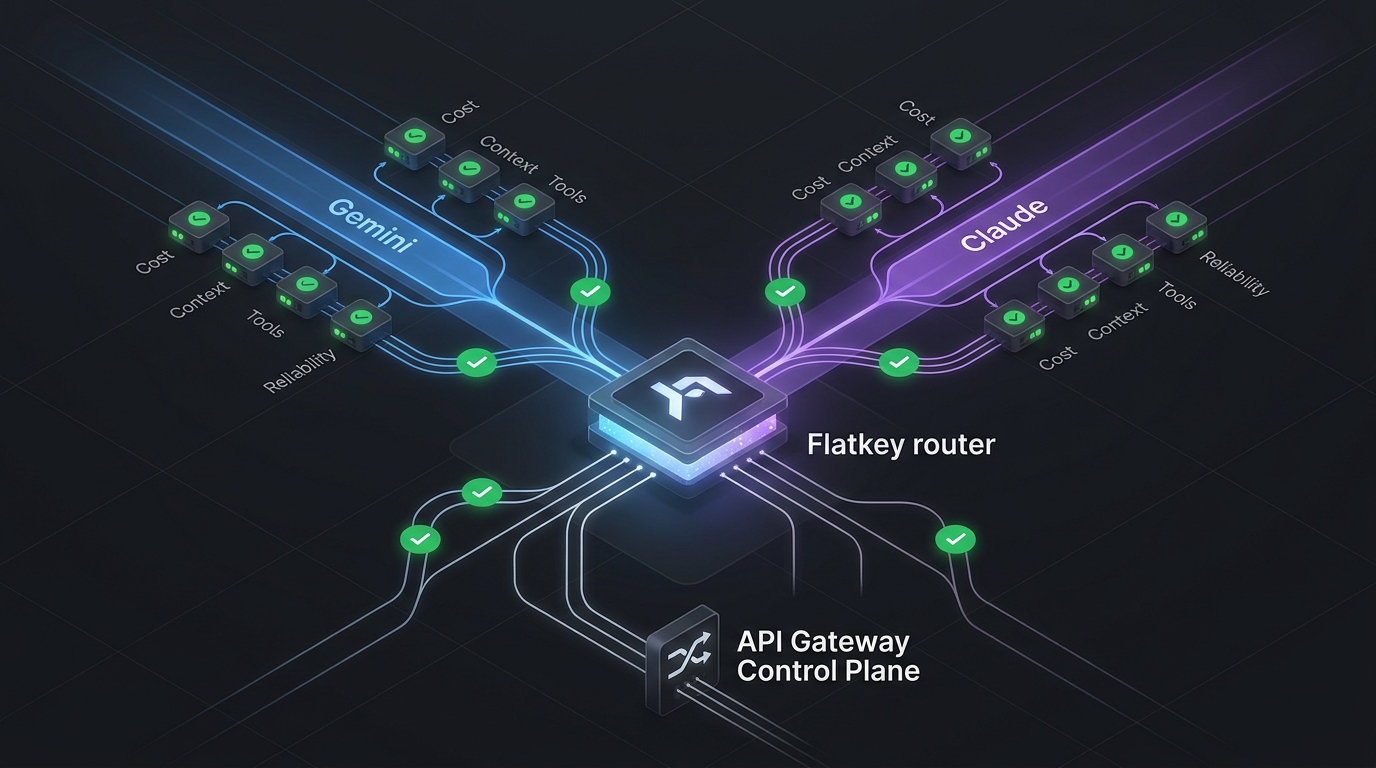
Flatkey is relevant because its public product copy positions flatkey.ai around one API key, an OpenAI-compatible base URL at https://router.flatkey.ai/v1, clear pricing, unified billing, usage analytics, dashboard controls, automatic switching, load balancing, and quota limits. Those features make routing easier to centralize. They do not remove the need for an explicit model fallback checklist that engineering, product, finance, and security can review.
Quick Answer: The Model Fallback Checklist
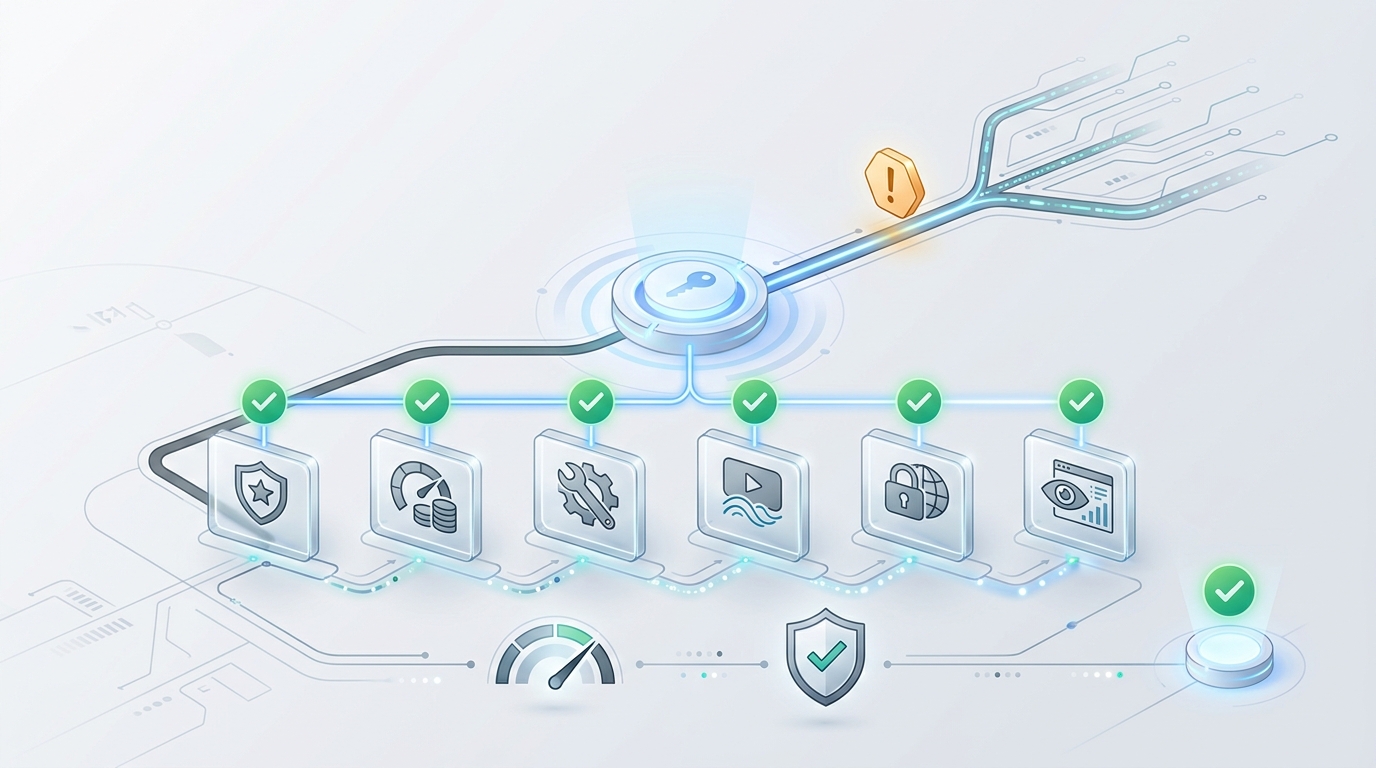
Use this model fallback checklist as the go/no-go gate before enabling an LLM model fallback in production. Each row should have an owner, a pass condition, and a stop condition.
| Gate | Pass Question | Stop Condition | Evidence To Keep |
|---|---|---|---|
| Quality | Does the fallback meet the same task-specific evals as the primary route? | Block fallback if it changes required facts, format, safety posture, or customer-visible tone beyond the accepted regression budget. | Eval set, pass rate, failure examples, reviewer notes, approved fallback scope. |
| Cost and quota | Can the fallback run inside the same budget, token cap, quota pool, and pricing unit assumptions? | Block fallback if it spends through another team, account, modality, or provider budget without approval. | Pricing snapshot, usage estimate, spend owner, quota owner, max attempts. |
| Tools and schema | Can the fallback handle the same function calls, structured outputs, tool side effects, and response formats? | Block fallback if required tool calls, JSON schema, streaming events, or output fields are unsupported or inconsistent. | Tool contract tests, schema validation, required/parallel tool-call checks, replay-safety notes. |
| Streaming and retry boundary | Is fallback allowed only before user-visible output, or is the UI designed to restart after partial output? | Block silent fallback after partial output, tool execution, or any non-idempotent side effect. | Attempt timeline, first-output timestamp, partial-output flag, retry/fallback reason. |
| Compliance and data boundary | Is the fallback approved for the same data class, region, vendor account, retention policy, and logging mode? | Block fallback on safety, privacy, DLP, auth, IP allowlist, unsupported-region, or unapproved vendor/account issues. | Data-class tag, approved vendor list, logging mode, policy decision, reviewer approval. |
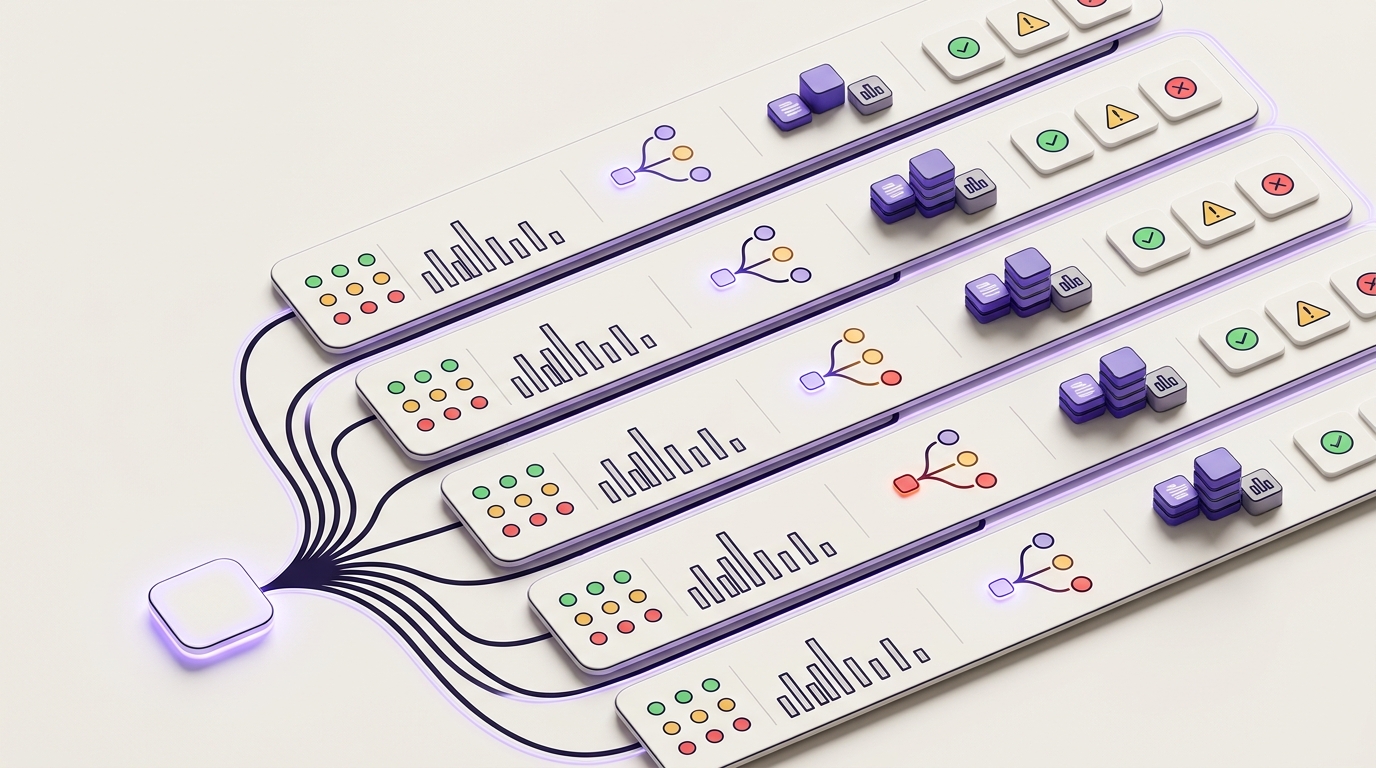
| Observability | Can operators reconstruct requested model, selected model, provider, attempts, errors, cost, and final outcome? | Block fallback if the final success would hide failed route attempts or budget impact. | Request ID, route policy ID, model attempt chain, provider errors, usage, cost, dashboard link. |
Why Fallback Is Not The Same As Retry
A retry sends the same request through the same logical route after a transient failure. A fallback changes the model, provider, account, endpoint family, or behavior surface. That is why an AI gateway fallback needs a stronger approval process than a standard network retry.
OpenAI's current error-code guidance separates authentication errors, rate limits, quota exhaustion, server errors, overload, and sudden request-rate slowdowns. Only some of those categories are retry or fallback candidates. A 500 or temporary overload may justify a bounded retry. A 401, unsupported region, safety block, malformed request, or exhausted monthly budget should usually fail closed until the owner fixes the underlying issue.
Public Vercel AI Gateway documentation describes ordered model fallbacks and provider-attempt metadata as a gateway pattern: the gateway can try backup models when the primary model fails or is unavailable, and metadata can show which model/provider attempts were made. Use that as pattern evidence, not as a Flatkey behavior claim. In your own system, the model fallback checklist should define which failures are allowed to move to the next route and which failures must stop.
Define Fallback Tiers Before Traffic
Not every fallback has the same risk. A same-model provider failover may preserve behavior better than a different model family, while a cheaper small model may be acceptable for classification but not for customer support answers. Put each route into a tier before enabling automatic switching.
| Fallback Tier | Typical Use | Main Risk | Approval Rule |
|---|---|---|---|
| Same model, different provider or account | Provider outage, account-level issue, regional capacity issue. | Provider-specific parameters, pricing, rate limits, and logging may differ. | Approve after endpoint, parameter, quota, cost, and log-field parity checks. |
| Same family, smaller or faster model | Latency-sensitive tasks, lightweight summaries, simple extraction. | Quality and instruction-following regressions. | Approve only for workflows that pass evals with the smaller model. |
| Different model family | Provider outage or feature-specific recovery. | Output style, safety behavior, tool calling, reasoning depth, and token usage can change. | Require product, engineering, and policy approval for each workflow. |
| Queue instead of fallback | Batch jobs, non-urgent enrichment, backfills, report generation. | Delayed user outcome, hidden backlog, stale data. | Approve when the user experience can tolerate delay and the job keeps ownership metadata. |
| Fail closed | Auth, permissions, safety, data boundary, budget exhaustion, malformed request. | Short-term failure is visible to users or operators. | Default for policy, security, compliance, and unapproved-budget cases. |
Quality Gate: Evaluate The Task, Not The Model Name
The quality row in a model fallback checklist should use workflow-specific evals. A fallback can be fine for title generation and wrong for contract review. It can be fine for a classification label and risky for a tool-using support workflow. The policy should test the task shape that will actually run in production.
Build a small but representative fallback eval set:
- Golden examples: successful primary-route outputs for normal cases, edge cases, and high-value customers.
- Failure examples: prompts that previously caused hallucination, refusal, schema drift, tool misuse, or overlong responses.
- Regression checks: required facts, forbidden claims, output schema, tone, citation rules, and safety posture.
- Human review: reviewer notes for examples where automated checks cannot decide quality.
- Fallback scope: the exact workflow, environment, customer tier, model list, and maximum attempt count where the fallback is approved.
OpenAI's eval examples describe graders that can check narrow fields, compare against ground truth, or judge an output more holistically. Use that pattern for fallback approval: each fallback candidate should have concrete pass/fail criteria, not a vague "looks good" review.
Cost Gate: Price The Fallback Path, Not Just The Primary
Fallback can turn a reliability incident into a cost incident if it silently moves traffic to a more expensive model, larger context window, different modality, premium provider tier, or separate quota pool. The cost part of this model fallback checklist should answer four questions before launch:
- What is the cost unit? Text tokens, cached input, reasoning tokens, image output, video seconds, or a provider-specific unit can change the budget shape.
- What is the maximum request cost? Set input, output, context, reasoning, and attempt limits for the fallback path.
- Whose budget is used? Do not spill production traffic into another team, customer, BYOK account, or provider balance without approval.
- How will finance see it? Logs should distinguish requested model, selected model, provider, route reason, token usage, and cost.
Cloudflare's AI Gateway docs are useful pattern evidence here: its logging page lists request metadata such as provider, status, token usage, cost, and duration; custom metadata can tag requests with team or test identifiers; and custom-cost headers can override public model cost assumptions for request-level accounting. Flatkey users should make the same kind of evidence visible through the Flatkey dashboard, usage logs, and billing review before relying on automatic fallback.
Tool And Schema Gate: Prove Compatibility Before You Switch
Tool-heavy workflows need a stricter model fallback checklist than plain text generation. OpenAI's function-calling guide defines tools as functionality you expose to the model, and describes a multi-step flow: send available tools, receive a tool call, execute application-side code, send tool output back, and receive the final response. That means the fallback model must be tested against the full tool loop, not just the first answer.
Run tool compatibility tests for:
- Tool selection: does the fallback call the right tool when the primary model does?
- Arguments: do required fields, enums, IDs, and nested JSON objects validate?
- Side effects: is the tool idempotent, or could a fallback repeat a refund, email, ticket update, or database write?
- Parallel tools: if the primary route uses parallel tool calls, does the fallback support the same behavior or need serialization?
- Structured output: does the fallback satisfy the schema that downstream code expects?
- Refusals and policy outcomes: can the application detect when the fallback refused or blocked an unsafe request?
OpenAI's structured output docs state that Structured Outputs are designed to make model responses adhere to a supplied JSON Schema, and distinguish function calling from response-format schemas. They also note that structured outputs can still contain mistakes and should be handled with instructions, examples, or simpler subtasks when needed. For fallback policy, that means schema validation is necessary but not sufficient: validate the content and the side effect as well.
Streaming Gate: Do Not Hide Partial Output
Streaming adds a separate boundary to the model fallback checklist. Before the first visible token, fallback can be a clean route choice. After the user has seen partial output, a silent route switch can merge two different model answers and hide the incident.
Use this default rule:
- Before first output: fallback may be allowed if the failure is transient and the fallback route is pre-approved.
- After first output: mark the answer incomplete and ask the user to restart or retry explicitly.
- After a tool side effect: fail closed or use an idempotent recovery path. Do not replay blindly.
- After a safety or compliance block: fail closed. Do not route to a less constrained model to get an answer.
This pairs with the AI API retry strategy and AI API load balancing and failover playbooks. Retry, fallback, queue, and fail-closed decisions should share one failure taxonomy so final success does not erase the route path.
Compliance Gate: Keep The Same Data Boundary
A fallback route can cross boundaries that are invisible in a simple code path. It may use a different provider, account, region, logging mode, credential owner, retention setting, or moderation policy. The compliance row in a model fallback checklist should be explicit enough that a reviewer can say yes or no before traffic moves.
| Boundary | Question To Ask | Default Posture |
|---|---|---|
| Data class | Is this fallback allowed for customer content, internal docs, regulated data, secrets, or PII-like payloads? | Fail closed unless the data class is approved for the fallback route. |
| Provider and account | Does the route use the same vendor account, BYOK account, or approved vendor list? | Require account-owner approval before cross-account spillover. |
| Logging mode | Are prompts and outputs stored, or is the route metadata-only? | Use metadata-only where sensitive payload retention is not approved. |
| Region or access policy | Could the fallback violate an IP allowlist, unsupported-region rule, or customer data-location rule? | Fail closed and alert the owner. |
| Safety and policy | Was the primary route blocked by safety, moderation, DLP, or tool authorization? | Do not bypass a policy block with fallback. |
Cloudflare's logging docs provide a concrete public example of why this matters: request logs can include prompts and responses, while a per-request header can skip payload storage and keep metadata. Your Flatkey fallback policy should similarly decide when raw content can be stored and when route evidence should be metadata-only.
Observability Fields For Fallback Review
If the log only says "request succeeded," the model fallback checklist failed. Operators need to see the attempt chain that led to success or failure.
| Field | Why It Matters |
|---|---|
| Route policy ID and version | Shows which approved policy allowed or blocked fallback. |
| Requested model and selected model | Separates user intent from router decision. |
| Provider, account, endpoint family, and region if applicable | Shows whether the request crossed an operational or compliance boundary. |
| Error class and status code per attempt | Distinguishes transient provider failure from auth, quota, request-shape, or policy issues. |
| Tool-call IDs, schema validation result, and side-effect status | Prevents duplicate tool execution and hidden schema drift. |
| Usage, cost, cache, and quota owner | Connects reliability recovery to spend and budget review. |
| Partial-output flag and first-output timestamp | Proves whether fallback happened before or after user-visible output. |
| Final disposition | One of: primary success, fallback success, queued, user retry required, fail closed. |
The companion AI API observability logs article goes deeper on incident fields. For fallback, prioritize the route attempt chain and the stop reason.
A Flatkey Staging Rollout Plan
Use this rollout plan when testing an AI gateway fallback through Flatkey or any OpenAI-compatible router. It keeps the model fallback checklist tied to evidence rather than assumptions.
- Create a staging key: keep fallback tests away from production customer traffic.
- Confirm the base route: point one OpenAI-compatible client at
https://router.flatkey.ai/v1and verify the primary model, endpoint family, usage row, and dashboard visibility. - Capture current catalog facts: on June 18, 2026, the Flatkey pricing API returned 638 model rows, 23 vendors, and endpoint families including OpenAI chat completions, OpenAI Responses, Anthropic messages, Gemini generateContent, image generation, and video generation. Treat that as dated proof, not a permanent contract.
- Pick one fallback tier: start with the lowest-risk fallback that fits the workflow, such as a same-model route or a clearly scoped lower-cost model for a narrow task.
- Run evals before traffic: test golden examples, edge cases, schema validation, tool calls, streaming boundaries, and policy blocks.
- Run forced failure tests: simulate primary timeout, rate limit, provider error, malformed request, auth error, quota exhaustion, policy block, and post-output stream failure.
- Review logs and billing: confirm requested model, selected model, fallback reason, provider attempt, usage, cost, key, team, and environment are visible.
- Set a rollback rule: disable fallback automatically or manually if quality, cost, policy, or observability gates fail.
Pair this with LLM API gateway architecture, enterprise AI API gateway checklist, and Flatkey pricing when you move from staging to production.
Fallback Policy Template
This template is not a Flatkey API contract. It is a review artifact your team can adapt before enabling fallback.
{
  "policy_id": "support-chat-fallback-v1",
  "workflow": "customer-support-chat",
  "environment": "production",
  "primary_route": {
    "model": "primary-approved-model",
    "endpoint_family": "openai-chat-completions"
  },
  "fallback_routes": [
    {
      "model": "approved-backup-model",
      "allowed_reasons": ["primary_timeout", "temporary_5xx", "provider_unavailable"],
      "blocked_reasons": ["auth_error", "invalid_request", "quota_exhausted", "safety_block", "unapproved_data_class"],
      "requires_eval_pass": true,
      "requires_cost_owner": true,
      "requires_tool_contract_pass": true,
      "allow_after_partial_output": false
    }
  ],
  "limits": {
    "max_total_attempts": 2,
    "max_elapsed_ms": 12000,
    "max_input_tokens": 8000,
    "max_output_tokens": 1200,
    "max_estimated_cost_usd": 0.05
  },
  "logging": {
    "record_attempt_chain": true,
    "record_requested_and_selected_model": true,
    "record_error_class_per_attempt": true,
    "record_usage_and_cost": true,
    "payload_logging_mode": "metadata_only"
  },
  "rollback": {
    "disable_on_schema_failures": true,
    "disable_on_unapproved_cost_spike": true,
    "disable_on_policy_boundary_error": true
  }
}
FAQ
What is a model fallback checklist?
A model fallback checklist is a production review list for deciding whether a backup model or provider can safely handle traffic when the primary route fails. It should cover quality, cost, quota, tools, streaming behavior, compliance boundaries, observability, and rollback rules.
When should I use LLM model fallback instead of retrying?
Use LLM model fallback when the primary route has a transient provider-side failure or unavailability and the backup route is already approved for the same workflow. Do not use fallback for malformed requests, auth errors, safety blocks, budget exhaustion, or unapproved data classes.
How should an AI gateway fallback handle tool calls?
An AI gateway fallback should prove tool compatibility before production. Test tool selection, JSON arguments, required fields, schema validation, side effects, idempotency, parallel calls, and final response format. If a tool already caused a side effect, do not replay the request through another model unless the operation is explicitly safe to repeat.
Final Review Step
Before enabling fallback, ask one direct question: can we explain why this route switched, what changed, what it cost, whether it crossed a policy boundary, and how to roll it back? If the answer is no, the model fallback checklist is not complete.
Flatkey can centralize model access, routing, billing, usage visibility, and key management behind one OpenAI-compatible path. Use that central point to make fallback decisions testable before automatic switching reaches production traffic. When you are ready to validate routes in staging, get a key and start with one approved fallback policy.