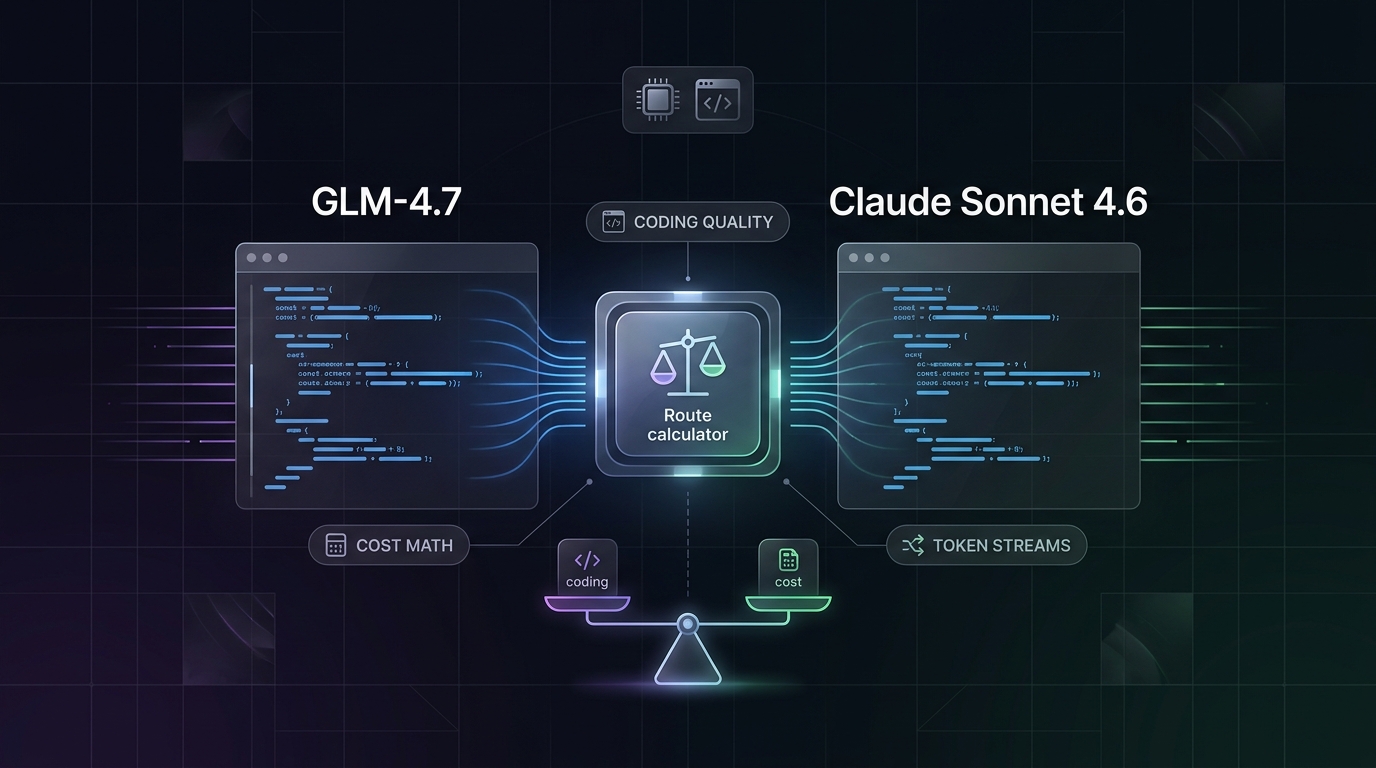
If you are comparing GLM-4.7 vs Claude Sonnet 4.6: Coding Quality and Cost Math, do not start with a leaderboard screenshot. Start with the workload you actually run: codebase search, patch planning, test repair, tool calls, review passes, and the amount of context your agent carries between steps.
The short version: GLM-4.7 is the lower list-price route for high-volume coding-agent experiments, while Claude Sonnet 4.6 is the premium route when you need Anthropic's latest Sonnet behavior, long-context coding claims, and a mature Claude API surface. The right answer is often not a permanent switch. It is a routing rule: send exploratory, repetitive, and cost-sensitive coding jobs to GLM-4.7; reserve Claude Sonnet 4.6 for the harder turns that justify its higher output-token price.
Flatkey helps teams run that decision as infrastructure instead of as a debate. Put both models behind one OpenAI-compatible router, measure accepted patches and per-request cost, and update the route once your own test suite has evidence.
GLM-4.7 vs Claude Sonnet 4.6: the quick comparison
| Decision point | GLM-4.7 | Claude Sonnet 4.6 | What to do |
|---|---|---|---|
| Official list price | $0.60 / 1M input tokens, $2.20 / 1M output tokens | $3 / 1M input tokens, $15 / 1M output tokens | Use list price for first-pass cost math, then verify current router price before production. |
| Input-token price gap | Baseline | 5x GLM-4.7 | GLM-4.7 is easier to test on context-heavy codebase reads. |
| Output-token price gap | Baseline | About 6.8x GLM-4.7 | Pay attention to long patch explanations, generated tests, and retries. |
| Context positioning | Z.AI model card describes GLM-4.7 with long-context support and coding/reasoning orientation. | Anthropic announced Claude Sonnet 4.6 as a coding-focused Sonnet release with a 1M-token context window. | Do not choose only on max context. Test retrieval, edit quality, and tool discipline. |
| Best first use | Bulk code reading, cheaper candidate patches, repetitive CI-fix loops, budget-sensitive agents. | High-stakes patch planning, architecture review, ambiguous refactors, final code-review passes. | Use a two-lane route: GLM-4.7 for volume, Sonnet 4.6 for escalation. |
This comparison is deliberately practical. A public model benchmark can be a useful starting signal, but coding quality is workload-specific: your framework, tests, repository size, dependency graph, prompt style, and tool adapter change the result. For GLM-4.7 vs Claude Sonnet 4.6: Coding Quality and Cost Math, the winning measurement is accepted work per dollar, not raw tokens per dollar.
Cost math: why output tokens matter
Official list pricing makes the budget difference visible:
| Workload shape | Token mix | GLM-4.7 list-cost estimate | Claude Sonnet 4.6 list-cost estimate | Sonnet multiple |
|---|---|---|---|---|
| Prompt-heavy codebase scan | 1M input, 100K output | $0.82 | $4.50 | 5.5x |
| Balanced coding agent run | 1M input, 1M output | $2.80 | $18.00 | 6.4x |
| Output-heavy patch generation | 1M input, 2M output | $5.00 | $33.00 | 6.6x |
| Monthly agent volume | 100M input, 20M output | $104.00 | $600.00 | 5.8x |
The pattern is simple: Claude Sonnet 4.6 can still be the right route, but it needs to earn the difference. If Sonnet turns three GLM attempts into one accepted patch, the higher price may be justified. If both models produce similar accepted changes after the same review loop, GLM-4.7 will usually be the better default for that workload.
Use this formula:
accepted-output cost =
  (input_tokens / 1,000,000 * input_price)
+ (output_tokens / 1,000,000 * output_price)
+ retry_cost
+ human_review_cost
+ failed_test_cost
Then compare accepted patches, not raw generations:
cost per accepted patch =
  total route cost / patches merged without rollback
That is the useful GLM-4.7 vs Claude Sonnet 4.6 cost math. It includes the expensive part of coding agents: retries, failed tests, and review time.
Official pricing references
The cost examples above use provider list prices checked on September 22, 2026. For current values, verify the Z.AI pricing page, the GLM-4.7 model card, the Anthropic pricing page, and Anthropic's Claude Sonnet 4.6 announcement. If you are routing through Flatkey, also check the live Flatkey model directory before you lock a rollout.
Coding quality: what to test before you switch
Do not ask, "Which model is better at coding?" Ask these five questions:
| Test | Why it matters | Pass condition |
|---|---|---|
| Repository navigation | Coding agents spend many tokens finding the right files before editing. | The model identifies the correct files without broad, wasteful context loading. |
| Patch minimality | Cheaper tokens do not help if the patch is noisy. | Diff is small, local, and easy to review. |
| Test repair | Most agent value appears after a failing test, not before it. | The model reads the failure, changes the right code, and avoids unrelated rewrites. |
| Tool discipline | Coding agents need to call search, edit, and test tools in the right sequence. | The model does not loop, fabricate files, or ignore tool output. |
| Escalation quality | Some tasks need a stronger route after a cheaper first pass. | The model can critique a candidate patch and produce a cleaner second attempt. |
For a fair GLM-4.7 vs Claude Sonnet 4.6 evaluation, run both models through the same prompts, same repository snapshot, same timeout, and same judge rubric. Blind-review the final diffs when possible. If you know which model produced the patch, you will overfit to brand expectations.
When GLM-4.7 is the better default
Choose GLM-4.7 first when the task is high-volume, repeatable, and easy to validate automatically:
- Codebase indexing and symbol-map summaries.
- Candidate bug-fix patches where tests are the real judge.
- Bulk lint, type, or dependency-upgrade repair.
- Exploratory agent runs where you expect several failed attempts.
- Long-context repository reads where input cost dominates.
In these cases, GLM-4.7's lower list price gives you more room to experiment. The important constraint is verification: do not let a cheaper route merge code without tests, static analysis, or human review for sensitive paths.
When Claude Sonnet 4.6 deserves the premium route
Use Claude Sonnet 4.6 when the task is ambiguous, high-stakes, or review-heavy:
- Architecture-level refactors with many hidden tradeoffs.
- Security-sensitive patches.
- Migration plans where missing edge cases are expensive.
- Code reviews that need careful reasoning about intent, not just syntax.
- Final escalation after GLM-4.7 produces a plausible but uncertain patch.
The premium route is easier to defend when it reduces retries, prevents a bad merge, or saves senior-review time. That is why the decision should be route-level rather than model-loyal. Make Claude Sonnet 4.6 the escalation lane, then promote it to default only for workloads where the evidence says it wins.
A routing policy for coding agents
Start with a simple rule set:
| Route | Use it for | Fallback rule |
|---|---|---|
| GLM-4.7 default | First-pass code search, candidate patch, test-fix loop, low-risk edits. | Escalate after two failed test-repair attempts or one confidence warning. |
| Claude Sonnet 4.6 escalation | Risky refactors, architecture review, security-adjacent edits, final review. | Fall back to GLM-4.7 for repeatable subtasks once plan is clear. |
| Human review | Public API changes, auth, billing, data retention, destructive migrations. | Require explicit approval before merge. |
With Flatkey, this policy can live outside the application code. Your agent points at one OpenAI-compatible base URL, you keep one key and one ledger, and you measure model routes by accepted output, latency, retries, and spend. That is more durable than hardcoding a model name into every tool config.
For setup patterns, use the Flatkey API quickstart and the AI model catalog guide to confirm model IDs, endpoint support, pricing units, and route behavior before rollout.
Copyable evaluation scorecard
Use this scorecard for a one-week pilot:
| Metric | How to measure | Why it matters |
|---|---|---|
| Accepted patch rate | Merged patches / attempted tasks | Captures real usefulness. |
| Cost per accepted patch | Route spend / accepted patches | Normalizes price and quality. |
| Retry rate | Model attempts per accepted task | Reveals hidden quality cost. |
| Test-pass recovery | Failed-test tasks fixed without human rewrite | Measures agentic coding value. |
| Review minutes | Human review time per patch | Converts quality into operating cost. |
| Rollback rate | Reverted patches / merged patches | Penalizes risky "looks right" code. |
| Context waste | Input tokens that did not affect final diff | Finds prompt and retrieval problems. |
Run at least 30 comparable tasks before you make a durable routing decision. If your queue is smaller, treat the result as a directional signal, not a winner-take-all conclusion.
Recommended decision
For most coding-agent teams, the practical answer to GLM-4.7 vs Claude Sonnet 4.6: Coding Quality and Cost Math is:
- Start GLM-4.7 as the default route for cost-sensitive coding loops.
- Put Claude Sonnet 4.6 behind an escalation rule for high-risk or repeatedly failing tasks.
- Compare cost per accepted patch, not cost per token.
- Keep the route table flexible because model quality and prices move faster than application code.
Flatkey is built for exactly that operating model: one key, one balance, one invoice, official model endpoints, and per-request usage records across models. Instead of deciding once, you can run GLM-4.7 and Claude Sonnet 4.6 side by side, measure what your agents actually accept, and route each workload to the model that earns the job.
FAQ
Is GLM-4.7 cheaper than Claude Sonnet 4.6?
Using official list prices checked on September 22, 2026, yes. GLM-4.7 lists at $0.60 per 1M input tokens and $2.20 per 1M output tokens, while Claude Sonnet 4.6 lists at $3 per 1M input tokens and $15 per 1M output tokens. Verify current provider and router prices before production because pricing can change.
Is Claude Sonnet 4.6 better for coding?
Anthropic positions Claude Sonnet 4.6 as a coding-focused Sonnet release, but "better" depends on your repo, prompts, tools, and acceptance criteria. For production decisions, test both models on your own coding-agent tasks and compare accepted patches, retries, review time, and rollbacks.
Should I use one model or route between both?
Route between both. Use GLM-4.7 for lower-cost first-pass work and Claude Sonnet 4.6 for escalation, review, or high-risk edits. This usually beats a static all-or-nothing model choice.
What is the best metric for this comparison?
Cost per accepted patch is the most useful metric. It combines model price, output quality, retries, test failures, and human review time into one operating number.
Can I test GLM-4.7 and Claude Sonnet 4.6 through one API?
Yes, if your gateway supports both model IDs and the endpoint shape your agent needs. Flatkey's model directory currently lists glm-4.7 and claude-sonnet-4-6, so teams can test both behind one Flatkey key and one usage ledger.