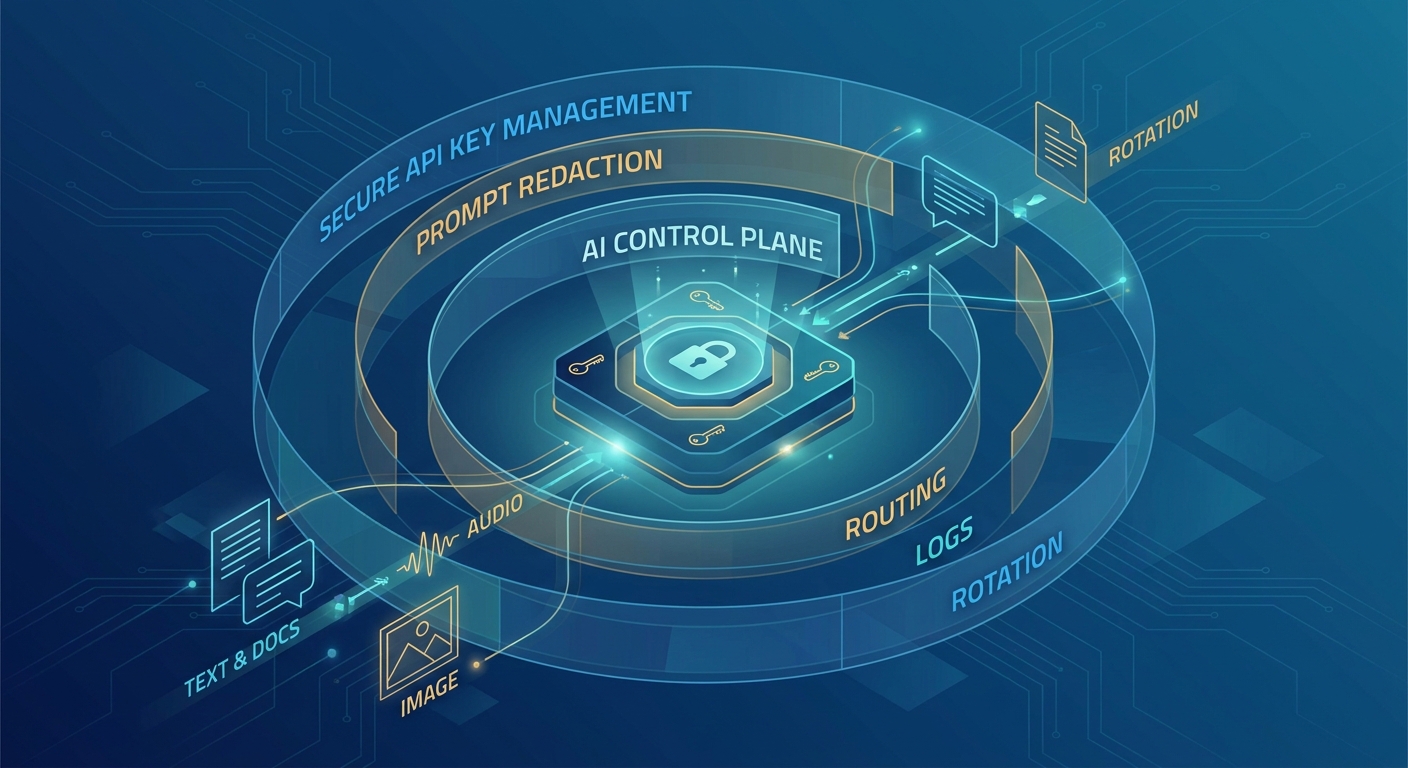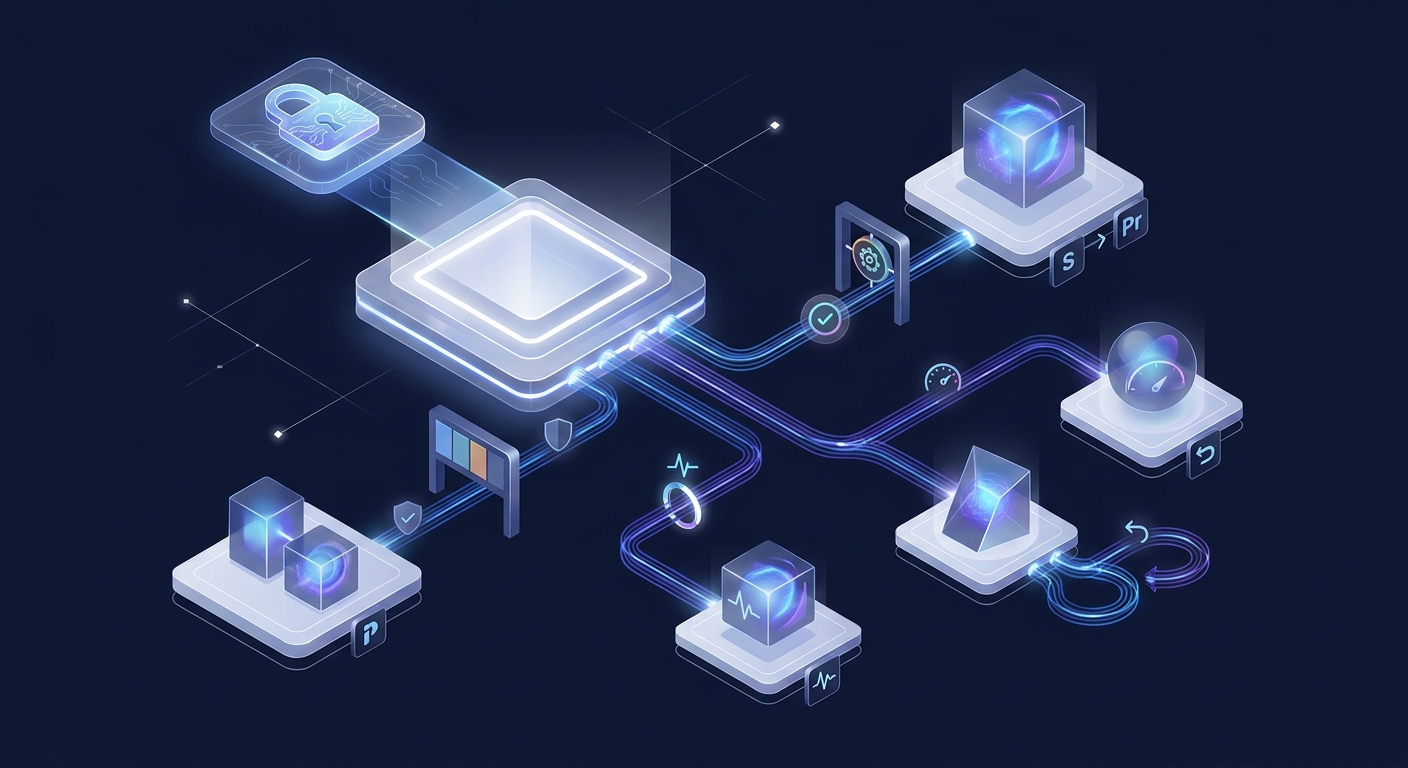
An AI gateway for teams should solve a broader problem than connecting one application to one model. Engineering needs a stable integration. Platform teams need controlled keys and routing. Finance needs a clear view of spend and ownership. Procurement needs a commercial path that does not multiply with every provider account.
Claude API access is often the trigger for this evaluation, especially when a product team operates across regions or expects to compare more than one model family. But the buying decision is not “direct Claude or gateway” in isolation. It is whether the company wants each workload to manage access, billing, routing, and controls separately—or place those responsibilities behind one shared layer.
Flatkey is designed for teams shipping AI features through one key, one OpenAI-compatible base URL, and one billing path across supported models. This page explains where that model helps, what it does not replace, and what an engineering, platform, and finance buying committee should verify before approving it.
Provider-policy boundary: An AI gateway does not bypass provider terms, supported-region rules, model availability, or data-residency requirements. Anthropic remains the source of truth for Claude pricing and provider-specific regional rules. Verify the exact model, endpoint, route, and policy requirements for every production workload.
Quick answer: when does an AI gateway for teams make sense?
An AI gateway for teams is a strong fit when several roles need one operating model for AI access:
- Engineering wants one integration surface instead of separate client code for every provider.
- Platform wants server-side keys that can be created by environment, rotated, and revoked.
- Finance wants consolidated billing and a clearer path from usage to owner.
- Product teams want to compare supported models without rebuilding the whole access layer.
- Procurement wants a single commercial conversation for a growing AI portfolio.
Direct provider access can still be the right choice when one provider is the durable standard, the team is comfortable with its account and billing model, and no cross-provider routing or consolidated control layer is needed.
The practical question is not which pattern is universally better. It is which responsibilities your team wants to own repeatedly.
The buying-committee matrix
Use this matrix to decide whether a shared gateway removes enough operational work to justify adoption.
| Decision area | Engineering manager asks | Platform team asks | Finance or procurement asks | Evidence to approve |
|---|---|---|---|---|
| Access | Can existing services connect with limited code change? | Can keys stay server-side and be separated by environment? | Can access expand without opening a new account workflow for every team? | Working SDK test, key lifecycle test, supported endpoint list |
| Claude compatibility | Does the required Claude model work for our messages, tools, streaming, and output format? | Which protocol and route support the exact model ID? | Is the route commercially available for the intended workload? | Production-shaped test set and current route metadata |
| Routing | Can we change supported model IDs without rewriting the application? | Are fallback and route changes deliberate and observable? | Can routing policy support cost and continuity goals? | Staging runbook, rollback test, owner for route changes |
| Billing | Can usage be connected to the service or team that generated it? | Are usage and errors visible at the shared layer? | Is there one balance or invoice path and a current pricing source? | Usage export, cost-owner mapping, pricing-page review |
| Controls | Can developers get access without sharing secrets? | Can keys be revoked, rotated, and isolated by environment? | Are team-level controls sufficient for the approval process? | Key inventory, permissions test, offboarding procedure |
| Operations | Who responds when a model, route, or provider behavior changes? | Can we diagnose authentication, limit, and upstream errors? | Who owns budget exceptions and vendor escalation? | Named owners, alert path, incident and budget playbooks |
If the committee cannot fill the final column with testable evidence, the purchase is not ready—regardless of how attractive the model list looks.
What one shared access layer changes
Without a gateway, each provider integration tends to bring its own API key, endpoint, SDK assumptions, billing view, usage vocabulary, rate limits, and operational runbook. That can be manageable for one application. It becomes harder when multiple teams independently add Claude, OpenAI-compatible models, image models, speech models, or regional providers.
An AI gateway for teams moves several recurring concerns into one access layer:
- One base URL: Applications point to a shared OpenAI-compatible gateway endpoint for supported routes.
- One key pattern: Teams authenticate with gateway keys rather than distributing upstream provider credentials throughout the application estate.
- One model-selection surface: Supported model IDs can be tested through the same integration pattern.
- One billing path: Usage can roll into one balance, top-up, or invoice workflow instead of scattered provider bills.
- One operational boundary: Platform owners get a consistent place to document access, errors, routing, and escalation.
Flatkey documents the OpenAI-compatible base URL https://router.flatkey.ai/v1, Bearer authentication, streaming, response usage fields, and common error handling. Teams should still test each required model and feature because compatibility does not make providers identical.
Claude API access beyond a one-region operating model
The phrase “outside one-region setups” can describe several different problems. Separate them before choosing a route:
- The engineering team is distributed, but inference location is not regulated.
- Customers are distributed, and latency needs to be tested from more than one geography.
- The company requires a specific inference geography or data-residency posture.
- A required Claude model is available only through certain provider or partner routes.
- The team wants a global product architecture but a controlled set of approved model routes.
An AI gateway for teams can simplify the access and operating layer around these decisions. It cannot redefine Anthropic’s regional policy or make an unavailable route available. Anthropic’s current pricing documentation distinguishes global, regional, and multi-region patterns and describes provider-specific premiums for some newer models and configurations. Treat those rules as inputs to architecture and procurement, not as problems a gateway silently removes.
For the narrower implementation discussion, read Claude API access outside one-region setups.
Access and key management for multiple teams
Shared access should not mean a shared secret copied into every repository. A production AI gateway for teams should support an explicit key lifecycle:
- Create separate keys for development, staging, and production.
- Store keys in server-side secret management, never in client applications.
- Assign an owner and workload to every active key.
- Test revocation before an incident or employee departure.
- Rotate keys on a documented schedule and after suspected exposure.
- Remove unused keys and review permission errors as control signals.
Flatkey’s authentication documentation covers key creation, Bearer-token use, environment separation, rotation, revocation, and common authentication failures. The buying committee should validate the workflow directly rather than assuming that “one key” means one permanent credential for the whole company.
Consolidated billing without losing cost ownership
One bill is useful only if the organization can still answer who generated the cost. A finance-ready AI gateway for teams evaluation should map the commercial view to operational ownership.
| Finance question | Minimum useful answer |
|---|---|
| What are we paying for? | Model, workload, time period, and usage unit |
| Who owns the spend? | Team, service, environment, or cost center |
| Which rate applies? | Current route and pricing source, checked on a stated date |
| What changed? | Volume, model mix, output length, retries, or routing change |
| What happens at the limit? | Alert, quota, approval, top-up, or controlled failure |
| How do we forecast? | Workload volume multiplied by measured cost per successful task |
Do not evaluate Claude cost from an old copied price table. Use Anthropic’s official pricing documentation for provider rules and Flatkey’s live pricing page for the routes and commercial options currently offered through Flatkey.
Routing and fallback: require a runbook, not a checkbox
Model routing can reduce integration friction, but an unchecked fallback can create product risk. Before approving an AI gateway for teams, define:
- The primary model ID for each workload.
- The exact events that permit a fallback.
- Whether fallback is automatic, manual, or disabled.
- The quality and format threshold every fallback must pass.
- The maximum cost difference the route may introduce.
- The logging fields required to reconstruct the decision.
- The rollback owner when provider behavior changes.
Test with real prompts, tool definitions, structured outputs, streaming behavior, long inputs, and failure cases. A successful “hello world” request proves connectivity; it does not prove production equivalence.
A 30-minute technical evaluation
The fastest useful proof is a small production-shaped test, not a long architecture debate.
1. Connect a non-production service
Configure an OpenAI-compatible client with the Flatkey base URL and a staging key. Keep the key in a server-side environment variable.
from openai import OpenAI

client = OpenAI(
    api_key="YOUR_FLATKEY_API_KEY",
    base_url="https://router.flatkey.ai/v1",
)

response = client.chat.completions.create(
    model="YOUR_VERIFIED_MODEL_ID",
    messages=[
        {"role": "user", "content": "Return a two-line deployment risk summary."}
    ],
)

print(response.choices[0].message.content)
2. Test the required Claude behavior
Use the exact model ID and route you intend to buy. Check message handling, system instructions, streaming, tool use, structured output, context size, usage fields, latency, and error behavior.
3. Rotate and revoke the key
Confirm that a new key can replace the old one without exposing upstream provider credentials. Then revoke the old key and verify that the application fails clearly.
4. Attribute the test cost
Record the workload owner, model, request count, input and output usage, retries, and total cost. Finance should be able to connect the test to a team and an approval decision.
5. Simulate one route failure
Decide what the service should do when authentication fails, a limit is reached, the requested model is unavailable, or an upstream route errors. Verify the runbook before production traffic depends on it.
Direct Claude access versus an AI gateway for teams
| Choose direct Claude API access when… | Choose an AI gateway for teams when… |
|---|---|
| Claude is the durable standard for the workload | Multiple model families are under active evaluation |
| The team wants a first-party Anthropic relationship | The team wants one shared integration and billing layer |
| Provider-specific features justify a dedicated client | OpenAI-compatible access reduces repeated integration work |
| Separate billing and key operations are acceptable | Platform and finance need consolidated operations |
| Routing across providers is not a requirement | Supported-route switching and fallback are planned capabilities |
Some companies use both patterns: direct access for provider-specific workloads and a gateway for shared or multi-model services. The architecture should reflect tested requirements, not an ideological preference for consolidation.
Approval checklist for the team buyer page
Before moving from evaluation to production, confirm:
- Integration: A production-shaped request works through the intended endpoint.
- Claude route: The exact Claude model ID and required features are verified.
- Region: Provider policy and any inference-location requirements are documented.
- Keys: Development, staging, and production credentials have owners and rotation procedures.
- Billing: Finance can connect usage to a team and current commercial terms.
- Routing: Primary, fallback, and rollback behavior are explicit.
- Limits: Rate, quota, concurrency, and budget responses are tested.
- Observability: Usage, latency, errors, model ID, and workload owner are recorded.
- Security: Secrets stay server-side and revocation has been tested.
- Procurement: The required plan, invoice, support, and control expectations are confirmed.
Evaluate Flatkey with your buying committee
Flatkey’s product focus is teams shipping AI features with one key, one compatible access layer, and one billing path across supported models. The next step is to compare the live plan and route details against the matrix above.
Review Flatkey pricing and team options, select the required Claude and multi-model routes, and run the 30-minute evaluation with engineering, platform, and finance present. Approve the gateway only when the proof matches the message: access is simpler, ownership is clearer, and the team knows exactly what happens when a route, key, limit, or budget changes.
Frequently asked questions
Can an AI gateway provide Claude API access in unsupported regions?
Do not assume so. A gateway does not bypass Anthropic policy, local law, supported-region rules, or data-residency requirements. Verify the exact provider route and applicable terms before production use.
Does OpenAI compatibility make Claude behave exactly like an OpenAI model?
No. A compatible request surface can reduce client changes, but model features, parameters, tool behavior, streaming, response formats, limits, and safety behavior can differ. Test the exact production workload.
Should every team share one API key?
No. “One key” describes a unified gateway credential pattern, not a recommendation to reuse one permanent secret everywhere. Separate keys by environment or workload, assign owners, and test rotation and revocation.
Can finance get one invoice for multiple AI providers?
Flatkey’s current pricing page presents one balance and invoice path across supported providers and describes Enterprise options for larger usage, procurement, custom routing, and team-level controls. Confirm current terms on the live pricing page.
What should we test before approving an AI gateway for teams?
Test the exact model and endpoint, production-shaped prompts, streaming and tools, key rotation and revocation, usage attribution, error behavior, routing and rollback, provider-region requirements, and the current commercial path.