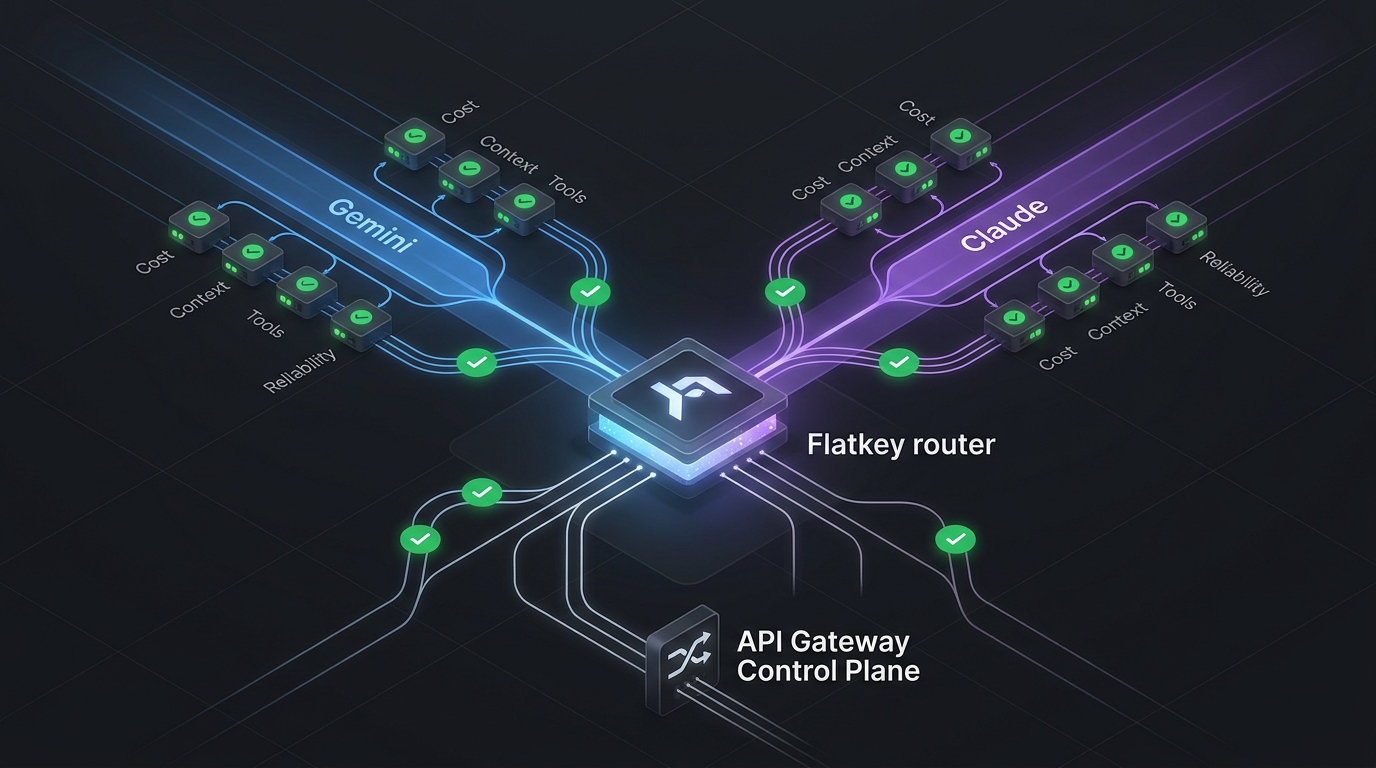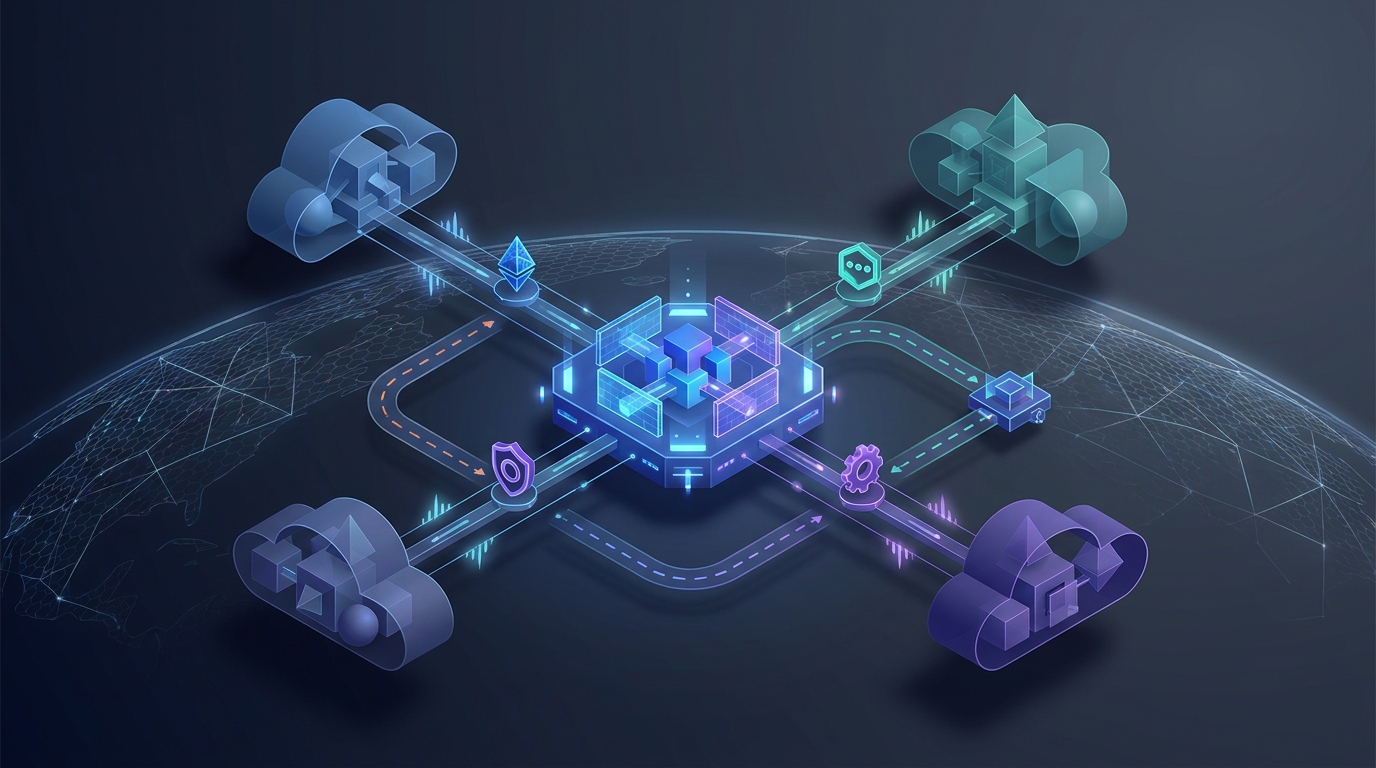
Claude API access becomes harder when a product, team, or customer base no longer fits inside one region. The difficulty is not just obtaining an API key. You also have to separate provider availability, cloud-region coverage, data-processing requirements, client compatibility, fallback behavior, and billing ownership.
The safest solution is not to disguise where traffic originates or bypass a provider restriction. It is to design an approved access topology: choose a valid Claude route for each workload, keep the application contract stable, and prove that every route meets the same security and reliability requirements.
This guide explains how to do that with direct Anthropic access, cloud-platform routes, and an API gateway such as Flatkey.
Quick answer
For Claude API access outside a one-region setup, use this sequence:
- Verify that the organization and intended usage are eligible under Anthropic's current supported-country policy.
- Define where requests may be sent and where data may be processed.
- Compare direct Anthropic access with Claude through Amazon Bedrock or Google Cloud Vertex AI.
- Put a stable gateway contract in front of approved routes if multiple teams, providers, or regions must be managed together.
- Test model behavior, streaming, tools, rate limits, errors, logging, and failover on every route.
- Keep an availability ledger so operations can see which model, region, protocol, and owner are approved.
An API gateway can simplify credentials, routing, observability, and provider changes. It cannot make an unsupported account, prohibited use case, or noncompliant data path acceptable.
“Regional access” is four different problems
Teams often use “region” as if it means one thing. In production architecture, it usually hides four separate questions.
| Question | What you must verify |
|---|---|
| Account eligibility | Whether the organization and intended use are supported by the provider's current terms and country availability |
| Endpoint availability | Whether the required Claude model is offered through the selected direct or cloud-platform route |
| Processing location | Whether the route's processing and retention behavior fits contractual, privacy, and residency requirements |
| Application reachability | Whether the workload can reliably reach the endpoint with acceptable latency, rate limits, and failure behavior |
Do not treat a successful test request as proof that all four questions are resolved. A request can work technically while the policy, residency, or operational design remains incomplete.
Anthropic maintains a current supported countries and regions list. Because availability can change, check that live page during architecture review and again before production launch.
Choose the right Claude access route
There is no universally best route. The correct choice depends on your existing cloud footprint, procurement model, geographic requirements, and tolerance for provider-specific integration work.
| Access route | Strongest fit | Main tradeoff |
|---|---|---|
| Direct Anthropic API | Teams that want the first-party Claude API surface and can operate within the supported account and processing model | Separate provider credentials, billing, limits, and operational tooling |
| Claude on Amazon Bedrock | AWS-centered teams that want Claude inside AWS identity, networking, governance, and regional operations | Bedrock model availability and API behavior must be checked per region and model |
| Claude on Vertex AI | Google Cloud-centered teams that want Claude within their existing GCP project and governance model | Vertex model availability, regional endpoints, quotas, and request differences require separate testing |
| Multi-provider API gateway | Products that need one client contract, centralized keys, usage visibility, and controlled switching among approved routes | The gateway becomes another production dependency and does not replace provider policy review |
Anthropic documents Claude integrations for both Amazon Bedrock and Vertex AI. Use the cloud provider's current regional model documentation as the source of truth for the exact model and deployment location you plan to use.
What an API gateway can—and cannot—solve
A gateway is useful when regional complexity is becoming application complexity.
It can provide:
- one client-facing base URL
- separate credentials by environment, team, or workload
- model aliases that reduce client-side rewrites
- centralized usage and error visibility
- controlled routing among approved providers or deployments
- a place to apply quotas, spend controls, and rollback rules
It cannot provide:
- permission to use a provider where your organization or use case is not supported
- automatic compliance with data-residency or sector-specific obligations
- identical Claude behavior across direct, Bedrock, Vertex AI, and compatibility layers
- guaranteed access to every Claude model in every geography
- a substitute for contracts, data-processing review, or security approval
That distinction matters. “Claude API access outside one-region setups” should describe an operational architecture, not a geographic bypass.
For the broader procurement and team-control decision, see AI Gateway for Teams: Claude API Access Beyond One-Region Setups. This guide focuses on implementing and validating the access topology itself.
Build an approved-route matrix before writing code
Start with a table that forces every route to declare its constraints.
| Field | Example decision |
|---|---|
| Workload | Customer-support summarization |
| Data class | Internal, no regulated identifiers |
| Primary route | Direct Anthropic API |
| Secondary route | Claude on approved cloud platform |
| Approved model IDs | Explicit allowlist, not a broad wildcard |
| Request protocol | Native Anthropic Messages or tested compatibility path |
| Allowed processing locations | Security-approved list |
| Credential owner | Platform engineering |
| Billing owner | Finance or FinOps |
| Failover trigger | Sustained availability error, not a single timeout |
| Rollback owner | Named on-call team |
This matrix becomes your availability ledger. Update it when a model is added, deprecated, moved, or exposed through a new provider route.
The ledger also prevents a common mistake: assuming that a familiar model name means the same capabilities everywhere. Tool use, streaming, token limits, request parameters, safety behavior, and error shapes can differ by route. Test the exact model identifier and endpoint you intend to ship.
Keep the application contract stable
The application should not need to understand every provider and regional detail. Put that complexity behind a narrow adapter or gateway interface.
A practical contract includes:
- a stable base URL
- an internal model alias
- a normalized request envelope
- a documented streaming format
- a consistent error taxonomy
- request IDs that survive provider handoffs
- usage fields that finance and engineering can reconcile
If your stack already uses OpenAI-compatible clients, Flatkey can reduce migration work by keeping the client-facing contract stable while the approved upstream route changes. If a workflow requires Anthropic-native behavior, preserve a native path and test it separately rather than assuming compatibility is perfect.
The Flatkey integration starter shows how to begin with one key and multi-model testing. Teams comparing gateway options can also review Flatkey vs OpenRouter for Claude API access.
A production setup workflow
1. Classify the workload
Record the data type, customer geography, latency target, required Claude features, expected volume, and fallback tolerance. Do not route sensitive and nonsensitive workloads through the same policy simply because they use the same model family.
2. Approve the route, not just the vendor
“Anthropic approved” is too broad. Approval should name the access path, model, account or cloud project, region configuration, data class, retention expectation, and owner.
Anthropic's privacy documentation describes data handling for commercial products, but your team must verify the current terms that apply to its account and selected route. Cloud-platform access may introduce separate provider terms and logging settings.
3. Scope credentials by environment and workload
Use different credentials for development, staging, and production. Where possible, separate high-risk or high-volume workloads so one leak, quota event, or billing anomaly does not affect the entire product.
Never place a provider or gateway secret in browser code, mobile binaries, public repositories, analytics payloads, or support screenshots. The secure API key management guide covers rotation, redaction, and incident-response controls in more detail.
4. Configure explicit model aliases
Map an internal alias such as claude-support-primary to one approved model route. Do not let clients request arbitrary model IDs unless that behavior is intentional and governed.
Model aliases make controlled changes easier, but they should not hide material behavior changes. If an alias moves to another model or provider path, run the evaluation suite and record the change.
5. Add timeouts, retries, and circuit breaking
Retry only requests that are safe to retry. Use exponential backoff with jitter, cap the number of attempts, and avoid retry storms during a provider incident.
Open a circuit when a route shows sustained availability failures. A fallback should activate only when the alternate route is approved for the same data class and has passed the same capability tests.
6. Preserve observability across routes
At minimum, log:
- internal request ID
- route and model alias
- provider or deployment selected
- latency and time to first token
- input and output token counts when available
- normalized error class
- retry and fallback events
- cost attribution fields
Avoid turning logs into a second prompt archive. Redact or hash sensitive values and set retention intentionally.
Run two smoke tests, then a real evaluation
One successful text response is not enough.
Smoke test A: client-contract test
Confirm that the application's normal SDK or HTTP client can:
- authenticate
- resolve the intended model alias
- complete a short request
- stream if streaming is required
- return a traceable request ID
Smoke test B: route-specific test
Confirm that the selected upstream route can:
- call the exact production model
- handle your tool definitions or structured-output pattern
- return expected usage fields
- produce actionable limit and policy errors
- expose enough metadata for incident response
Production-shaped evaluation
Then replay a representative evaluation set. Compare task quality, refusal behavior, tool-call accuracy, latency, truncation, and cost. A route is not interchangeable merely because both endpoints return HTTP 200.
For workloads split across regional and local providers, use the regional LLM provider routing guide to keep provider-specific checks explicit.
Design failover without creating a compliance failure
Failover is useful only when the secondary route is already approved. During an incident is the worst time to discover that the backup has different data-processing, logging, or contract terms.
Use these guardrails:
- Maintain an allowlist of route pairs approved for each data class.
- Trigger failover on sustained error or latency thresholds.
- Keep a maximum fallback duration.
- Record every fallback decision with the original and selected route.
- Notify the workload owner when traffic crosses provider or cloud boundaries.
- Reconcile usage and billing after the incident.
- Run a scheduled failover drill before relying on the path.
For some workloads, the correct fallback is a queue, degraded feature, or human handoff—not another model route.
Common mistakes
Treating a gateway as a policy bypass
A different base URL does not erase provider rules, contractual restrictions, or local law. Verify eligibility and route terms directly.
Using “global” without defining it
Global can mean customer reach, endpoint routing, account availability, processing location, or multi-region failover. State which meaning applies.
Assuming cloud routes are identical
Bedrock and Vertex AI are not transparent mirrors of the direct Anthropic API. Model availability, quotas, request formats, regions, and operational ownership may differ.
Failing over sensitive traffic to an unapproved route
A technically healthy fallback can still violate internal policy. Approve route pairs before activation.
Sharing one permanent key everywhere
One gateway can simplify access without requiring one secret for every environment. Scope and rotate gateway credentials just as carefully as provider keys.
Launch checklist
- [ ] Supported-country and intended-use eligibility verified
- [ ] Direct or cloud route selected for each workload
- [ ] Processing-location and retention requirements documented
- [ ] Exact model IDs allowlisted
- [ ] Credentials separated by environment or workload
- [ ] Native and compatibility paths tested independently
- [ ] Streaming, tools, limits, and error behavior validated
- [ ] Logs redact sensitive content
- [ ] Usage and billing owners named
- [ ] Secondary route approved for the same data class
- [ ] Circuit breaker and rollback tested
- [ ] Availability ledger added to the launch runbook
Frequently asked questions
Can a gateway provide Claude API access in an unsupported country?
Do not assume so. A gateway is not permission to bypass Anthropic's supported-country policy, provider terms, sanctions, export controls, or local law. Confirm eligibility using current official documentation and your own legal or compliance process.
Is Claude on Bedrock or Vertex AI the same as the direct Anthropic API?
No. The underlying model family may be Claude, but account setup, regions, quotas, request handling, model availability, billing, and operational controls can differ. Test each route as a distinct production dependency.
Does an OpenAI-compatible endpoint support every Claude feature?
Not automatically. Compatibility can reduce client changes, but native Claude features and parameter behavior may not map one-to-one. Use an explicit capability test for tools, streaming, structured output, token limits, and errors.
Should we use one Claude route worldwide?
Only if that route satisfies every workload's eligibility, processing, latency, reliability, and commercial requirements. Many teams need separate approved routes behind one stable application contract.
What should we check before buying a gateway?
Verify exact model access, route ownership, supported protocols, key isolation, logs, quotas, billing visibility, fallback controls, incident support, and the rules that still remain with the upstream provider. Then review current Flatkey pricing and model access against your approved-route matrix.
Final take
Claude API access outside one-region setups is an architecture and governance problem before it is a networking problem.
Start with provider eligibility and data requirements. Choose a direct, Bedrock, Vertex AI, or gateway route deliberately. Keep the application contract stable, but keep route differences visible in testing and operations. Approve fallbacks before incidents, and maintain a ledger that names the model, region, protocol, credential owner, and rollback path.
That approach gives product teams broader operational flexibility without pretending that geography, provider policy, and data controls have disappeared.