Claude API pricing explained: token rates, cache writes, and the real cost model
If you are comparing Claude API pricing on Monday, July 20, 2026, the most important thing to understand is that there is no single Claude price. Anthropic's official pricing depends on the model tier, whether tokens are input or output, whether prompt caching is active, whether the workload can use the Batch API, and whether you add regional routing or data-residency controls.
That is where most pricing roundups get weak. They copy the table, but they do not explain what actually moves the bill. This guide starts with Anthropic's official rate card, then turns it into practical cost math for product teams. It also covers the point where Claude API pricing stops being only an Anthropic question and becomes an operating-model question about shared billing, routing, and access across more than one model family.
Claude API pricing at a glance
Anthropic's official pricing page prices Claude API usage per million tokens. On July 20, 2026, these are the most useful current rows for most teams evaluating production traffic:
| Model | Base input | 5-minute cache write | 1-hour cache write | Cache hit | Output |
|---|---|---|---|---|---|
| Claude Haiku 4.5 | $1 / MTok | $1.25 / MTok | $2 / MTok | $0.10 / MTok | $5 / MTok |
| Claude Sonnet 4.6 | $3 / MTok | $3.75 / MTok | $6 / MTok | $0.30 / MTok | $15 / MTok |
| Claude Sonnet 5 | $2 / MTok through August 31, 2026; $3 / MTok starting September 1, 2026 | $2.50 / MTok intro; $3.75 / MTok standard | $4 / MTok intro; $6 / MTok standard | $0.20 / MTok intro; $0.30 / MTok standard | $10 / MTok intro; $15 / MTok standard |
| Claude Opus 4.8 | $5 / MTok | $6.25 / MTok | $10 / MTok | $0.50 / MTok | $25 / MTok |
The table above is the center of the current Claude API pricing conversation, but it is still only the starting point.
What most teams miss about Claude API pricing
Three details matter more than another generic model-tier summary.
1. Prompt caching changes the real bill quickly
Anthropic states that prompt caching uses these multipliers relative to base input price:
| Cache operation | Multiplier | Meaning |
|---|---|---|
| 5-minute cache write | 1.25x | You pay a small premium to store the prompt for reuse |
| 1-hour cache write | 2x | You pay more up front for longer cache duration |
| Cache read | 0.1x | A cache hit costs 10% of normal input price |
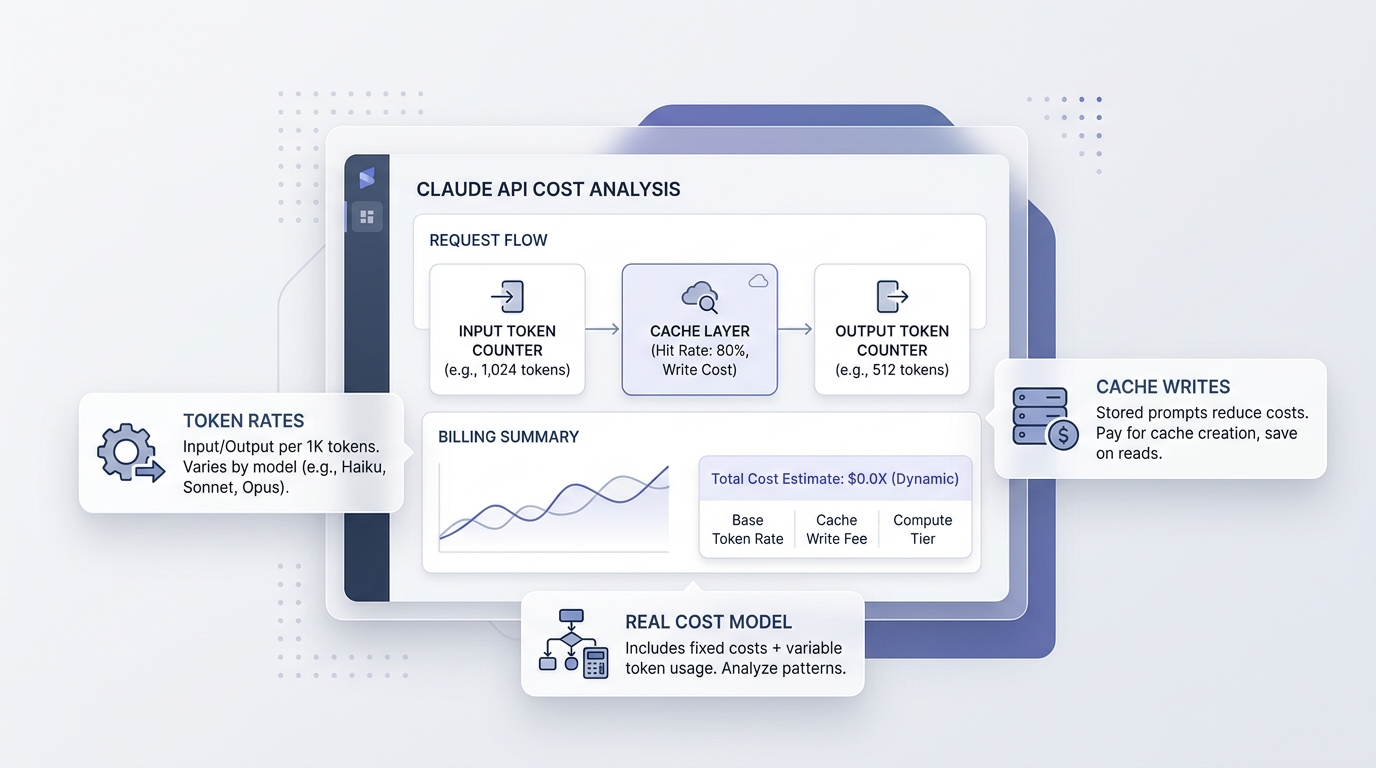
This is why repeated system prompts, long reusable instructions, stable knowledge packs, and document-review context can have a much lower effective cost than the raw table suggests. Anthropic explicitly notes that a 5-minute cache write pays off after one cache read, while a 1-hour cache write pays off after two reads.
2. Batch API pricing cuts async workloads in half
Anthropic's docs state that the Batch API gives a 50% discount on both input and output tokens. That matters for backfills, offline analysis, nightly evaluation jobs, or large document-review queues that do not need instant responses.
For many teams, the fastest cost win is not switching away from Claude. It is moving the right Claude workload into batch mode.
3. Tokenizer changes can distort naive price comparisons
Anthropic also notes that Claude Opus 4.7 and later Opus models, plus Claude Sonnet 5 and newer related families, use a newer tokenizer that can produce roughly 30% more tokens for the same text. That does not make the models overpriced. It means your real Claude API pricing depends on your own prompt shape and output style, not just the list price.
Claude API pricing by workload
The easiest way to choose the right tier is to start from workload shape instead of brand familiarity.
| Workload | Best default tier | Why | Main watchout |
|---|---|---|---|
| Classification, extraction, short routing tasks | Claude Haiku 4.5 | Lowest current entry price for high-volume work | Output-heavy prompts can still erase the apparent savings |
| General product chat, summarization, assistant flows | Claude Sonnet 4.6 or Sonnet 5 | Best balance between cost and quality for most production teams | Sonnet 5 introductory pricing ends on September 1, 2026 |
| Harder coding, deep reasoning, difficult multi-step agents | Claude Opus 4.8 | Premium reasoning tier with the highest capability ceiling | Output tokens are expensive, so prompt discipline matters |
| Backfills, bulk analysis, nightly processing | Same model, but through Batch API | Same model quality with lower unit cost | Not suitable for interactive user-facing flows |
This is the part most search results skip. Teams do not buy a model name. They buy a workload profile.
Three fast cost examples
These examples use Anthropic's official list prices on July 20, 2026.
Lightweight support classifier on Haiku 4.5
Assume 20M input tokens and 4M output tokens in one month.
| Line item | Cost math | Total |
|---|---|---|
| Input | 20 x $1 |
$20 |
| Output | 4 x $5 |
$20 |
| Total | $40 |
For narrow tasks, Claude API pricing is mostly an input-volume problem.
Product copilot on Sonnet 4.6 with cache hits
Assume 30M uncached input tokens, 50M cache-hit tokens, and 8M output tokens.
| Line item | Cost math | Total |
|---|---|---|
| Uncached input | 30 x $3 |
$90 |
| Cache hits | 50 x $0.30 |
$15 |
| Output | 8 x $15 |
$120 |
| Total | $225 |
This is where Claude API pricing stops looking like a simple rate card. Reused context can change Sonnet economics materially.
Async document review on Opus 4.8 through Batch API
Assume 12M input tokens and 3M output tokens.
| Line item | Standard | Batch |
|---|---|---|
| Input | 12 x $5 = $60 |
12 x $2.50 = $30 |
| Output | 3 x $25 = $75 |
3 x $12.50 = $37.50 |
| Total | $135 | $67.50 |
For offline work, the most useful Claude API pricing insight is often not "Opus is expensive." It is "premium quality may still be economical if the job can run asynchronously."
Long context and regional pricing notes
Anthropic's current pricing docs also make two details clear:
- Claude Opus 4.6, Claude Opus 4.7, Claude Opus 4.8, Claude Sonnet 4.6, and later listed current families include the full 1M token context window at standard pricing.
- For Claude 4.5-era models and later, regional or multi-region endpoint options can introduce a 10% premium over global routing, and US-only inference settings can apply a 1.1x multiplier on pricing categories where supported.
That means the hidden cost driver is usually not a special long-context surcharge. It is oversized prompts, underused caching, or a residency requirement that changes the multiplier.
When direct Anthropic access is enough
Direct Anthropic access is still a clean choice when all of the following are true:
- Claude is the only model family you need in production.
- Billing can stay inside one provider relationship.
- Engineering is comfortable managing model access and spend directly in one system.
- Finance and ops do not need one shared routing and invoice surface across providers.
If that is your environment, a gateway may be premature.
When Claude API pricing becomes an operating-model problem
The buying decision changes once the team is no longer Claude-only.
That usually happens when:
- you need Claude plus GPT, Gemini, DeepSeek, or other families under one integration layer
- finance wants one balance or one invoice instead of scattered provider billing
- engineering wants one base URL and one key-management pattern across providers
- ops wants model-level request logs, shared quotas, or a cleaner review path for spend
This is the gap most Claude API pricing articles do not cover. Once a team becomes multi-model, the real problem is not only token cost. It is coordination cost.
Where Flatkey fits
Flatkey's public surfaces, reviewed on Monday, July 20, 2026, support a specific and cautious value argument:
- The homepage positions Flatkey around every official model, one key, including official GPT, Claude, Gemini, DeepSeek, Qwen, GLM, and Seedance access.
- The same page states that Flatkey routes requests to official endpoints, supports 160+ frontier models behind one key, and verifies those routes hourly.
- The pricing page states that one balance can route across GPT, Claude, Gemini, DeepSeek, image, audio, and video through one OpenAI-compatible gateway.
- That pricing page also states that usage is metered by model, token type, and request logs, and that enterprise plans are the fit for larger monthly usage, invoicing, procurement, custom routing discounts, or team-level controls.
The safe conclusion is not that Flatkey guarantees a specific public Claude row at a fixed percentage below Anthropic list price in every case. The safe conclusion is that teams evaluating Claude API pricing may also want a simpler control plane once Claude is only one part of the stack.
If that is your situation, review the current Flatkey pricing page, then compare it with your broader model-routing workflow in AI API Gateway Architecture: One Key, Model Routing, and the End of Provider Account Sprawl and OpenRouter alternative for Claude API access: Flatkey vs OpenRouter for teams.
FAQ
What is Claude API pricing right now?
As of July 20, 2026, Anthropic's official pricing page lists current Claude families with pricing per million tokens, plus separate prompt-caching columns, batch pricing, and regional-pricing notes. For many teams, the most relevant rows are Haiku 4.5, Sonnet 4.6, Sonnet 5 introductory pricing, and Opus 4.8.
Is Claude API pricing only about input and output tokens?
No. Real Claude API pricing also depends on prompt caching, batch processing, tokenization behavior, long prompt shape, and any residency or regional pricing modifiers that apply to the chosen deployment path.
Does prompt caching really lower Claude API cost?
Yes. Anthropic's pricing docs state that cache reads cost 10% of normal input price. For repeated prompt context, that can materially lower the effective cost of the workload after the initial cache write.
When does the Batch API matter?
It matters whenever a Claude workload is asynchronous. Anthropic states that Batch API pricing carries a 50% discount on both input and output tokens, which can change the economics of large offline jobs.
When should a team look beyond Anthropic's direct rate card?
A team should look beyond the direct rate card when Claude is no longer the only provider in use. At that point, the operational cost of fragmented billing, routing, and access can matter almost as much as raw token spend.
Conclusion
The best way to evaluate Claude API pricing is to stop asking for one number and start asking four questions:
- Which Claude tier fits the workload?
- Can the workload benefit from prompt caching?
- Can any portion move to Batch API pricing?
- Is Claude still the only model family the team needs to operate?
Anthropic's current docs answer the first three. If the fourth question is starting to matter, then the next step is not only price comparison. It is control-plane comparison.
Review the current Anthropic pricing docs, then compare your broader model-access and billing requirements on Flatkey pricing.