Teams searching for an openrouter alternative for Claude-family traffic usually are not asking a beginner question. They already know they want one client-facing API surface. The real decision is which control layer should own routing, billing review, privacy controls, and team policy after Claude traffic leaves the app.
For that use case, Flatkey and OpenRouter solve adjacent but different problems.
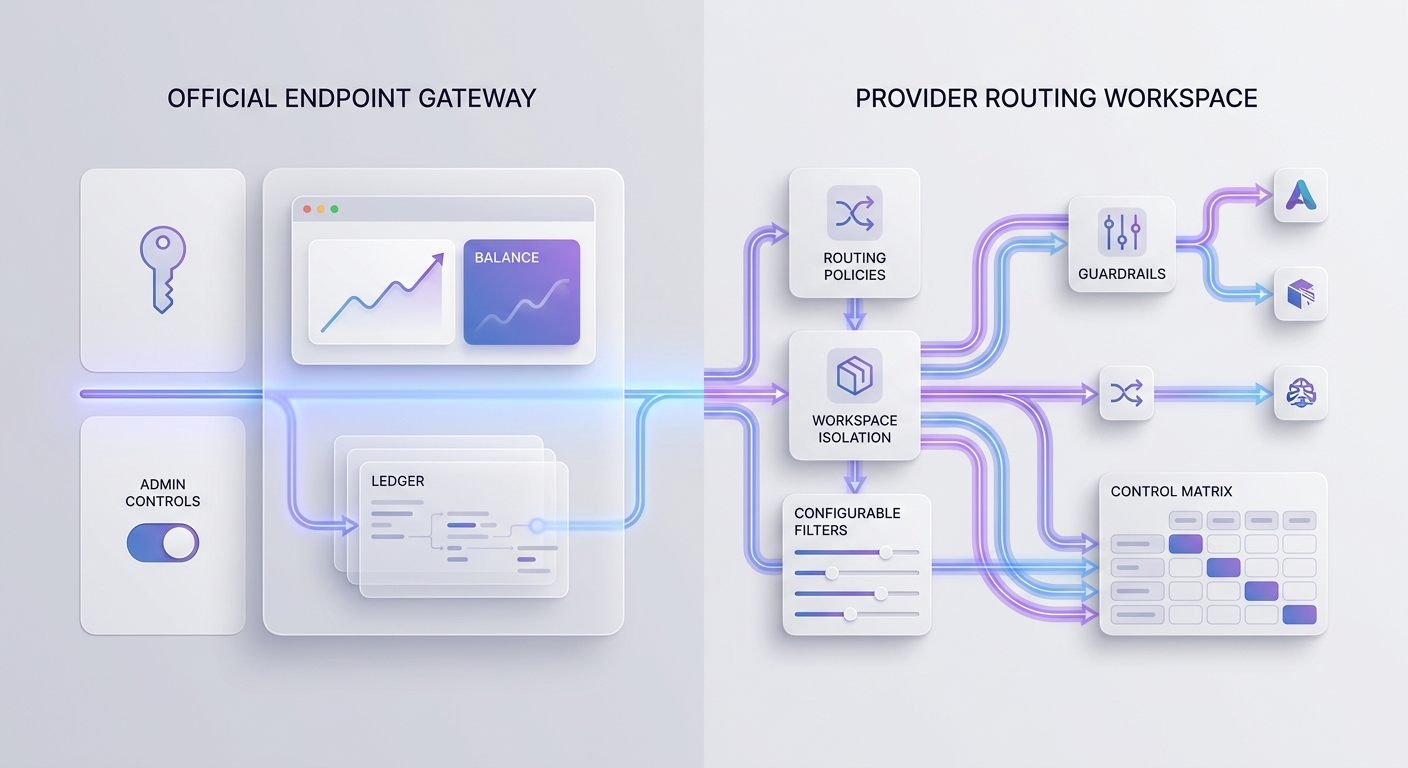
Flatkey positions itself as an official-endpoint gateway: one key, one dashboard, one base URL, one balance, and pricing or usage review in the same operating surface. OpenRouter positions itself as a programmable routing marketplace: one API, many providers, rich provider preferences, workspace isolation, and guardrails that can be enforced at the organization, member, or API-key level.
If your team says it needs Claude API access outside one-region setups, the safe way to interpret that is not “find a loophole.” It usually means: keep the client integration stable while upstream routing, procurement, privacy, and spend controls remain reviewable. That is the comparison this page focuses on.
Short answer
If your team wants official-endpoint positioning, one dashboard, one balance, visible usage logs, and simple team controls, Flatkey is the stronger OpenRouter alternative.
If your team wants fine-grained provider routing rules, workspace-level isolation, programmable guardrails, and a broader provider-policy control surface, OpenRouter remains a strong fit.
The difference is less about “supports Claude” and more about which operating model you want your team to standardize on.
What Flatkey and OpenRouter both do well
Both platforms reduce the overhead of managing separate provider integrations one by one.
They both give teams a unified API surface instead of asking every product, script, or agent workflow to talk directly to a different provider.
They both can sit between your application and Claude-family traffic so your team can standardize keys, client configuration, and observability.
They both support policy layers above the raw model call.
That shared surface is why the comparison matters: once two tools are both “good enough” at basic routing, the buying decision shifts to finance review, policy design, and team workflow.
Where Flatkey differs from OpenRouter
Flatkey’s public product story is explicit: every official model, one key. On the live homepage checked on 2026-07-20, Flatkey says requests go to official GPT, Claude, Gemini, DeepSeek, Qwen, and GLM APIs; the page shows an OpenAI-compatible base URL at https://router.flatkey.ai/v1 and an Anthropic-style base URL at https://router.flatkey.ai. The same page also foregrounds hourly verification, zero retention of request content, sub-key caps, model allowlists, ledger access, invoices in 48 hours, and one dashboard for usage, routing, and errors.
That is a specific operating stance: keep the gateway opinionated, keep the official-endpoint story prominent, and keep billing review near routing review.
OpenRouter documents a different center of gravity. Its provider-routing docs expose a provider object with ordered provider preferences, fallback controls, parameter-compatibility requirements, data-collection filters, ZDR enforcement, provider allow/ignore lists, price/latency/throughput sorting, and max-price controls. Its workspaces docs add separate API keys, routing defaults, guardrails, observability, and member access per workspace. Its guardrails docs add budget limits, provider and model allowlists, ZDR enforcement, and layered assignments at member or API-key scope.
That is also a clear stance: give operators a large routing policy surface and let them tune provider behavior per request, per key, or per workspace.
Comparison table: Flatkey vs OpenRouter for Claude-centric teams
| Decision area | Flatkey | OpenRouter |
|---|---|---|
| Positioning | Official-model gateway with one key, one dashboard, and one balance | Unified API with multi-provider routing controls and workspaces |
| Claude client compatibility | Public homepage shows Anthropic-style base URL and OpenAI-compatible base URL | Official docs show Bearer-auth API with OpenAI-compatible access patterns |
| Billing visibility | Homepage and pricing page foreground one balance, one invoice, usage logs, and pricing review | Docs expose usage accounting in responses and unified billing across workspaces |
| Routing model | Publicly emphasizes flatkey-auto, official endpoints, and no routing fee |
Docs expose provider order, sort, fallbacks, max-price, ZDR, and provider filters |
| Workspace/team model | Public homepage emphasizes sub-key caps, model allowlists, ledger, invoices, and support | Docs expose workspaces, members, org admins, management keys, and enterprise budgets |
| Privacy/control framing | Publicly says zero retention of request content and official APIs only | Docs say provider policies vary by provider and can be filtered with privacy settings, ZDR, and guardrails |
| Best fit | Teams that want cleaner procurement and simpler reviewable operations | Teams that want more explicit provider-policy tuning and workspace programmability |
Billing visibility is the clearest split
Many teams start looking for an openrouter alternative only after the billing problem becomes operational, not technical.
The Flatkey pricing page checked on 2026-07-20 pushes a very direct promise: top-up bonus credit, one invoice across providers, one balance that can route across model families, and usage analytics with cost controls. The homepage pushes the same direction with per-request ledger language and dashboard-centric review.
That matters if your finance or platform team wants one place to answer:
- Which team key generated this Claude spend?
- Which model or route consumed the balance?
- Where do we cap or allow traffic without introducing another billing layer?
OpenRouter absolutely has billing and usage primitives. Its usage-accounting docs say usage details are included automatically in responses, including token counts, cost, and cache details. Its authentication docs also say keys can carry credit limits. Its workspaces docs say billing is unified across all workspaces. But the public documentation emphasis is different: OpenRouter leads with programmable control surfaces and usage accounting, while Flatkey leads with a consolidated billing-and-operations surface.
If the strongest internal requirement is “make Claude spend reviewable for finance and platform without another interpretation layer,” Flatkey is the more natural pitch.
Routing policy is where OpenRouter stays stronger
This is the area where a fair comparison should not force Flatkey into a category it is not trying to own publicly.
OpenRouter’s provider-routing docs expose more routing switches directly in the request contract than Flatkey’s public site does. You can define provider order, allow or deny fallbacks, require parameter support, restrict data collection, enforce ZDR, ignore specific providers, sort by throughput or latency, and enforce max-price preferences. The auto-router docs also describe model-and-provider stickiness for conversations, plus openrouter/auto-beta routing based on task classification and community spend-share signals.
That makes OpenRouter attractive for teams that treat provider routing itself as a first-class programmable object.
Flatkey’s public framing is more opinionated. The homepage emphasizes official endpoints, hourly verification, and flatkey-auto choosing the best official model per request with no routing fee. That is useful when your team wants the gateway to feel simpler and more procurement-safe. It is less attractive when your team wants to micro-specify provider behavior at request level.
So the routing-policy question is straightforward:
- If you want a bigger routing policy surface, OpenRouter remains stronger.
- If you want a simpler official-endpoint abstraction with less routing policy exposed in public product language, Flatkey is the better OpenRouter alternative.
Team controls are closer than many comparison pages admit
A weak competitor page would say OpenRouter is only for individuals and Flatkey is for teams. The current public docs do not support that claim.
OpenRouter’s workspaces docs describe separate environments with workspace-specific API keys, routing defaults, guardrails, observability, and member access. The workspace-budgets docs say enterprise customers can enforce daily, weekly, monthly, or lifetime budgets with automatic 403 blocking. The guardrails docs describe member assignments, API-key assignments, provider allowlists, model allowlists, and ZDR policies. That is real team-control surface area.
Flatkey’s public site, meanwhile, emphasizes a different set of controls: sub-key caps, model allowlists, a ledger API, one invoice across providers, support for procurement workflows, and usage review from the same dashboard. That is also legitimate team-control surface area, but it is more operations-and-finance centered than policy-programming centered.
So the honest decision rule is this:
- Choose Flatkey if your team-control requirement starts with budget review, procurement clarity, and a simpler operator surface.
- Choose OpenRouter if your team-control requirement starts with workspace segmentation, guardrail layering, and explicit provider-policy configuration.
What about privacy and retention?
This is another place where teams should be precise.
Flatkey’s homepage publicly states zero retention of request content. If your compliance review wants the gateway itself to make a strong platform-level statement, that message is easy to understand.
OpenRouter documents privacy differently. Its provider-logging docs say each provider on OpenRouter has its own data handling policies and that users can restrict routing with account-level privacy settings, per-request data-policy filters, and ZDR controls. Its provider-routing docs also document data_collection and zdr request options, and its guardrails docs say ZDR can be enforced per model group.
That does not make one model “secure” and the other “insecure.” It means the two products package privacy differently:
- Flatkey publicly markets a cleaner platform-level retention story.
- OpenRouter publicly documents a richer set of provider-policy filters because provider behavior may differ inside the network.
If your security review wants the simplest answer possible, Flatkey may be easier to justify. If your security review wants explicit provider-policy tuning knobs, OpenRouter may be easier to justify.
Which one is better for Claude API access outside one-region setups?
For most teams, this phrase points to an operations problem, not a magic-access problem.
The usual requirement looks like this:
- Keep one stable client integration for Claude-family requests.
- Avoid scattering provider-specific keys across agents, scripts, and products.
- Make spend, routing behavior, and privacy controls reviewable by more than one engineer.
- Preserve a path to stricter policy when the team grows.
On that definition, Flatkey is the better OpenRouter alternative when you want the answer to be: “one key, one dashboard, one balance, one official-endpoint control layer.”
OpenRouter is the better fit when you want the answer to be: “one API, but expose provider routing, workspace policy, and privacy filtering as explicit levers.”
Neither answer changes the fact that upstream provider policy still matters. A gateway can centralize your control plane. It does not erase the underlying provider’s own availability, pricing, or residency rules.
How to choose in practice
Use this table if your team is actively deciding this week.
| If your priority is... | Choose... | Why |
|---|---|---|
| One dashboard for spend, usage, routing, and procurement review | Flatkey | The public product story is built around one balance, one invoice, and reviewable dashboard operations |
| Provider-level routing rules and workspace programmability | OpenRouter | Official docs expose more routing and guardrail levers directly in the contract |
| A simpler official-endpoint story for Claude-centric traffic | Flatkey | Public messaging is explicitly about official APIs only and hourly verification |
| Explicit privacy filters across a provider network | OpenRouter | Docs expose data_collection, zdr, guardrails, and workspace controls |
| Mixed-team buying process with finance and platform stakeholders | Flatkey | One-balance and one-invoice framing is easier for shared operational review |
Before you standardize on either gateway
Run the same checklist for both:
- Confirm how your team wants to review Claude spend: response-level accounting, dashboard ledger, invoice workflow, or all three.
- Decide whether routing policy should live mostly in code or mostly in an operator dashboard.
- Test the exact Claude-family workflows you care about: ordinary chat, long context, tool use, and any compliance-sensitive traffic.
- Decide whether your privacy review prefers a platform-level retention promise or provider-level filtering controls.
- Check your expected model costs against the current pricing page and your broader AI model pricing comparison workflow before moving production traffic.
Conclusion
The best openrouter alternative for Claude teams is not the tool with the longest feature list. It is the tool whose control model matches how your team actually buys, routes, reviews, and governs model traffic.
Choose Flatkey if you want an official-endpoint gateway with one key, one dashboard, one balance, and a cleaner billing-and-operations story.
Choose OpenRouter if you want a larger programmable routing surface with workspaces, guardrails, provider filters, and request-level policy control.
If your team is already at the point of comparing gateways instead of debating whether to use one, review the current Flatkey pricing, map your workload classes, and then standardize on the control plane that your finance, platform, and application teams can all operate without friction.