Enterprise AI Gateway: What It Does, Must-Have Features, and a Buyer's Checklist (2026)
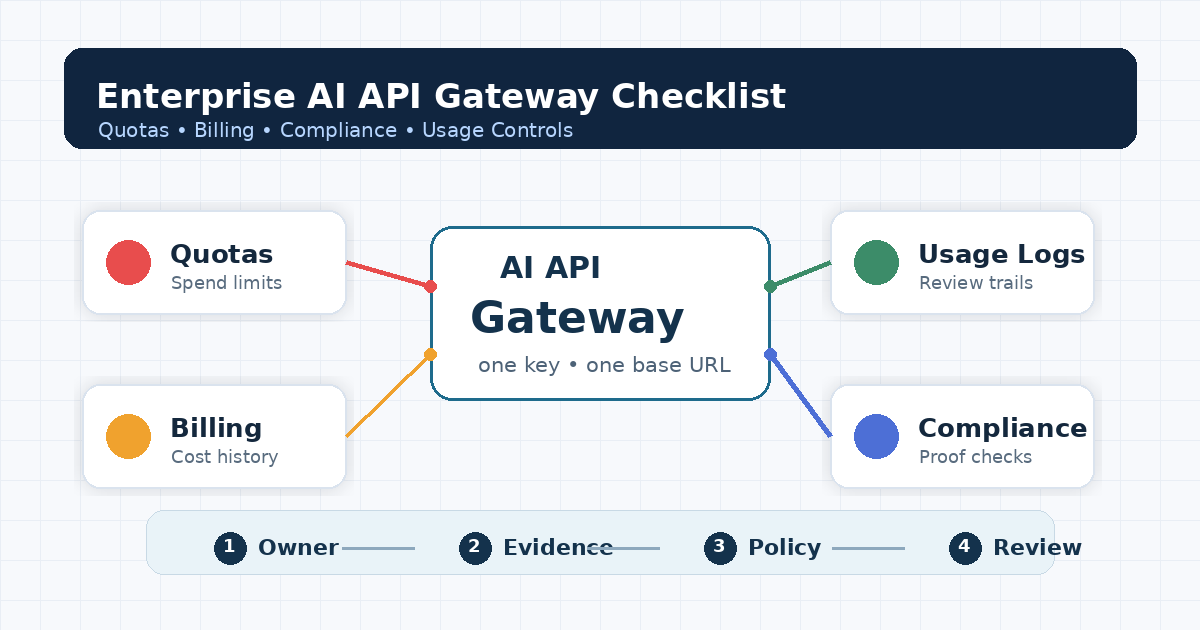
An enterprise AI gateway is a control layer between your applications and AI model providers that gives every team one governed entry point: it authenticates apps with scoped keys, routes requests across models and providers, enforces quotas and budgets, logs usage for cost and audit, and applies data and security policies. Enterprises adopt one when AI use spreads across many teams, providers, and keys, and finance, security, and platform owners need one place to see and control it. This guide covers the core features, deployment options, and a checklist you can use in procurement, current as of October 26, 2026.
It is written for platform, security, and procurement teams at companies running AI in production. For the basics, see what is an LLM gateway.
What an enterprise AI gateway does
| Function | What it gives you | Without a gateway |
|---|---|---|
| Unified API | One (usually OpenAI-compatible) endpoint for many providers and models | Each team integrates each provider separately |
| Identity and keys | Per-app, per-team, per-environment keys; revocation; model allow-lists | Shared provider keys in many repos |
| Routing and fallback | Policy-based model choice, failover across providers | Hard-coded models, outages hit users |
| Quotas and budgets | Rate limits, token quotas, spend caps per key or team | Surprise invoices |
| Usage and cost visibility | Per-request logs: model, tokens, cost, key, status | Spend visible only on provider invoices |
| Security and data policy | Redaction, logging rules, region pinning, guardrails | Each app does its own (or nothing) |
| Audit evidence | Exportable logs for SOC 2, internal audit, incident review | Evidence spread across vendors |
AI gateway vs API gateway
A traditional API gateway manages HTTP APIs by request count. An AI gateway adds AI-specific concerns: token-based limits and costs, model routing across providers, streaming responses, prompt and response policies, and model-level usage logs. Many API management vendors now ship AI gateway features on top of their API gateway, for example Azure API Management's GenAI gateway capabilities (token limits, token metrics, semantic caching, load balancing) and Kong AI Gateway. We compare the two categories in AI API gateway vs API management.
Must-have enterprise AI gateway features
1. Scoped keys and model allow-lists
Each app and environment should get its own key, with a list of approved models and a budget. Shared keys make it impossible to attribute cost or revoke access cleanly. Check that revocation is immediate.
2. Token-aware quotas and spend caps
Limits must count tokens and dollars, not just requests: per-key and per-team quotas, alerts at thresholds, and a hard cap that blocks requests. See AI API quota management.
3. Per-request usage and cost logs
Every request should record timestamp, key, team, model, input/output tokens, cost, latency, and status, with export to CSV/JSON or an API for finance tools. See per-key AI usage tracking and audit logs for AI API usage.
4. Routing and failover
Policy-based routing by task and cost, plus failover that respects data rules. A gateway that silently fails over to an unapproved provider is a compliance problem.
5. Data protection
Configurable logging (metadata only vs full prompts), redaction of PII and secrets, retention controls, and region options. Ask what the gateway itself stores and for how long.
6. Guardrails and security controls
Prompt-injection and content filters, output checks, and abuse detection; for example, Amazon Bedrock Guardrails and gateway plugins. Map these to the OWASP Top 10 for LLM Applications, and test them with a regular AI security audit rather than trusting the feature list; vendor-level questions belong in an AI vendor risk assessment.
7. Reliability and SLA
Published uptime target, status page, incident communication, and support response times. See AI gateway SLA questions.
8. Compliance evidence
SOC 2 Type II or ISO 27001 reports covering the gateway service, a DPA, a sub-processor list including model providers, and data residency statements.
Deployment options compared
| Option | Examples | Strengths | Trade-offs | Best for |
|---|---|---|---|---|
| Cloud provider gateway | Azure APIM, Cloudflare AI Gateway | Fits existing cloud, IAM, and networking | Tied to one cloud; you still contract each model provider | Teams standardized on one cloud |
| API management vendor | Kong AI Gateway, MuleSoft | Extends an existing API program | Licensing and operation effort | Large API platforms |
| Self-hosted open source | LiteLLM proxy | Full control, runs in your network | You operate, scale, and secure it | Strict data control, strong platform team |
| Managed multi-model gateway | Flatkey, Portkey, others | Fast start, one bill, many models | Another vendor in the data path; assess it | Teams wanting speed and one bill |
Self-hosting is not free: you own upgrades, scaling, and on-call. We compare costs in managed AI API gateway vs self-hosted LLM proxy.
Enterprise AI gateway buyer's checklist
| # | Check | Evidence to ask for | Pass criteria |
|---|---|---|---|
| 1 | Key scoping | Console demo, docs | Per-app keys, model allow-lists, instant revocation |
| 2 | Quotas and caps | Your own test with a low limit | Requests blocked at the limit |
| 3 | Usage logs | Sample export | Model, tokens, cost, key, status per request |
| 4 | Cost attribution | Team/project tagging docs | Spend by team without spreadsheets |
| 5 | Routing and failover rules | Config docs, test | Failover limited to approved providers |
| 6 | Data retention | DPA, policy, setting | Retention meets your policy; prompts not stored unless needed |
| 7 | Sub-processors | List with regions | All model providers named |
| 8 | Security attestations | SOC 2 Type II / ISO 27001 report | Gateway service in scope, current period |
| 9 | SLA and support | SLA document, status page | Uptime target and support hours fit your needs |
| 10 | Model coverage | Catalog | Models you need, with versions |
| 11 | Pricing model | Price list, invoice sample | Clear per-token prices, fees, and billing method |
| 12 | Exit plan | Export docs, contract | Logs exportable; OpenAI-compatible API eases switching |
For the full procurement file, use our AI gateway procurement evidence packet.
Testing a gateway before you sign
Run these against a trial account with test keys only.
Check the OpenAI-compatible endpoint and log the usage fields:
curl https://router.flatkey.ai/v1/chat/completions \
  -H "Authorization: Bearer $GATEWAY_TEST_KEY" -H "Content-Type: application/json" \
  -d '{"model":"gpt-6.1-sol","messages":[{"role":"user","content":"Reply OK"}],"max_tokens":5}'
Confirm a low quota actually blocks traffic, and that a disallowed model is rejected:
import os, requests

URL = "https://router.flatkey.ai/v1/chat/completions"
H = {"Authorization": f"Bearer {os.environ['LOW_QUOTA_TEST_KEY']}"}

codes = []
for _ in range(30):
    r = requests.post(URL, headers=H, timeout=30, json={
        "model": "claude-haiku-5-5", "max_tokens": 5,
        "messages": [{"role": "user", "content": "ping"}]})
    codes.append(r.status_code)
print({c: codes.count(c) for c in set(codes)})   # expect some 429/403 once the quota is used

r = requests.post(URL, headers=H, timeout=30, json={
    "model": "model-not-on-allow-list", "messages": [{"role": "user", "content": "ping"}]})
print("disallowed model ->", r.status_code)        # expect a 4xx error, not a response
Replace the URL with each gateway you evaluate; the test is the same.
Where Flatkey fits
Flatkey is a managed multi-model gateway: one key and an OpenAI-compatible endpoint at https://router.flatkey.ai/v1 for GPT, Claude, Gemini, Qwen, DeepSeek, and other models. Documented controls include per-request usage logs with model, tokens, cost, and key, CSV/JSON export, a monthly spend cap, and per-environment API keys with immediate revocation. The Flatkey enterprise page lists tree-structured sub-keys with budgets and model allow-lists, a spend API, committed-volume pricing, invoicing, a 99.5% public availability target, SOC 2 and ISO 27001, and zero retention of request content (as stated on October 26, 2026). As with any vendor, ask for the reports and DPA and verify the controls with the tests above. Per-model prices are on Flatkey pricing.
How much does an AI gateway cost?
Pricing models vary: open-source gateways are free to use but cost infrastructure and engineering time; cloud gateways usually charge per request or per unit on top of your model bills; managed multi-model gateways typically bill per token for model usage, sometimes with platform fees or volume discounts. Compare the total: model tokens + gateway fees + engineering time + the savings from routing and quotas.
FAQ
What is an enterprise AI gateway?
It is a central control layer between applications and AI model providers that provides one API, scoped keys, routing and failover, quotas and budgets, usage and cost logs, and security and data policies for the whole organization.
What is the difference between an AI gateway and an API gateway?
An API gateway manages HTTP APIs by requests. An AI gateway adds token-based limits and costs, multi-provider model routing, streaming, prompt and response policies, and model-level usage logs.
How much does an AI gateway cost?
It depends on the model: open source (infrastructure and staff cost), cloud gateway (usage fees on top of model bills), or managed multi-model gateway (usually per-token model pricing plus possible platform fees). Compare total cost, including the time your team spends operating it.
Do I need an AI gateway if I only use one provider?
Possibly not at first. Once several teams, keys, or providers are involved, or finance needs per-team cost tracking and caps, a gateway usually saves more effort than it costs.
What are the best enterprise AI gateways?
The right choice depends on your cloud, data rules, and team. Common categories are cloud gateways (Azure APIM, Cloudflare), API management vendors (Kong, MuleSoft), self-hosted open source (LiteLLM), and managed multi-model gateways (Flatkey, Portkey). Run the same checklist and tests on each.
Sources
Checked October 26, 2026: Azure APIM GenAI gateway, Kong AI Gateway, Cloudflare AI Gateway, LiteLLM proxy, Amazon Bedrock Guardrails, OWASP LLM Top 10, Flatkey enterprise.