Teams evaluating the Seedance API often start with the same instinct: put an open-source layer in front of the provider, normalize the client contract, and keep the routing stack self-hosted. That is a reasonable first move. For many text workloads, an open-source AI API gateway can remove SDK churn, centralize keys, and give engineering one place to enforce basic policy.
The problem is that text-to-video evaluation is usually not a text-only operations problem.
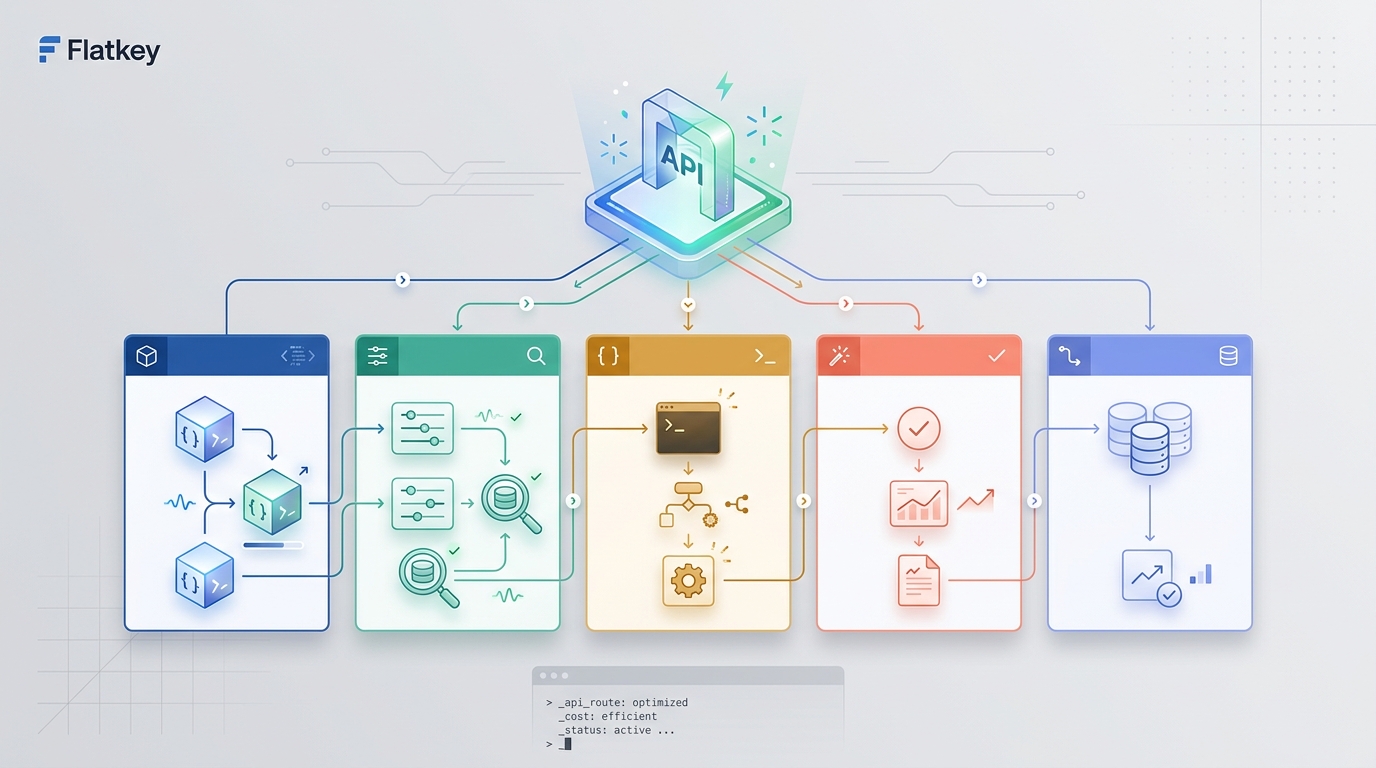
As of Monday, July 20, 2026, Flatkey's live homepage still positions the product around official APIs only, verified hourly, 160+ frontier models behind one key, and Seedance 2.5 video on the same access layer as GPT, Claude, Gemini, DeepSeek, and other model families. The same public surface also foregrounds sub-key caps, model allowlists, a per-request ledger API, invoices in 48 hours, and zero retention of request content. Flatkey's live pricing FAQ on the same date still says one balance can route across GPT, Claude, Gemini, DeepSeek, image, audio, and video models through one OpenAI-compatible gateway, and that usage is metered by model, token type, and request logs.
That framing matters for Seedance-style video work. The gateway question is not only "can I proxy the request?" It is also "who owns the routing surface, provider accounts, usage review, billing reconciliation, team limits, and production support path once video traffic starts moving?"
Short answer
If your team is still proving basic integration patterns, an open-source AI API gateway can be enough.
If your team is trying to operationalize Seedance API access for shared product use, the hosted layer starts to matter much faster than it does for ordinary chat completions.
Use this rule of thumb:
| Situation | Open-source gateway only | Hosted routing layer matters |
|---|---|---|
| One team, one engineer, low traffic | Usually enough | Nice to have |
| Simple smoke tests and local evaluation | Usually enough | Nice to have |
| Multiple provider accounts and prepaid balances | Pain starts quickly | Usually better |
| Shared billing review across product, ops, and finance | Weak by default | Stronger fit |
| Video jobs, retries, and approval workflows | Partial fit | Usually stronger |
| Team caps, allowlists, invoices, and request-level audit | Possible, but you own the build | Built into the operating layer |
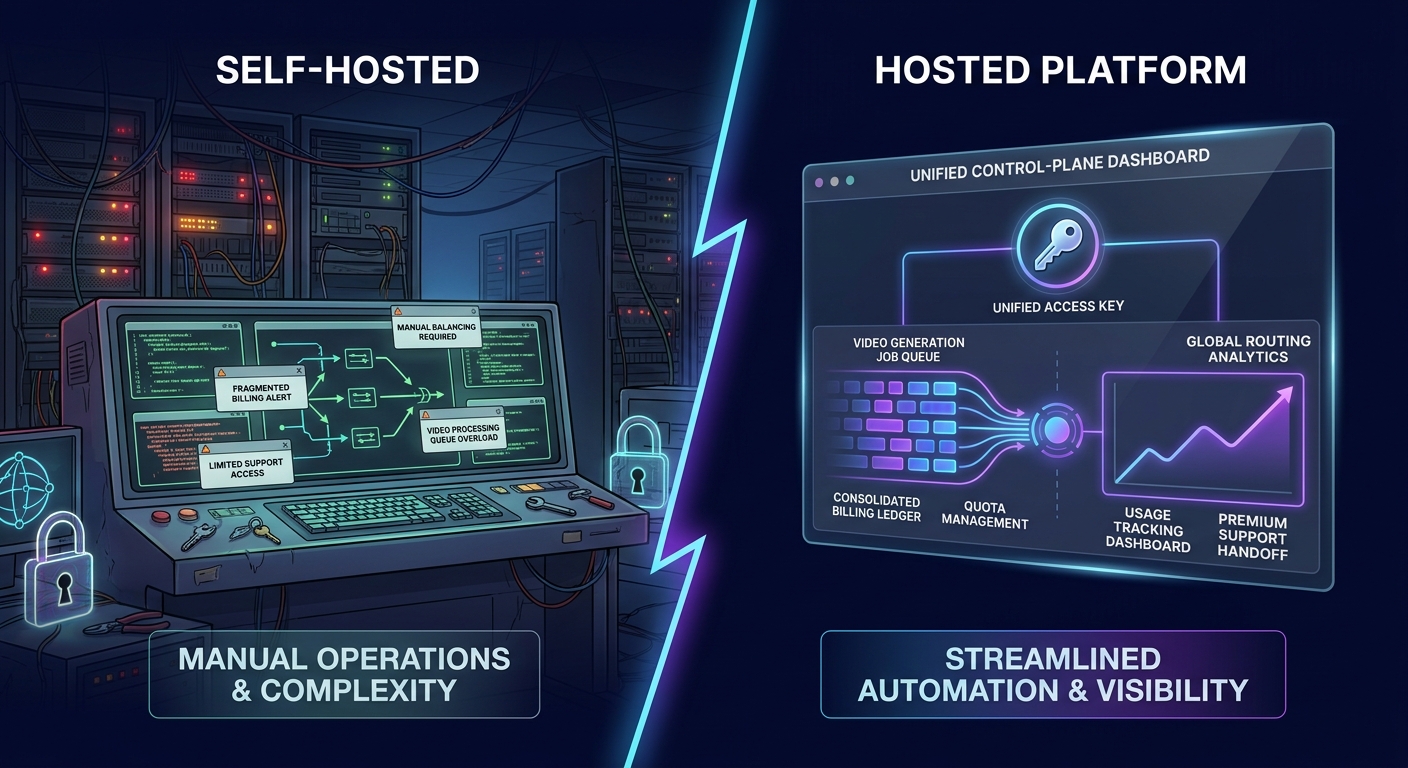
An open-source gateway solves the client surface. It does not automatically solve the operating surface.
What an open-source AI API gateway actually helps with
The reason technical evaluators keep looking at an open-source AI API gateway is simple: it solves real pain.
A self-hosted gateway is often useful when you want to:
- keep one client-facing API contract while changing upstream providers
- normalize auth, request formatting, or base URLs
- centralize model names and routing rules in one service
- add engineering-owned controls without waiting on a vendor roadmap
- keep the gateway inside your own infrastructure boundary
For early evaluation, that can be enough.
If your team only needs to answer "Can we route a Seedance request through one internal layer?" you may not need more than that. In fact, the hosted layer can be premature if:
- traffic is still tiny
- one engineer owns the stack
- billing review is not yet shared
- support expectations are low
- your product is not yet exposing video jobs to real users
That is the strongest honest case for DIY.
Why Seedance-style video workloads change the equation
The objection usually sounds like this:
"Why not just self-host the gateway and keep control?"
Because text-to-video is rarely just a proxying problem.
Video workloads change the operating model in four ways:
- They cost more per job than ordinary text requests.
- They usually involve queueing, waiting, and asset handling rather than instant text output.
- They are more likely to involve cross-team review because product, design, and operations all care about the output.
- They push billing, retry, and support questions into the foreground faster.
That is why Seedance evaluation is a better objection-handling topic than another generic gateway explainer. The harder part is not "Can I reach the model?" The harder part is "Can the team run the workflow without scattering ownership across infra, billing, and support?"
Where the open-source stack still leaves work on your team
An open-source AI API gateway can sit in front of the provider, but your team still owns the surrounding system.
That usually means you still need to manage:
- provider accounts and upstream API keys
- prepaid balances or billing relationships at each upstream
- request logs and spend review that non-engineers can actually use
- team-level quotas and model access rules
- invoice and ledger workflows
- incident handling when one upstream becomes unavailable or changes behavior
- the support burden when internal users ask why cost, status, or availability changed
This is the core distinction between "routing works" and "operations work."
For text traffic, teams can sometimes tolerate rough edges here because each request is small and the recovery path is fast. For video traffic, those rough edges become visible much earlier.
What Flatkey changes in this decision
Flatkey is relevant because the public product surface is explicitly not just a proxy story.
On Monday, July 20, 2026, Flatkey's homepage still supported these review-safe public claims:
- official APIs only
- verified hourly
- 160+ frontier models behind one key
- Seedance 2.5 video on the model surface
- one OpenAI-compatible base URL at
https://router.flatkey.ai/v1 - one Anthropic-style base URL at
https://router.flatkey.ai - sub-key caps
- model allowlists
- per-request ledger API
- invoices in 48 hours
- zero retention of request content
The live pricing FAQ on the same date also still supported these safe public claims:
- one balance can route across text, image, audio, and video model families
- usage is metered by model, token type, and request logs
- enterprise is the right fit for invoicing, procurement, custom routing discounts, or team-level controls
That means Flatkey is not just answering "Can I call Seedance?" It is answering a broader operating question:
| Operating need | DIY open-source gateway | Flatkey public positioning |
|---|---|---|
| Keep one client surface | Yes | Yes |
| Use one base URL | Yes | Yes |
| Avoid scattered provider keys in app code | Yes | Yes |
| Unify balances across model families | Not by default | Publicly yes |
| Give finance and ops one review surface | Usually custom work | Publicly yes |
| Apply sub-key caps and model allowlists | Possible with custom build | Publicly yes |
| Keep request-level ledger and invoicing close to routing | Usually custom build | Publicly yes |
That is the real objection-handling answer. The hosted layer becomes valuable when the team wants the control plane and the money plane to stop living in separate systems.
The decision point for Seedance API product teams
If your team is evaluating the Seedance API for a real product, the important question is not "open source or hosted?" in the abstract.
It is this:
Which parts of the stack do you actually want to own?
Use this matrix:
| If you want to own... | Open-source gateway is a better fit |
|---|---|
| Gateway deployment and runtime | Yes |
| Provider-account sprawl | Still yours |
| Billing reconciliation across providers | Still yours |
| Internal support for routing and usage questions | Still yours |
| Team policy and quota logic | Still yours unless you build it |
| If you want to standardize... | Hosted routing layer is a better fit |
|---|---|
| One key and one balance | Yes |
| Shared usage review | Yes |
| Team-level controls | Yes |
| Procurement and invoicing handoff | Yes |
| Fewer "which account paid for this?" questions | Yes |
This is why the decision tends to shift once a video workload leaves the sandbox.
When an open-source AI API gateway is enough
It is enough when your team can honestly say all of the following:
- Engineering is comfortable owning the gateway runtime.
- Provider accounts and balances are still simple.
- Usage review does not need a shared business workflow yet.
- Video jobs are still evaluation traffic, not production traffic.
- Internal users can tolerate rough edges in logs, billing, or support.
If that is your current state, DIY can be the right call.
When the hosted layer wins
The hosted layer usually wins when any of these become true:
- More than one team needs to understand usage and cost.
- You are routing across text, image, audio, and video under the same budget.
- Video evaluation is moving toward production approval.
- The team wants sub-keys, allowlists, or caps without building them from scratch.
- Finance, procurement, or support needs the same operating surface as engineering.
That is where Flatkey's live pricing page becomes more than a rate card. It becomes part of the operating argument.
A practical evaluation path
If you are leaning toward DIY but want to avoid rebuilding the same support burden later, use this order:
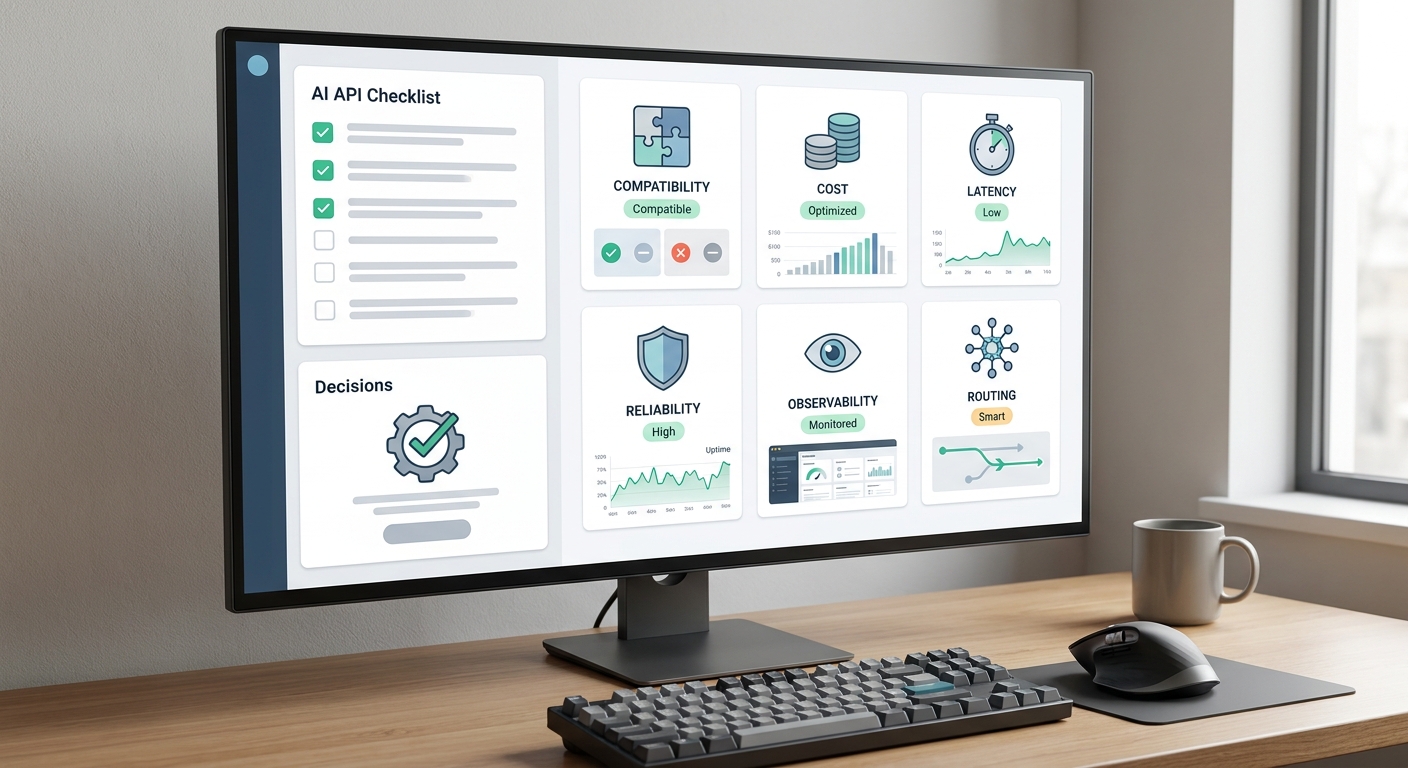
- Start with the architecture checklist in AI API Gateway Requirements: What Production Teams Need Beyond a Proxy.
- Compare the operational tradeoff in Flatkey vs Direct Provider Accounts for Multi-Model Products.
- If you already want the lowest-friction integration path, use the live Seedance quickstart in Seedance API for text-to-video product teams.
- Use the current pricing page before you approve shared rollout, because that is where unified-balance and usage-review questions become concrete.
FAQ
What is an open-source AI API gateway good for?
An open-source AI API gateway is good for normalizing provider access, centralizing routing logic, and keeping the gateway runtime inside your own infrastructure. It is often enough for early evaluation or engineering-owned internal use.
Why does Seedance API evaluation make the hosted layer more relevant?
Because video workloads create more visible cost, queueing, asset handling, and support questions than ordinary text traffic. That makes billing review, team controls, and shared observability matter earlier.
Can an open-source gateway still work for Seedance API traffic?
Yes. It can work well for smoke tests, controlled internal use, or a team that is comfortable owning the surrounding operational burden. The issue is not technical possibility. It is ownership.
What does Flatkey add beyond routing?
On Flatkey's public surfaces checked on July 20, 2026, the platform adds one-key access, official-endpoint framing, hourly verification, one balance across model families, request-level usage review, sub-key caps, model allowlists, invoicing, and zero-retention positioning.
When should a product team stop treating the gateway as an engineering-only decision?
As soon as usage review, team budgets, procurement, support, or cross-model billing become shared responsibilities. That usually happens earlier for video than for text.