vLLM vs SGLang: Throughput, Latency, Model Support, and Operations
The sglang vs vllm decision is not a generic "which server is faster?" contest. vLLM and SGLang are both serious LLM inference frameworks, both can expose OpenAI-compatible endpoints, and both can serve production traffic on cloud GPUs. The right choice depends on request shape, model family, structured-output needs, cache reuse, GPU topology, and how much operational surface your team wants to own.
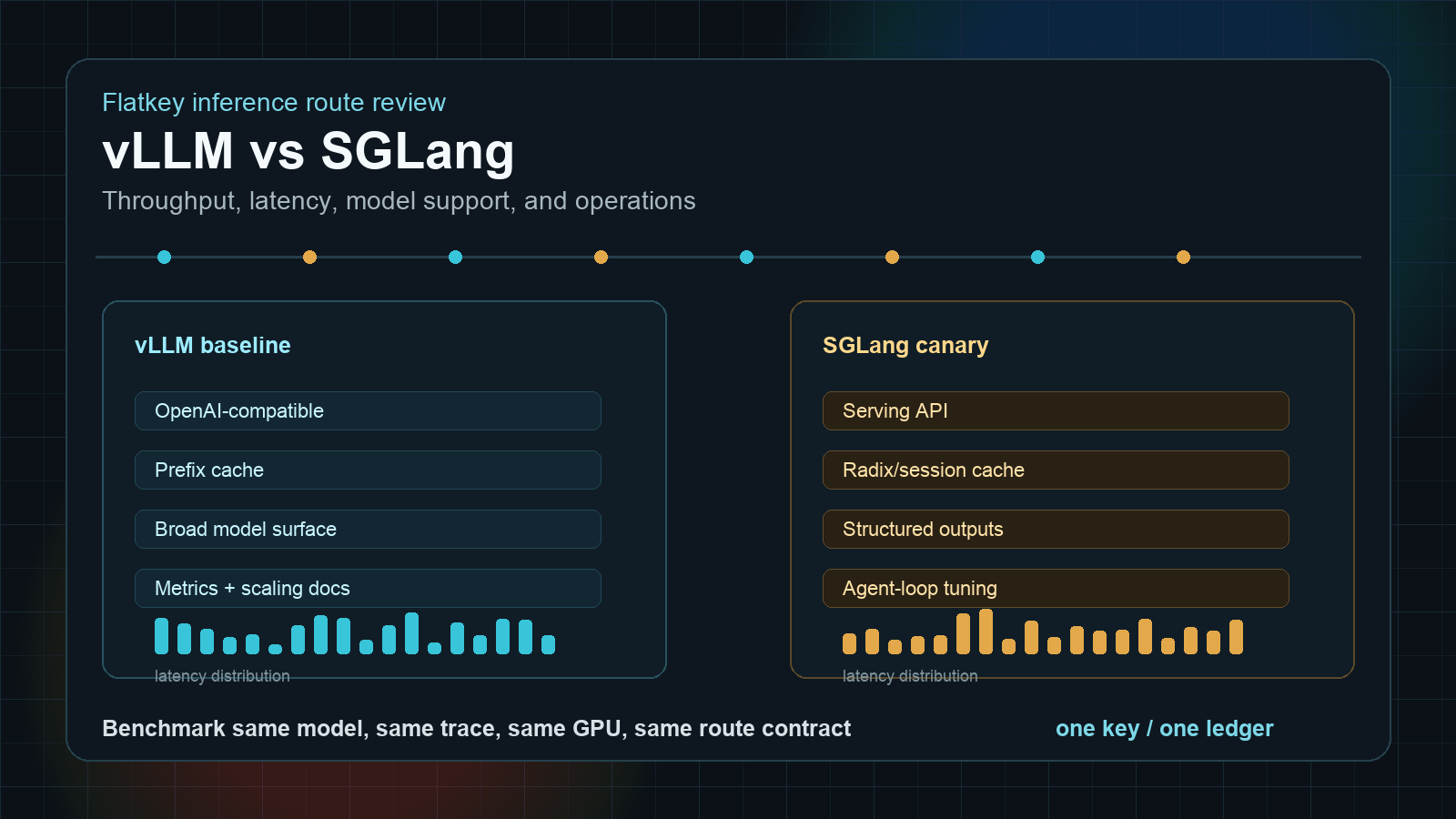
The short answer: start with vLLM when you need the broadest production default, mature model coverage, familiar OpenAI-compatible serving, metrics, and multi-GPU scaling patterns. Test SGLang when latency-sensitive agent loops, structured outputs, multimodal serving, session/prefix reuse, or SGLang-specific model optimizations are central to the workload. Use Ollama for local development and demos, not as the main comparison point for high-throughput cloud GPU serving.
This guide gives enterprise AI teams a practical vLLM vs SGLang comparison across throughput, latency, model support, and operations. It also includes a benchmark plan you can copy before committing GPU capacity.
Quick vLLM vs SGLang decision matrix
| Decision factor | vLLM is usually the safer starting point when... | SGLang is worth a serious canary when... |
|---|---|---|
| Throughput | You need a mature serving engine with broad model support, PagedAttention lineage, prefix caching, speculative decoding options, quantization options, metrics, and multi-GPU deployment patterns. | Your workload benefits from SGLang's runtime focus on low-latency/high-throughput serving, Radix-style cache reuse, structured outputs, multimodal paths, or model-specific SGLang release work. |
| Latency | Tail latency is mostly driven by batching, model size, context length, GPU class, and queue control; you want predictable operations before framework tuning. | You have multi-turn or agent sessions where cache reuse and structured decoding change time-to-first-token and completion latency. |
| Model support | You need the broadest practical list of generative, pooling, embedding, rerank, reward, multimodal, and hardware-supported models from a single serving stack. | Your exact target model appears in SGLang's supported-models pages, cookbook, or recent release notes, and SGLang has a known optimization path for it. |
| Structured outputs | You can rely on OpenAI-compatible response formats or app-side validation, and structured output is not the main latency bottleneck. | JSON schema, regex, or EBNF-constrained output is a core endpoint behavior, especially for agents and workflow automation. |
| Operations | You want production-stack guidance, metrics, parallelism docs, common deployment patterns, and easier hiring/on-call familiarity. | Your platform team can absorb faster-moving serving internals and wants to tune cache/session behavior more aggressively. |
| Migration risk | You already run OpenAI-compatible clients and want to keep the server swap reversible. | You can isolate one route, benchmark it independently, and rollback if real traffic does not improve. |
For most teams, the pragmatic answer is not "standardize on one forever." It is:
- Put vLLM behind a stable OpenAI-compatible route for the default production baseline.
- Canary SGLang for workloads where structured output, cache reuse, or SGLang-optimized models can move a real service-level metric.
- Compare both by cost per accepted output, p95 latency, p99 latency, error rate, GPU utilization, and operator time.
What is vLLM?
vLLM is an open-source LLM serving engine built around efficient memory management for inference. Its original paper introduced PagedAttention for KV-cache memory management and positioned vLLM as a high-throughput serving system for large language models. The current vLLM docs cover OpenAI-compatible serving, supported model architectures, automatic prefix caching, speculative decoding, quantization, metrics, and parallelism/scaling deployment patterns.
In practice, vLLM is the default candidate when your team asks:
- Can we expose a familiar
/v1/chat/completionsor OpenAI-compatible endpoint? - Can we serve popular open-weight models without building a custom runtime path?
- Can we scale from one GPU to tensor, pipeline, data, context, or expert parallel configurations?
- Can we export useful metrics and integrate the endpoint into an existing platform stack?
- Can we find engineers and examples when something breaks at 2 a.m.?
That maturity matters. A serving framework is not only a kernel benchmark; it is a queue, scheduler, cache policy, model loader, metrics surface, upgrade plan, and incident boundary.
What is SGLang?
SGLang is an inference framework for production-level serving of large language and multimodal models. Its docs describe a runtime designed for low-latency and high-throughput inference from single-GPU setups to distributed clusters. It supports OpenAI-compatible APIs, structured outputs with JSON schema, regex, and EBNF constraints, session-aware radix cache behavior, HiCache, hardware-platform guides, and a supported-models catalog across text generation, multimodal, embeddings, reranking, reward, classification, and specialized model classes.
SGLang is especially interesting when the endpoint is not just "take prompt, return text." It deserves a canary when:
- The application needs strict structured output, not just best-effort JSON.
- The workload has repeated prefixes, long-lived sessions, multi-turn agents, or tool loops where cache reuse matters.
- The model family is covered by SGLang docs or recent SGLang release work.
- The team wants to tune serving behavior for low-latency agent actions, vision-language serving, or specialized output constraints.
- The team is comfortable validating a faster-moving runtime against its own production traffic.
SGLang can be a strong choice, but do not choose it from a benchmark screenshot alone. Confirm the exact model, context length, tokenizer, batch shape, structured-output mode, GPU class, and failure mode you will operate.
Throughput: tokens per second is only the first metric
For vLLM vs SGLang throughput, do not compare a single tokens-per-second number from two different blog posts. Throughput changes with:
- Model family and parameter count.
- Context length and output length.
- Batch size and request arrival pattern.
- Prompt-prefix reuse.
- Structured-output constraints.
- Quantization mode.
- GPU type, memory size, interconnect, and driver stack.
- Tensor, pipeline, data, context, or expert parallel settings.
- Admission control and queue timeout policy.
vLLM's advantage is that it gives many teams a strong baseline quickly. The docs expose clear serving, model-support, metrics, prefix-caching, speculative-decoding, quantization, and scaling paths. If your platform team needs a production default this week, vLLM is usually where the first benchmark should start.
SGLang's advantage appears when the workload matches its serving design. SGLang's structured-output support and cache features can change the practical throughput of workflows that repeat prefixes, run agent sessions, or need constrained decoding. If your traffic is full of long prompts with shared system instructions, retrieval templates, few-shot examples, or tool schemas, benchmark SGLang with cache behavior turned on instead of treating every request as independent.
Use this normalized throughput score:
accepted output throughput =
  accepted output tokens or accepted structured results
  / wall-clock test duration
Then add GPU economics:
cost per accepted output =
  (GPU rental + storage + load time + retries + operator time)
  / accepted results
That second line is where cloud GPU decisions become real. If a framework posts higher raw throughput but needs more failed retries, more manual tuning, or a model-specific workaround, the cheaper endpoint may be the other one.
Latency: measure prefill, decode, and tail separately
For vLLM vs SGLang latency, split the request into phases:
| Latency metric | What it tells you | Why it matters |
|---|---|---|
| Time to first token | Prefill, scheduling, queue, and cache behavior | Critical for chat, agents, copilots, and interactive tools. |
| Inter-token latency | Decode performance under load | Shapes perceived streaming speed. |
| End-to-end latency | User-visible completion time | Best metric for complete tasks and API SLOs. |
| p95 and p99 latency | Tail risk under concurrency | Determines whether the service survives real traffic. |
| Queue wait time | Admission-control health | Prevents framework comparisons from hiding overload. |
| Retry-adjusted latency | Real user cost after failures | Captures OOM, timeout, eviction, and upstream errors. |
vLLM is often easier to baseline because more teams know how to run it, observe it, and scale it. SGLang may win specific latency cases when its cache and structured-output path line up with your workload. The only honest way to know is to run both with the same request trace.
Do not benchmark with one synthetic prompt and declare a winner. Build three traces:
- Short chat: short prompt, short output, high concurrency.
- Long-context RAG: long prompt, medium output, repeated system and retrieval template.
- Agent/tool loop: repeated schema, structured outputs, multiple turns, cancellation and retries.
If SGLang beats vLLM only on the agent/tool loop, that is still useful. Route that class separately. If vLLM is close enough with simpler operations, the operational simplicity may be worth more than a narrow latency win.
Model support: breadth versus exact fit
Model support is where many sglang vs vllm debates become too abstract. The question is not "which project supports more models?" The question is "which runtime supports the exact models, modalities, precision modes, and deployment hardware we need now?"
Use this model-support checklist:
| Check | Why it matters |
|---|---|
| Exact model architecture listed | Prevents surprise fallback or unsupported kernels. |
| Tokenizer and chat template compatibility | Avoids subtle output quality or formatting regressions. |
| Context window tested at target length | Long context can change KV-cache memory pressure. |
| Multimodal input path tested | Vision-language workloads are not the same as text-only chat. |
| Structured output tested | JSON schema or grammar constraints can change latency and correctness. |
| Quantization mode tested | Weight-only, activation, and KV-cache quantization have different tradeoffs. |
| Parallelism mode tested | Single-GPU success does not prove multi-GPU serving. |
| Hardware backend tested | NVIDIA, AMD, CPU, XPU, TPU, NPU, and platform-specific paths differ. |
| Upgrade path reviewed | New framework releases can improve support but also change flags and behavior. |
vLLM's docs expose a wide supported-models surface and hardware-specific sections. That makes vLLM a strong default when procurement or platform teams need a lower-risk base layer across many model families.
SGLang's supported-models pages and hardware-platform guides show a broad set of maintained paths too, including text generation, multimodal, embeddings, reranking, reward, classification, and specialized models. That makes SGLang attractive when its supported path maps tightly to a model family you actually run.
The wrong pattern is choosing a framework because it supports a model in a README, then discovering that your required context length, quantization mode, GPU class, or structured-output mode has not been validated.
Operations: the part benchmark posts usually skip
The operational difference between vLLM and SGLang matters more as soon as traffic is customer-facing. Your on-call team needs answers to ordinary production questions:
- How do we roll a new model without breaking active requests?
- Which metrics tell us the endpoint is overloaded?
- How do we isolate queue wait from decode time?
- What happens when one GPU OOMs?
- How do we set max context length, max batch size, and concurrency without starving small requests?
- How do we restart workers without losing every in-flight request?
- How do we reproduce a bad output with the same model, tokenizer, prompt template, and sampling parameters?
- How do we attribute cost to a team, product, customer, or environment?
vLLM has a mature production ecosystem around OpenAI-compatible serving, production stack integrations, metrics, and scaling docs. That does not make it automatic, but it lowers the first-run operational burden.
SGLang has serious operations features too, including OpenAI-compatible serving, hardware-platform docs, cache controls, structured-output paths, and model gateway material. The tradeoff is that your team may need more workload-specific validation because SGLang's strengths are often tied to the exact serving pattern.
For enterprise AI teams, the best pattern is to keep the client contract stable and make the serving engine swappable behind a route. That means:
- One OpenAI-compatible endpoint contract.
- Stable request IDs and error envelopes.
- Versioned model aliases.
- Separate canary route for SGLang tests.
- Per-route metrics for latency, throughput, errors, retries, and cost.
- Rollback plan before the canary receives production traffic.
Flatkey fits the layer above this decision. If your team serves some workloads through self-hosted GPUs and others through official model APIs, Flatkey can provide one key, one balance, one invoice, model and tool usage records, and governance controls across API-side workloads. For cloud GPU decisions, that lets you compare self-hosted endpoint cost against AI model pricing comparison, GPU rental prices, AI gateway pricing, and AI API quota controls instead of treating every inference service as a separate finance problem.
vLLM vs SGLang benchmark plan
Use this vLLM vs SGLang benchmark plan before making a framework call.
1. Freeze the workload
Create a request trace with:
- 1,000 to 10,000 representative prompts.
- Prompt token length distribution.
- Expected output token distribution.
- Required structured-output schema, if any.
- Required modality: text, vision-language, embedding, rerank, or reward.
- Real concurrency targets.
- Cancellation, timeout, and retry behavior.
- Expected p95 and p99 SLOs.
2. Freeze the hardware
Run both frameworks on the same GPU setup:
- GPU model and memory.
- GPU count.
- SXM or PCIe where relevant.
- CUDA, ROCm, driver, and container image versions.
- CPU, RAM, storage, and network path.
- Tensor or pipeline parallel settings.
- Same model weights and tokenizer.
If you change hardware between tests, you are no longer comparing vLLM vs SGLang. You are comparing two deployment stacks.
3. Freeze serving knobs
Record:
- Max model length.
- Max batched tokens.
- Max concurrent requests.
- Cache settings.
- Quantization settings.
- Speculative decoding settings.
- Structured-output backend.
- Tool-calling or reasoning parser settings.
- Admission-control policy.
Keep one "default" run and one "tuned" run for each framework. Default tells you time-to-production. Tuned tells you ceiling.
4. Measure the right outputs
Create a table like this:
| Metric | vLLM default | vLLM tuned | SGLang default | SGLang tuned |
|---|---|---|---|---|
| Accepted requests per minute | ||||
| Accepted output tokens per second | ||||
| Time to first token p50 / p95 / p99 | ||||
| End-to-end latency p50 / p95 / p99 | ||||
| Error rate | ||||
| Retry-adjusted latency | ||||
| GPU memory headroom | ||||
| GPU utilization | ||||
| Queue wait p95 | ||||
| Cost per accepted result | ||||
| Operator time to deploy | ||||
| Operator time to debug |
The last two rows are intentionally non-glamorous. They often decide the real winner.
5. Run failure tests
Do not choose a serving framework until you test failure behavior:
- Overload the queue.
- Send too-long context.
- Kill one worker.
- Restart the pod during traffic.
- Trigger OOM with a known bad request.
- Cancel streaming clients.
- Return invalid structured output and confirm app-side handling.
- Roll back to the previous container.
The framework that fails in a way your team understands may be safer than the one with a slightly better median-latency run.
Ollama vs vLLM vs SGLang
The query ollama vs vllm vs sglang usually mixes two different jobs.
Ollama is excellent for local development, demos, laptop workflows, and simple OpenAI-compatible local testing. It is useful when a developer wants to pull a model and run a local API quickly.
vLLM and SGLang are the serious comparison for cloud GPU inference serving. They are built for server deployment, batching, model-serving throughput, multi-GPU concerns, and production endpoint behavior. If your question is "how do I run a model on my MacBook or dev workstation?", compare Ollama. If your question is "how do I serve paid users on H100, H200, L40S, A100, or rented GPU clusters?", compare vLLM and SGLang.
Practical recommendations
| Team situation | Recommended path |
|---|---|
| First production open-weight LLM endpoint | Start with vLLM, then benchmark SGLang on the same route contract. |
| Structured-output-heavy agent service | Canary SGLang early; compare JSON validity, latency, and retry rate against vLLM. |
| Many model families and modalities | Use vLLM as the first baseline, then validate SGLang only for routes where it has a clear supported path. |
| Long-session agent or repeated-prefix workload | Benchmark SGLang cache/session behavior directly against vLLM prefix caching. |
| Procurement comparing cloud GPU plans | Benchmark both and calculate completed-workload cost, not GPU hourly price alone. |
| Small team with no platform on-call | Prefer the framework with simpler docs, easier metrics, and fewer custom flags for your exact model. |
| Local prototyping | Use Ollama locally, then re-benchmark on vLLM or SGLang before promising production numbers. |
| API-side workload with uncertain GPU utilization | Compare self-hosting against a model API path through Flatkey before renting long-lived capacity. |
Frequently asked questions
What is SGLang vs vLLM?
SGLang and vLLM are open-source LLM inference serving frameworks. vLLM is widely used as a production serving baseline with broad model support, OpenAI-compatible serving, metrics, prefix caching, speculative decoding, quantization, and scaling docs. SGLang is a production serving framework focused on low-latency and high-throughput inference, with OpenAI-compatible APIs, structured outputs, cache/session features, multimodal support, and supported-models documentation.
Is SGLang faster than vLLM?
Sometimes, for some workloads. A meaningful sglang vs vllm answer depends on the model, prompt length, output length, batch shape, structured-output mode, cache reuse, GPU class, and tuning. Do not trust a universal winner claim. Run the same request trace on both frameworks and compare accepted throughput, p95/p99 latency, error rate, and cost per accepted result.
Is vLLM better for production?
vLLM is often the safer first production baseline because it has broad docs, model support, OpenAI-compatible serving, metrics, and common deployment patterns. That does not mean it wins every route. SGLang can be the better production choice for routes where structured outputs, cache reuse, multimodal behavior, or model-specific SGLang support drives a measurable improvement.
Should I use Ollama, vLLM, or SGLang?
Use Ollama for local development and simple model testing. Use vLLM or SGLang for cloud GPU serving. Start with vLLM when you want the broadest default path; canary SGLang when your workload needs structured outputs, low-latency agent loops, or SGLang-supported model optimizations.
How should I benchmark vLLM vs SGLang?
Freeze the model, tokenizer, hardware, container, request trace, context lengths, concurrency, and serving knobs. Measure time to first token, end-to-end p95/p99 latency, accepted output throughput, error rate, retry-adjusted latency, GPU memory, GPU utilization, queue wait, and cost per accepted result. Run default and tuned configurations for both.
Official sources checked
This comparison is based on current framework documentation and papers, not a single third-party benchmark screenshot. Useful primary references include:
- vLLM OpenAI-compatible server docs
- vLLM supported models
- vLLM prefix caching docs
- vLLM metrics docs
- vLLM parallelism and scaling docs
- vLLM PagedAttention paper
- SGLang documentation
- SGLang OpenAI-compatible API docs
- SGLang structured outputs docs
- SGLang session-aware radix cache docs
- SGLang supported models
- SGLang paper
- Ollama OpenAI compatibility docs
Bottom line
For the sglang vs vllm decision, choose vLLM as the default baseline when your enterprise AI team needs broad model support, mature serving docs, and easier operations. Choose SGLang for routes where structured outputs, session/cache behavior, multimodal serving, or model-specific support can improve real latency, throughput, or correctness. Keep the client contract stable, benchmark both on your own traffic, and route by workload rather than ideology.
If the benchmark shows that self-hosting is not yet cheaper or simpler than a model API, use Flatkey's one key, one balance, and usage ledger to compare official API routes before committing to long-lived GPU capacity.