AI inference means using a trained AI model on new input to produce an output: a classification, prediction, embedding, image, token stream, or decision. Training changes a model’s learned parameters; inference uses those parameters to do useful work. For an LLM, the practical job is to turn a prompt into generated tokens quickly, reliably, and at a cost that fits the workload.
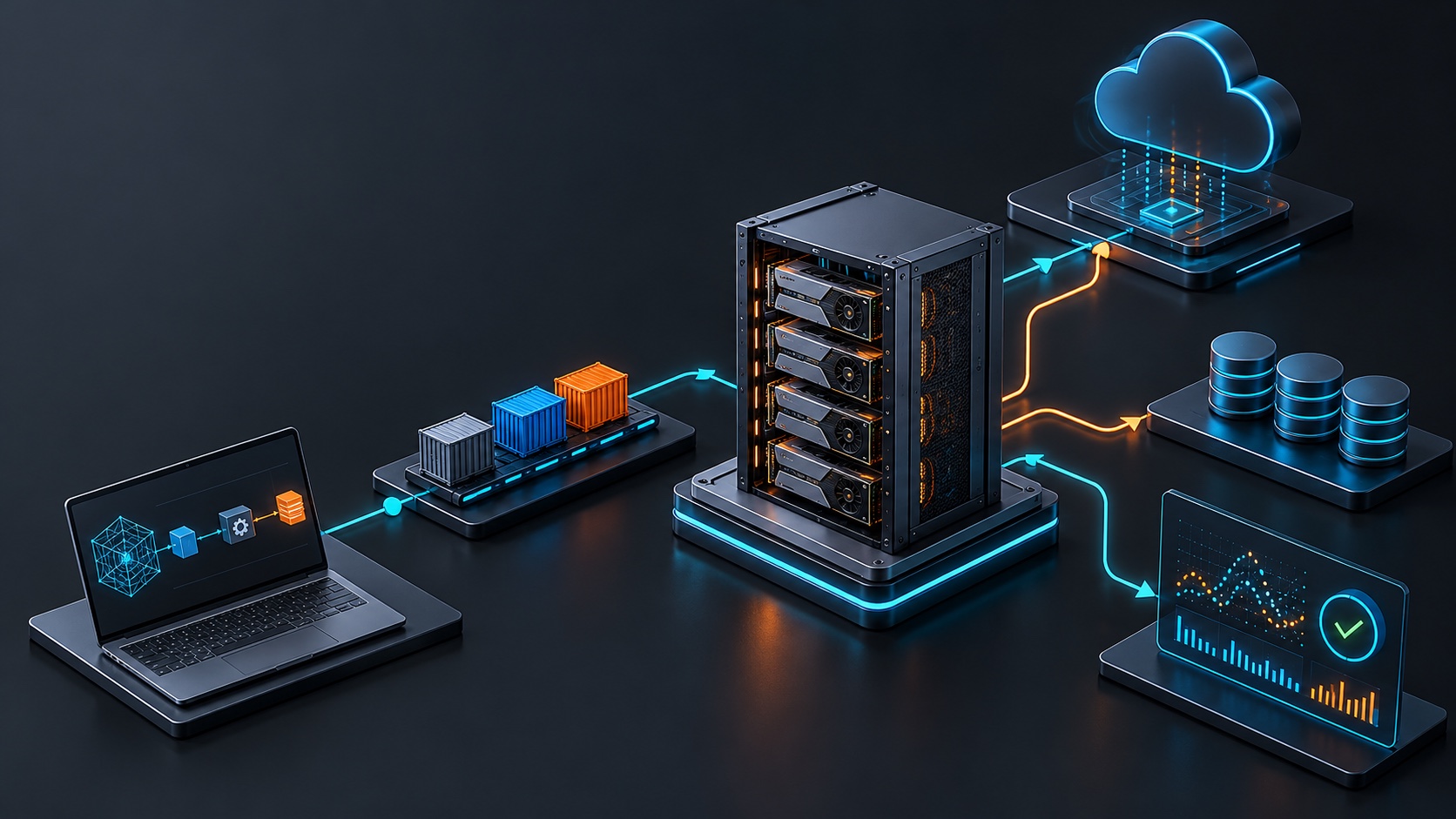
That definition is simple. Operating inference in production is not. A request has to be authenticated, routed, queued, tokenized, scheduled on hardware, run through the model, streamed back, measured, and recovered when something fails. This guide explains AI inference meaning in that operational sense: what happens between an application request and a useful response, which measurements actually matter, and how to deploy the workload on cloud GPUs without treating a demo as a production system.
AI inference meaning in one sentence
AI inference is the execution phase of machine learning: a trained model applies learned parameters to new data and returns an output. NVIDIA describes inference as the point at which a trained model generates outputs from new data, while training is the iterative process of adjusting model weights from training data. NVIDIA’s AI inference overview is a useful primary reference for the distinction.
If you searched for AI inference meaning, keep this mental model:
Training teaches a model. Inference puts the trained model to work.
For a chat application, that work is generative: process the prompt, predict one next token at a time, and return a stream until a stop condition is reached. For a classifier, it may be a single score. For an embedding model, it may be a vector. The core idea does not change: new input goes in; a result comes out; learned weights remain fixed for that request.
AI inference vs. training vs. fine-tuning vs. serving
These terms are related but solve different jobs. Confusing them leads teams to buy the wrong infrastructure or measure the wrong thing.
| Term | What changes? | Typical output | Main operating concern |
|---|---|---|---|
| Training | Model weights are updated across many examples. | A new model checkpoint. | Data, distributed compute, convergence, checkpointing. |
| Fine-tuning | Some or all model weights are updated for a narrower task. | A specialized checkpoint or adapter. | Dataset quality, evaluation, versioning, regression risk. |
| Inference | The trained model runs on new inputs; weights are not updated by the request. | A prediction, token sequence, vector, image, or other result. | Latency, throughput, capacity, availability, and cost. |
| Serving | The systems layer that exposes inference to applications. | A reliable endpoint, queue, scheduler, and observability surface. | Routing, batching, deployment, authentication, rollout, and recovery. |
In other words, AI inference meaning is not “the whole platform.” It is the model-execution step. Inference serving is the surrounding production system that makes that step usable by other software.
This framing turns AI inference meaning from a vocabulary question into an operating decision: identify the model-execution step first, then assign ownership for everything that makes it dependable.
How AI inference works for an LLM
The exact implementation differs across model families, but a production LLM request usually follows this path:
- The application sends a request. The client supplies messages or a prompt, generation limits, and identity or tenant context.
- An edge or API layer validates and routes it. This is where authentication, quotas, model selection, safety checks, and request logging commonly live.
- The server tokenizes the input. Text becomes model-readable token IDs. Image, audio, or structured inputs need their modality-specific preprocessing.
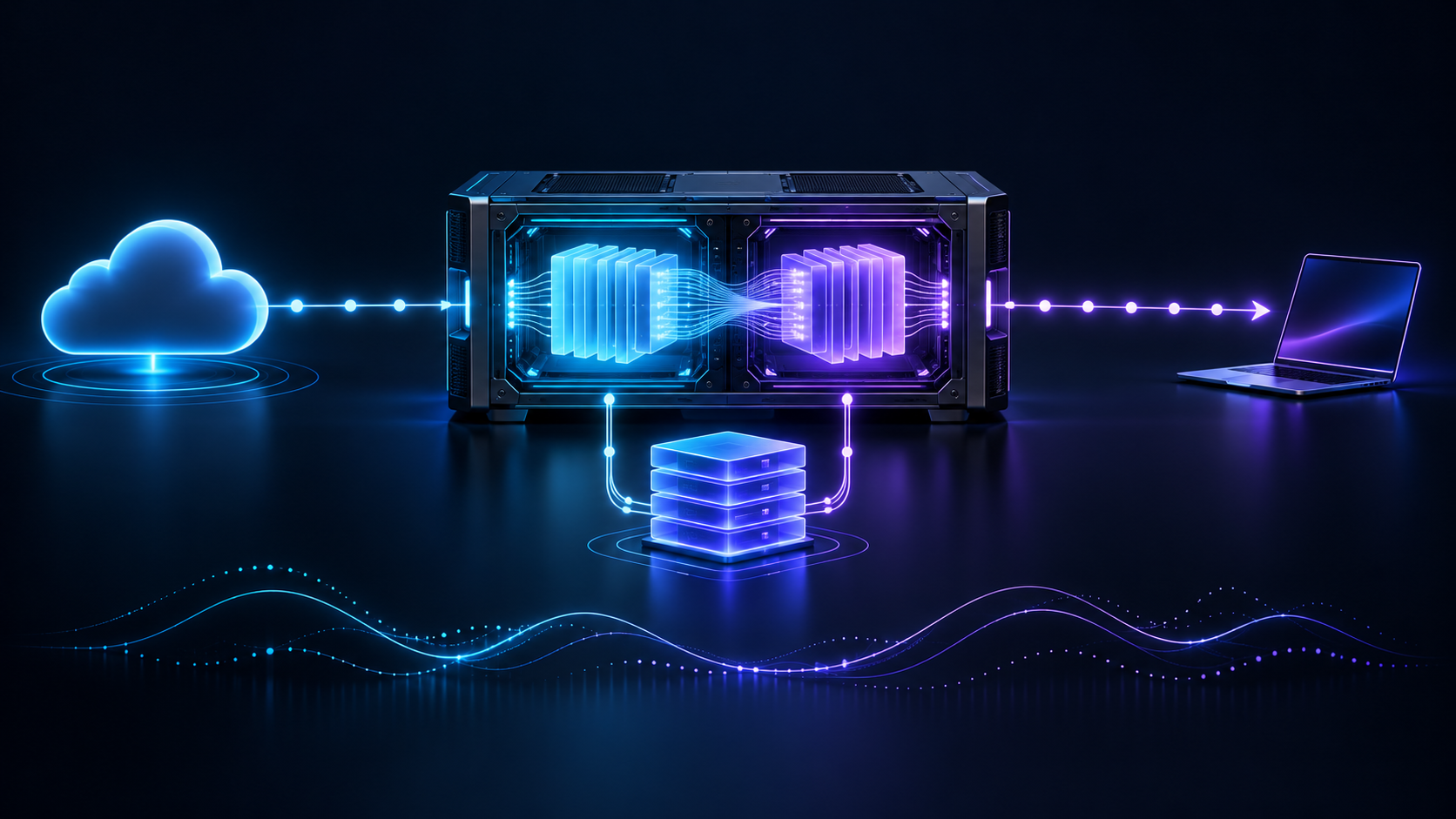
- Prefill processes the prompt. The model computes the prompt context in a large first pass. NVIDIA’s LLM inference overview separates this from decode and treats both as parts of end-to-end request latency. See the prefill/decode description.
- The server retains usable attention state. Transformer-serving systems commonly keep key/value (KV) state for active sequences so each next token does not require recomputing the entire prior context. TensorRT documents KV cache as an application- or framework-managed memory resource rather than an afterthought. Read the TensorRT KV-cache reference.
- Decode generates output token by token. The model repeatedly predicts the next token, updates state, and either streams the partial response or waits for completion.
- The platform meters and observes the result. A production response should leave enough evidence to investigate latency, errors, saturation, and usage without storing more customer content than the system needs.
That is the architecture hiding behind the short definition of AI inference meaning. A model alone is not a low-latency service; it needs a path for requests, compute, state, and feedback.
The cloud inference architecture to draw before deploying
Before choosing a GPU type or a serving engine, sketch the request path. The following reference architecture applies to a self-hosted LLM or multimodal model endpoint on cloud GPUs.
Client / application
        │
        ▼
API edge: auth · limits · request IDs · routing
        │
        ▼
Queue / scheduler ──► admission controls and timeouts
        │
        ▼
Inference server: tokenizer → prefill → KV cache → decode / stream
        │                         │
        ▼                         ▼
GPU worker pool              cache-capacity signals
        │
        ▼
Metrics, traces, logs, alerts, and deployment controls
Each layer owns a distinct failure mode:
- API edge: invalid credentials, quota exhaustion, wrong model parameters, tenant isolation, and request correlation.
- Queue and admission layer: back-pressure, priority decisions, timeout policy, and protection against overload cascades.
- Inference server: model loading, tokenization, batching, memory allocation, prompt execution, token generation, and streaming.
- GPU worker pool: hardware availability, driver/runtime compatibility, GPU memory headroom, network topology, and replica health.
- Observability: whether a slow request was waiting, prefilling, decoding, retrying, or failing before it ever reached a GPU.
For large-scale deployments, this structure may add a model registry, artifact storage, a separate prefill tier, a separate decode tier, or a cache-aware router. Do not begin there. Start with one observable, repeatable path and introduce separation only when measurements show that the simpler topology misses its service objective.
The four performance dimensions that matter
Teams often ask, “How fast is the model?” That is too vague to guide an inference deployment. A useful performance review separates four dimensions.
| Metric | What it tells you | Why it changes deployment decisions |
|---|---|---|
| Time to first token (TTFT) | Time from accepted request to first streamed token. | It represents the wait a chat user feels before anything happens. Prompt length, queueing, prefill capacity, and cold starts can dominate it. |
| Time per output token (TPOT) / inter-token latency | Average time between subsequent generated tokens. | It describes how responsive a streaming answer feels after it starts. Decode capacity and active concurrency matter here. |
| End-to-end latency | Full request duration, including queue, processing, streaming, and response completion. | It matters for synchronous workflows, tool calls, and jobs that cannot use partial output. |
| Throughput and goodput | Work completed per time, with goodput constrained by the latency target you actually promised. | It prevents a high token-per-second number from disguising a queue that misses user-facing deadlines. |
Current vLLM documentation exposes histograms for queue time, prefill time, decode time, TTFT, request latency, and time per output token through its metrics endpoint. Use its production metrics list as a concrete instrumentation checklist.
The important connection is this: the performance of AI inference is not one number. A deployment can produce impressive aggregate tokens per second while still giving interactive users a poor TTFT. It can also deliver a fast first token while slowing badly for long outputs. Measure the request path in phases before changing hardware or tuning flags.
Why batching improves throughput—and can hurt the wrong latency target
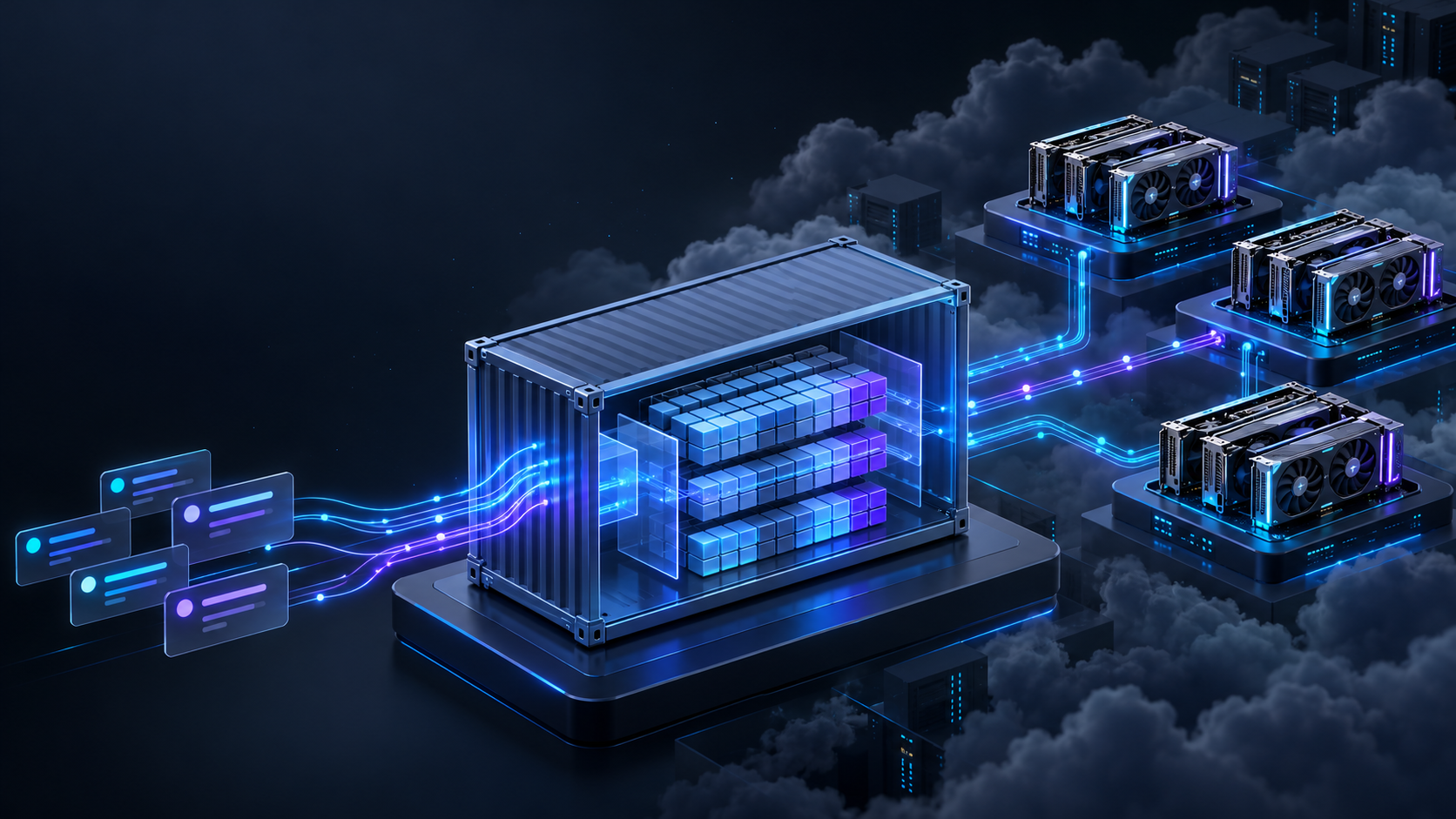
Cloud GPUs are expensive when they sit idle, so inference servers commonly group compatible requests into batches. NVIDIA Triton’s dynamic batcher combines requests and lets operators bound how long the scheduler waits for a larger batch. That makes the tradeoff explicit: a longer waiting window may improve utilization and throughput, while adding queue delay. Triton’s batcher documentation explains the controls.
For LLMs, “continuous,” “inflight,” or “iteration-level” batching can make that scheduling more flexible. Rather than waiting for every sequence in an old batch to finish, a server can fill freed slots with new or ongoing work at successive generation steps. NVIDIA documents this approach as a way to mix new and in-progress requests during iterative processing. See the Triton continuous-batching explanation.
Do not treat batching as a checkbox. Test it against a written latency budget:
- Interactive chat and IDE assistance usually care strongly about TTFT and output cadence.
- Batch summarization, embedding generation, and offline enrichment may accept a longer queue in exchange for higher completed-work throughput.
- Long-context work shifts more pressure toward prefill and cache capacity.
- Long-output work keeps decode resources occupied for longer, which changes fair-queuing and cancellation behavior.
That tradeoff is central to AI inference meaning in practice: the service must decide how to share finite compute, not merely execute a forward pass.
Cloud GPU deployment: managed API or self-hosted inference?
There is no universal “right” deployment model. Choose based on the control surface your workload truly needs.
| Choose a managed model API when… | Choose self-hosted cloud GPU inference when… |
|---|---|
| You need to ship a feature before you need to operate model infrastructure. | You need control over the serving stack, model artifact, hardware topology, or runtime configuration. |
| Provider-managed capacity, model updates, and endpoint operations fit the workload. | You can define and operate capacity, deployment, observability, and incident ownership. |
| The integration needs a stable API contract more than direct access to GPU settings. | Your load shape, data boundary, model customization, or optimization work requires lower-level control. |
| You want to test several models without standing up a separate serving path for each one. | You have a measured workload and an explicit reason to own the inference path. |
Most mature systems are hybrid. A team may self-host a stable, high-volume model while using managed APIs for long-tail models, experimental modalities, burst capacity, or a fallback route. The useful question is not “cloud GPU or API?” but “which parts of the request path must we own?”
For a deeper cost-and-operations decision framework, see GPU cloud vs. model API. If you choose to own a serving endpoint, the OpenAI-compatible inference server guide covers a practical vLLM-oriented implementation path.
A production-minded cloud GPU deployment playbook
For a deployment team, AI inference meaning becomes an accountability map: identify each phase of the request, define the objective it must meet, and make the owner and signal for failure visible.
1. Write an acceptance contract before provisioning
Document the workload in terms that can be tested:
- Model and version, including license and artifact source.
- Input modality, prompt-length distribution, and expected output lengths.
- Peak and sustained request concurrency.
- TTFT, TPOT, end-to-end latency, error-rate, and availability objectives.
- Streaming, cancellation, data-retention, and regional requirements.
- A representative evaluation set for output quality—not just a load generator.
Without this contract, “we need a faster GPU” is not a decision. It is a guess.
2. Build a single-replica baseline
Run one model replica in a non-production environment and collect phase-level metrics under a representative mix of short and long inputs. Record the model server version, driver/runtime version, model revision, tokenizer revision, batch policy, and concurrency. A reproducible baseline makes later capacity and incident analysis possible.
For teams choosing a serving engine, vLLM vs. SGLang is a workload-oriented comparison rather than a blanket winner claim.
3. Plan memory as weights plus runtime state, not just model size
GPU memory must accommodate more than the checkpoint. It also needs room for runtime buffers and active sequence state such as KV cache. The TensorRT documentation makes the allocation boundary visible: cache capacity is managed outside the transformer layer itself. That means model loading can succeed while real concurrent traffic still creates cache pressure.
Use an empirical capacity test with your actual context lengths and output limits. Track cache occupancy, preemptions or evictions when your server exposes them, and failure behavior at the admission boundary. For a related framework on planning GPU memory, read LLM GPU memory requirements.
4. Make GPU scheduling explicit
Kubernetes supports vendor device plugins for GPUs and exposes them as schedulable resources. Its GPU scheduling guidance specifies that custom GPU resources belong in a container’s limits, with requests either omitted or equal to the limit. Review the Kubernetes GPU scheduling documentation before adapting the manifest below.
apiVersion: apps/v1
kind: Deployment
metadata:
  name: inference-server
spec:
  replicas: 1
  selector:
    matchLabels:
      app: inference-server
  template:
    metadata:
      labels:
        app: inference-server
    spec:
      containers:
        - name: server
          image: registry.example.com/inference-server:immutable-tag
          resources:
            limits:
              nvidia.com/gpu: 1
              cpu: "4"
              memory: 32Gi
Treat nvidia.com/gpu as an example resource name for an NVIDIA device-plugin installation. Confirm the resource name, node labels, runtime, and placement policy in your own cluster before deployment. Do not use this minimal manifest as a complete production configuration; it intentionally omits secrets, probes, network policy, storage, autoscaling, and rollout controls.
5. Tune queueing and batching against the SLO
Start with a conservative queue limit and an explicit timeout. Increase batch size or batching delay only while the relevant percentiles stay inside the acceptance contract. Use separate load tests for:
- Small prompts and short outputs.
- Long prompts and short outputs.
- Short prompts and long outputs.
- Mixed tenants with different priorities.
- Slow clients that stop reading a stream.
- Cancellation, retry, and worker-failure paths.
If a change improves one profile while degrading another, do not average them away. Split the workloads, revise admission policy, or state the service tier honestly.
6. Instrument the layers, not just the model
At minimum, record request IDs; status codes; model/version; queue duration; prefill duration; time to first token; decode duration; time per output token; generated-token counts; cancellation rate; and GPU/server health. Correlate client-visible latency with server phase metrics. That lets an on-call engineer answer a basic but critical question: did this request wait, compute, fail, or disconnect?
7. Roll out gradually and rehearse failure
Use immutable artifacts, health checks that test model readiness, a canary traffic slice, and an easy rollback path. Then test the failures you hope never occur: model load failure, unavailable GPU worker, saturated queue, dependency timeout, invalid model configuration, and client disconnect during streaming.
If one model cannot meet the workload’s reliability target alone, decide in advance whether the fallback should be another self-hosted replica, a different model, or a managed API route. This model fallback strategy guide can help frame that decision.
Common mistakes when teams first deploy AI inference
Treating a successful demo as a capacity plan
A one-user prompt proves that the model can start. It does not prove that the endpoint meets its latency objective under production concurrency, variable prompt lengths, streaming clients, or a failed worker.
Optimizing throughput before defining a latency promise
Larger batches can improve hardware utilization, but an interactive product is judged by the time users wait. Define the percentile target first, then tune the system that serves it.
Measuring only average latency
An average hides queue spikes, long-tail prompts, cold starts, and tenant interference. Use percentiles and phase-specific metrics. A fast mean is not evidence that the slowest user experience is acceptable.
Ignoring KV-cache behavior
Token generation is stateful across a sequence. Cache occupancy, context length, concurrency, reuse policy, and eviction behavior can make or break real load even when a weight-only memory estimate looked comfortable.
Making hardware the first decision
Hardware matters, but model format, serving engine, request distribution, batching policy, topology, and observability change the result. Measure the workload before declaring a GPU configuration “fast enough.”
AI inference FAQ
Is AI inference the same as an AI model API?
No. AI inference is the model executing on new input. An AI model API is one way to access inference. The API provider may operate the serving infrastructure for you, or you may expose your own inference server behind an API.
Does inference change the model?
Ordinary inference does not update model weights. Training and fine-tuning do. A system may log inference outcomes for later evaluation or training, but that is a separate workflow with its own data and governance choices.
Why is LLM inference split into prefill and decode?
Prefill processes the prompt context, while decode produces output tokens sequentially. The phases stress a serving system differently, which is why TTFT and output-token cadence should be measured separately.
Do I need cloud GPUs for AI inference?
Not always. Some workloads run on CPUs, edge accelerators, or a managed model API. Cloud GPUs are relevant when your model, latency target, throughput requirement, or serving configuration needs GPU acceleration and you want to operate that infrastructure.
What should I monitor first?
Start with successful requests, errors, queue time, TTFT, time per output token, end-to-end latency, generated-token counts, and GPU/server health. Add model-specific cache and scheduler metrics as your serving engine exposes them.
Put the definition to work
The practical AI inference meaning is straightforward: a trained model runs on new input and produces an output. The engineering work is making that output timely, observable, economical, and resilient under real traffic.
Start by writing the request profile and acceptance metrics. Choose a managed API when it provides the control level your workload needs; choose cloud GPU inference when you have a measured reason to own the serving path. Then make prefill, decode, queueing, cache state, and failure handling visible before you optimize.
If some workloads are better served through an API rather than self-hosted GPUs, explore Flatkey’s model catalog or compare the architecture options in the GPU cloud vs. model API guide.