Most teams ask the GPU cloud vs model API question too late. They rent GPUs, deploy a serving stack, tune batching, hire platform support, and only then compare the bill with a managed model API. By that point, the comparison is already biased toward the path they have sunk effort into.
The better question is simpler: do you need control of the GPU layer, or do you need reliable model outputs at the lowest accepted cost?
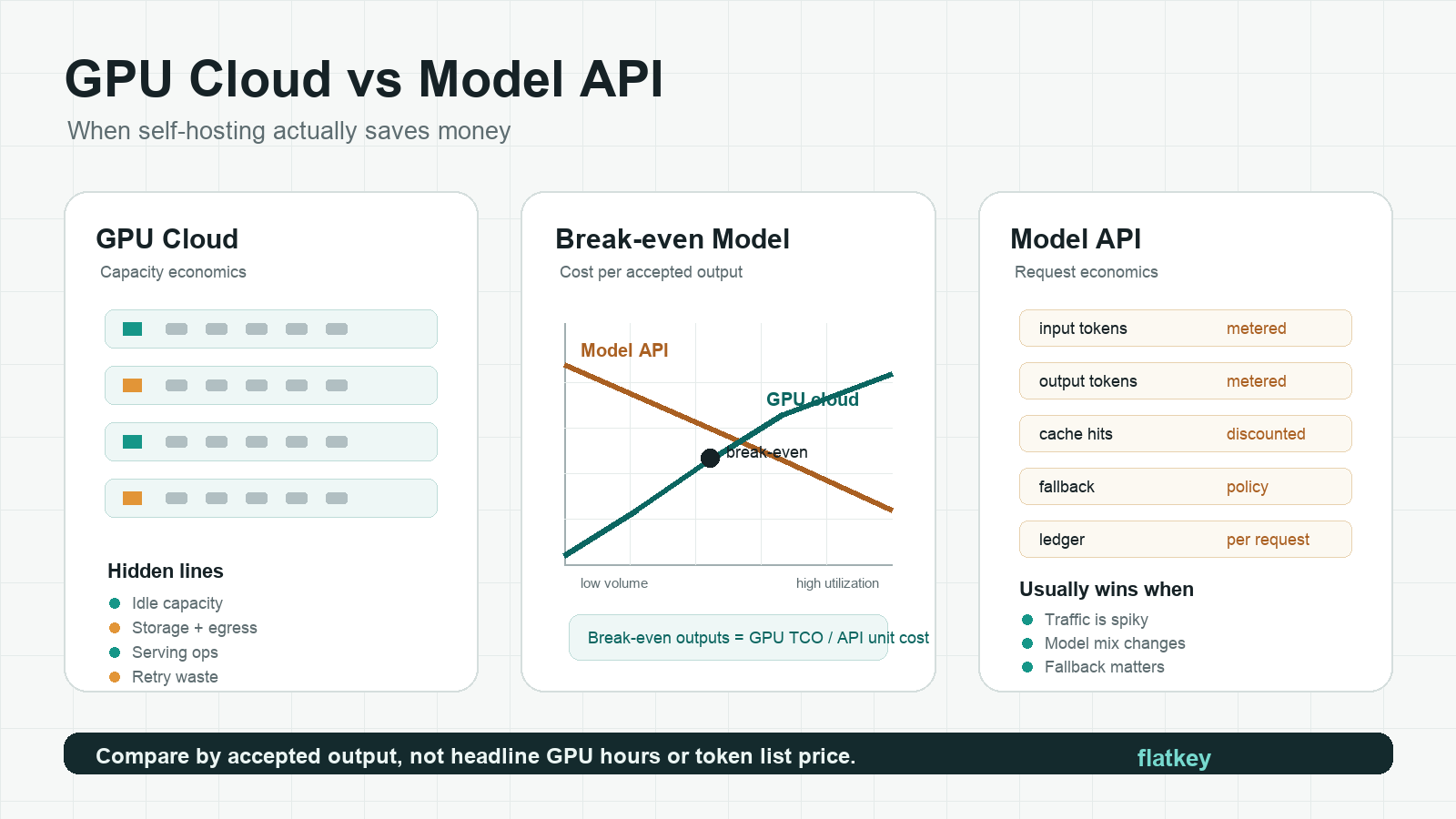
For enterprise AI teams, GPU cloud starts to save money when you have sustained demand, a stable model choice, high useful utilization, and the engineering team to run inference. A model API is usually cheaper when traffic is spiky, model choice changes often, retries and failover matter more than hardware control, or you need frontier models that cannot be self-hosted.
Flatkey's practical rule: compare GPU cloud vs model API by cost per accepted output, not by GPU hourly rate or token list price alone.
GPU cloud vs model API quick answer
Use this table before building a spreadsheet.
| Situation | Usually start with | Why |
|---|---|---|
| Early product, changing prompts, uncertain demand | Model API | You avoid idle GPUs while you learn traffic, quality, and model fit. |
| High-volume batch inference on one stable open model | GPU cloud | Sustained utilization can amortize the serving stack. |
| Customer-facing chat with unpredictable bursts | Model API or hybrid | Autoscaling, fallback, and no idle capacity often matter more than the raw unit price. |
| Proprietary weights, custom kernels, strict data locality | GPU cloud | The business requirement is control, not just cost. |
| Multi-provider model routing, frontier models, or frequent model swaps | Model API | You avoid rebuilding serving infrastructure for every model change. |
| Long-term steady workload with proven utilization | Reserved GPU cloud, dedicated GPU cluster, or colocated GPUs | Commitment can lower effective capacity cost after demand is proven. |
The rest of this guide gives a copyable model for comparing GPU cloud vs model API without hiding idle time, retries, operations, or quality filters.
The cost unit that actually matters
Do not compare:
- GPU hourly rate vs token price.
- Cloud quote vs a best-case benchmark.
- Model API list price vs a fully utilized self-hosted cluster.
Compare one of these denominators instead:
| Workload | Best denominator |
|---|---|
| LLM chat or agents | Cost per accepted response, accepted task, or accepted output token |
| Batch classification or extraction | Cost per accepted record |
| Code generation | Cost per accepted patch or completed coding task |
| Image generation | Cost per accepted image after quality filters |
| Video generation | Cost per accepted second or accepted clip |
| Fine-tuning or training | Cost per completed run |
For most inference teams:
effective_unit_cost =
  all_in_monthly_cost
  / accepted_outputs_after_retries_quality_filters_and_failures
This is where many GPU cloud vs model API comparisons flip. A self-hosted endpoint can show great benchmark throughput and still lose if utilization is low, the model fails quality checks, or engineers spend too much time keeping the stack healthy.
Model API cost model
A model API looks simple because the bill is usually metered by request, token, image, video second, or tool call. But a fair model API model still needs more than the published unit price.
Use this model:
monthly_model_api_cost =
  input_token_cost
  + cached_input_or_context_cost
  + output_token_cost
  + tool_or_media_cost
  + retry_and_fallback_cost
  + gateway_or_router_cost
  + observability_and_finops_cost
Then normalize:
model_api_cost_per_accepted_output =
  monthly_model_api_cost
  / accepted_outputs
What to capture:
| Cost line | What to check |
|---|---|
| Input and output tokens | Official provider pricing page, model ID, context window, output cap, and checked date. |
| Cached input | Whether the provider supports prompt caching or cache-hit discounts, and whether your workload actually reuses context. |
| Batch pricing | Whether batch or async processing fits your latency requirement. |
| Retries | Rate-limit retries, transient errors, failed quality checks, and fallback requests. |
| Router/gateway layer | Any gateway fee, usage ledger, model allowlist, sub-key budget, or invoice workflow. |
| Operations | Integration, monitoring, provider status handling, and finance reconciliation. |
Use official source pages for current numbers, not copied rate tables. Start with OpenAI API pricing, Anthropic pricing, Google Gemini API pricing, and your gateway or router's current pricing page.
For Flatkey, the model API side is about one key, one balance, and one usage ledger across official models and tools. That matters when the real cost problem is not a single model call, but scattered keys, multiple invoices, per-team budget controls, and fallback across providers.
GPU cloud cost model
GPU cloud is not just the GPU hourly price. A production self-hosted model API has capacity cost, serving software, storage, networking, monitoring, uptime work, and idle capacity.
Use this model:
monthly_gpu_cloud_cost =
  gpu_compute_hours
  + storage_and_snapshot_cost
  + bandwidth_and_egress_cost
  + load_balancing_and_network_cost
  + serving_stack_cost
  + observability_and_logging_cost
  + platform_engineering_cost
  + support_plan_or_managed_service_cost
  + idle_capacity_cost
  + retry_failure_and_redeployment_waste
Then normalize:
self_hosted_cost_per_accepted_output =
  monthly_gpu_cloud_cost
  / accepted_outputs
What to capture:
| Cost line | Why it changes the answer |
|---|---|
| GPU model and memory | H100, H200, B200, A100, L40S, and RTX-class GPUs have different memory, throughput, supply, and price curves. |
| Product mode | On-demand, spot, reserved, marketplace, serverless GPU, dedicated cluster, and bare metal have different reliability profiles. |
| Utilization | A cheaper self-hosted endpoint loses quickly if the GPU sits idle. |
| Serving stack | vLLM, SGLang, TensorRT-LLM, NIM, or custom servers need real operations support. |
| Storage and model loading | Large weights, snapshots, volumes, and repeated pulls can become material. |
| Networking | Egress, private links, public IPs, and load balancing can change unit economics. |
| Failures | Out-of-memory errors, preemptions, bad containers, and cold starts increase accepted cost. |
Use current provider pages as checkpoints: AWS EC2 pricing, AWS P5 instances, Google Cloud GPU pricing, RunPod pricing, Lambda GPU Cloud, and Vast.ai pricing.
Treat every GPU price as time-stamped. Marketplace supply, regional availability, and committed quotes can move faster than the article you are reading.
The break-even formula
This is the point where a GPU cloud vs model API decision becomes finance-grade instead of opinion-driven.
The simplest break-even model is:
break_even_outputs =
  monthly_gpu_cloud_cost
  / model_api_cost_per_accepted_output
If your workload produces more accepted outputs than break_even_outputs, self-hosting may save money. If it produces less, a model API is probably cheaper.
You can also express the same idea in utilization:
required_utilization =
  monthly_gpu_cloud_cost
  / equivalent_model_api_cost_at_expected_volume
That formula is useful only if the workload is stable. If volume, model, context length, or quality target changes every month, the model API side has option value that a utilization formula does not capture.
Worked example: why hourly GPU price can mislead
Assume a team is deciding whether to self-host a stable open model.
| Input | Example value |
|---|---|
| All-in GPU cloud cost | $24,000 per month |
| Accepted output volume | 30 million accepted outputs per month |
| Self-hosted cost per accepted output | $0.0008 |
| Model API cost per accepted output | $0.0012 |
| Monthly model API cost at same volume | $36,000 |
| Apparent self-hosting savings | $12,000 per month |
In that base case, GPU cloud appears to save money.
Now stress the assumptions.
| Change | Effect |
|---|---|
| Useful utilization drops by 35% | Self-hosted unit cost rises because the fixed GPU pool does less accepted work. |
| Retry or quality-fail rate doubles | Both paths get more expensive, but self-hosting also absorbs capacity waste. |
| The product switches to a larger model | Existing GPUs may need sharding, more memory, or a new serving stack. |
| Demand becomes spiky | The model API can scale with demand; the GPU pool must be sized for peaks or accept queues. |
If the downside case wipes out the savings, self-hosting is not actually cheaper. It is a capacity bet.
When GPU cloud actually saves money
GPU cloud can save money when most of these are true:
- You have sustained demand, not occasional bursts.
- The model family is stable for months, not days.
- The model is open-weight or otherwise available to self-host.
- The workload has high useful utilization after queue gaps and failures.
- Latency targets can be met with your serving stack.
- You can run vLLM, SGLang, TensorRT-LLM, NIM, or another stack reliably.
- The team can monitor GPU utilization, memory pressure, p95/p99 latency, error rate, and retry amplification.
- You have a plan for model loading, cache warming, shutdown automation, and rollout safety.
- The quote includes storage, egress, support, and availability assumptions.
- Finance is comfortable funding capacity before every request arrives.
This is common for high-volume batch inference, internal extraction pipelines, stable support bots, domain-specific open models, and workloads where custom weights or data locality matter.
For deeper GPU-side planning, use Flatkey's guides on GPU rental prices, best GPU for LLM inference, GPU cluster rental, and GPU cluster TCO.
When model APIs stay cheaper
Model APIs usually stay cheaper when these are true:
- Traffic is bursty, seasonal, or still unknown.
- The app needs multiple frontier models.
- The model changes faster than your infrastructure plan.
- The team needs fallback, rate-limit handling, invoices, usage logs, and budget controls more than hardware control.
- You cannot keep GPUs busy enough to offset idle time.
- You do not have a platform team ready to operate the serving layer.
- The workload includes closed models, multimodal generation, proprietary provider capabilities, or fast-moving model launches.
- Procurement wants per-request attribution instead of a pooled infrastructure bill.
This is where the GPU cloud vs model API comparison is not only about price. A model API can reduce integration time, procurement complexity, and incident surface area.
Flatkey fits this side of the decision when teams want one OpenAI-compatible route for many official models, one prepaid balance, one invoice, sub-key budgets, model allowlists, request-level usage records, and failover across upstream channels. See the related guides on AI model pricing comparison, AI API pricing comparison, AI gateway pricing, and AI API spend management.
Hybrid is often the real answer
Many enterprise AI teams should not force one universal answer. A hybrid model is often more defensible:
| Workload slice | Better default |
|---|---|
| Stable high-volume open-weight inference | GPU cloud |
| Frontier model reasoning or coding | Model API |
| Batch jobs that can queue | GPU cloud, spot, or reserved capacity |
| Customer-facing bursts | Model API or hybrid overflow |
| Proprietary weights | GPU cloud |
| Model exploration | Model API |
| Regulated deployment with infrastructure control | Dedicated GPU cloud, private GPU cloud, colocation, or on-premises |
The hybrid pattern is:
- Route unknown and variable workloads through model APIs.
- Benchmark stable workloads on GPU cloud.
- Move only the workloads with proven volume and model stability to self-hosting.
- Keep a model API fallback for overflow, model upgrades, and provider diversity.
That path avoids the most expensive mistake: buying GPU capacity for a workload that later changes shape.
Benchmark plan before switching
Run the same traffic through both paths for at least one representative window.
| Metric | GPU cloud path | Model API path |
|---|---|---|
| Accepted outputs | ||
| Input tokens or records | ||
| Output tokens or results | ||
| p50 / p95 / p99 latency | ||
| Time to first token | ||
| Error rate | ||
| Retry rate | ||
| Quality rejection rate | ||
| Idle capacity | N/A | |
| Staff hours | ||
| Storage and egress | ||
| Total cost | ||
| Cost per accepted output |
Then ask:
- Does GPU cloud still win after idle time?
- Does it still win after staff time?
- Does it still win after retries and quality filters?
- Does it still win if the model changes?
- Does it still win if traffic drops 30%?
- Does it still win if p95 latency must improve?
If the answer is yes under the downside case, self-hosting deserves a serious procurement path.
Procurement checklist
For GPU cloud:
- What exact GPU, memory size, CPU, RAM, disk, interconnect, and network bandwidth are included?
- Is the capacity on-demand, spot, marketplace, secure cloud, reserved, dedicated, or bare metal?
- What storage, snapshot, egress, public IP, load balancer, support, and observability costs are excluded?
- What happens during host failure, preemption, maintenance, or capacity shortage?
- Can the provider run your actual benchmark before commitment?
- What is the minimum term, ramp path, and exit cost?
For model APIs:
- What exact model IDs, context windows, output caps, and pricing units are used?
- Are cache hits, batch jobs, image/video units, and tool calls priced separately?
- What are the rate limits and fallback options?
- How are retries, failed provider calls, and quality rejections counted?
- Can finance export usage by team, key, model, environment, and customer?
- What data retention, compliance, and SLA terms apply?
Source checklist
Use these official pages as starting points for current inputs:
| Source type | Pages to check |
|---|---|
| Model API pricing | OpenAI API pricing, Anthropic pricing, Google Gemini API pricing |
| GPU cloud pricing | AWS EC2 pricing, AWS P5 instances, Google Cloud GPU pricing, RunPod pricing, Lambda GPU Cloud, Vast.ai pricing |
| Serving frameworks | vLLM OpenAI-compatible server, SGLang documentation |
| GPU specifications | NVIDIA H100, NVIDIA H200, NVIDIA DGX B200 |
| FinOps structure | FinOps FOCUS |
| Flatkey cost context | Flatkey pricing, Flatkey Compute, Flatkey Compute price index |
Frequently asked questions
Is GPU cloud always cheaper than a model API?
No. GPU cloud is cheaper only when useful utilization is high enough to offset idle capacity, storage, egress, serving operations, retry waste, and staff time. A model API can be cheaper for bursty or changing workloads even when the token price looks higher.
When does self-hosting an LLM save money?
Self-hosting saves money when the model is stable, volume is high, utilization is predictable, the team can operate the serving stack, and the all-in GPU cloud cost per accepted output is below the model API cost under downside assumptions.
How should I compare GPU cloud vs model API pricing?
Compare cost per accepted output. Include tokens, GPU hours, storage, bandwidth, idle time, retries, failure rate, quality filters, engineering time, support, and finance operations. Do not compare only hourly GPU price with token list price.
What is the biggest hidden cost of GPU cloud inference?
The biggest hidden costs are usually idle capacity, engineering operations, storage and egress, failed deployments, out-of-memory retries, and under-tested serving changes. These costs do not appear in the headline GPU hourly rate.
What is the biggest hidden cost of model APIs?
The biggest hidden costs are usually retries, fallback calls, long prompts, uncached context, output-heavy responses, tool or media calls, scattered provider accounts, and weak usage attribution. A request-level ledger helps expose these costs.
Should enterprise AI teams use a hybrid architecture?
Often, yes. Use model APIs for exploration, frontier models, bursts, and fallback. Move only stable high-volume workloads to GPU cloud after a benchmark proves lower accepted cost. Keep the API path available for overflow and model changes.
Bottom line
GPU cloud vs model API is not a philosophical decision. GPU cloud vs model API is a workload economics decision.
Choose GPU cloud when you can keep capacity busy, the model is stable, and hardware control creates a real advantage. Choose a model API when flexibility, multi-provider access, faster model changes, and per-request governance are worth more than theoretical hardware savings.
The safest path is staged: start with the model API, benchmark the workload, move stable slices to GPU cloud only when the break-even math survives downside cases, and keep an API route for fallback and future model changes.
If you are comparing GPU cloud vs model API for a production AI workload, Flatkey can help on the API side with one key, one balance, official model routes, usage ledgers, budgets, and invoices while your team proves which workloads truly deserve dedicated GPU capacity.