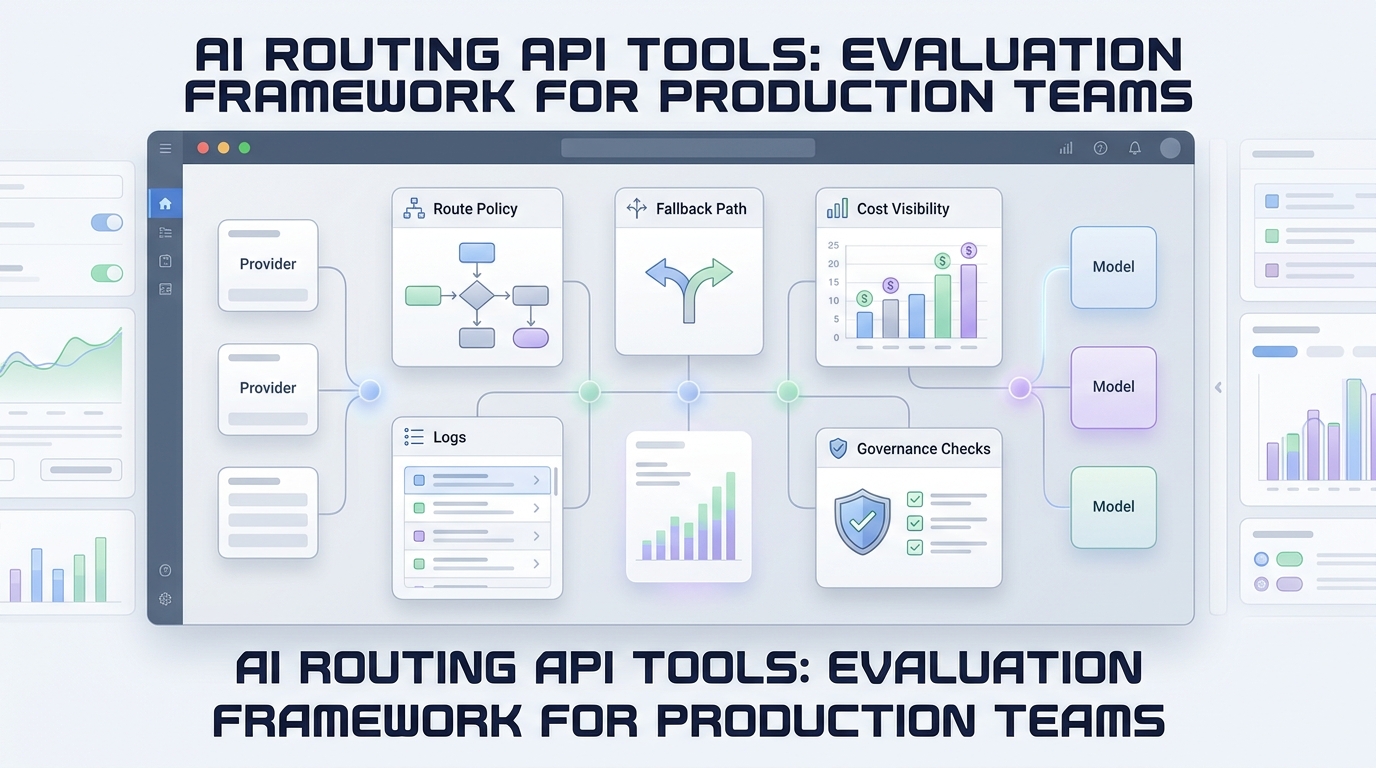
AI Routing API Tools: Evaluation Framework for Production Teams
If you are comparing AI routing API tools, the question is not which product has the longest model list. The real question is whether the route layer is safe enough to put production traffic through it.
That means you need to evaluate compatibility, routing policy, fallback behavior, spend visibility, logs, and governance together. A tool that looks good in a demo can still fail once a team needs one key, one bill, and one reviewable path for model changes.
What buyers are actually evaluating
Most teams are not buying a router for the abstraction alone. They are buying a control surface for model access, request handling, and operational visibility.
Current Flatkey pages say the product routes requests to official GPT, Claude, Gemini, DeepSeek, Qwen, and GLM APIs, with 100+ frontier models and 1,000+ AI tools behind one key. The same site positions Flatkey around one key, more models, more tools, lower costs, and an OpenAI-compatible gateway surface.
That is the right framing for this article. A useful evaluation should answer:
- Can the gateway reach the models and tools the workflow needs?
- Can existing SDKs keep working with minimal change?
- Can routing policy be explained and audited?
- Can cost and quota be enforced before spend drifts?
- Can engineers debug the route after an incident?
- Can security and finance own the access path without key sprawl?
The evaluation framework
Use the same scorecard for every AI routing API tools rollout.
| Dimension | What to test | Pass looks like |
|---|---|---|
| Compatibility | SDK shape, auth, endpoint format, tool schema | The app calls the gateway without adapter churn |
| Task success | Real prompts against real workflows | The model result is correct enough to ship |
| Routing policy | Model choice, fallback, priority, health checks | The route can be explained and changed deliberately |
| Reliability | Retries, timeouts, circuit behavior, failure handling | Failures degrade predictably |
| Cost | Token usage, tool charges, fallback costs, limits | Spend can be estimated before launch |
| Observability | Route, model, latency, usage, errors, owner | You can answer who called what and why |
| Governance | Keys, permissions, approval flow, revocation | Dangerous actions stay controlled |
1. Compatibility
The first test is not whether a gateway supports a model family in theory. It is whether your client can talk to it without a rewrite.
- Does the gateway accept your current SDK or HTTP client?
- Can you swap only the base URL or API key when needed?
- Do tool definitions survive validation and return the fields your code expects?
- Can the app handle structured results, streaming, and error states cleanly?
- If the route supports multiple endpoint styles, is the one you need actually documented and testable?
Flatkey’s homepage and product pages still emphasize one-key access, OpenAI-compatible routing, and broad model coverage. That makes compatibility the right first filter for AI routing API tools evaluation: if the client contract breaks, the rest of the framework does not matter.
2. Task success
A route can be compatible and still be wrong for the job.
Test real tasks, not vanity prompts. A good evaluation set usually includes clean inputs, missing fields, ambiguous requests, long-context requests, cases that trigger more than one tool, and edge cases that force fallback.
Score the result on workflow outcome, not on how fluent the text sounds.
3. Routing policy
Routing is where the gateway becomes a control layer instead of a proxy.
| Decision | Required answer |
|---|---|
| Primary model | Which exact model is approved? |
| Fallback | What happens if the primary route fails? |
| Protocol | Does the client expect OpenAI-style or provider-native behavior? |
| Region | Which provider rules apply to the route? |
| Failure handling | Retry, fail closed, or switch models? |
| Change ownership | Who may alter the route? |
4. Reliability
Every route creates a second failure surface: the tool or model path itself.
| Failure mode | What to verify |
|---|---|
| Missing parameter | The app gets a sane refusal or clarification |
| Slow tool | Timeout and retry budgets hold |
| Tool error | The workflow does not loop forever |
| Parallel call | Multiple route calls do not corrupt state |
| Hidden fallback | Results stay comparable when fallback is disabled |
| Injection risk | Untrusted tool output does not override policy |
5. Cost
A route that works but loses cost context is still a problem.
AI traffic has variable units: input tokens, output tokens, cache writes, cache reads, image requests, video requests, and tool calls. The right metric is often cost per accepted task, not cost per raw request.
6. Observability
You cannot operate what you cannot see.
At minimum, log request ID, model, tool name, route decision, latency, retry count, success or failure state, workspace or team key, and cost or usage units.
7. Governance
Separate read routes from write routes. Put approval around anything that creates, deletes, pays, ships, or sends.
A simple scorecard
| Test | Score |
|---|---|
| Correct route selected | 0-2 |
| Required arguments present | 0-2 |
| Output accepted by downstream system | 0-2 |
| Recovery after tool error | 0-2 |
| Parallel tool behavior | 0-2 |
| Cost stays inside budget | 0-2 |
| Logs are reviewable | 0-2 |
Where Flatkey fits
Flatkey is the useful comparison surface when AI routing API tools are part of a broader stack.
If you are still deciding whether the route itself is the problem, start with the AI API gateway requirements. If the real issue is keeping one control plane across providers, review the AI API gateway architecture and pricing next. For teams already feeling billing and usage drift, the AI gateway for teams guide is the next adjacent read.
The decision rule
Use AI routing API tools when the workflow is explicit enough to govern, visible enough to operate, and cheap enough to retry.