A successful Gemini API demo proves that a model can answer one request. It does not prove that your application can protect credentials, preserve response contracts, survive rate limits, control cost, handle model changes, or recover from an incident.
This Gemini API production checklist turns a prototype into an operable production dependency. It is designed for backend teams supporting web apps, mobile backends, SaaS products, internal tools, and customer-facing workflows—not only autonomous AI agents.
Time-sensitive authentication note: Google’s current Gemini API key documentation says the service is moving to Google Cloud API keys. The transition begins on August 31, 2026, and Google expects full enforcement on September 23, 2026. Teams shipping before or across those dates should verify key ownership, project association, restrictions, and rotation in the target environment rather than assuming a prototype key will remain valid.
The Short Version: 18 Checks Before Launch
Use this list as a release gate. The detailed sections below explain how to implement each item.
Access and security
- Production calls originate from a trusted backend, not a browser or mobile binary.
- The API key belongs to a named Google Cloud project and workload owner.
- Key restrictions, rotation, revocation, and emergency replacement are documented.
- Staging and production use separate credentials, quotas, and monitoring.
Model and response contract
- The application pins an intentional model identifier rather than silently following an alias.
- Required modalities, regions, context size, tools, and output features are tested.
- Structured outputs use a schema and validation layer.
- Provider-specific request and response fields are isolated behind an adapter.
Reliability and operations
- Every call has a connection timeout, response deadline, and total retry budget.
- Retries are limited to transient failures and use exponential backoff with jitter.
- Concurrency is load-tested against the project’s current rate limits.
- Logs capture model, latency, tokens, status, retry count, and a correlation ID.
- Dashboards separate provider errors, application validation errors, and user cancellations.
Quality, cost, and rollout
- A representative evaluation set has release thresholds.
- Safety and refusal behavior are tested with real product scenarios.
- Token and request budgets are enforced per user, tenant, or workflow.
- The release uses staging, canary traffic, a kill switch, and a tested rollback.
- A fallback path exists for critical workloads.
1. Choose the Integration Surface Deliberately
Before writing production code, decide which Google surface the application is actually integrating with. The Gemini Developer API is optimized for direct Gemini development, while Vertex AI adds Google Cloud controls that may matter for enterprise deployment, such as broader identity, governance, and platform integration.
Do not let an SDK import make this architecture decision accidentally. Write down:
| Decision | Production question |
|---|---|
| API surface | Gemini Developer API or Vertex AI? |
| Owning project | Which team owns credentials, quota, billing, and incidents? |
| Deployment environments | Are development, staging, and production isolated? |
| Data boundary | What content can be sent to the provider? |
| Feature dependency | Do you require structured output, function calling, files, caching, streaming, or multimodal input? |
| Portability | Must the workload move to another model or provider? |
For many products, the best first design is a small provider adapter owned by the backend. It should accept an application-level request and return an application-level result. Authentication, model names, provider errors, token metadata, and SDK objects stay inside the adapter.
That boundary prevents Gemini-specific fields from spreading through business logic. It also makes controlled multi-model testing possible later. If portability is already a requirement, review an OpenAI-compatible API gateway migration checklist before the integration becomes difficult to unwind.
2. Move Credentials Out of Client Code
Never ship a Gemini API key in frontend JavaScript, a desktop bundle, a browser extension, or a mobile application. Obfuscation is not a security boundary. A determined user can inspect network traffic, binaries, storage, or runtime memory and recover the key.
Use this request path instead:
User device → Your authenticated backend → Gemini API
The backend should enforce:
- User authentication: identify who initiated the request.
- Authorization: verify that the user or tenant can run this workflow.
- Input limits: cap payload size, file type, media duration, and prompt length.
- Usage limits: enforce per-user and per-tenant budgets before calling the model.
- Audit context: attach an internal correlation ID without logging sensitive content by default.
Store keys in a secret manager or deployment secret store. Document the owner, project, environment, creation date, restrictions, rotation interval, and revocation procedure. Keep a tested emergency key replacement path that does not require a full application release.
Because Google has announced the 2026 move to Google Cloud API keys, production teams should treat key migration as an active release dependency, not a future housekeeping task. Verify the current requirements in Google’s Gemini API key documentation before launch.
For a broader cross-provider policy, use this secure API key management guide.
3. Pin the Model and Record Its Contract
Model identifiers are part of your production API contract. A model change can alter latency, token usage, safety behavior, supported features, and the shape or quality of outputs even when your application code does not change.
Create a model manifest in configuration rather than scattering names through the codebase:
workload: support_reply_draft
provider: google
model: configured-stable-model-id
required_capabilities:
  - text_input
  - structured_output
  - streaming
max_output_tokens: 900
timeout_ms: 20000
fallback_workload: support_reply_draft_backup
evaluation_suite: support-replies-v4
The exact model ID must come from the current Gemini models documentation. Prefer a stable model for production unless a preview-only capability is worth the additional change risk. If you use a preview model, add an explicit review date and replacement owner.
Test the capabilities your application actually needs. A general “hello world” call does not verify:
- image, audio, video, or document input;
- streaming behavior;
- tool or function calling;
- structured output constraints;
- context limits and token counting;
- safety behavior;
- file lifecycle;
- caching behavior;
- latency under realistic concurrency.
Record the SDK version, API surface, model ID, request configuration, and evaluation dataset for every release. That gives you a reproducible baseline when results change.
4. Treat Model Output as Untrusted Input
Natural-language output is probabilistic. Even a strong model can omit fields, produce an unexpected enum, include extra commentary, or return a syntactically valid object that violates business rules.
For machine-consumed output, use Gemini’s structured output capabilities and validate the result again in your application.
Use four layers:
- Response schema: constrain the expected object shape.
- Parser validation: reject malformed JSON and incorrect types.
- Business validation: enforce allowed states, ranges, ownership, and database rules.
- Repair policy: decide whether to retry, ask the model to repair, use a fallback, or send the case to a human.
For example, a model-generated refund recommendation might be valid JSON but still exceed the user’s authorization, reference an unavailable product, or violate a refund window. Schema validation cannot replace application authorization.
Version schemas just like API contracts. Add fixtures for valid outputs, missing fields, unknown enum values, nulls, oversized strings, duplicated actions, and adversarial content. Do not silently coerce an invalid response into a valid business action.
5. Put a Policy Boundary Around Function Calling
Function calling helps the model propose tool invocations, but the model should not own authorization or execution policy. Google’s function calling documentation describes the model-to-tool pattern; your application remains responsible for deciding whether a proposed call is allowed.
For every callable function:
- use a narrow name and schema;
- allow only necessary fields;
- validate every argument server-side;
- re-check the user’s authorization at execution time;
- set execution timeouts and result-size limits;
- make side effects idempotent where possible;
- require confirmation for high-impact actions;
- log the decision and result without exposing secrets.
Split read-only tools from write tools. A product search and a payment capture should not share the same approval policy. For destructive or financially meaningful actions, present the proposed operation to the user or an authorized reviewer before execution.
Also defend against prompt injection in retrieved pages, documents, emails, and tool results. Treat external content as data, not trusted instructions. The tool policy belongs in code outside the model prompt.
6. Define Safety and Product Behavior Together
Provider safety controls and product policy solve different problems. Gemini safety settings can help classify or block certain harmful content, but your product still needs rules for age restrictions, regulated workflows, brand risk, abuse, sensitive data, and escalation.
Build a safety test matrix that covers:
| Scenario | Expected behavior |
|---|---|
| Clearly allowed request | Useful answer without unnecessary refusal |
| Disallowed request | Refuse or block with an appropriate user message |
| Ambiguous high-risk request | Ask for clarification or escalate |
| Sensitive personal data | Minimize, redact, or reject according to policy |
| Prompt injection | Ignore untrusted instructions and preserve tool restrictions |
| Repeated abuse | Rate-limit, suspend, or route to review |
Review Google’s current Gemini safety settings, then define your own application-level behavior. Store policy versions with evaluation results so a change to a threshold or user message can be audited.
Safety testing must include false positives. A system that blocks too much can be as unusable as one that blocks too little.
7. Budget Context, Files, and Cache Lifecycle
Large prompts and multimodal inputs create more than a cost problem. They affect latency, rate-limit consumption, timeout behavior, storage, privacy, and debugging.
Set explicit limits for:
- prompt and conversation length;
- file size and accepted media types;
- audio or video duration;
- image count and resolution;
- retrieved document count;
- maximum output tokens;
- cached-context lifetime;
- user and tenant consumption.
Use token counting during development and before expensive calls where practical. Google documents token behavior in its token guide. If repeated long context dominates a workload, evaluate context caching, but treat cached content as a managed data asset with ownership, expiration, invalidation, and deletion rules.
Do not assume every file should be sent in full. Extract relevant pages, compress images appropriately, remove unsupported metadata, and reject files that exceed product limits. Track the original asset, transformed asset, upload state, retention policy, and deletion outcome.
8. Engineer Retries Around a Total Time Budget
Retries can improve reliability or amplify an outage. The difference is whether they are bounded, selective, and observable.
Classify failures before retrying:
| Failure | Default action |
|---|---|
| Invalid key or permission | Do not retry; alert and use the credential runbook |
| Invalid request or schema | Do not retry unchanged; fix the request |
| Safety block | Follow product policy; do not blindly retry |
| Rate limit | Back off with jitter; respect current quota guidance |
| Server error | Retry within a small attempt and time budget |
| Network timeout | Retry only if the operation is safe and budget remains |
| Client cancellation | Stop work and release resources |
Every request needs three limits:
- Connection timeout for establishing the request.
- Attempt deadline for one provider call.
- Total workflow deadline across retries and fallbacks.
Use exponential backoff with random jitter. Cap attempts. Respect cancellation. Prevent retry storms with concurrency limits and a circuit breaker. For user-facing interactions, prefer a fast fallback or degraded response over an invisible minute-long retry loop.
Gemini limits vary by model, tier, and project, so retrieve the current values from Google’s Gemini API rate limits rather than copying a number into permanent documentation.
9. Make Usage, Quality, and Failure Observable
A production dashboard should answer three questions quickly:
- Is the provider healthy?
- Is the application integration healthy?
- Are users receiving acceptable results at an acceptable cost?
Record structured metadata for each call:
- timestamp and environment;
- application workload and version;
- configured model ID;
- internal correlation ID;
- latency and time to first token;
- input and output token usage when available;
- status category and normalized error code;
- retry and fallback counts;
- schema-validation outcome;
- safety or refusal outcome;
- user, tenant, or feature bucket using privacy-safe identifiers;
- estimated or reconciled cost.
Avoid logging complete prompts and responses by default. Content logs can create security, privacy, compliance, and retention risk. Prefer metadata, hashes, redacted samples, and explicitly governed debugging captures.
Create alerts for authentication failures, elevated rate limits, provider errors, latency, schema failures, fallback activation, cost spikes, and safety drift. Include the model and application release in every dashboard so changes can be correlated.
10. Measure Cost Per Successful Product Outcome
Token price alone does not tell you whether an integration is efficient. A cheaper request can cost more per successful task if it requires longer prompts, more retries, more repair calls, or more human review.
Track:
cost per successful task =
  model requests
  + retries
  + repair calls
  + fallback calls
  + retrieval and storage
  + human review
Set budget controls at several levels:
- maximum tokens per request;
- maximum requests per workflow;
- per-user and per-tenant quotas;
- daily anomaly alerts;
- feature-level cost ceilings;
- an emergency disable switch.
Review current model access and pricing before selecting a production default, then compare models with one representative evaluation set rather than choosing from a price table alone.
11. Build an Evaluation Gate Before Model Changes
Create a versioned dataset from real product scenarios, sanitized production examples, edge cases, and known failures. Score the properties that matter to the workflow:
- task completion;
- factual consistency;
- schema validity;
- safety and refusal quality;
- latency;
- token usage;
- cost per successful task;
- human preference where appropriate.
Define thresholds before running a candidate. Keep a set of “must not regress” cases for critical behavior. When a model, prompt, schema, SDK, safety setting, or retrieval strategy changes, rerun the same suite.
For cross-provider evaluations, use a repeatable multi-model prompt testing workflow so each candidate receives equivalent inputs, limits, and scoring.
12. Release With a Canary and a Rollback
Do not switch all traffic immediately because a staging test passed.
Use this rollout sequence:
- Offline evaluation: pass quality, safety, schema, latency, and cost thresholds.
- Staging: verify credentials, quotas, files, callbacks, streaming, and dashboards.
- Shadow traffic: compare outputs without affecting users where policy allows.
- Internal canary: expose the release to employees or test tenants.
- Small production canary: route a controlled percentage of eligible traffic.
- Progressive ramp: increase traffic only while metrics remain healthy.
- Full release: preserve the ability to revert configuration immediately.
The rollback should be a configuration change, not a code deployment. Keep the previous model, prompt, schema, and routing policy available until the observation window closes.
Critical workflows need a fallback hierarchy. Depending on the product, that may be:
primary Gemini model
→ alternate Gemini model
→ compatible provider or gateway route
→ deterministic degraded experience
→ human queue
Fallbacks must be tested, not merely configured. Verify that response schemas, safety behavior, tool availability, and cost controls still hold.
13. Prepare a Gemini Incident Runbook
Write the runbook before the first incident. Include:
- credential owner and rotation steps;
- provider status and escalation links;
- model and configuration history;
- dashboards and alert definitions;
- known error mappings;
- circuit-breaker and kill-switch controls;
- fallback activation procedure;
- user communication owner;
- data exposure assessment steps;
- rollback validation;
- post-incident evaluation updates.
Run a game day for at least four scenarios: revoked credentials, sustained rate limits, elevated latency, and invalid structured output. Confirm that the on-call engineer can identify the fault domain and stabilize the product without editing prompts in production.
Production Readiness Worksheet
Copy this table into the launch ticket and assign an owner to every row.
| Area | Owner | Evidence | Status |
|---|---|---|---|
| API surface and project ownership | Architecture decision record | ||
| Key migration and rotation | Secret inventory and runbook | ||
| Model and SDK pinning | Release manifest | ||
| Structured output validation | Schema tests | ||
| Tool authorization | Policy tests | ||
| Safety behavior | Evaluation report | ||
| Context and file limits | Load and boundary tests | ||
| Rate-limit and retry behavior | Failure-injection results | ||
| Observability | Dashboard and alerts | ||
| Cost controls | Budget rules and anomaly alerts | ||
| Canary and rollback | Deployment checklist | ||
| Incident response | Game-day evidence |
Common Questions
Can a production app call the Gemini API directly from the browser?
No. Put the provider call behind your authenticated backend so the API key remains secret and you can enforce authorization, quotas, validation, logging, and abuse controls.
Should I use a Gemini “latest” alias in production?
Prefer an intentional, documented model identifier and a controlled upgrade process. An alias can be useful for experimentation, but production workloads need reproducible evaluations and a rollback target.
Are structured outputs guaranteed to satisfy my business rules?
No. Structured output helps constrain syntax and shape. Your application must still validate permissions, ranges, ownership, state transitions, and every side effect.
Which Gemini API errors should I retry?
Retry transient network failures, rate limits, and selected server failures within a strict total time and attempt budget. Do not retry authentication, permission, or invalid-request errors unchanged.
When should I add a multi-model gateway?
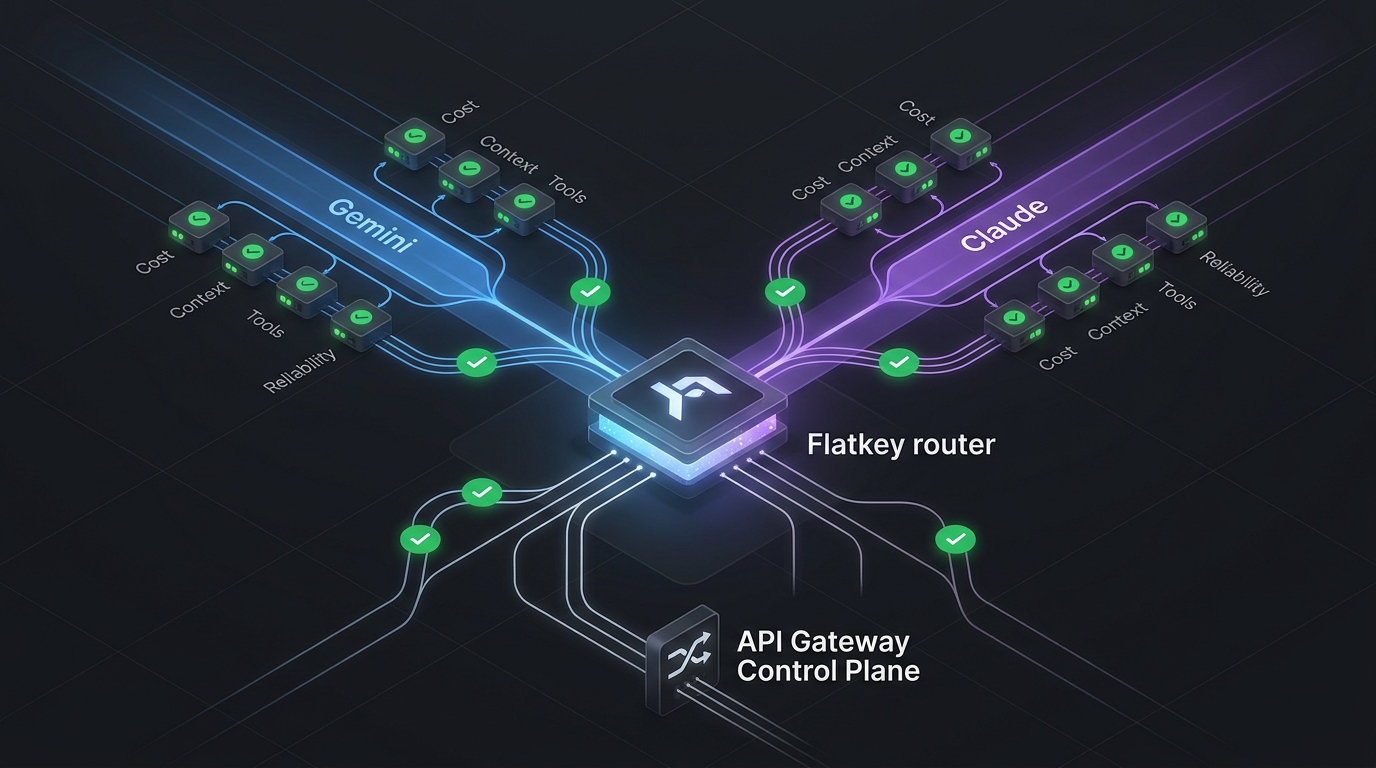
Add a gateway when separate provider credentials, quotas, logs, billing, evaluations, and fallback paths are slowing delivery. Keep a direct integration when provider-native features are strategically important and your team can operate the additional complexity.
Ship the Integration You Can Operate
The safest Gemini API launch is not the one with the most elaborate prompt. It is the one with explicit ownership, protected credentials, a pinned model contract, validated outputs, bounded failure behavior, measurable quality, cost controls, and a tested rollback.
Start by moving calls behind the backend and completing the production readiness worksheet. Then run the same evaluation set against your chosen Gemini model and at least one fallback. If multi-provider operations become the bottleneck, use the Flatkey integration starter to test compatible workloads through one key and one OpenAI-compatible base URL.