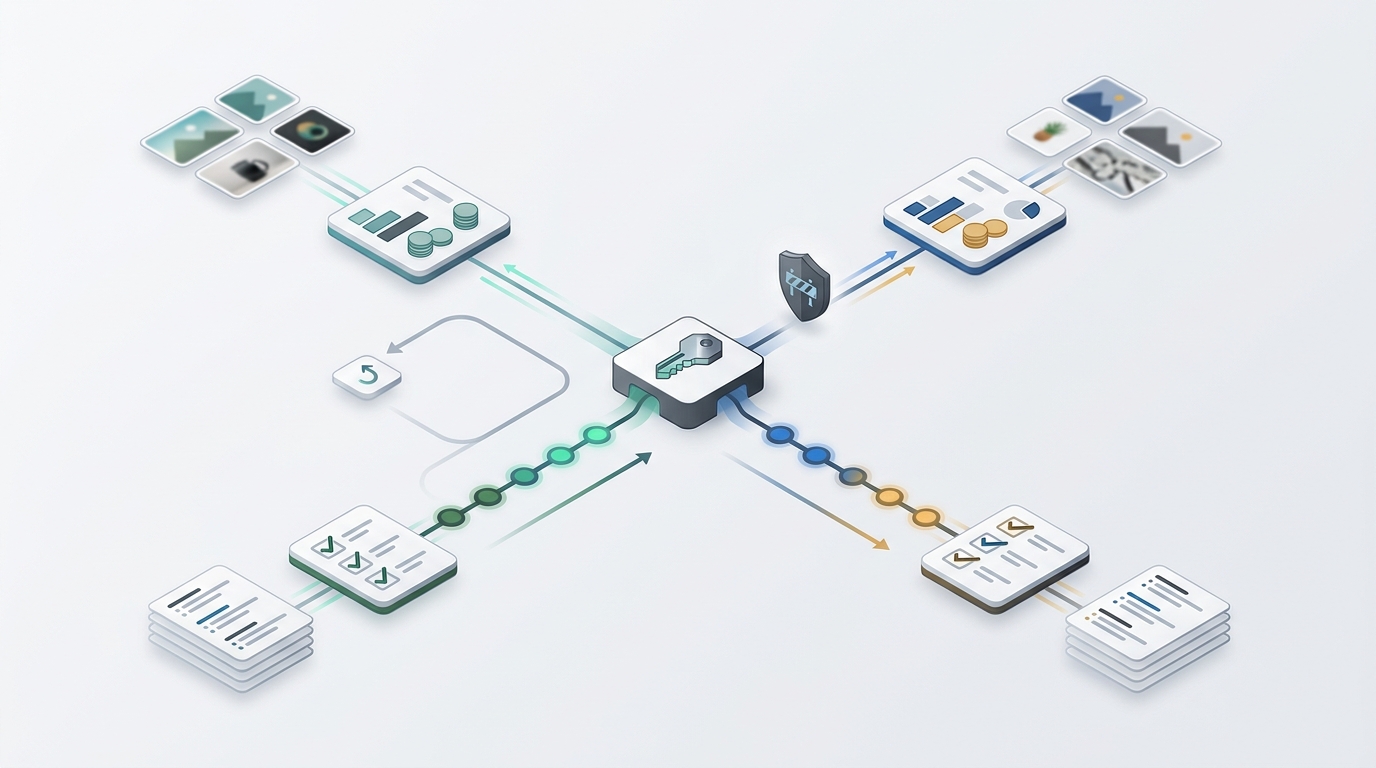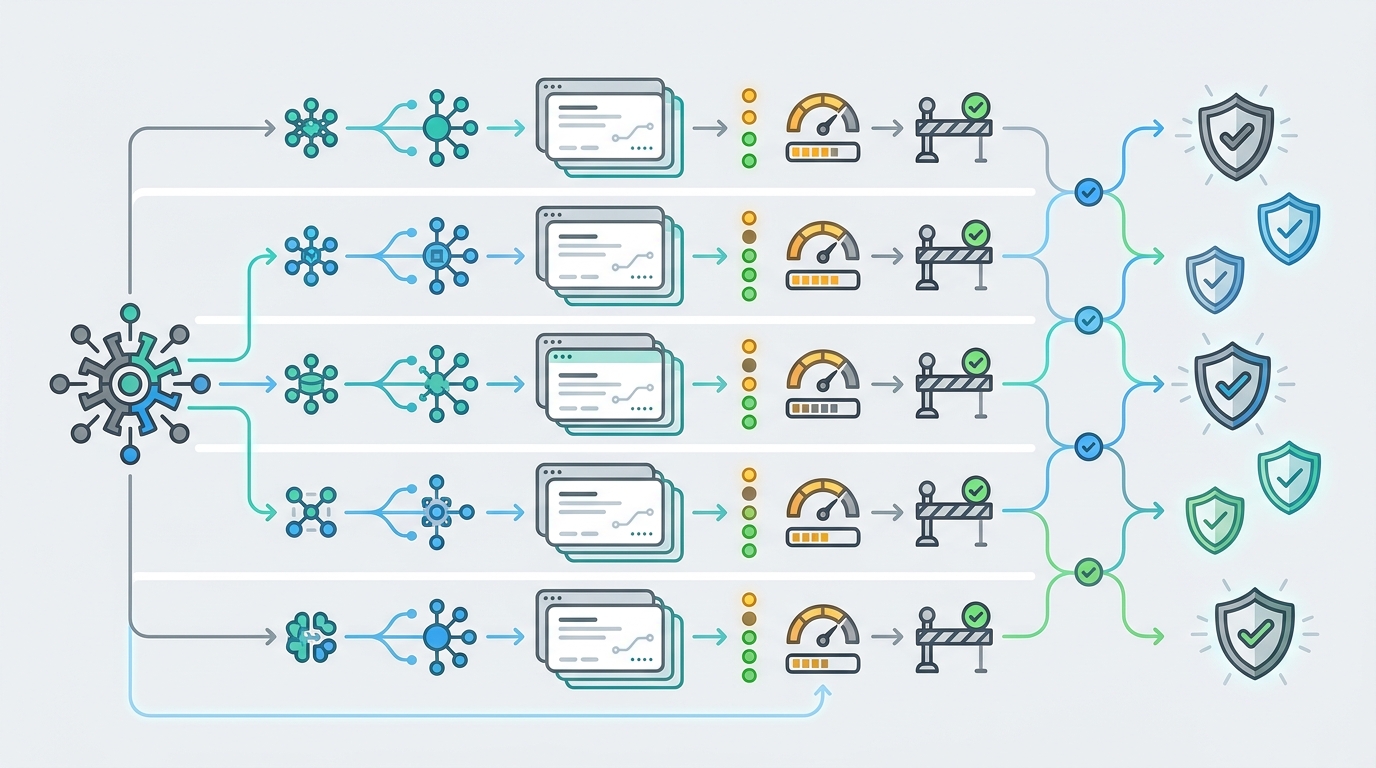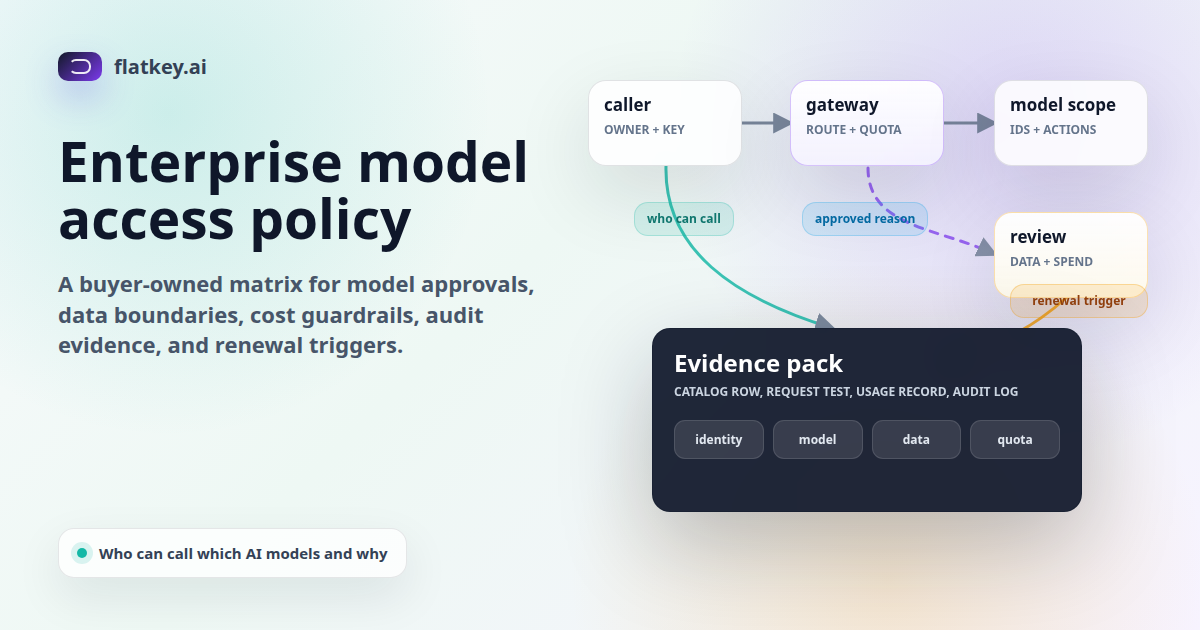
An enterprise model access policy answers one operational question before it becomes an incident: who is allowed to call which AI models, through which key or workload identity, for which business reason, with what evidence trail?
That policy matters more as teams move from one provider account to a shared model gateway. Flatkey can centralize model access, routing, billing, usage analytics, and operational controls behind one API gateway, but the enterprise still owns the approval logic. The gateway should make the policy enforceable and reviewable; it should not replace the policy.
This guide was prepared on June 25, 2026 from Flatkey public homepage and pricing snapshots, the Flatkey pricing API snapshot, OpenAI platform permission and workload identity docs, Anthropic Admin API docs, and Google Cloud Model Garden access-control docs. Treat the product and catalog details as dated public evidence. Before production use, verify the current Flatkey console, selected model rows, account permissions, data terms, route status, and smoke-test logs.
Quick Answer: Enterprise Model Access Policy
An enterprise model access policy should be a living approval matrix, not a static trust-page paragraph. Each row should name the caller, environment, credential, model or model group, allowed action, data class, cost guardrail, routing rule, evidence owner, and renewal trigger.
| Policy Field | Decision To Record | Evidence To Keep |
|---|---|---|
| Caller | Human user, app service, agent, batch job, vendor integration, or CI workload. | Owner, team, ticket, service account, key name, and workload identity mapping. |
| Model scope | Approved model IDs, provider families, endpoint types, and fallback models. | Catalog row, provider doc, route test, pricing snapshot, and fallback decision. |
| Allowed action | Chat, responses, embeddings, images, video, tool calls, batch, tuning, or deployment. | Feature smoke test, unsupported-feature result, and reviewer signoff. |
| Data boundary | Public, internal, customer, regulated, confidential, or prohibited data classes. | DPA, retention setting, logging scope, redaction rule, and security review note. |
| Spend and quota | Budget owner, per-key quota, alert threshold, rate limit, and cutoff behavior. | Usage report, billing row, quota screenshot/export, and renewal review. |
| Renewal trigger | Model version change, provider policy change, new modality, incident, or spend spike. | Change log, incident review, model-retirement notice, and approval update. |
Why Model Access Policy Breaks Down
Most AI access rules start as informal Slack approvals: "use the fast model for staging," "do not send customer data to the image route," or "finance needs a cheaper fallback." Those instructions are hard to audit because they skip three things: a named caller, an approved model surface, and a reason that can survive renewal.
Official provider controls show why the policy needs structure. OpenAI documents permissions for model requests, project API keys, project administration, service accounts, and usage export. OpenAI workload identity mappings can narrow which external identities mint access tokens for a service account. Anthropic's Admin API covers organization members, workspace members, API keys, usage and cost reports, rate limits, and compliance data. Google Cloud Model Garden can allow or deny specific models and actions through organization policy, where explicit deny values take precedence during policy evaluation.
Those provider-side controls are useful, but they are not a cross-provider enterprise model access policy by themselves. A platform team still has to decide how those controls map to internal applications, environments, model groups, data categories, cost owners, and exception reviews.
Who Can Call Which AI Models And Why
Start with callers, not models. A model list without caller context tells security very little. A caller list without model context tells finance very little. A good enterprise model access policy ties them together.
| Caller Type | Default Access | Reason To Approve | Reason To Deny Or Limit |
|---|---|---|---|
| Production application service | Dedicated key or workload identity, approved chat/response models, production quota. | Customer-facing feature requires stable latency, logged usage, and rollback. | Unknown data retention, untested tool behavior, or no owner for spend review. |
| Internal automation or agent | Service account, narrow model set, no broad admin credential, lower quota. | Repeatable workflow with clear owner, prompts, logs, and failure handling. | Can act on sensitive systems without approval or lacks audit metadata. |
| Developer sandbox | Non-production key, low quota, limited data classes, short rotation window. | Experimentation needs fast feedback without touching production data. | Shared key, personal account, copied production prompt, or missing deletion path. |
| Design or media workflow | Image or video routes only when output rights, content policy, and budget are approved. | Approved campaign or prototype with media-specific review and usage cap. | No legal review for training/input rights, watermark policy, or spend exposure. |
| Finance, security, and procurement reviewers | Read-only usage, invoice, audit, and catalog evidence where available. | They need traceability without production request privileges. | Reviewer access should not become a hidden route for model calls. |
Build The Policy Around Evidence, Not Promises
The scarcity in most enterprise AI trust reviews is not another vendor claim. It is a buyer-owned evidence file that proves each approval is current. An enterprise model access policy should tell reviewers exactly what artifact closes each control.
1. Model Catalog Evidence
On June 25, 2026, the Flatkey pricing API returned 631 model rows across 23 vendors, with endpoint families for OpenAI-style chat completions, OpenAI-style responses, image generation, video generation, Gemini, and Anthropic-style messages. The same snapshot returned availability labels including available, official_unsupported, and unknown_failure.
Use that kind of catalog data as a starting inventory, not as final production authorization. The policy row should still require a current catalog check, a selected model ID, a route smoke test, and the account-specific permission state before production traffic moves.
2. Permission Evidence
Record who can manage keys separately from who can make model requests. OpenAI's permission table distinguishes model request capability from project API-key management, project administration, service accounts, and usage export. Anthropic's Admin API similarly separates organization membership, workspace membership, API keys, usage/cost reporting, rate limits, and compliance/audit surfaces.
In practice, that means a developer may be allowed to call approved staging models without being allowed to create production keys. A finance operator may be allowed to inspect usage and billing evidence without being able to run prompts. A CI workload may be allowed to mint short-lived credentials for one service account but not inherit every human admin permission.
3. Data Boundary Evidence
Every policy row should specify what data can enter the route. Do not describe this only as "safe" or "approved." Use operational labels: public docs, internal docs, customer support text, customer PII, regulated records, secrets, source code, images, audio, video, or prohibited data.
Then attach proof: retention setting, logging setting, DPA or contractual scope, redaction rule, prompt storage decision, and an example request that uses synthetic or approved test data. If the evidence file is missing, the policy should default to no production approval.
4. Cost And Quota Evidence
A model that is safe for a five-request test can still be unsafe for a high-volume job. The enterprise model access policy should record a budget owner, quota limit, alert threshold, usage review cadence, and cutoff rule for every production key or service account.
Flatkey's public positioning around unified billing and usage analytics is useful here because the policy can point reviewers to one gateway evidence trail. Still, the buyer should verify that usage appears under the expected key, model, endpoint, team, and billing owner before increasing quotas.
Flatkey Policy Matrix Template
Use this template as the first approval worksheet. It is intentionally concrete. If a row cannot be completed, it is not ready for production.
| Column | Example Entry | Renewal Trigger |
|---|---|---|
| App or workflow | Support reply summarizer, production API. | New product surface or new customer data class. |
| Owner | Support platform team, named engineering owner, named finance owner. | Team ownership change or rotation miss. |
| Credential | Flatkey production key or workload identity mapped to one app. | Key rotation, leaked secret, or identity-provider change. |
| Approved model scope | Two chat models, one lower-cost fallback, no image or video route. | New model ID, provider deprecation, fallback failure, or quality regression. |
| Allowed actions | Non-streaming chat and streaming chat; no tools until tool-call test passes. | New tool schema, batch job, tuning request, or modality expansion. |
| Data classes | Customer support text after redaction; no secrets, payment data, or regulated records. | New input source, logging change, retention change, or legal update. |
| Quota and spend | Daily cap, monthly owner, alert at 50/80/100 percent, cutoff owner. | Spend spike, launch, model price change, or budget owner change. |
| Evidence pack | Catalog row, route test, usage row, billing row, audit log, rollback test. | Quarterly review, incident, provider change, or renewal review. |
Access Rules For A One-Key Gateway
A one-key gateway can simplify developer onboarding, but it also concentrates policy responsibility. For Flatkey, the buyer should create an enterprise model access policy that treats the gateway key as a controlled production credential, not a shared convenience token.
- Separate environments. Development, staging, and production should not share the same key, quota, or model approval row.
- Separate owners. The person who requests model access should not be the only person who approves data scope, budget, and renewal.
- Separate modalities. Text, embeddings, image generation, video generation, and tool calls deserve separate approvals because they carry different data, cost, and output risks.
- Separate experiments from launch paths. A model can be approved for benchmarking without being approved for customer traffic.
- Separate fallback from escalation. A fallback model should have its own data, cost, and quality approval instead of silently inheriting the primary model's row.
Approval Workflow
The workflow should be short enough for product teams to use and strict enough for procurement to trust.
- Request. The app owner proposes the model, endpoint type, data class, environment, quota, and business reason.
- Screen. Platform confirms that the model appears in the current catalog and that the route, key, group, and account permission can be tested.
- Test. Engineering runs synthetic-data smoke tests for the allowed action: chat, streaming, tools, embeddings, image, video, batch, or tuning.
- Evidence. Operations saves the request metadata, response shape, usage row, billing row, quota state, and rollback result.
- Approve. Security, finance, and the app owner sign the row with a renewal date and trigger list.
- Monitor. Usage, cost, errors, latency, and model changes are reviewed on a fixed cadence.
- Renew or revoke. The row is renewed only if the model, provider terms, data scope, cost profile, and owner still match the original reason.
What To Review Before Renewal
Renewal is where an enterprise model access policy either stays useful or becomes stale paperwork. Review these items before extending any production model grant:
| Review Area | Question | Revoke Or Rework If |
|---|---|---|
| Model identity | Is the same model ID, version, provider, and endpoint still approved? | The model was renamed, replaced, deprecated, or moved to a different route. |
| Data scope | Is the input data still limited to the approved class? | New customer, regulated, image, audio, code, or secret-bearing data appears. |
| Usage and cost | Do usage and billing rows match the expected key, team, endpoint, and budget? | Spend spikes, unowned calls, or missing usage records appear. |
| Feature behavior | Do streaming, tool calls, structured output, or media routes still behave as tested? | A provider or gateway behavior changes without a fresh smoke test. |
| Fallback | Does fallback still meet data, quality, cost, and compliance constraints? | The fallback model changed or started handling data it was not approved to process. |
Common Mistakes
Avoid these policy shortcuts:
- Approving a provider instead of a model. "Approved for OpenAI" or "approved for Claude" is too broad for enterprise review.
- Approving a model without an action. Chat, embeddings, image, video, tools, tuning, and batch do not carry the same risk.
- Letting fallbacks inherit approval. Fallbacks change data path, quality, cost, and incident behavior.
- Using one shared key. Shared keys erase attribution and make quota, billing, and incident review harder.
- Skipping renewal triggers. A policy without triggers will miss model retirement, provider term changes, and product expansions.
Bottom Line
An enterprise model access policy is the operating contract between product teams, platform engineering, security, finance, and procurement. It should say who can call which AI models and why, but it should also say what evidence proves the decision is still true.
Use the enterprise AI API gateway checklist to review broader gateway controls, the AI API audit logs guide to decide what evidence to retain, and the AI API vendor risk assessment to structure procurement review. When your policy matrix is ready, check the current Flatkey model pricing catalog and get a key.
FAQ
What is an enterprise model access policy?
An enterprise model access policy is a governed approval matrix that defines who may call each AI model or model group, through which credential, for which action, using which data classes, under which cost and audit controls.
How often should model access approvals be reviewed?
Review production approvals at least quarterly and whenever a model version, provider term, route status, data class, quota, owner, or fallback changes.
Should developers get broad access to every model behind a gateway?
No. Developer access should be scoped by environment, model group, data class, quota, and owner. Broad shared keys make attribution and incident review weaker.
Can a pricing catalog prove that a model is approved for production?
No. A catalog row can prove discoverability or current listing evidence, but production approval still needs current account permission, route status, data review, cost guardrails, and a smoke test.
How does Flatkey fit into model access governance?
Flatkey can provide one gateway surface for model access, routing, billing, usage analytics, and controls. The buyer should still maintain the policy matrix, evidence pack, renewal cadence, and exception process.