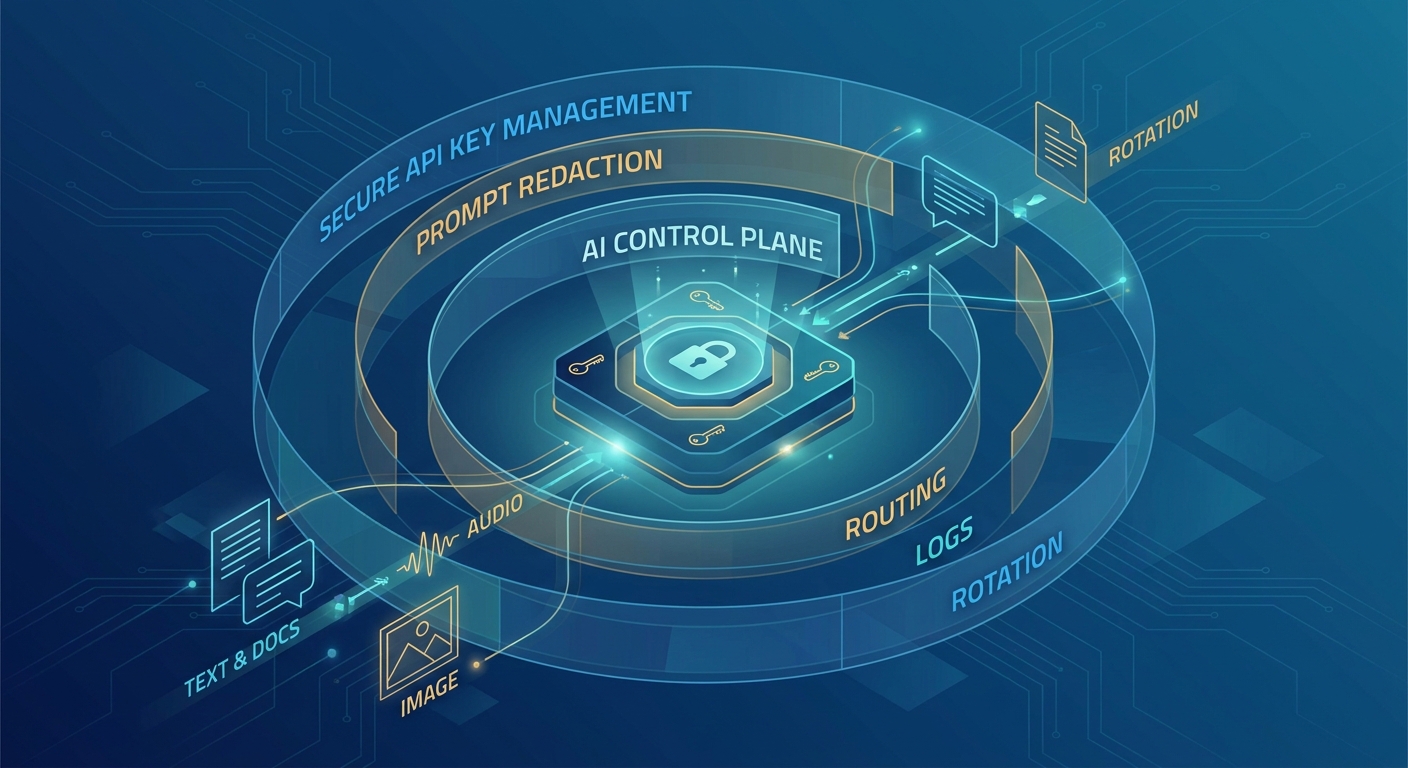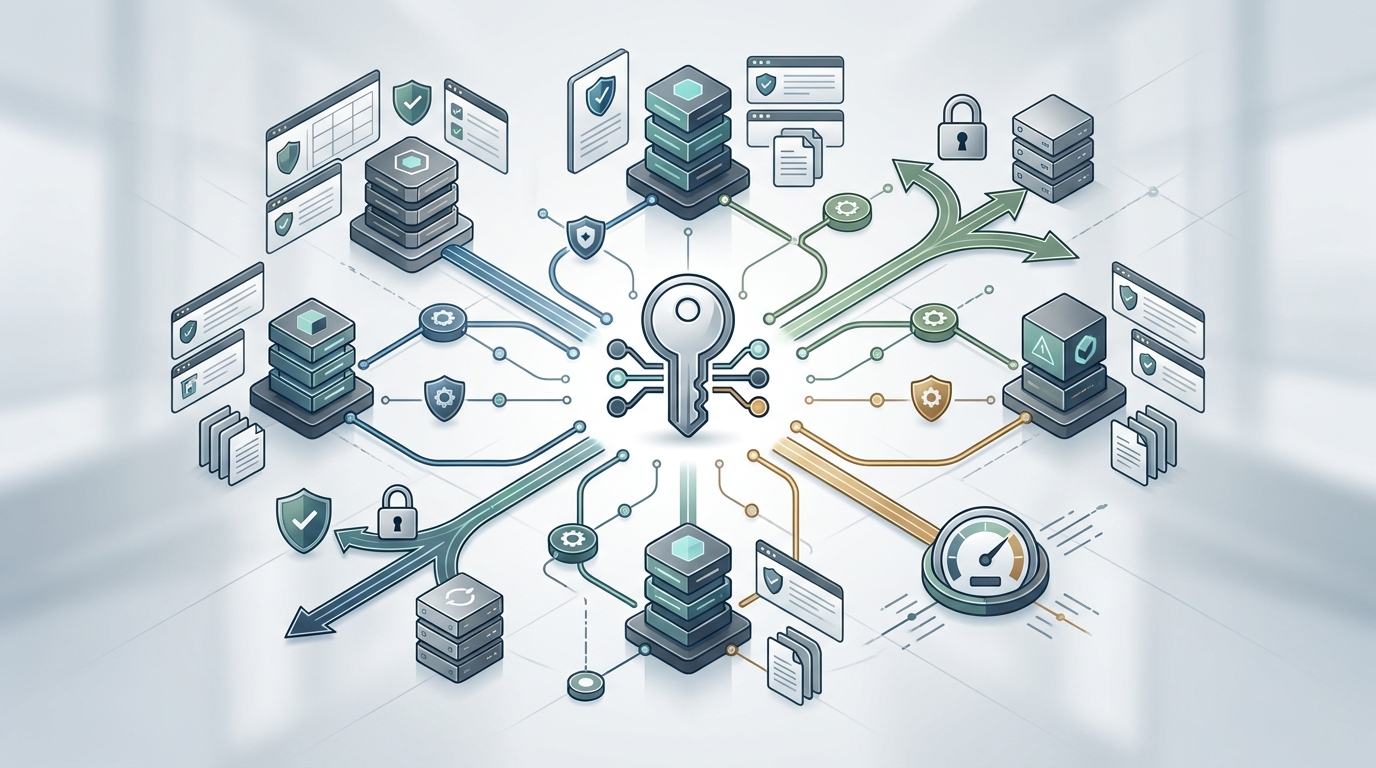
AI API vendor risk assessment gets complicated when the vendor is a multi-model gateway instead of a single model provider. The buyer is not only approving one API endpoint. The buyer is approving a request path that may include a gateway account, API keys, model routes, fallback behavior, usage logs, billing records, support workflows, and downstream model providers.
This guide is for procurement, security, platform, compliance, and vendor-risk teams reviewing an AI API gateway before production traffic. It is not legal, audit, or compliance advice. Use it as a practical question bank: what to ask, what evidence to request, what to test in staging, and what to keep in the procurement file.
Flatkey is relevant because flatkey.ai currently positions the product as one API gateway for production AI teams, with one key, model access, routing, billing, usage analytics, operational controls, and a console. A pricing API snapshot taken on June 19, 2026 returned 638 model rows, 23 listed vendors, and endpoint families including OpenAI-compatible, Anthropic, Gemini, image generation, Responses, and video. Flatkey's public footer also links to SOC 2 Type II and ISO 27001:2022 certificate lookup pages for VOC AI Inc. Treat those as dated public screening evidence, not a substitute for the private report, signed agreement, DPA, account configuration, route test, or support confirmation.
Quick Answer: What An AI API Vendor Risk Assessment Should Prove
An AI API vendor risk assessment should prove four things: where data flows, who can change that flow, what evidence exists when the flow changes, and which responsibilities remain with the buyer. A generic vendor questionnaire rarely goes deep enough for a gateway that can route across multiple providers.
| Risk Area | Question To Ask | Evidence To Request | Stop Condition |
|---|---|---|---|
| Provider exposure | Which downstream model providers, endpoint families, regions, and accounts can receive each approved workflow? | Route inventory, model catalog, provider policy, route-change record, and current availability status. | The vendor cannot show which provider may process prompts and outputs. |
| Data flow | What prompt, output, metadata, error, support, and billing data is processed or retained? | Privacy policy, DPA path, retention policy, payload logging mode, deletion/export process, and provider terms. | Payload handling or retention is unclear for the data class being routed. |
| Security controls | Does the control evidence cover the gateway service you will use? | SOC 2 Type II report, ISO 27001 scope, bridge letter if needed, exceptions, CUECs, and subservice treatment. | The report scope cannot be tied to the actual gateway, keys, logs, support, or routing workflow. |
| Auditability | Can the buyer reconstruct who sent traffic, which route handled it, what it cost, and what changed? | Sample log export, administrative event trail, key owner fields, route attempt fields, usage units, and billing records. | Logs only show success/failure without owner, route, model, provider, or cost context. |
| Continuity | What happens when a provider, model, account, region, or route fails? | Fallback policy, retry policy, provider-attempt metadata, incident runbook, rollback path, and customer notification process. | Fallback can silently move traffic to an unapproved provider or data boundary. |
| Billing controls | Can usage be attributed to the right team, key, workflow, model, and cost owner? | Usage dashboard, billing export, quota/budget controls, recharge records, pricing unit, and anomaly review process. | Procurement cannot connect a route decision to spend evidence. |
Start With A Request Path Map
The first mistake in AI API vendor risk assessment is treating the gateway as a black-box substitute for direct provider onboarding. A gateway reduces operational sprawl only if the buyer can describe the new request path with enough precision for security and procurement review.
For each production workflow, map these fields before scoring the vendor:
| Field | What To Capture | Why It Matters |
|---|---|---|
| Application and environment | App name, owner, staging/production boundary, data class, and business use case. | The same gateway can be low risk for public content generation and high risk for customer-support or regulated data. |
| Credential boundary | Key owner, rotation process, revocation path, service account, and who can create or view keys. | One shared key can hide accountability; separate keys make audit and incident containment easier. |
| Gateway route | Endpoint family, model row, provider, group/tier, fallback rule, and route owner. | Route selection decides who may see the request and which cost, availability, and provider terms apply. |
| Downstream provider | Provider name, provider account model, region or processing location if available, and data-use terms. | Gateway approval does not automatically approve every downstream provider. |
| Evidence surface | Logs, metadata, admin events, billing records, support tickets, and export paths. | Procurement approval should depend on evidence the buyer can inspect later. |
NIST's AI Risk Management Framework gives useful language for this kind of review because it separates governance, mapping, measurement, and management. In a gateway review, those ideas become concrete: who owns the route, what context is mapped, how risks are measured, and how changes are managed after approval.
Ask Provider Exposure Questions Before Data Questions
A multi-model gateway can make AI API operations simpler, but it also changes the vendor-risk conversation. The buyer has to know whether the gateway is merely passing traffic to a single approved provider, choosing among several providers, or applying fallback/load-balancing behavior that can change the downstream recipient.
Use these AI API vendor risk assessment questions for provider exposure:
| Question | Evidence | Reviewer Note |
|---|---|---|
| Which providers can receive this workflow today? | Current catalog row, endpoint family, provider, availability status, and route configuration. | Do not approve a category such as "all GPT models" without named rows and owners. |
| Who can add, remove, or reorder providers? | Admin permissions, route-change audit trail, approval workflow, and notification setting. | A provider change is a risk change, not just an engineering optimization. |
| Can the gateway fail over to a different provider automatically? | Fallback policy, attempt metadata, stop conditions, and rollback process. | Fallback should be pre-approved for each workflow and data class. |
| Are provider-specific terms different across fallback routes? | Provider data-use terms, retention statements, training terms, regional processing terms, and support path. | A fallback route can cross a data-use or retention boundary. |
| How are unsupported, unavailable, or failing models represented? | Availability status, incident message, current route test, and expected customer-facing behavior. | A catalog entry is not the same thing as a production-ready route. |
OWASP's GenAI supply-chain risk guidance is useful here because a model workflow often depends on components and services outside the buyer's direct codebase. For a gateway, the practical supply-chain file should include the gateway vendor, cloud and support systems, downstream model providers, logging and analytics systems, billing processors, and any service that can affect prompt, output, metadata, or key handling.
Turn Data Flow Into A Checklist
A strong AI API vendor risk assessment does not ask one broad question such as "is our data secure?" It breaks the data flow into separate records because each record can have a different risk and retention profile.
| Data Type | Questions For The Gateway Vendor | Buyer Evidence To Save |
|---|---|---|
| Prompts and inputs | Are prompts stored, inspected, redacted, encrypted, or passed to downstream providers? Can payload logging be disabled? | Logging setting, privacy policy, DPA or data-processing terms, and account-specific confirmation. |
| Outputs | Are outputs stored with prompts? Are outputs used for debugging, support, quality review, abuse review, or provider improvement? | Retention policy, support-data policy, and test log showing whether output payloads are saved. |
| Request metadata | Which metadata fields are retained, such as key, project, model, provider, status, token count, cost, error class, and duration? | Sample metadata-only log export and field dictionary. |
| Administrative events | Are key creation, revocation, route changes, permission changes, and billing changes auditable? | Admin event sample, role matrix, and access-review process. |
| Support materials | Can support staff access request records, error traces, prompts, outputs, screenshots, or account configuration? | Support access policy, escalation path, and data minimization rule. |
| Billing records | Which usage fields are stored for billing, refund, dispute, tax, accounting, or fraud review? | Billing export, invoice or recharge record, and retention statement. |
Flatkey's public privacy page says inputs and outputs may pass through Flatkey systems and relevant model or technical services, and that processing may be subject to different provider rules. It also references request metadata, error records, usage records, necessary logs, support materials, and retained records for tax, accounting, security, risk control, payment, dispute, audit, compliance, or legal needs. Those public statements are useful starting evidence. They still need to be matched to the buyer's account, data class, contract, DPA path, and dashboard settings.
Review SOC 2, ISO, GDPR, And Buyer Controls Together
Security certifications help procurement triage, but they do not close an AI API vendor risk assessment by themselves. A public badge answers a screening question. The buyer still needs the scope, period, criteria, exceptions, complementary user entity controls, subservice organization treatment, and account-specific configuration.
| Evidence | What It Can Help Prove | What It Does Not Prove Alone |
|---|---|---|
| SOC 2 Type II report | Controls over the described system for the covered Trust Services Criteria during the report period. | It does not prove every model route, provider, log field, data class, or customer configuration is approved. |
| ISO 27001:2022 certificate | Information security management system scope and certification status. | It does not replace a SOC 2 report, DPA, route test, or buyer control review. |
| GDPR documents | Role mapping, processor review, data minimization, security of processing, transfer safeguards, and rights workflows when personal data is involved. | It does not become satisfied because a vendor has a security badge. |
| Gateway logs and admin events | Operational evidence for who used the route, which model/provider handled it, what it cost, and what changed. | They do not prove contract terms, retention limits, or provider data-use rules unless tied to policy. |
| Buyer controls | Approved use cases, data classification, key taxonomy, route approvals, budget limits, and review cadence. | They do not replace vendor controls; they make vendor evidence usable in the buyer environment. |
For Flatkey, the public certificate lookup pages checked on June 19, 2026 showed VOC AI Inc. with a SOC 2 Type II entry, certificate USA-SOC2-220513, listed period July 15, 2025 to July 14, 2026, and active status; the ISO page showed certificate USA-I-270513, ISO 27001:2022, listed period May 1, 2024 to April 30, 2027, and active status. Use those pages to start the trust file, then request the private report and scope details directly from Flatkey before approval.
For GDPR-specific review depth, pair this article with the GDPR AI API gateway checklist. For SOC 2 evidence depth, use the SOC 2 AI API gateway evidence checklist.
Require Logs That Reconstruct The Decision
The most useful logs for AI API vendor risk assessment are not just debug logs. They are procurement evidence. They should let a reviewer reconstruct the request owner, route, provider, model, status, usage, cost, and administrative changes without exposing more prompt or output data than necessary.
Public gateway docs show the shape of useful evidence. Cloudflare's AI Gateway logging docs describe logs with fields such as provider, timestamp, request status, token usage, cost, duration, and optional DLP fields, with a payload logging control that can keep metadata while skipping raw request and response bodies. Cloudflare's custom metadata docs show request tags such as user or team identifiers for filtering and analysis. Use those as public pattern evidence, not as a Flatkey behavior claim.
| Log Field | Why Procurement Cares | Privacy Guardrail |
|---|---|---|
| Timestamp and request ID | Supports incident review, billing dispute review, and provider outage reconstruction. | Avoid putting personal data in request IDs. |
| Key, project, app, or owner | Connects usage to a responsible team and environment. | Use non-sensitive identifiers instead of user names when possible. |
| Model, provider, and endpoint family | Shows which downstream route processed the request. | Do not assume the visible model name captures every provider or account detail. |
| Status, error class, and fallback attempt | Explains whether the gateway retried, failed, or moved to a backup route. | Make fallback attempt metadata available without exposing raw payload content. |
| Input/output usage units and cost | Supports quota, budget, chargeback, and anomaly review. | Usage metadata can often be retained separately from prompt/output payloads. |
| Administrative changes | Shows who created keys, changed permissions, changed routes, or modified billing controls. | Restrict admin-log access and retain it according to security policy. |
Flatkey users should verify which of these fields are visible in the current account and export path. Public marketing copy and policy pages are not enough. Save a staging test record, a denial record, a route-change record, and a billing record in the procurement packet.
Separate Reliability From Approved Fallback
Reliability claims can create hidden vendor risk if a fallback route is not approved. Vercel's public AI Gateway fallback docs describe a pattern where backup models can be tried in order when the primary model fails and provider metadata can show model attempts. That is useful pattern evidence for what a gateway can expose. It does not prove how Flatkey behaves for a specific account.
For an AI API vendor risk assessment, ask these fallback questions before production:
- What failures trigger fallback? Provider timeout, rate limit, model unavailable, 5xx, and network errors are different from malformed requests, policy blocks, auth failures, or budget exhaustion.
- Which backup routes are pre-approved? Each backup should have provider, model, endpoint family, data class, cost, and compliance review.
- What metadata shows the attempt chain? A successful final response should not hide failed provider attempts.
- Can fallback be disabled per workflow? Some regulated or customer-facing flows should fail closed instead of moving to a different provider.
- Who gets notified? Procurement, security, platform, and finance may all need a route-change or fallback incident record.
- How is rollback handled? The team needs an owner, a runbook, and a clear stop condition.
Use the AI API key rotation workflow and AI API audit logs checklist as adjacent evidence checks when reliability and security reviews overlap.
Do The Billing And Quota Review Early
Cost is part of AI API vendor risk assessment because route changes can also change spend. A gateway may simplify billing, but procurement should still ask how usage is measured, attributed, limited, disputed, refunded, and retained.
| Billing Question | Evidence To Request | Risk If Missing |
|---|---|---|
| What is the pricing unit for each approved route? | Catalog row, pricing unit, model ratio, completion ratio, cache ratio, or per-second/per-image unit when relevant. | Teams may approve a model without understanding how usage becomes cost. |
| Can spend be attributed by key, project, team, workflow, or environment? | Usage dashboard, export fields, metadata tags, and billing report sample. | Shared usage becomes a finance and accountability problem. |
| Can budgets or quota limits stop runaway usage? | Budget settings, quota configuration, alert settings, and over-limit behavior. | A prompt loop, fallback loop, or integration bug can become a cost incident. |
| How are recharge, refund, dispute, and tax records retained? | Terms, billing export, invoice or recharge page, and retention statement. | Procurement cannot reconcile usage to payment or dispute evidence. |
Flatkey's public terms and homepage describe prepaid balance, model access, usage, billing, keys, team settings, permissions, budgets, models, logs, and security settings. Verify the exact labels and available controls in the current console before relying on them for buyer approval.
Flatkey Procurement Questions To Ask Before Approval
Use this Flatkey-specific AI API vendor risk assessment checklist after the general gateway questions are answered. The goal is to separate public proof from account-specific proof.
| Flatkey Review Item | What Public Evidence Shows | What To Verify Directly |
|---|---|---|
| Gateway positioning | Flatkey public copy says one key, model access, routing, billing, usage analytics, operational controls, and console context. | Which account, route, endpoint family, and model rows are enabled for your production workflow. |
| Catalog scope | June 19, 2026 pricing API snapshot returned 638 model rows and 23 listed vendors. | Current row, provider, pricing unit, route status, and availability on the day of approval. |
| SOC 2 and ISO evidence | Public footer links to SOC 2 Type II and ISO 27001:2022 certificate lookup pages for VOC AI Inc. | Private SOC 2 report, ISO scope, report period, exceptions, CUECs, subservice organizations, and bridge letter if needed. |
| Data handling | Flatkey privacy page describes inputs, outputs, request metadata, usage records, logs, support materials, retention, and provider processing at a public-policy level. | DPA path, payload logging setting, retention periods, support access, provider data-use terms, and deletion/export process for your account. |
| Administration | Terms mention organization administrator control over permissions, budgets, models, logs, keys, and security settings. | Exact role matrix, admin event logs, route-change approval, and who can modify fallback or model access. |
| Operations | Public copy describes automatic switching and load balancing. | Failure triggers, fallback stop conditions, provider-attempt metadata, incident process, and buyer notification. |
After those checks, send the buyer to the enterprise AI API gateway checklist for the broader architecture review and to Flatkey pricing for current catalog inspection. When the route is acceptable, the conversion path is simple: get a key, run a low-risk staging test, save the evidence, and only then move approved traffic.
Procurement Evidence Packet Template
The final output of an AI API vendor risk assessment should be a packet that another reviewer can reopen later. Keep it short enough to maintain, but specific enough to survive incident review.
| Packet Section | Required Contents | Owner |
|---|---|---|
| Use case summary | Workflow, environment, data class, business owner, technical owner, and approval date. | Product or platform owner |
| Route inventory | Gateway account, key/project, model row, provider, endpoint family, fallback routes, and pricing unit. | Platform engineering |
| Security file | SOC 2 report, ISO evidence, exceptions, bridge letter, CUECs, subservice organizations, and penetration/security notes if supplied. | Security or GRC |
| Privacy file | DPA path, role map, data categories, retention, payload logging, deletion/export, support access, and provider terms. | Privacy or legal |
| Operations file | Smoke test, denial test, fallback test if enabled, route-change test, incident runbook, and rollback owner. | Platform engineering |
| Audit file | Log field sample, admin event sample, billing sample, quota/budget screenshot or export, and access-review process. | Security and finance |
| Decision record | Approved routes, disallowed routes, unresolved risks, renewal date, review triggers, and signoff owners. | Procurement or risk owner |
Step-By-Step Workflow
- Classify the workflow: name the app, owner, environment, data class, user population, and expected request volume.
- List approved routes: record gateway account, endpoint family, model row, provider, fallback path, pricing unit, and route owner.
- Request trust evidence: collect SOC 2, ISO 27001, privacy, DPA, subservice, incident, support, and retention evidence.
- Run a staging smoke test: send harmless test traffic, then save the log record, usage record, billing record, and route record.
- Run a denial test: try a disallowed model, expired key, over-quota request, or blocked data class and save the result.
- Review fallback behavior: approve or disable fallback per workflow; do not allow silent provider changes for sensitive flows.
- Approve buyer controls: define key rotation, access review, route review, budget alerts, incident response, and renewal cadence.
- Save the decision: document what is approved, what is prohibited, what needs renewal, and what triggers re-review.
FAQs
What is an AI API vendor risk assessment?
An AI API vendor risk assessment is a procurement and security review of an AI API vendor's data flow, security evidence, provider exposure, operational controls, logs, billing controls, continuity process, and buyer responsibilities. For a multi-model gateway, it should include downstream model providers and route-change behavior.
How is a multi-model gateway risk assessment different from a single-provider review?
A single-provider review usually focuses on one provider's contract, data terms, security evidence, and API behavior. A gateway review must also cover route selection, fallback, catalog changes, key ownership, gateway logs, billing attribution, downstream providers, and who can change which provider receives traffic.
Does SOC 2 approval mean an AI gateway is approved for all production use cases?
No. SOC 2 evidence can help evaluate control design and operation for the described system and covered criteria, but it does not automatically approve every buyer workflow, data class, model route, fallback path, provider term, or account setting. Tie the report to a specific route and buyer control file.
What logs should procurement ask for before approving an AI gateway?
Ask for log or export samples that show timestamp, key or project, owner, model, provider, endpoint family, status, error class, token or usage units, cost, route attempt, administrative changes, and payload logging mode. Avoid storing raw prompts and outputs unless the use case and policy require it.
What should Flatkey buyers verify before production traffic?
Flatkey buyers should verify current model row, provider, endpoint family, pricing unit, availability, route behavior, logs, payload handling, retention, DPA path, SOC 2 report scope, ISO scope, admin role matrix, fallback behavior, billing export, and budget controls. Public pages are useful screening evidence, but production approval should use current account-specific evidence.
Final CTA
An AI API vendor risk assessment is strongest when it turns vendor claims into route-level evidence. For Flatkey, start with the public trust, pricing, and policy pages; then verify the exact model route, logs, controls, and contract path in your own account. When the route is ready for a low-risk staging test, get a key and build the procurement packet before production traffic moves.