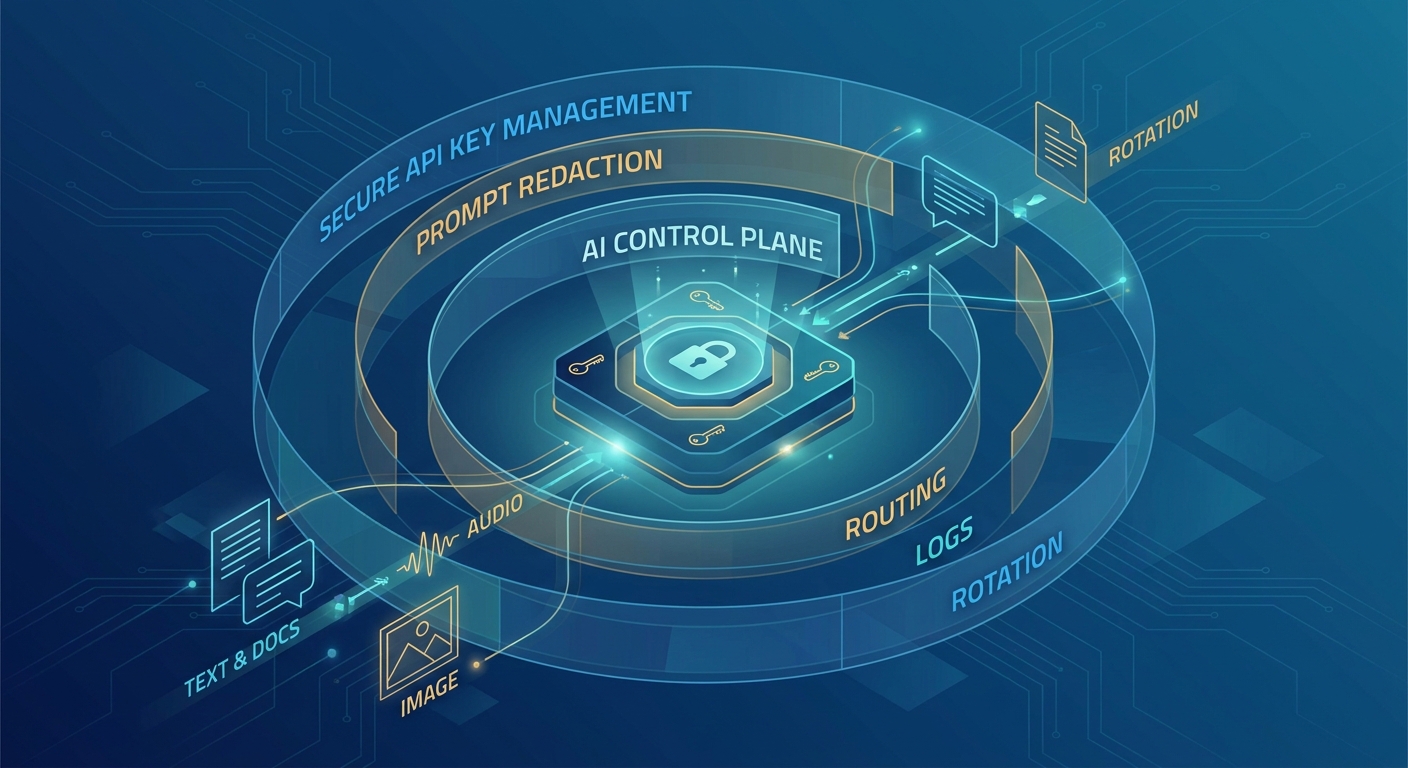
AI API audit logs are the evidence layer behind a security review. Reviewers are not only asking whether an app called a model. They want to know who made the request, which key or project was used, what model and provider handled it, whether sensitive payloads were stored, how long records are retained, and whether the team can reconstruct an incident without exposing prompts, completions, secrets, or personal data.
That makes AI API audit logs different from generic API logs. An LLM request can cross application owners, gateway keys, upstream providers, model routes, token meters, fallback paths, cost centers, and data-handling policies in one call. The audit trail has to connect those layers without turning the log store into a second sensitive-data warehouse.
Flatkey is relevant because flatkey.ai publicly positions the product as one API gateway for production AI teams, with model access, routing, billing, usage analytics, operational controls, a dashboard, and the router base URL https://router.flatkey.ai/v1. A central gateway can become the control point for AI API logging and reviewer evidence, but this article does not assume a Flatkey-specific audit-log export schema, retention period, or compliance scope. Verify those details in your current console before handing evidence to a buyer.
Quick Answer: What Security Reviewers Ask For
A good AI API audit logs package answers seven recurring questions. If you can answer them with records instead of screenshots and Slack messages, vendor review becomes much easier.
| Reviewer Question | Evidence To Show | Common Failure |
|---|---|---|
| Who used the AI API? | Actor, service account, key owner, app owner, project, team, environment, and request identifier. | Only a shared provider key appears, so ownership has to be guessed. |
| What model path was used? | Gateway route, provider, model, endpoint family, fallback decision, status, latency, and error class. | Application logs know the user action, while provider logs know the model call, but nothing links them. |
| What data was stored? | Payload logging mode, redaction policy, prompt/completion storage setting, and sensitive-data handling notes. | Raw prompts and responses are stored by default without a business reason or masking plan. |
| Can you reconstruct an incident? | Request IDs, timestamps, app trace IDs, gateway request IDs, provider request IDs where available, and exportable event history. | Logs are searchable in one dashboard but cannot be exported or correlated with app events. |
| How do you prevent uncontrolled spend? | Usage and cost reports by key, project, model, owner, and time bucket, plus quota or budget review evidence. | Audit logs show changes, but usage and cost reports are missing from the evidence set. |
| How long do logs remain? | Retention period, deletion behavior, archive/export process, and who can approve access to log extracts. | Teams keep logs forever because nobody chose a retention period. |
| Who can view the logs? | Role or group list, access approvals, log-access monitoring, and separation between metadata logs and payload logs. | Everyone with dashboard access can inspect sensitive request bodies. |
AI API Audit Logs Are Not The Same As Usage Reports
Security reviewers often say "logs" when they mean three different evidence types: audit events, request observability, and usage or cost reporting. Treating them as separate layers prevents messy answers.
| Evidence Type | Primary Question | Typical Fields | What It Does Not Prove Alone |
|---|---|---|---|
| Provider audit logs | Who changed organization, project, key, role, or configuration settings? | Actor, actor email or ID, event type, target resource, timestamp, IP/session details, and configuration-change details. | Which app request consumed tokens or which customer workflow triggered model traffic. |
| Gateway request logs | What happened to each AI API request? | Request ID, gateway key, app owner, provider, model, endpoint, status, latency, route/fallback, token counts, cost, and metadata. | Whether a provider-side role or key setting changed before the request. |
| Usage and cost reports | How much traffic, token volume, and spend happened by owner, key, project, model, and time bucket? | Input tokens, output tokens, cached tokens, request count, project, user, API key, model, line item, amount, and currency. | Who approved access, who changed a key, or what exact request failed during an incident. |
OpenAI's Admin API is a useful public example of this split. Its Audit Logs endpoint is described as listing recent user actions and organization configuration changes, while its usage and costs endpoints expose usage/cost fields and grouping options such as project, user, API key, model, service tier, line item, and time bucket. That separation is a good mental model for any AI API audit logs program: audit events, request logs, and usage/cost reports should be connected, but they are not interchangeable.
The AI API Audit Logs Field Checklist
Use this checklist as the evidence matrix for AI gateway reviews. Not every field belongs in every log store. The point is to decide what belongs in metadata logs, what belongs in restricted payload logs, what belongs in provider admin logs, and what should not be retained at all.
| Field Group | Recommended Fields | Reviewer Value | Handling Note |
|---|---|---|---|
| Time and correlation | Event time, gateway request ID, app trace ID, provider request ID where available, and export batch ID. | Lets teams reconstruct sequence and join app, gateway, and provider records. | Use a stable interaction identifier for related events. |
| Identity and ownership | Gateway key owner, service account, project, app, team, cost center, environment, and customer tenant ID if needed. | Shows accountability and supports vendor-risk questions about shared keys. | Prefer internal IDs or hashed identifiers over raw personal data when possible. |
| Request path | Endpoint family, provider, model, route group, fallback decision, cache status, retry count, and status code. | Explains which model path served the request and why a fallback occurred. | Do not store secrets from request headers. |
| Operational metrics | Duration, time to first token where available, error class, rate-limit event, quota decision, and policy decision. | Supports incident triage and reliability review. | Keep error details useful but sanitize untrusted input. |
| Usage and cost | Input tokens, output tokens, cached tokens, request count, estimated cost, billable line item, and currency. | Supports budget review, cost allocation, and unusual-spend investigation. | Use team cost attribution and per-key usage tracking for rollups. |
| Payload policy | Payload logging mode, redaction result, DLP decision, prompt hash, response hash, and attachment/file indicators. | Shows whether sensitive content was stored, suppressed, or transformed. | Metadata-only logging is often enough for security review and incident triage. |
| Retention and access | Retention class, deletion date, archive location, export permission, viewer role, and log-access event. | Answers data minimization, storage limitation, and reviewer access-control questions. | Record access to sensitive logs and restrict payload views. |
OWASP's logging guidance is a good baseline here: application logs should record when, where, who, and what; event data from other trust zones should be treated as untrusted; and sensitive data should be removed, masked, sanitized, hashed, or encrypted before it lands in logs. For AI API audit logs, that last point matters because prompts and completions can contain secrets, regulated data, customer content, and internal strategy.
Evidence Matrix For SOC 2, ISO 27001, GDPR, And Vendor Review
The table below is not a legal-control mapping. It is a practical way to translate security-review language into evidence your platform team can actually produce.
| Review Area | What Reviewers Usually Ask | Evidence From AI API Audit Logs | Evidence Owner |
|---|---|---|---|
| Access control | Who can create, view, update, or revoke AI API keys and gateway settings? | Provider admin audit events, gateway key inventory, role/group list, and access-review record. | Security or platform |
| Change control | How do you prove a model route, quota, key, or policy changed through an approved process? | Change ticket, approver, audit event, before/after setting, deployment record, and rollback note. | Platform engineering |
| Incident response | Can you reconstruct suspicious usage or provider errors for a defined period? | Request IDs, timestamps, actor/project/key metadata, route decisions, status codes, token counts, and exported event bundle. | Security operations |
| Data minimization | Do you store raw prompts and responses? If yes, why and who can see them? | Payload logging mode, redaction policy, restricted payload viewer list, and evidence that metadata-only mode exists where used. | Security, privacy, and app owner |
| Retention | How long are logs kept and how are expired logs deleted? | Retention policy, storage limit, deletion rule, archive rule, and log-access monitoring record. | Security and data governance |
| Cost governance | Can you detect unexpected model spend or attribute it to a team? | Usage/cost exports grouped by key, project, model, team, time bucket, and quota events. | FinOps or platform |
| Vendor risk | Can you show a reviewer a concrete, repeatable evidence workflow? | Reviewer packet with source systems, export date, time range, owner, redaction statement, and evidence index. | Security and procurement |
For GDPR-style reviews, the official regulation's Article 5 principles include data minimisation and storage limitation. Applied to AI API audit logs, that means you should document why each stored field is necessary, avoid retaining raw payloads by default, and set a retention period that matches the purpose of the logs.
What Not To Put In LLM Audit Logs
The fastest way to fail a logging review is to create more sensitive data than the production app itself needs. LLM audit logs should help answer security questions without becoming an uncontrolled copy of customer conversations.
| Data | Risk | Safer Pattern |
|---|---|---|
| Raw prompts and completions | May contain personal data, secrets, customer content, privileged content, or regulated data. | Default to metadata-only logs; store payloads only for approved use cases with restricted access and retention. |
| API keys, bearer tokens, and provider credentials | Creates credential exposure inside the evidence system. | Never log secrets. Store a key ID, key owner, or hashed fingerprint instead. |
| Unredacted user identifiers | Expands privacy scope and makes exports harder to share. | Use internal user IDs, tenant IDs, or salted hashes unless raw values are required and approved. |
| Full request and response headers | Headers can carry cookies, auth tokens, trace baggage, and internal infrastructure names. | Keep allowlisted headers only, such as request ID, user agent class, or safe gateway metadata. |
| Debug traces from failed model calls | Debug data can include raw payloads, stack traces, and internal implementation details. | Sanitize before persistence and store extended debug records separately from standard audit logs. |
Cloudflare's public AI Gateway docs show a useful distinction: per-request controls can skip raw request and response payload storage while preserving metadata such as token counts, model, provider, status code, cost, and duration. Vercel's public AI Gateway observability docs describe request summaries by project and API key plus detailed request logs with token and cost fields. Those are public examples of the general pattern: keep metadata broadly useful, and gate payload visibility tightly.
How To Design An AI Gateway Audit Trail
An ai gateway audit trail works best when it is designed before a reviewer asks for it. Use this workflow to turn scattered logs into review evidence.
- Choose the control point. Decide which requests must go through the AI gateway, which provider admin events stay in provider audit logs, and which app events stay in application logs.
- Define safe owner metadata. Standardize project, app, team, environment, cost center, customer tenant, and key owner fields. Avoid free-form values that leak personal data.
- Decide payload logging mode. Separate metadata-only logging from raw prompt/response logging. Require explicit approval for payload storage.
- Map request IDs. Pass a request or trace ID from the app to the gateway and preserve gateway/provider identifiers where available.
- Separate change events from request events. Key creation, route changes, role changes, and quota changes belong in audit events. Model calls belong in request logs.
- Connect usage and cost. Add rollups by key, project, model, team, and time bucket so budget questions are answerable from the same evidence packet.
- Set retention and export rules. Decide who can export logs, how extracts are redacted, where evidence is stored, and when it is deleted.
- Test a reviewer packet. Pick a harmless time range, export the evidence, and confirm another engineer can reconstruct a request path from the packet alone.
- Review access quarterly. Log access to logs, restrict payload views, and remove stale dashboard/export permissions.
If you already route traffic through Flatkey, start the workflow from the central router: verify the current base URL, keys, owners, usage analytics, billing context, routing controls, quota controls, and dashboard labels. Then connect those records to app trace IDs and provider-side audit events. For adjacent setup work, use the enterprise AI API gateway checklist, the AI API observability logs guide, and the gateway key rotation runbook.
Reviewer Packet Template
When a buyer asks for AI API audit logs, do not send a raw export with no explanation. Send an evidence packet that shows scope, data handling, and traceability.
| Packet Section | Contents | Why It Matters |
|---|---|---|
| Scope statement | System, environment, date range, included apps, included gateway keys, and excluded sources. | Prevents reviewers from assuming the sample covers every production path. |
| Source index | Provider audit logs, gateway request logs, app logs, usage/cost reports, change tickets, and access-review record. | Shows which system proves each part of the trail. |
| Field dictionary | Meaning of request ID, actor, key owner, project, provider, model, status, tokens, cost, route, and payload mode. | Lets reviewers interpret exports without guessing. |
| Redaction statement | What was masked, hashed, removed, or intentionally not collected. | Shows data-minimization discipline. |
| Retention statement | Retention class, deletion schedule, archive location, and exception process. | Answers storage-limitation and evidence-availability questions. |
| Access statement | Roles that can view metadata logs, roles that can view payload logs, and how log access is monitored. | Shows least-privilege review around the evidence itself. |
| Sample trace | One safe, non-sensitive request showing app event, gateway request, provider route, usage/cost rollup, and final status. | Proves the evidence path works end to end. |
Flatkey Implementation Notes
For Flatkey teams, keep implementation notes tied to current product proof rather than assumptions. The public site supports a one-gateway positioning story around model access, routing, billing, usage analytics, operational controls, dashboard context, pricing context, and the router base URL. That is enough to frame a practical evidence workflow, but it is not enough to claim a specific native AI API audit logs export format.
- Use the gateway as the owner boundary. Map router keys and projects to app owners, teams, environments, and cost centers before production traffic grows.
- Link logs to spend controls. Pair request-level observability with quota management, cost attribution, and the live pricing catalog.
- Separate metadata and payload evidence. A reviewer can often validate access, route, cost, and incident-reconstruction controls without seeing raw prompts or responses.
- Check the dashboard on review day. Verify labels, export behavior, role permissions, route status, model availability, and retention controls before committing them to a buyer questionnaire.
- Keep the CTA simple. If you want one gateway control point for AI API logging, routing, billing, and usage review, Get a key.
FAQ: AI API Audit Logs
What are AI API audit logs?
AI API audit logs are records that help teams prove who changed AI API access or configuration, which apps and keys generated model traffic, what provider/model path served requests, what usage and cost occurred, and how sensitive payload data was handled.
Are LLM audit logs the same as observability logs?
No. LLM audit logs usually focus on accountability, access, configuration changes, and reviewer evidence. Observability logs focus on request debugging, latency, token usage, errors, and route behavior. Mature teams connect both views through request IDs and owner metadata.
Should AI API logging store prompts and responses?
Not by default. Store metadata first: request IDs, owner fields, model, provider, status, token counts, cost, latency, route, and payload logging mode. Store raw prompts or responses only when there is a clear approved purpose, restricted access, redaction, and a defined retention period.
What fields should an ai gateway audit trail include?
An ai gateway audit trail should include request time, request ID, app or project, key owner, environment, provider, model, endpoint, route/fallback decision, status, latency, token counts, cost, quota decision, payload logging mode, retention class, and export/access controls.
How does Flatkey help with AI API audit logs?
Flatkey provides a central AI API gateway context for model access, routing, billing, usage analytics, operational controls, and dashboard review. Use that central point to standardize owner metadata and evidence workflows, then verify current console behavior before claiming specific audit-log export, retention, or access-control capabilities.
When a buyer asks for AI API audit logs, the best answer is not a pile of raw records. It is a clear evidence packet: what was logged, what was intentionally not logged, who can see it, how long it stays, and how one request can be reconstructed from app to gateway to provider to cost rollup. If you are centralizing AI API access and need that evidence path, Get a key.