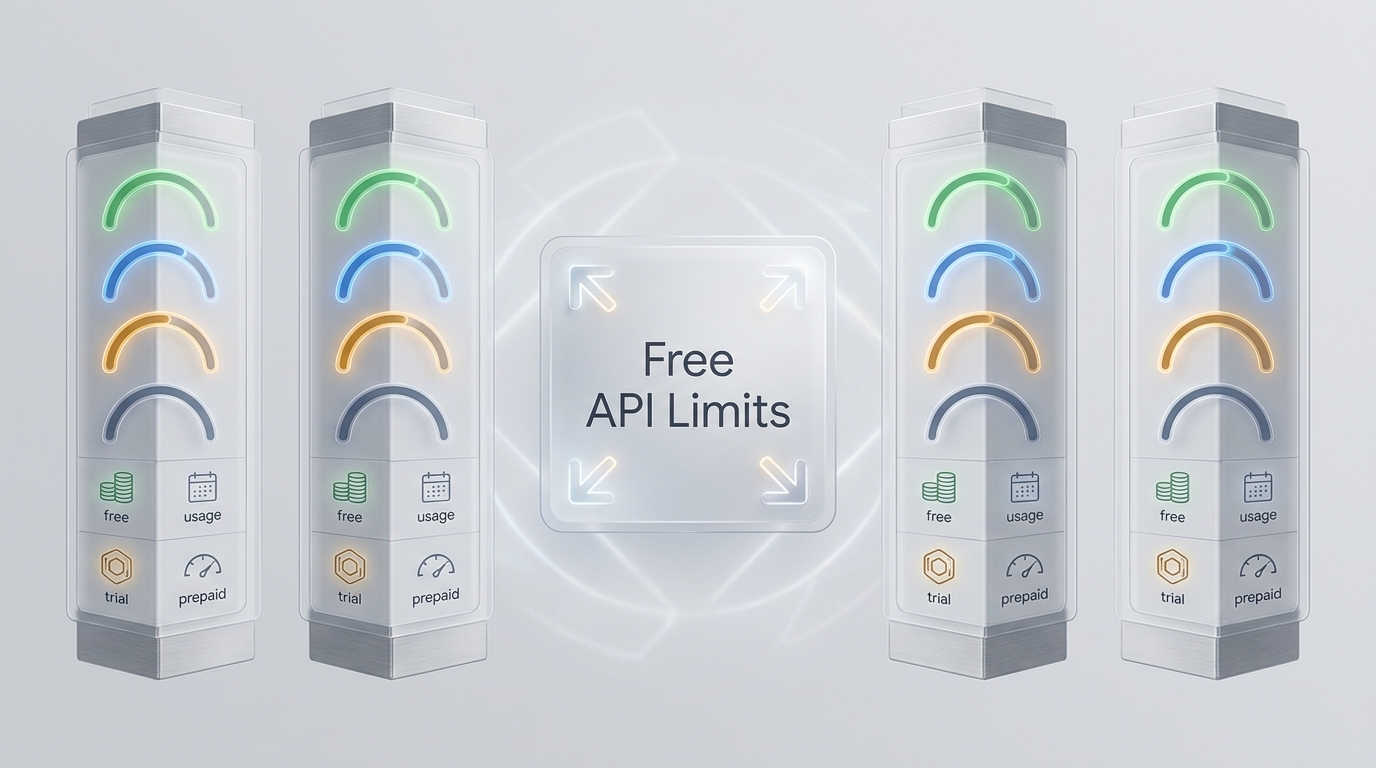
Free Tier Showdown: OpenAI vs Claude vs Gemini vs DeepSeek Free API Limits is not a contest where every provider offers the same kind of "free." The important question is whether you get recurring free API tokens, temporary trial or usage-tier access, prepaid low-cost access, or only a dashboard limit that protects you from overspending.
The short answer for indie hackers:
- Gemini is the clearest recurring free API tier for early experiments. Google describes a Free plan with limited model access, free input and output tokens, Google AI Studio access, and lower rate limits.
- OpenAI exposes a Free usage tier and then paid tiers, but exact model rate limits are account- and project-specific. You need to check the limits page for your organization before planning a launch.
- Claude is best treated as paid API access with tiered spend and rate limits. New organizations may start below standard limits while Anthropic builds account history.
- DeepSeek is not a classic recurring free-tier play. It is a low-cost API with balance-based billing, possible granted balance, and published concurrency limits.
For a weekend prototype, Gemini is usually the easiest place to test without entering a card or committing spend. For a product that might ship, the better move is to compare free-start convenience against the first paid step, rate-limit predictability, data-use terms, and how easy it is to move the same workload behind a stable router later.
Free Tier Showdown: OpenAI vs Claude vs Gemini vs DeepSeek Free API Limits at a glance
| Provider | Free-start type | What the public docs make clear | Practical risk for indie hackers |
|---|---|---|---|
| OpenAI | Usage-tier access, then paid tiers | OpenAI's rate-limit guide lists a Free tier for allowed geographies with a monthly usage limit, and paid tiers beginning after $5 paid. Limits vary by model, organization, and project. | Do not assume a public fixed RPM/TPM table applies to your account. Check the dashboard before a demo, cron job, or launch. |
| Claude | Console/API key with tiered limits | Anthropic requires a Console account and API key. Rate limits and monthly spend caps are tier-based, and new organizations can start in an Evaluation tier below standard limits. | Great models, but not the cleanest "free API quota" answer. Plan for billing setup and traffic ramping. |
| Gemini | Explicit free plan | Google says the Gemini API Free plan includes limited model access, free input and output tokens, and Google AI Studio access. Limits are per project, vary by model, and are visible in AI Studio. | Strongest free-start option, but free-tier data can be used to improve Google products. Move to paid for production privacy and higher limits. |
| DeepSeek | Low-cost prepaid or granted-balance access | DeepSeek bills per 1M tokens, deducts usage from topped-up or granted balance, returns 402 when balance runs out, and publishes concurrency limits for current models. | Cheap to test at small scale, but not a static recurring free tier. You still need balance and 429 handling. |
The winner of Free Tier Showdown: OpenAI vs Claude vs Gemini vs DeepSeek Free API Limits depends on what you mean by free. If "free" means recurring free API tokens, start with Gemini. If "free" means "I can create an account and keep the first experiment cheap," OpenAI and DeepSeek deserve tests too. If "free" means "no billing conversation before production," none of these providers should be treated as a launch plan.
What "free API limits" actually means
Most searches for Free Tier Showdown: OpenAI vs Claude vs Gemini vs DeepSeek Free API Limits blur together four different things:
- Free API token pricing: Input and output tokens can be free of charge under a free tier.
- Usage-tier cap: The account can call the API up to a defined monthly cap, but exact model throughput still depends on rate limits.
- Trial or granted balance: You may have credits or granted balance, but it can run out.
- No subscription fee: There may be no monthly seat fee, but token usage is still billable.
Do not put those in the same spreadsheet column. A free plan with low RPM is useful for a prototype but can fail under a public launch. A paid low-cost API can be cheaper than "free" if its free alternative makes you rewrite code, wait on quota, or accept data-use terms you cannot ship with.
OpenAI free API limits
OpenAI's current rate-limit documentation is clear about the mechanics: rate limits can be measured in requests per minute, requests per day, tokens per minute, tokens per day, images per minute, and audio minutes per minute. OpenAI also states that rate limits are defined at organization and project level, vary by model, and can be inspected in the limits area of the developer console.
The same page lists usage tiers. It shows a Free tier for users in allowed geographies with a $100/month usage limit, then paid tiers such as Tier 1 after $5 paid, Tier 2 after $50 paid, and higher tiers after larger paid thresholds.
That does not mean every OpenAI model has a public, stable free RPM/TPM quota you can copy into a launch plan. For this Free Tier Showdown: OpenAI vs Claude vs Gemini vs DeepSeek Free API Limits, the safe reading is:
- Use OpenAI when you want strong general-purpose models and a mature API surface.
- Check your account's actual rate limits before planning a product demo.
- Treat the Free tier as an account-stage signal, not a guarantee that your chosen model can absorb production traffic.
- Add retry and backoff for 429 and 503 responses.
- Move to paid tiers early if your product has scheduled jobs, background agents, or user-facing traffic.
OpenAI also publishes per-token pricing by model. For low-cost experiments, the cheapest practical path is usually a smaller model, short context, aggressive token budgeting, and logging every request's accepted output rate.
Claude free API limits
Claude's API setup starts with a Claude Console account and an API key. Anthropic's API overview says the Console is where teams create API keys, add users, set up billing, and experiment in the playground.
Anthropic's rate-limit documentation frames access around spend limits and rate limits. Spend limits cap monthly API cost by tier, while rate limits govern requests and tokens. The published standard tiers include Start, Build, Scale, and Custom. The Start tier carries a $500 monthly spend cap, Build a $1,000 cap, and Scale a much higher cap. Rate limits for the Messages API are listed by model class in RPM, input tokens per minute, and output tokens per minute.
The key detail for Free Tier Showdown: OpenAI vs Claude vs Gemini vs DeepSeek Free API Limits is Anthropic's Evaluation-tier caveat: new organizations and organizations with limited usage history may start below the standard limits while account history is established.
That makes Claude a strong model choice but a weaker "free API limits" answer. Use Claude when model behavior, long-context work, tool-use behavior, or Claude-specific quality matters. Do not assume it is the easiest provider for a no-card recurring free API prototype unless your account shows credits or free access in Console.
Before launch, check:
- current organization tier,
- workspace limits,
- Messages API RPM, input-token, and output-token limits,
- spend cap,
- cache behavior if prompt caching is part of your cost model,
- whether your workload uses Claude-native features that will not port cleanly to OpenAI-compatible routes.
Gemini free API limits
Google gives the clearest free-tier story in this comparison. The Gemini Developer API pricing page says developers and small projects can start free of charge. It lists a Free plan with limited model access, free input and output tokens, and Google AI Studio access. The same page distinguishes Paid, where production applications get higher rate limits and content is not used to improve Google products.
Google's rate-limit page explains that Gemini API limits are typically measured across requests per minute, input tokens per minute, and requests per day. It also says limits are applied per project rather than per API key, vary by model, are more restricted for experimental and preview models, and can be viewed in AI Studio. The Free usage tier requires an active project or free trial; Tier 1 requires linked billing.
For Free Tier Showdown: OpenAI vs Claude vs Gemini vs DeepSeek Free API Limits, Gemini wins the "free recurring API experiment" slot because the public docs explicitly say free input and output tokens are available for supported models.
The tradeoffs are just as important:
- Free-tier content is marked as used to improve Google products.
- Some models or features are not available on Free tier.
- Published limits are not guaranteed capacity.
- Limits move with your project's tier and account status.
- Production-grade features, higher limits, and stricter data-use expectations usually push you to Paid.
Gemini is the right first stop for a throwaway prototype, prompt experiment, or feature spike. It is not automatically the right production route if your app needs Claude behavior, OpenAI-specific features, DeepSeek economics, or a multi-provider fallback plan.
DeepSeek free API limits
DeepSeek is the easiest provider here to misunderstand. It is often discussed as a low-cost API, but the official docs are not positioned like Gemini's recurring free plan.
DeepSeek's pricing page lists token prices per 1M tokens and says charges are deducted from topped-up balance or granted balance, with granted balance used first when both exist. The error-code page says a 402 response means insufficient balance and tells users to top up. The rate-limit page publishes concurrency limits for current models and says requests above the limit receive HTTP 429.
As of this article's source check, DeepSeek publishes:
| Model | Public concurrency limit |
|---|---|
deepseek-flash |
2,500 |
deepseek-v4-pro |
500 |
For Free Tier Showdown: OpenAI vs Claude vs Gemini vs DeepSeek Free API Limits, that means DeepSeek belongs in the "low-cost prepaid or granted-balance" column, not the "recurring free tier" column.
DeepSeek can still be an excellent prototype provider when:
- your workload is cost-sensitive,
- OpenAI-compatible setup matters,
- you can test current model IDs before routing traffic,
- you can handle 402 and 429 cleanly,
- you are willing to monitor balance and concurrency instead of relying on a free quota.
The production question is not "Is DeepSeek free?" It is "Can DeepSeek produce accepted outputs cheaply enough, with enough concurrency, and with a rollback route if the model or account limits change?"
A practical free-start decision tree
Use this decision tree before opening provider accounts for a new project.
| If your next step is... | Start with... | Why |
|---|---|---|
| Prompt exploration, hackathon demo, or throwaway prototype | Gemini Free | The public docs explicitly describe free input and output tokens for supported models. |
| OpenAI SDK-based product spike | OpenAI or Gemini OpenAI compatibility | OpenAI is the native SDK path; Gemini can be tested through an OpenAI-compatible route for common chat workflows. |
| Claude-quality evaluation | Claude | Free tier is not the main reason; model behavior is. Check Console limits first. |
| Lowest-cost text generation experiment | DeepSeek plus one baseline provider | Token prices and concurrency can be attractive, but monitor balance and accepted-output quality. |
| Multi-provider product that may ship | Direct provider tests, then Flatkey route test | You need actual provider behavior and one operating layer for keys, usage, and cost once tests expand. |
The best early test is small and reversible. Use one prompt set, one evaluator, and one usage log. Run it through two or three providers, then compare accepted outputs, latency, cost, and limit friction. The provider with the most generous free start can still lose if it fails your output validator.
Copyable provider-limit checklist
Use this checklist when comparing Free Tier Showdown: OpenAI vs Claude vs Gemini vs DeepSeek Free API Limits for your own account.
provider_limit_review:
  date_checked: "2026-09-22"
  workload: "support_summary"
  providers:
    - openai
    - claude
    - gemini
    - deepseek
  verify_for_each_provider:
    free_start_type: "free tier | usage tier | credits | granted balance | prepaid only"
    billing_required_before_first_call: "yes | no | account-dependent"
    model_id_checked: true
    rpm_limit_checked: true
    tpm_or_itpm_limit_checked: true
    daily_limit_checked: true
    monthly_usage_or_spend_cap_checked: true
    data_use_terms_checked: true
    retry_after_or_429_behavior_checked: true
    balance_or_quota_alerts_configured: true
    fallback_route_defined: true
  launch_rule:
    do_not_ship_on_free_limits_only: true
    require_paid_or_controlled_quota_for_public_traffic: true
This checklist prevents the most common mistake: building on a free experiment and discovering at launch that your actual project, model, or region has a different quota.
Where Flatkey fits after the free tier test
Flatkey is not a replacement for checking each provider's official free tier. You should still verify OpenAI, Claude, Gemini, and DeepSeek directly when the exact provider behavior matters.
Flatkey becomes useful when your experiment turns into a product and the provider list starts to sprawl. Flatkey's docs describe one OpenAI-compatible endpoint at https://router.flatkey.ai/v1, a shared API key flow, model discovery, usage tracking, and a model directory across providers such as OpenAI, Anthropic, Google, and DeepSeek.
That matters after the first free test because the real operating cost is not just tokens. It is:
- provider keys in too many repos,
- separate bills and dashboards,
- inconsistent model IDs,
- different 429 and quota behavior,
- unclear usage ownership,
- no shared rollback path when a model or provider limit changes.
For a multi-provider app, keep direct-provider experiments small, then test the same workload through a router. Start with the Flatkey API quickstart, review the AI model catalog guide, and keep the AI API quota limits article open when building your quota checklist.
The bottom line
If you searched Free Tier Showdown: OpenAI vs Claude vs Gemini vs DeepSeek Free API Limits because you want the most free calls today, start with Gemini and confirm your project's live limits in AI Studio.
If you want the safest API path for a product, free tier is only the first filter. Compare the first paid tier, actual RPM and token limits, data-use terms, retry behavior, spend caps, and whether your code can switch providers without a rewrite.
Use OpenAI when you need its API surface and model family. Use Claude when Claude behavior is the reason for the product. Use Gemini when recurring free experimentation is the priority. Use DeepSeek when low-cost, balance-based experiments fit the workload. Use Flatkey when those experiments become a multi-provider operating problem.
Frequently asked questions
Which provider has the best free API tier?
For this Free Tier Showdown: OpenAI vs Claude vs Gemini vs DeepSeek Free API Limits, Gemini has the clearest public free API plan because Google documents free input and output tokens for supported models. Always check AI Studio for your project's live limits.
Does OpenAI have free API limits?
OpenAI's rate-limit docs list a Free usage tier for allowed geographies and show higher paid tiers after payment thresholds. Exact rate limits vary by model, organization, and project, so check the OpenAI limits dashboard for your account before relying on it.
Is Claude API free?
Do not plan around Claude as a stable public recurring free API quota. Anthropic documents Console/API-key access, billing setup, spend caps, and tiered rate limits. Your Console may show account-specific credits or limits, but the public docs should be treated as a paid API planning baseline.
Is DeepSeek API free?
DeepSeek should be treated as low-cost and balance-based rather than a recurring free API tier. Its docs describe topped-up or granted balance, 402 insufficient-balance errors, token pricing, and model concurrency limits.
Should I build a production app on free API limits?
No. Use free API limits to learn the model and prototype the workflow. Before public traffic, move to a paid or controlled quota, add usage alerts, define retry and fallback behavior, and log cost per accepted output.