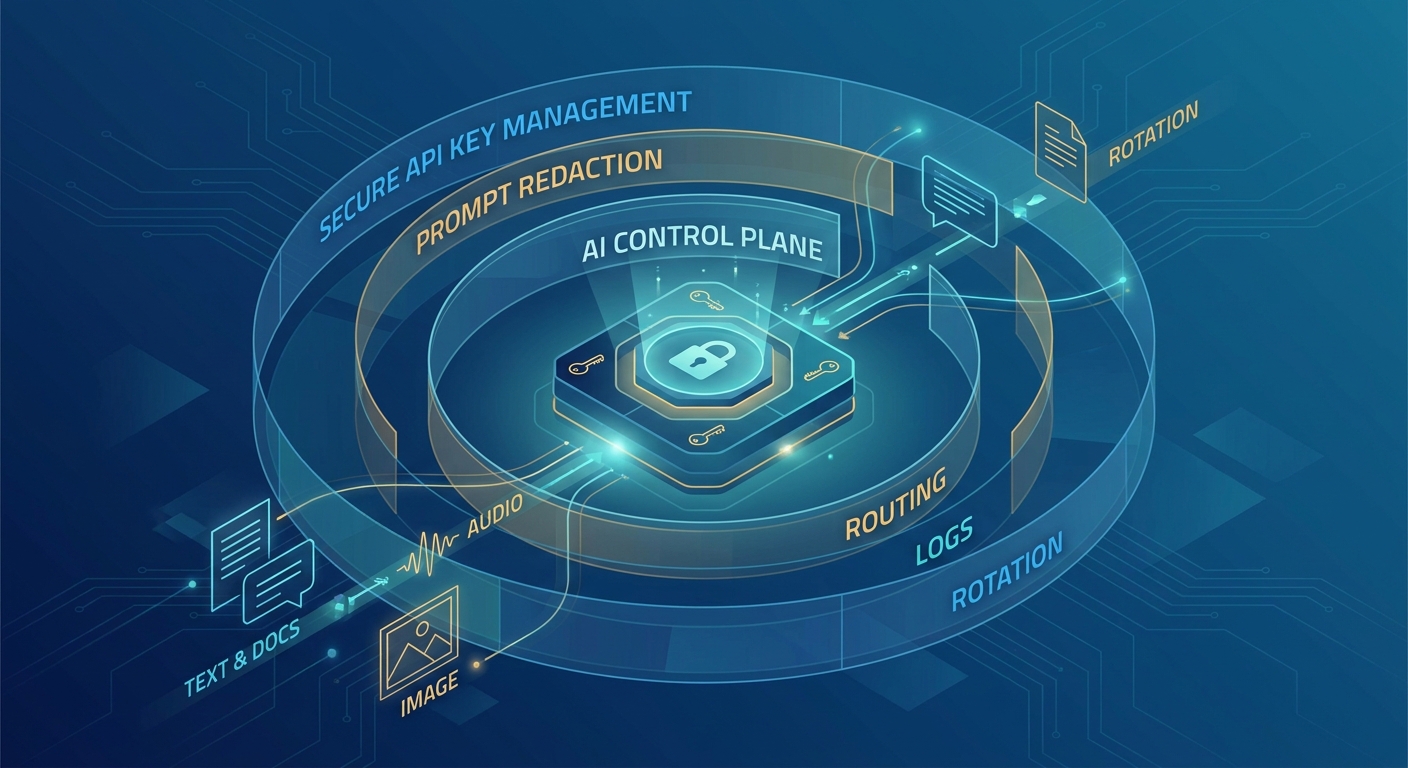
GDPR AI API gateway review starts with a simple question: can you explain where personal data can enter, which service sees it, what is logged, how long evidence remains, and which vendor terms govern the request path?
That question is harder for AI APIs than for a normal SaaS integration. One user action can move through your app, an AI gateway, one or more model providers, fallback routes, log stores, billing records, support tools, and security review exports. Prompts, files, images, tool calls, and model outputs can contain personal data even when the product team did not design the feature as a regulated workflow.
This GDPR AI API gateway checklist is written for platform, security, privacy, and procurement teams that need a practical review packet. It is not legal advice. Use it to prepare the technical evidence your privacy counsel, DPO, security reviewer, or buyer will ask for: data boundaries, log policy, vendor review, subprocessor mapping, transfer safeguards, and operational controls.
Flatkey is relevant because flatkey.ai publicly positions the product as one API gateway for production AI teams, with model access, routing, billing, usage analytics, operational controls, a dashboard, and model pricing across 638 model rows and 23 vendors in the June 19, 2026 pricing API snapshot. Flatkey's public privacy page also says inputs and outputs may pass through its systems and relevant model services to provide the service, and that request metadata, error records, usage records, necessary logs, and support materials may be retained for troubleshooting, security, metering, disputes, or compliance. Treat those as dated public facts, not a substitute for a DPA, order form, retention schedule, or counsel review.
Quick Answer: What A GDPR AI API Gateway Review Should Prove
A GDPR AI API gateway review should prove that your team has mapped the AI request path, reduced unnecessary personal data, separated metadata logs from payload logs, checked each model vendor's processing terms, and defined retention and access controls for operational evidence.
| Review Area | Evidence To Prepare | Why It Matters |
|---|---|---|
| Data boundary | Diagram showing app, gateway, providers, logs, support tools, billing, and exports. | Reviewers need to see where personal data can cross systems and jurisdictions. |
| Role assignment | Controller, processor, subprocessor, and customer responsibility notes for each party. | GDPR Article 28 processor reviews depend on contract role and instruction boundaries. |
| Input and output scope | Allowed data classes, prohibited data classes, redaction policy, and user notice path. | Data minimisation requires a reason for collecting or sending personal data. |
| Logs and retention | Metadata fields, payload logging mode, retention period, deletion path, and access list. | Logs often become the hidden copy of prompts, outputs, identifiers, and incidents. |
| Vendor review | Provider terms, DPA, data use policy, retention controls, residency options, and subprocessor list. | AI routing can silently change the downstream processor set unless routes are governed. |
| Transfer safeguards | Processing locations, transfer mechanism, regional endpoint constraints, and escalation owner. | Cross-border transfers require documented safeguards when EU personal data leaves the EEA. |
| Operational controls | Key ownership, route approval, model fallback policy, quota controls, incident export, and access reviews. | Procurement teams want proof that the gateway is controlled after launch, not only before launch. |
Start With The Data Boundary, Not The Model List
The first mistake in a GDPR AI API gateway review is to start with model names. Model lists matter, but the real review unit is the request path. Draw the full path for each production workflow before approving a gateway route.
| Boundary | Question To Answer | Evidence Owner | Common Gap |
|---|---|---|---|
| Application to gateway | Which app, environment, customer tenant, user role, and API key can send the request? | Platform engineering | Shared keys hide the app or tenant that produced the traffic. |
| Gateway to provider | Which provider and endpoint family can receive the request, including fallback routes? | Platform and privacy | Fallback is treated as reliability only, but it can change vendor and transfer scope. |
| Gateway to logs | Which fields are written to request logs, audit logs, usage records, and billing records? | Security operations | Raw prompts land in debug logs with no retention class. |
| Gateway to support | Can support staff, vendors, or incident responders view payloads or only metadata? | Support and security | Support tickets include copied prompts, screenshots, or customer identifiers. |
| Exports and reviews | What can be exported for a buyer, auditor, or regulator, and who approves it? | Security and legal | Teams can show dashboard screenshots but cannot produce a controlled evidence bundle. |
Use the boundary map to decide whether a model route is acceptable for the data class. For example, a public marketing-copy workflow, an internal support-summary workflow, and a customer-facing claims-review workflow should not inherit the same provider set, payload logging mode, or retention period by accident.
Map Controller, Processor, And Subprocessor Roles
GDPR role mapping is not a slogan. Under the GDPR, the controller decides the purposes and means of processing, while processors act on documented instructions. The European Data Protection Board's controller and processor guidance is useful background for separating those roles, and GDPR Article 28 is the contract-review anchor for processors.
For AI gateway procurement, keep the role map operational:
| Party | Likely Review Question | What To Verify |
|---|---|---|
| Your company | Are you the controller for end-user personal data in this AI workflow? | Purpose, lawful basis, notice, data-subject rights path, DPIA need, and internal owner. |
| AI gateway | Is the gateway acting as processor, independent controller for some account data, or both depending on field? | DPA, privacy policy, security appendix, retained metadata, support data, and account/billing records. |
| Model provider | Does the downstream provider process customer content, metadata, abuse-monitoring logs, or application state? | Provider DPA, data controls, retention settings, training/data-use terms, regional processing, and safety exceptions. |
| Observability and support tools | Do logs, traces, tickets, or replay tools receive personal data from prompts or outputs? | Subprocessor list, field redaction, access permissions, retention class, and export controls. |
The key is to split customer content, account data, usage metadata, billing records, security logs, and support materials. One vendor may have different roles or retention rules for each category. That is why a GDPR AI API gateway review should not stop at "we use a DPA."
Build A Data-Minimisation Policy For Prompts And Outputs
GDPR Article 5 includes principles such as data minimisation and storage limitation. For an AI API gateway, that means teams should avoid sending personal data that is not necessary for the model task, and avoid retaining payload copies longer than the evidence need requires.
Convert that principle into routing rules:
| Data Class | Default Gateway Policy | Exception Path | Review Evidence |
|---|---|---|---|
| No personal data | Allow approved models and standard metadata logs. | Still block secrets, access tokens, and credentials. | Data-class declaration and sample sanitized payload. |
| Basic business contact data | Prefer pseudonymous IDs and redact direct identifiers when the task does not need them. | Allow direct identifiers only with app-owner signoff. | Field inventory, redaction test, and route owner. |
| Customer content or support text | Use metadata-only logs unless troubleshooting needs a restricted payload copy. | Temporary payload capture with ticket, expiry, and restricted viewers. | Payload logging mode, retention date, and access audit. |
| Special-category or high-risk data | Block by default until privacy review, DPIA screening, and provider review are complete. | Explicit legal/security approval, strict vendor set, and narrow retention. | DPIA screening result, lawful basis note, and vendor contract review. |
| Secrets and credentials | Block or redact before the gateway and never store in logs. | No routine exception. Use incident process if leakage occurs. | Secret-scanning test and incident handling path. |
OWASP's logging guidance reinforces the same practical point for application logs: decide what to log, sanitize data from other trust zones, and mask or remove sensitive data before it lands in a log store. In AI systems, prompts and outputs deserve the same treatment as request bodies, uploaded files, and support transcripts.
Separate Metadata Logs From Payload Logs
A strong GDPR AI API gateway design starts with metadata logs and makes payload capture the exception. Metadata is usually enough for spend review, reliability triage, vendor review, and many security investigations. Payload logs need tighter justification because prompts and outputs can contain personal data, confidential business data, or secrets.
| Log Layer | Useful Fields | Privacy Handling | Review Use |
|---|---|---|---|
| Request metadata | Request ID, timestamp, app, environment, key owner, route, provider, model, endpoint family, status, latency, and error class. | Avoid raw user identifiers when a hashed or internal ID works. | Incident reconstruction, model-route review, and owner accountability. |
| Usage and cost | Input tokens, output tokens, request count, estimated cost, provider, model, team, project, and billing group. | Keep usage records separate from full prompt text. | Spend control, procurement reporting, and unusual-usage review. |
| Policy decision | Route allow/deny, data-class label, redaction result, fallback reason, quota decision, and reviewer approval ID. | Record the decision without storing sensitive payload content. | Shows that controls were enforced at runtime. |
| Payload capture | Prompt/output sample, file reference, tool call body, attachment type, redaction result, and expiry date. | Restrict access, encrypt at rest, set a short retention period, and record every viewer. | Use for targeted debugging, investigation, or buyer evidence only when necessary. |
| Administrative audit | Who created keys, changed routes, approved providers, changed retention, or exported logs. | Retain as security evidence with access-review controls. | Vendor review, SOC 2 style evidence, and change control. |
Public gateway products illustrate why this distinction matters. Cloudflare AI Gateway documents request logs and observability patterns, and Vercel AI Gateway documents observability for requests and usage. Those are useful public patterns, but your evidence packet should describe your own gateway settings, not assume another vendor's defaults.
For Flatkey, use the current dashboard and account documentation as the source of truth for which logs, metadata, exports, and retention settings are available in your plan. The public privacy page says Flatkey may retain request metadata, error records, usage records, necessary logs, and support materials for listed operational purposes, but it does not publish a customer-specific log schema or retention schedule.
Review Provider Data Controls Before Enabling A Route
Provider review is where many AI gateway checklists stay too vague. A model provider is not only a model. It may have separate rules for chat completions, responses, files, images, audio, fine-tuning, batch jobs, prompt caching, abuse monitoring, regional processing, and deleted objects.
For each provider and endpoint family in your route, fill this table before production use:
| Provider Review Item | Question | Evidence To Save |
|---|---|---|
| Training and model improvement | Can customer content be used for model training or improvement by default? | Current provider data-use page, enterprise terms, or DPA excerpt. |
| Abuse monitoring | Are prompts, outputs, files, or metadata retained for abuse monitoring? For how long? | Retention table, data-control setting, approval requirement, and project-level configuration. |
| Application state | Does the endpoint store conversation state, files, vectors, batch inputs, generated media, or cached prompt data? | Endpoint-specific retention note and deletion method. |
| Data residency and transfers | Can the provider process or store content in a required region? | Regional endpoint, residency setting, transfer mechanism, and unsupported endpoint list. |
| Subprocessors | Which third parties support the provider, gateway, observability, support, or billing flow? | Subprocessor list, change-notice terms, and procurement approval record. |
| High-risk restrictions | Does the provider restrict sensitive data, regulated industries, minors, biometric data, automated decisions, or customer-facing use? | Acceptable-use policy, safety policy, product-specific restrictions, and app-owner signoff. |
OpenAI's public data-controls documentation is a good example of the level of detail to look for. It distinguishes abuse-monitoring logs, application state, endpoint-specific retention, Zero Data Retention eligibility, data residency, and third-party service limitations. Do the same for every model vendor you enable behind a GDPR AI API gateway.
Treat Fallback As A Privacy And Vendor-Risk Change
Model fallback is usually designed for reliability, but it can change privacy posture. If the gateway switches from one provider to another, the request may be processed under a different DPA, retention rule, geographic region, abuse-monitoring policy, or subprocessor set.
Before enabling fallback for EU personal data, define:
- Allowed fallback set: the exact providers, models, endpoint families, and regions approved for the data class.
- Disallowed fallback set: providers or modalities that must fail closed for privacy, contract, residency, or safety reasons.
- Evidence fields: route attempted, fallback reason, final provider, final model, policy decision, and approval record.
- User impact: whether output quality, automated-decision logic, notice language, or customer contract terms change when fallback occurs.
Use Flatkey's model fallback evaluation checklist as the reliability companion, but add privacy approval to the route-change process. A fallback that is safe for uptime may still be unacceptable for a regulated data class.
The Vendor Review Packet For Procurement
Procurement teams do not want a vague answer like "the gateway handles it." They want a packet that ties the gateway, model vendors, logs, and internal controls into one reviewable story. Use this packet for each production AI workflow.
| Packet Item | What It Should Include | Owner |
|---|---|---|
| Workflow summary | Business purpose, data class, user population, countries, model tasks, and launch owner. | Product |
| Data-flow diagram | App, gateway, providers, observability, support, billing, exports, and retention stores. | Platform |
| Vendor matrix | Gateway, model providers, logging tools, support tools, payment/billing vendors, and subprocessors. | Procurement |
| Log policy | Metadata fields, payload policy, redaction, access groups, retention, deletion, and export approvals. | Security |
| Transfer review | Processing locations, regional settings, transfer mechanism, SCC/TIA status where applicable, and fallback constraints. | Privacy/legal |
| Operational controls | Key rotation, route approval, quota limits, incident runbook, owner reviews, and change history. | Platform and security |
| Buyer-facing evidence | Security certificate links, DPA status, support contact, privacy policy, terms, and approved statement library. | Sales engineering |
Flatkey can fit this packet as the central access, routing, billing, and usage layer. The review still needs legal entity review, account-specific settings, provider terms, and current route verification. Do not hand a buyer a generic GDPR AI API gateway checklist as if it proves compliance by itself.
Implementation Checklist For A GDPR AI API Gateway
Use this implementation checklist before you route live EU personal data through any AI gateway.
- Classify the workflow: name the business purpose, data subjects, data categories, countries, and prohibited inputs.
- Map the request path: record app, gateway, model providers, endpoint families, logs, support tools, billing, exports, and fallback routes.
- Confirm roles: document controller, processor, subprocessor, and independent-controller areas for account, usage, and security data.
- Minimize payloads: redact identifiers, block secrets, use pseudonymous IDs, and avoid sending fields the model task does not need.
- Choose logging mode: default to metadata-only logs, then require explicit approval for temporary payload capture.
- Set retention: assign retention classes for metadata, payload captures, usage records, security logs, support tickets, and exports.
- Review providers: check training/data-use terms, retention controls, application-state storage, regional settings, and subprocessors.
- Constrain fallback: allow fallback only to approved providers and models for the same data class, or fail closed.
- Record runtime evidence: log route decisions, policy outcomes, usage, key owner, and administrative changes.
- Re-review on change: rerun the packet when model, provider, route, region, payload logging, retention, or product use changes.
How Flatkey Helps Centralize The Review
Flatkey's public product copy says it unifies model access, routing, billing, usage analytics, and operational controls for teams shipping AI products. Its current pricing API snapshot exposes endpoint families for OpenAI chat completions, OpenAI Responses, Anthropic messages, Gemini generateContent, image generation, and video generation, plus public model/vendor metadata. That makes Flatkey a practical place to centralize route inventory, model access, cost visibility, and operational review for an AI gateway program.
For a GDPR AI API gateway rollout, use Flatkey as the control-plane checkpoint:
- Assign separate keys or projects for environments, teams, workflows, and data classes.
- Use the model catalog and pricing page as a current verification path before enabling a provider route.
- Keep usage and billing records separate from raw prompt and output payloads.
- Pair gateway evidence with AI API audit logs, procurement notes, and current provider DPAs.
- Use the broader enterprise AI API gateway checklist for quota, billing, failover, and vendor-review alignment.
The important caveat: public pages do not prove your account's retention, route policy, payload logging, DPA status, or regulatory fit. Verify those details in the current Flatkey console, order terms, privacy policy, and any signed agreement before production launch.
Common Failure Modes
| Failure Mode | Why It Creates Risk | Fix |
|---|---|---|
| One shared production key | Logs cannot reliably show which app, customer, or owner sent personal data. | Separate keys by app, environment, team, and data class. |
| Raw prompt logging by default | The log store becomes a secondary personal-data repository. | Use metadata-only logs by default and short-lived restricted payload capture for exceptions. |
| Unreviewed fallback provider | The same request can move to a vendor with different retention, transfer, or subprocessor terms. | Constrain fallback to reviewed providers or fail closed for sensitive workflows. |
| No retention class for AI records | Prompts, outputs, request metadata, support tickets, and billing records are kept inconsistently. | Define retention per record type and document deletion/export paths. |
| Vendor review only at onboarding | Model routes, endpoint behavior, and provider policies change after launch. | Trigger re-review on route, model, region, retention, and payload-policy changes. |
FAQ
Is a GDPR AI API gateway enough to prove GDPR compliance?
No. A GDPR AI API gateway can centralize controls and evidence, but GDPR compliance depends on the full processing context: purpose, lawful basis, notices, data-subject rights, contracts, subprocessors, transfers, security, retention, and governance.
Should AI gateway logs store prompts and responses?
Not by default. Start with metadata-only logs for routing, owner, model, token, cost, error, and policy decisions. Store prompts or outputs only when there is a documented need, restricted access, redaction, and a short retention period.
What should procurement ask an AI gateway vendor?
Ask for the legal entity, DPA path, subprocessor list, data-processing locations, data-use and training terms, request/log retention, payload logging controls, security certifications, incident process, support-data handling, and how model fallback changes downstream vendors.
How does model fallback affect GDPR review?
Fallback can change the processor, subprocessor set, location, retention behavior, and provider policy for the same request. Treat fallback as a privacy and vendor-risk change, not only a reliability feature.
Where does Flatkey fit in this checklist?
Flatkey can act as the gateway checkpoint for model access, routing, billing, usage visibility, and operational control. Buyers should still verify current Flatkey account settings, signed terms, DPA status, log behavior, retention, and provider routes before production use.
Final Review Before You Get A Key
A GDPR AI API gateway should make AI traffic easier to govern, not harder to explain. Before production launch, make sure every approved route has a data-boundary map, provider review, log policy, retention class, fallback rule, and buyer-ready evidence packet. Then use Flatkey to centralize access and routing behind one gateway, with current vendor and account settings checked before real customer data flows.
Get a key when you are ready to centralize model access, routing, usage visibility, and operational controls behind a reviewable gateway.