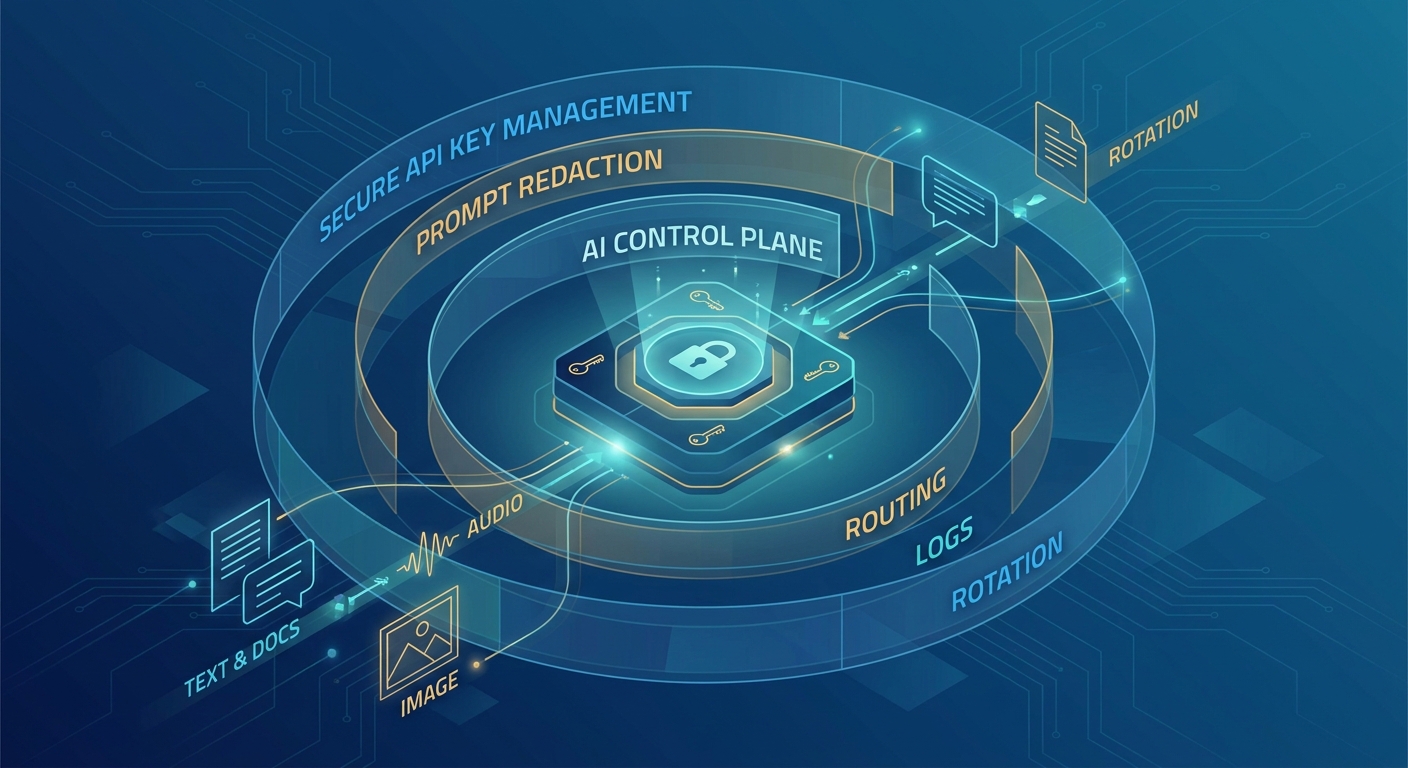
Secure API key management for AI products is not just a matter of putting a provider credential in a vault. AI applications send prompts, files, retrieved context, tool arguments, and model outputs through systems that often span several providers and environments. A key can be perfectly encrypted at rest while the surrounding request path still exposes sensitive data through browser bundles, debug logs, CI output, support exports, or an over-permissioned routing service.
The practical goal is therefore broader: keep long-lived provider keys away from untrusted clients, give each workload the smallest useful identity, control what data can cross each model boundary, and make rotation and revocation routine rather than disruptive.
This guide gives platform, security, and AI product teams an operating model they can implement. It includes a threat model, key inventory template, control-plane architecture, zero-downtime rotation runbook, logging rules, CI/CD safeguards, incident-response workflow, and a production checklist.
The five boundaries an AI key can cross
Start by mapping the places where a secret or the data it authorizes can move. Most failures occur because teams protect the provider key but overlook one of these adjacent boundaries.
| Boundary | Typical failure | Required control |
|---|---|---|
| Client to application | A provider key is embedded in a browser bundle, mobile binary, desktop app, or extension | Keep provider keys server-side; issue short-lived user or session credentials to clients |
| Application to gateway | Every service shares one unrestricted key | Use workload identities, scoped gateway tokens, quotas, and explicit route policy |
| Gateway to provider | One credential can access every model, project, or environment | Separate keys by provider, environment, workload, and risk tier where supported |
| Request to logs | Authorization headers, prompts, files, or outputs appear in traces | Denylist secret fields, minimize payload logging, tokenize identifiers, and test redaction |
| Human operations | Keys are pasted into tickets, chat, runbooks, or support tools | Use controlled access workflows, audited retrieval, break-glass procedures, and automatic expiry |
This boundary map changes the design question from “Where do we store the key?” to “Which identity can make which request, with which data, through which route, and what evidence remains afterward?”
Use a server-side key custody model
Long-lived provider credentials should not be delivered to browser, mobile, desktop, or extension clients. Anything shipped to an end-user device should be treated as recoverable by that user or by malware running with the same privileges.
A safer pattern is:
- The client authenticates to your backend using a user session, device credential, or short-lived application token.
- Your backend authorizes the requested feature and applies per-user or per-tenant limits.
- A gateway or server-side integration chooses the approved provider and model.
- The provider key is retrieved at runtime or made available to the trusted workload through the deployment platform.
- The provider response returns through the same policy boundary.
The client never needs the provider secret. It only receives authority to call your product under the limits you define.
For coding agents and local developer tools, use the same principle with a deliberate exception model. A developer may need a local credential, but it should be a product or gateway credential with revocation, usage attribution, and bounded scope—not a shared organization-wide provider key copied into dotfiles across the company.
Build a key inventory before you rotate anything
Rotation projects fail when teams do not know which workload uses a key. Create a machine-readable inventory and assign an owner before changing credentials.
At minimum, record:
| Field | Example | Why it matters |
|---|---|---|
| Secret ID | prod-support-chat-anthropic-01 |
A stable internal reference that is not the secret value |
| Provider and project | Provider account + project identifier | Defines the external blast radius |
| Environment | Development, staging, production | Prevents test systems from inheriting production authority |
| Workload | support-chat-api |
Enables attribution and targeted revocation |
| Owner | Team and on-call rotation | Creates accountability during incidents |
| Storage location | Secret manager path or deployment binding | Shows where the source of truth lives |
| Allowed models/routes | Approved model family or gateway policy | Limits unexpected use |
| Spend and request limits | Workload budget, RPM, TPM, or concurrency controls | Constrains abuse and runaway automation |
| Created and last rotated | Timestamps | Makes stale credentials visible |
| Rotation method | Dual-key, version alias, or maintenance window | Prevents improvised changes |
| Revocation dependency | Services that must be updated first | Protects availability |
| Data classification | Public, internal, confidential, regulated | Connects key policy to prompt governance |
Do not put the key value in the inventory. Store only metadata and a reference to the managed secret.
Separate identities by environment, workload, and risk
The most common anti-pattern is a single production key shared by every service. It is convenient until one repository, test runner, contractor laptop, or support transcript leaks it. Then the team cannot revoke the key without disrupting unrelated products.
Prefer separate identities for:
- Production, staging, development, and local testing.
- Customer-facing traffic, internal tools, batch jobs, and evaluation pipelines.
- High-risk workflows that can call tools or process confidential data.
- Different business units or tenants when contractual boundaries require separation.
- Emergency or break-glass access, which should remain disabled or tightly controlled during normal operation.
Where a provider offers restrictions, apply them. Restrictions may include allowed APIs, models, source networks, projects, referrers, applications, or quotas. Google Cloud’s API key guidance, for example, recommends restricting keys, isolating them, deleting unneeded keys, avoiding repository commits, and monitoring their use.
If the provider does not offer sufficiently granular controls, enforce them at your own gateway. A central gateway can validate the calling workload, map it to an approved route, apply budgets and rate limits, and keep vendor credentials behind one reviewed server-side boundary. Review the broader AI API gateway architecture guide for routing and failover design.
Treat prompt and log governance as part of key management
An API key authorizes a data path. Protecting the key without controlling that path leaves the main AI-specific risk unresolved.
Before routing a request, classify the payload and apply a minimum-necessary rule:
- Remove credentials, tokens, cookies, private keys, and connection strings.
- Exclude fields the model does not need.
- Tokenize or pseudonymize direct identifiers when the task can work without them.
- Reject unsupported regulated or contractually restricted data.
- Separate system instructions from untrusted user or retrieved content.
- Validate tool arguments before an agent can call external systems.
Logs need an explicit schema. Do not rely on developers remembering not to log a request object. Define which fields are allowed, then discard or transform everything else.
A useful production event can contain:
{
  "request_id": "req_01J...",
  "tenant_id_hash": "tnt_7f2...",
  "workload": "support-chat-api",
  "route_policy": "support-low-risk-v3",
  "provider": "selected-provider",
  "model": "selected-model",
  "input_tokens": 842,
  "output_tokens": 211,
  "latency_ms": 1370,
  "status": 200,
  "key_version": "v12",
  "redaction_policy": "customer-support-v4"
}
It should not contain the authorization header, raw provider key, complete prompt, uploaded document, unredacted tool argument, or full model output by default. If payload capture is necessary for a tightly controlled evaluation or incident, make it time-bounded, access-controlled, and visibly separate from routine telemetry.
The OWASP Logging Cheat Sheet provides a useful baseline for excluding access tokens, passwords, encryption keys, and other sensitive data from application logs.
Design zero-downtime API key rotation
Rotation is only a control if it can be performed safely. A runbook that causes an outage will be deferred until an emergency.
Use a dual-key or versioned-secret sequence where the provider supports overlapping credentials:
- Create a new provider key. Apply the same or narrower restrictions as the old key.
- Store it as a new secret version. Do not overwrite the old value in place if your platform supports versions or aliases.
- Deploy readers that accept the new version. Update the gateway or workloads to resolve the current alias or version.
- Shift traffic and observe. Confirm successful requests, expected models, spend, rate limits, and error rates using the new key version.
- Remove old consumers. Check deployment inventories, jobs, workers, and disaster-recovery environments.
- Revoke the old key. Do not merely stop using it; invalidate it at the provider.
- Verify rejection. A controlled test should confirm that the old credential no longer works.
- Record evidence. Save timestamps, owners, affected workloads, validation results, and the next review date.
For a system that supports key version selection, the application should refer to a stable alias rather than hard-coding a secret version:
type ProviderCredential = {
  value: string;
  version: string;
};

async function loadProviderCredential(): Promise<ProviderCredential> {
  const activeVersion = await secretStore.resolveAlias("ai/provider/active");
  const value = await secretStore.readVersion("ai/provider", activeVersion);

  return { value, version: activeVersion };
}
Do not print value, serialize the returned object, or attach it to an error. Log only the non-secret version identifier.
The OWASP Secrets Management Cheat Sheet recommends planning the full secret lifecycle, including creation, rotation, revocation, expiration, auditing, backup, and break-glass access. It also emphasizes automating rotation where practical.
Prevent secrets from entering repositories and CI logs
Secret managers do not help after a credential is copied into source code, a fixture, a build artifact, or a CI transcript.
Use controls at three stages:
Before commit
- Provide
.env.examplefiles with placeholders, never working credentials. - Keep local secret files outside version control.
- Run a fast secret scanner in pre-commit hooks for common provider patterns and high-entropy values.
- Teach developers that deleting a secret in a later commit does not remove it from history.
At push and pull request
- Enable repository secret scanning and push protection where available.
- Add custom patterns for internal gateway tokens that public scanners will not recognize.
- Require a documented bypass reason and route bypasses to security review.
- Scan generated files, notebooks, test snapshots, and infrastructure plans—not only application source.
GitHub documents push protection as a way to scan during the push process and block detected secrets before they enter a repository. Detection is not a reason to keep the key: treat any confirmed committed credential as exposed and rotate it.
During CI/CD
- Prefer workload identity or short-lived federation over stored cloud credentials.
- Expose a secret only to the job and step that need it.
- Mask known secret values, but do not depend on masking as the primary control.
- Disable shell tracing around secret retrieval.
- Prevent untrusted forked code from accessing deployment secrets.
- Review artifacts, caches, crash dumps, and test reports for accidental capture.
Monitor use without logging the secret
Good monitoring answers “who used which authority?” without recording the authority itself.
Track:
- Workload, environment, tenant or project, and key version.
- Provider, model, route policy, and fallback path.
- Request counts, token volume, spend, latency, and error class.
- Source network or deployment identity where useful.
- Access to the secret manager, including denied reads.
- Key creation, restriction changes, rotation, revocation, and deletion.
- Sudden use from an unexpected environment, geography, model, or time window.
Set alerts around behavior, not just total spend. A stolen low-budget key can still expose prompts or probe internal workflows. Conversely, a legitimate batch job can create a spend spike without credential compromise. Correlate provider usage with application request IDs, gateway policy decisions, deployment events, and secret-manager audit logs.
For traffic controls that complement credential controls, use the LLM rate limits guide and the LLM API fallback routing playbook.
Use an exposure-to-revocation incident clock
When a key may be exposed, the first goal is containment—not proving whether an attacker used it.
Run this sequence:
- Declare the credential suspect. Record when and where it may have been exposed.
- Create a replacement through the normal controlled path. Do not paste a new key into chat to speed up the incident.
- Shift legitimate workloads to the replacement. Use the prepared rotation procedure.
- Revoke the suspect key. If immediate revocation would create unacceptable harm, isolate routes and reduce limits while completing the cutover.
- Search every copy location. Check source history, CI logs, artifacts, container layers, support systems, dashboards, notebooks, local configuration, and backups.
- Review authorized data paths. Determine which prompts, outputs, files, tools, or models the key could access—not just its billing scope.
- Correlate activity. Compare provider usage, gateway logs, deployments, secret reads, and user activity.
- Notify the right owners. Involve security, platform, legal, privacy, and customer teams according to the data and contracts involved.
- Remove the root cause. Add the missing scanner, restriction, identity boundary, or log filter.
- Measure the clock. Record time to detection, replacement, traffic cutover, revocation, and verification.
The most actionable metric is often exposure-to-revocation time: how long a suspected credential remains usable after the organization has credible evidence of exposure. Reducing that interval requires prepared ownership, inventory, automation, and tested rotation—not a longer policy document.
Reference architecture for multi-provider AI products
A secure multi-provider setup can be organized into five layers:
- Client identity layer: authenticates the user, device, agent, or application without exposing provider credentials.
- Application authorization layer: verifies product entitlements, tenant boundaries, feature access, and budgets.
- Data policy layer: classifies and redacts prompts, files, retrieved context, and tool arguments.
- Gateway and routing layer: selects approved models, applies quotas, records non-secret attribution, and handles failover.
- Provider credential layer: stores isolated vendor credentials, rotates versions, and exposes them only to the trusted routing workload.
This design limits blast radius. A compromised client token does not automatically reveal a provider key. A compromised workload identity should not grant access to every provider. A leaked provider credential should not authorize every environment. A logging failure should not expose both the secret and the full payload.
Flatkey’s product positioning is one OpenAI-compatible endpoint and unified access across multiple model providers. That can reduce the number of vendor-specific integrations an application maintains, but a gateway does not remove your responsibility to secure client authentication, classify request data, configure logs, assign owners, and test revocation. Evaluate the exact controls available for your account and architecture before production rollout. You can start with the Flatkey integration guide and review current model access and pricing.
Production checklist
Use this checklist before launch and during quarterly control reviews.
Custody and identity
- No long-lived provider key is shipped in browser, mobile, desktop, or extension code.
- Every production workload has an identifiable owner and credential path.
- Production, staging, development, evaluation, and local access are separated.
- Shared human keys have been replaced with workload or gateway identities where possible.
- Provider and gateway restrictions are set to the narrowest practical scope.
Storage and delivery
- The source of truth is a managed secret store or controlled deployment binding.
- Applications retrieve secrets only at runtime and do not print or serialize them.
- CI jobs receive only the secrets required for the required step.
- Secret access and administrative changes are audited.
- Break-glass access is documented, time-bounded, and tested.
Data and observability
- Authorization headers and key values are excluded from logs, traces, errors, and support exports.
- Prompt, output, file, and tool-argument logging follows an allowlist schema.
- Redaction happens before multi-provider routing.
- Usage can be attributed to workload, environment, route, provider, model, and key version.
- Alerts cover unusual routes and identities as well as spend.
Rotation and response
- A tested dual-key or versioned-secret rotation runbook exists.
- Old keys are revoked at the provider and verified unusable.
- Secret scanning and push protection cover repositories and generated artifacts.
- A suspected leak triggers immediate containment without waiting for proof of abuse.
- Exposure-to-revocation time is measured after drills and incidents.
FAQ
What is secure API key management for AI products?
It is the practice of controlling the complete lifecycle and request path of credentials used to call AI models. It includes server-side custody, workload identity, least privilege, secret storage, routing policy, prompt and log governance, rotation, monitoring, and incident response.
Should an AI API key be stored in an environment variable?
An environment variable can be a delivery mechanism, but it is not a complete management system. The secret still needs a controlled source of truth, restricted deployment access, rotation, auditing, and protection from process dumps, logs, debug endpoints, and inherited child processes. Prefer platform-native secret injection or runtime retrieval when it improves those controls.
How often should AI API keys be rotated?
Use the provider’s capabilities, your threat model, contracts, and internal policy to define the interval. More important than choosing an arbitrary calendar number is proving that rotation is automated or rehearsed, old keys are revoked, suspected keys can be replaced immediately, and stale credentials cannot survive unnoticed.
Can a browser call an AI provider directly with a restricted key?
Some providers support client-facing restrictions for specific APIs, but a production AI product should assume a shipped credential can be recovered. A backend or gateway usually provides stronger control over user authorization, quotas, prompt redaction, provider selection, abuse response, and key revocation.
Is one gateway key safer than many provider keys?
It can reduce credential sprawl in application code, but it concentrates authority at the gateway. The gateway credential must be scoped, attributable, rate-limited, monitored, rotatable, and protected from clients. The provider credentials behind it still need isolation and lifecycle management.
What should we do if an API key appears in Git history?
Treat it as compromised. Revoke or rotate it, replace legitimate consumers, review provider and gateway activity, remove the value from active branches and relevant artifacts, and add preventive scanning. Rewriting history does not make a still-valid credential safe.