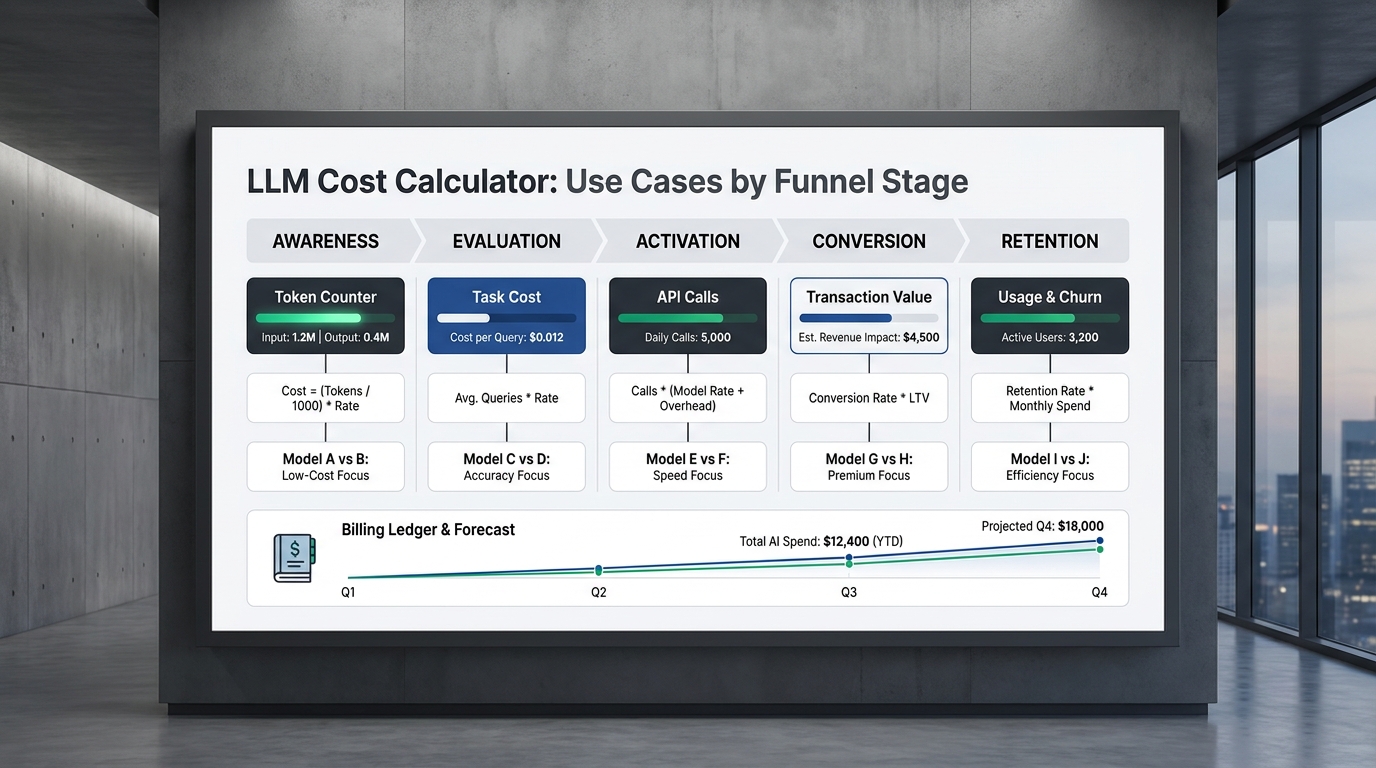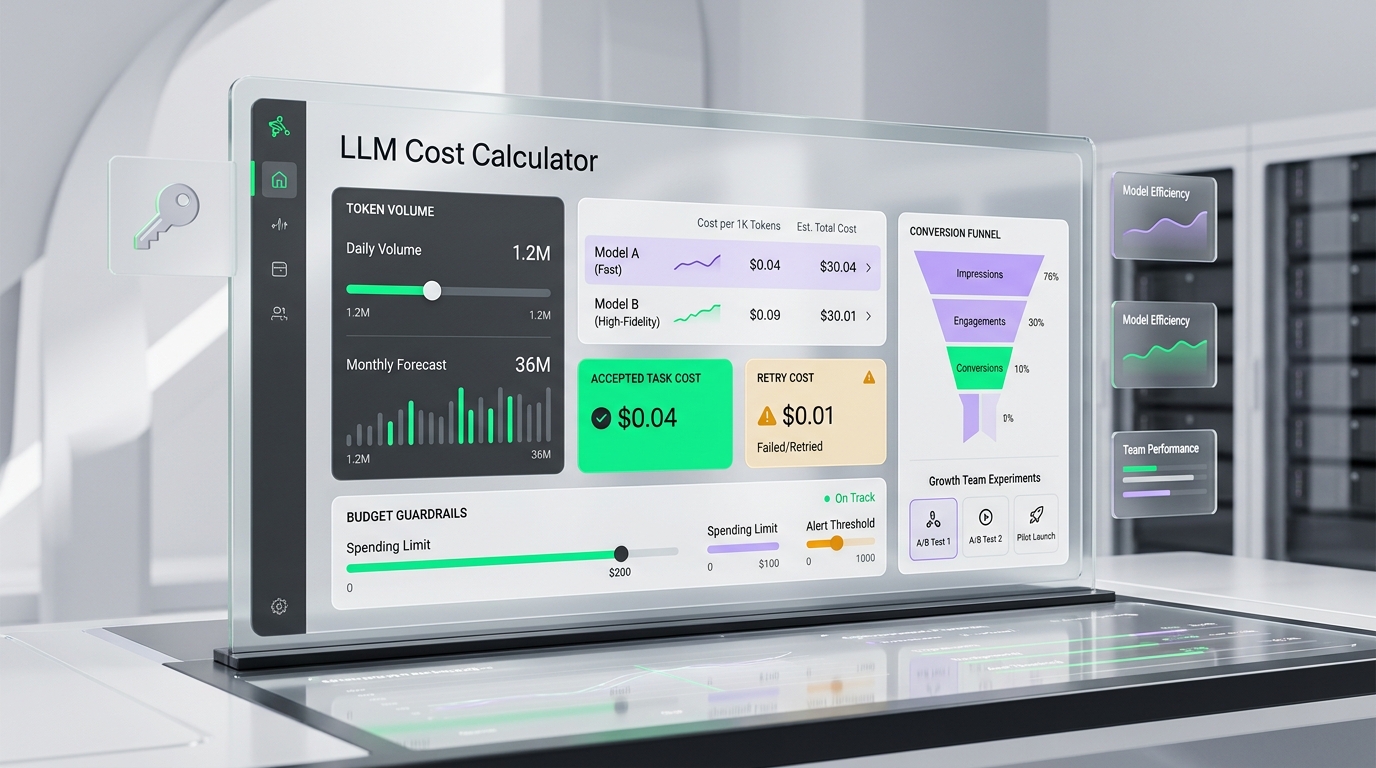
The cheapest model on a pricing page is not always the cheapest model in production. A lower input-token rate can be erased by longer outputs, weak cache reuse, retries, slower responses, or a quality drop that forces a second model call.
That is why the right way to compare AI model prices is to measure the cost of completing your workload successfully—not the cost of buying one million tokens in isolation.
This guide gives founders and engineers a practical evaluation framework to use before switching AI API providers. It covers headline prices, cache behavior, batch discounts, workload quality, latency, reliability, migration effort, and a worksheet you can reuse during monthly model reviews.
Start With Effective Cost per Successful Task
When teams first learn how to compare AI model prices, they often build a table with three columns: model, input price, and output price. That table is useful for discovery, but it is not a buying decision.
The more useful metric is:
Effective cost per successful task = total evaluation spend ÷ accepted task results
Suppose Model A appears 30% cheaper per token than Model B. If Model A needs more retries, produces longer answers, or fails your acceptance checks more often, its effective cost can be higher.
For each candidate, track:
- total input, cached-input, and output tokens;
- any reasoning, tool, image, audio, or search charges;
- successful responses and accepted outputs;
- retries, timeouts, rate-limit failures, and fallback calls;
- median and tail latency;
- engineering time required to migrate and operate the route.
This changes the question from “Which model has the lowest rate?” to “Which model completes this job at the best cost, quality, and operational risk?”
In other words, how to compare AI model prices is a workload measurement problem before it is a procurement problem.
Normalize the Price Units Before You Compare
Provider pricing pages do not always describe the same billable events in the same way. Before you compare AI model prices, convert every candidate into a common worksheet.
Any repeatable process for how to compare AI model prices must normalize these units before ranking candidates.
1. Separate input, cached input, and output
Input and output tokens usually have different rates. Cached input may have a lower read rate, while creating or writing a cache can have its own price or retention rules.
Do not enter one blended “token price.” Record these separately:
| Cost field | What to capture |
|---|---|
| Input | Uncached prompt tokens and the provider's billing unit |
| Cache write | Tokens charged when reusable context enters a cache |
| Cache read | Tokens served from cache and the applicable discount |
| Output | Visible generated tokens |
| Reasoning | Any separately reported or billable reasoning tokens |
| Tools and media | Search, code execution, images, audio, video, or other unit-based fees |
OpenAI, Anthropic, and Google each publish model pricing and caching details, but the mechanics differ. Read the current provider documentation instead of assuming that “cached input” means the same behavior everywhere.
2. Keep synchronous and batch work separate
Batch or asynchronous APIs can reduce cost for work that does not need an immediate response. They can also change completion windows, operational handling, and failure recovery.
A support chatbot and an overnight classification job should not use the same pricing assumption. Compare real-time traffic with real-time rates, and batchable traffic with the provider's current batch terms.
3. Separate modalities
Text tokens, generated images, audio seconds, and video seconds are different units. Do not hide them inside one “cost per request” number unless the request mix is fixed and documented.
If your product uses multiple modalities, build one cost model for each workload and then combine them using expected production volume.
4. Record context-window and output limits
A model may look inexpensive but require prompt truncation, document chunking, or multiple calls for your workload. Record the usable context window, maximum output, structured-output support, and tool constraints alongside price.
Model Your Actual Cache Behavior
Cache pricing is one of the biggest reasons a headline price comparison can mislead you.
To compare AI model prices accurately, estimate how much of your input is stable across requests. Examples include system instructions, a product catalog, a coding repository summary, a policy handbook, or a long few-shot prefix.
Use this formula for a simplified request:
request cost =
  (uncached input tokens × input rate)
  + (cache-write tokens × cache-write rate)
  + (cache-read tokens × cache-read rate)
  + (output tokens × output rate)
  + other billable units
Then test at least three cache scenarios:
| Scenario | Cache assumption | Why it matters |
|---|---|---|
| Cold | 0% reuse | New tenants, changed prefixes, or expired cache entries |
| Expected | Observed reuse from a representative traffic sample | Best estimate for normal production |
| Warm | High reuse | Stable prefixes and concentrated repeated traffic |
Do not use a warm-cache assumption for every request. Cache keys, minimum token thresholds, retention windows, prefix changes, and traffic distribution can all reduce the realized hit rate.
The safe decision is based on observed cache telemetry, not the maximum advertised discount.
This is a crucial part of how to compare AI model prices for applications with long, repeated prompt prefixes.
Build a Representative Evaluation Set
A useful AI model evaluation framework starts with production-shaped tasks. Public benchmarks can help you discover candidates, but they rarely match your prompt design, documents, tools, output schema, languages, or failure costs.
Create an evaluation set with four parts:
- Common tasks: the requests that create most of your volume.
- Hard tasks: the cases that require deeper reasoning or better instruction following.
- Risk tasks: prompts where hallucination, formatting failure, or unsafe output has a high cost.
- Edge tasks: long context, multilingual content, tool calls, unusual formatting, or sparse data.
For a narrow workflow, 50 to 100 carefully selected cases can be more useful than thousands of generic prompts. For a broad assistant, use a larger stratified set and report results by task class instead of hiding variation in one average.
Keep prompts, sampling settings, tool definitions, and output limits consistent across candidates. If a provider requires a different prompt format, document that difference as migration effort rather than quietly changing the test.
That controlled test set is the foundation for how to compare AI model prices without confusing a prompt change with a model improvement.
Define “Successful” Before Running the Test
You cannot calculate effective cost per successful task until you define success.
Use acceptance criteria that match the workload:
- Extraction: required fields present, valid schema, and field-level accuracy.
- Classification: precision, recall, or a reviewed confusion matrix.
- Code generation: tests pass, security checks pass, and the patch stays within scope.
- Customer support: grounded answer, correct policy use, useful tone, and no fabricated action.
- Agents: tool selection, argument validity, task completion, and recovery from tool errors.
- Content generation: factual support, brand fit, revision rate, and editor acceptance.
Use deterministic checks where possible. Add blinded human review for qualities that cannot be reduced to a test. If reviewers know which model produced an answer, brand expectations can distort the result.
Measure Latency and Reliability as Cost Inputs
A model that is slightly cheaper but regularly misses your latency target may reduce conversion or force you to build a more complex fallback system.
Track:
- time to first token;
- total response time;
- p50, p95, and p99 latency;
- timeout rate;
- 429 and 5xx rates;
- retry count;
- fallback frequency;
- incomplete or malformed response rate.
Rate limits belong in the same evaluation. A provider may offer an attractive unit price but insufficient requests per minute, tokens per minute, concurrency, or account-level capacity for your launch plan.
Run both an isolated quality test and a controlled load test. The isolated test tells you what the model can do. The load test tells you whether the provider can deliver it under your expected traffic pattern.
Capacity testing belongs in how to compare AI model prices because failed or delayed requests still create business and engineering costs.
Include Migration and Operating Costs
Teams learning how to compare AI model prices often ignore the one-time and recurring costs outside the API invoice.
Add these fields to the decision:
| Cost area | Questions to answer |
|---|---|
| API compatibility | Can you change a base URL and model ID, or must you rewrite request logic? |
| Tool calling | Do tool schemas, parallel calls, or result messages behave differently? |
| Structured output | Are your JSON schemas supported consistently? |
| Streaming | Will the client and UI handle the provider's event format? |
| Observability | Can you attribute usage, errors, latency, and cost by route or workload? |
| Governance | Do key controls, audit requirements, and data policies fit your organization? |
| Fallbacks | Can you switch models without duplicating provider-specific code? |
Estimate migration engineering hours, test maintenance, and the expected monthly operational burden. A small rate advantage may not justify a risky rewrite. Conversely, a compatible route with strong observability can make ongoing model reviews much cheaper.
Use a Weighted Decision Score—But Keep the Raw Metrics
After collecting the raw results, create a weighted score that reflects the workload.
Weights make how to compare AI model prices specific to your product instead of forcing every workload into the same definition of value.
Example weights for a production extraction service:
| Dimension | Example weight |
|---|---|
| Accepted-output rate | 35% |
| Effective cost per accepted output | 25% |
| p95 latency | 15% |
| Reliability under load | 15% |
| Migration and operating effort | 10% |
For an interactive coding assistant, quality and latency may deserve more weight. For offline document classification, batch cost and throughput may dominate.
Do not publish only the final score. Keep the raw measurements so stakeholders can see tradeoffs and change the weights without rerunning the evaluation.
A Reusable AI Model Price Comparison Worksheet
Use one row per model and workload combination:
| Field | Candidate A | Candidate B | Candidate C |
|---|---|---|---|
| Uncached input rate | |||
| Cache-write rate | |||
| Cache-read rate | |||
| Output rate | |||
| Other unit charges | |||
| Average uncached input tokens | |||
| Average cached input tokens | |||
| Average output tokens | |||
| Evaluation requests | |||
| Accepted outputs | |||
| Retry and fallback calls | |||
| Total evaluation spend | |||
| Effective cost per accepted output | |||
| p50 / p95 latency | |||
| Error rate | |||
| Migration hours | |||
| Decision notes |
Use these calculations:
acceptance rate = accepted outputs ÷ evaluation requests

effective cost per accepted output =
  (primary model spend + retry spend + fallback spend)
  ÷ accepted outputs

projected monthly cost =
  effective cost per accepted output
  × projected accepted tasks per month
Run sensitivity checks for traffic growth, cache hit rate, output length, and fallback rate. That shows which assumption can reverse the decision.
Common Mistakes When Comparing AI Model Prices
Choosing from a single prompt
One impressive response is a demo, not an evaluation. Use a representative set and report variance.
Comparing only input-token prices
Output tokens, cache mechanics, retries, and tools can dominate the final invoice.
Using maximum cache discounts as expected savings
Measure cache reuse under your own prompt structure and traffic distribution.
Ignoring output length
Two models can answer correctly while one generates twice as many billable output tokens.
Treating rate limits as a later problem
Capacity constraints can turn an inexpensive model into an unreliable production dependency.
Switching every workload at once
The best model can vary by task. Migrate one workload, add a rollback path, and keep the evaluation repeatable.
Where Flatkey Fits in the Evaluation Workflow
Flatkey provides access to a broad model catalog through one API key and gives teams usage visibility across their AI workloads. That makes it easier to move from a static AI model pricing comparison to repeated workload tests without rebuilding every integration around a separate provider account.
Start with the live Flatkey pricing page to review available models and current pricing. Then use the AI model pricing comparison for a current market-level view. This article's framework helps you turn those headline rates into a production decision.
The objective is not to switch providers more often. It is to make switching safer when the evidence supports it.
Final Checklist Before You Switch
Before changing a production route, confirm that you have:
- compared the current provider documentation on the same date;
- normalized input, output, cache, batch, tool, and modality charges;
- tested representative, hard, risk, and edge cases;
- defined acceptance criteria before reviewing outputs;
- calculated effective cost per successful task;
- measured latency, errors, rate limits, retries, and fallbacks;
- estimated migration and recurring operating costs;
- run sensitivity checks for volume and cache behavior;
- prepared a staged rollout, observability, and rollback plan.
That is how to compare AI model prices without optimizing the wrong number.
Frequently Asked Questions
What is the best metric for comparing AI model costs?
Use effective cost per successful task. It includes the primary call, retries, fallback spend, and the percentage of outputs that meet your acceptance criteria.
How often should teams compare AI model prices?
Review headline prices monthly and rerun workload evaluations when a major model, price, prompt, traffic pattern, or product requirement changes.
Should cached input be included in every comparison?
Yes, if your workload reuses a meaningful prompt prefix or context. Model cold, expected, and warm-cache scenarios instead of assuming the maximum cache discount applies to all traffic.
Are public AI benchmarks enough to choose an API provider?
No. Public benchmarks are useful for candidate discovery, but production selection should use your prompts, tools, data, languages, schemas, latency targets, and acceptance criteria.
Should one model handle every workload?
Not necessarily. Different workloads can favor different combinations of quality, latency, context size, tool behavior, and price. Evaluate and route by workload when the operational complexity is justified.
Primary Sources for Current Provider Terms
- OpenAI API pricing
- OpenAI Batch API guide
- Anthropic pricing documentation
- Anthropic prompt caching documentation
- Google Gemini API pricing
- Google Gemini context caching
- Amazon Bedrock model evaluation
Provider terms can change. Recheck each source on the day you run the evaluation.