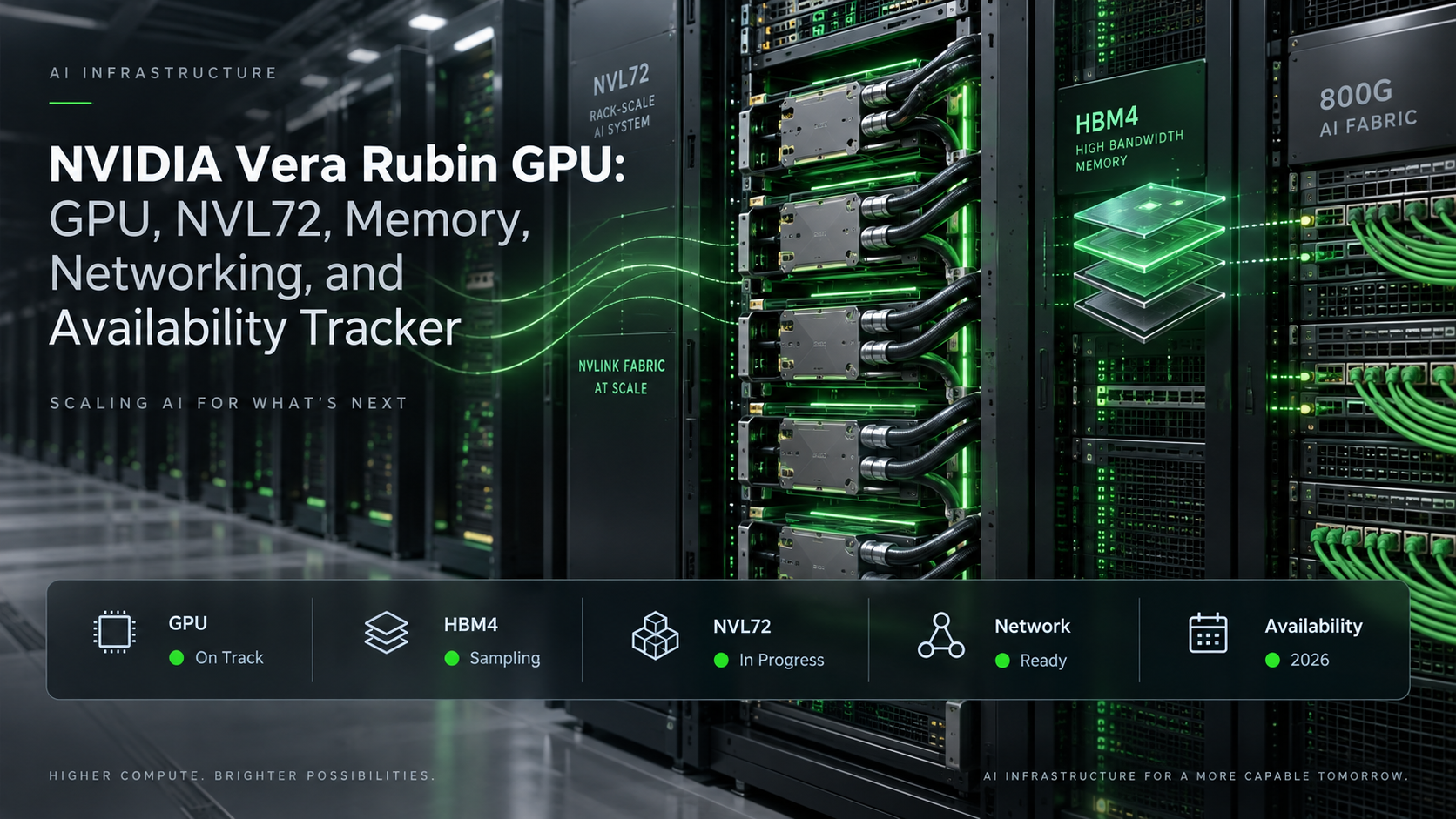
NVIDIA Vera Rubin GPU: GPU, NVL72, Memory, Networking, and Availability Tracker
The NVIDIA Vera Rubin GPU is not just a single accelerator to slot into a familiar server. NVIDIA is positioning Vera Rubin as a rack-scale and POD-scale AI factory platform for agentic workloads: more GPU memory, faster memory bandwidth, tighter scale-up fabric, and a networking stack designed for very large training and inference clusters.
For cloud GPU buyers, that changes the question. The question is not only "what are the NVIDIA Vera Rubin GPU specs?" It is also: when will Vera Rubin systems be available, what does NVL72 mean, how much HBM4 memory is exposed at rack scale, what networking is required, and when does it make more sense to use a model API while waiting for capacity?
This tracker summarizes what NVIDIA has publicly disclosed as of October 13, 2026 and separates confirmed specs from procurement assumptions.
Quick Answer: What Is NVIDIA Vera Rubin GPU?
The NVIDIA Vera Rubin GPU is the GPU generation inside NVIDIA's Vera Rubin platform, the successor platform after Grace Blackwell for large-scale AI factories. In NVIDIA's DGX Vera Rubin NVL72 system, the rack combines 72 NVIDIA Rubin GPUs with 36 NVIDIA Vera CPUs, 20.7 TB of HBM4 GPU memory, and 1,400 TB/s aggregate GPU memory bandwidth. NVIDIA labels these DGX Vera Rubin NVL72 specs as preliminary and subject to change, so procurement models should keep a tracked revision date.
NVIDIA also announced on May 31, 2026 that the Vera Rubin platform was ramping into full production, with production shipments set to begin starting in fall 2026. That matters for buyers because the first wave is likely to appear as integrated systems and cloud capacity before it becomes a simple "pick a GPU SKU" decision.
NVIDIA Vera Rubin GPU Tracker
| Field | Current Public Status | Why It Matters |
|---|---|---|
| GPU generation | Rubin GPUs in Vera Rubin systems | Successor platform for post-Blackwell AI factory deployments. |
| Rack form factor | DGX Vera Rubin NVL72 | Treat as rack-scale infrastructure, not a commodity PCIe GPU node. |
| GPU count per NVL72 | 72 Rubin GPUs | Defines the scale-up domain for one rack system. |
| CPU pairing | 36 Vera CPUs | CPU/GPU balance is part of the platform design. |
| GPU memory | 20.7 TB HBM4 per DGX Vera Rubin NVL72 | Key constraint for long-context inference, large MoE models, and training checkpoints. |
| Memory bandwidth | 1,400 TB/s aggregate GPU memory bandwidth | Memory bandwidth is often the limit before raw FLOPS for inference workloads. |
| Stated dense performance | 3,600 PFLOPS NVFP4 inference; 2,520 PFLOPS NVFP4 training; 1,260 PFLOPS FP8/FP6 training | Useful for platform comparison, but benchmark acceptance should use workload-specific tokens/sec and cost per accepted output. |
| Scale-up fabric | 9 L1 NVIDIA NVLink switches in the DGX Vera Rubin NVL72 spec | Determines how tightly the GPUs can operate as a single large compute domain. |
| Scale-out networking | More than 144 single-port ConnectX-9 VPI adapters at 800 Gb/s InfiniBand/Ethernet, plus 18 dual-port BlueField-4 VPI adapters at 400 Gb/s | Capacity planners need networking, cabling, power, security, and tenancy assumptions, not just GPU count. |
| Production status | Ramping into full production; shipments starting fall 2026 according to NVIDIA's May 31, 2026 release | Treat early availability as supply-chain and cloud-region dependent. |
NVIDIA Vera Rubin GPU Architecture: What Changes
The most important NVIDIA Vera Rubin GPU architecture shift is that the useful unit of analysis moves upward. With H100 or A100, many teams compared individual GPU instances. With GB200 and now Vera Rubin, buyers increasingly compare full rack systems, PODs, networking fabrics, and facility constraints.
That shift is visible in DGX Vera Rubin NVL72. A single rack-level system exposes 72 Rubin GPUs and 36 Vera CPUs. The platform is built for models that need fast communication across many accelerators: long-context inference, multi-step agent reasoning, post-training, reinforcement learning, synthetic data loops, and frontier model training.
For AI infrastructure teams, that means the NVIDIA Vera Rubin GPU should be evaluated across five layers:
- GPU compute: FLOPS by precision, kernel support, and framework maturity.
- HBM4 memory: usable memory per model replica, memory bandwidth, and KV cache capacity.
- NVLink domain: how much of the rack behaves like one tightly coupled accelerator pool.
- Scale-out fabric: how racks communicate across InfiniBand, Ethernet, Spectrum-X, or cloud provider fabric.
- Operations layer: orchestration, telemetry, cooling, failure domains, tenant isolation, and software support.
If your workload only needs hosted model calls, that stack may be more infrastructure than you want to own. If your workload needs custom model training, proprietary weights, low-level scheduler control, or fleet-level inference economics, Vera Rubin becomes a serious watchlist item.
NVIDIA Vera Rubin GPU Specs: What Is Confirmed
NVIDIA's DGX Vera Rubin NVL72 page currently lists these preliminary specs:
| Spec | DGX Vera Rubin NVL72 Public Figure |
|---|---|
| GPU and CPU | 72 NVIDIA Rubin GPUs and 36 NVIDIA Vera CPUs |
| Total GPU memory | 20.7 TB HBM4 |
| Aggregate GPU memory bandwidth | 1,400 TB/s |
| NVFP4 inference | 3,600 PFLOPS |
| NVFP4 training | 2,520 PFLOPS |
| FP8/FP6 training | 1,260 PFLOPS |
| NVLink switch system | 9 L1 NVIDIA NVLink switches |
| Front-end / scale-out adapters | 144+ ConnectX-9 VPI single-port adapters at 800 Gb/s InfiniBand/Ethernet |
| DPU / infrastructure adapters | 18 dual-port BlueField-4 VPI adapters at 400 Gb/s InfiniBand/Ethernet |
| Software | NVIDIA Mission Control, NVIDIA AI Enterprise, NVIDIA DGX OS |
| Support | Three years of enterprise business-standard support |
The "preliminary information" note is important. It does not make the NVIDIA Vera Rubin GPU spec sheet unusable; it means every budget model should include a "last verified" field and a refresh workflow before signing a capacity contract.
Why HBM4 Is the Spec to Watch
The secondary keyword "nvidia vera rubin gpu hbm4" is important because HBM4 changes the practical ceiling for inference and training workloads. Large models rarely fail because a theoretical FLOPS number is too low. They fail because the deployment cannot keep enough parameters, activations, KV cache, and routing state close to the compute units.
For inference, HBM4 affects:
- Long context: more room for KV cache before spilling or reducing batch size.
- Agentic workloads: more concurrent reasoning steps and tool-call state per model replica.
- MoE routing: better headroom for active experts and memory-bound routing paths.
- Batch economics: higher tokens/sec only matters if accepted output quality and latency stay inside the SLA.
For training and post-training, HBM4 affects checkpoint size, activation strategies, optimizer state placement, and how much communication overhead shows up when the job spans racks. A Vera Rubin procurement brief should therefore ask for memory-bandwidth and interconnect evidence alongside raw GPU pricing.
What NVL72 Means for Rack Buyers
The "nvidia vera rubin gpu rack" query usually comes from buyers trying to map a chip announcement to real infrastructure. In NVIDIA's naming, NVL72 is a rack-scale system with 72 GPUs connected through the NVLink switch system. That scale-up fabric is why the platform is more relevant to AI factory planning than to small, single-node GPU shopping.
For a cloud GPU or colocation team, NVL72 changes the operating checklist:
| Planning Area | Question to Ask |
|---|---|
| Power and cooling | Can the facility support the rack density, liquid-cooling assumptions, and service model? |
| Network topology | Is the provider offering the advertised InfiniBand/Ethernet fabric, or only isolated GPU instances? |
| Failure domain | What happens when one tray, switch, adapter, or rack fails during a multi-day job? |
| Scheduling | Can the scheduler reserve full NVL72 topology, or does it fragment GPU placement? |
| Storage | Can the storage path feed the rack without becoming the bottleneck? |
| Tenant isolation | How are BlueField, network policy, encryption, and multi-tenant boundaries configured? |
| Acceptance tests | Which workload-specific tokens/sec, step time, checkpoint, and recovery tests must pass before production? |
This is why Vera Rubin should sit next to your GPU cluster TCO worksheet, not just your GPU spec comparison table.
Availability Tracker: What Is Publicly Known
NVIDIA's May 31, 2026 Newsroom release says Vera Rubin is ramping into full production and that production shipments are set to begin starting in fall 2026. It also names server makers, storage partners, cloud providers, and ecosystem participants connected to the ramp.
That does not mean every buyer can rent an NVIDIA Vera Rubin GPU instance on day one. "Full production" and "available in the region, topology, quota, reservation term, and software stack you need" are different milestones.
Use this availability tracker when speaking with providers:
| Milestone | What to Confirm |
|---|---|
| Silicon / system production | Is the provider receiving Vera Rubin systems or only announcing future support? |
| Rack topology | Is capacity sold as full NVL72, partial rack, single tenant cluster, or shared GPU instances? |
| Region | Which cloud regions or colocation sites have physical inventory? |
| Network mode | InfiniBand, Ethernet, Spectrum-X, or provider-specific fabric? |
| Software stack | CUDA, drivers, Kubernetes, Slurm, vLLM, SGLang, NCCL, observability, and supported images. |
| Reservation model | On-demand, committed capacity, private cluster, managed service, or benchmark-only preview. |
| Acceptance window | Can you run a production-shaped benchmark before a long-term commitment? |
If your team is still deciding whether to wait, compare Vera Rubin availability against a GPU cloud vs model API baseline. The managed model API path may be faster for products that need output quality and uptime now, while Vera Rubin is more attractive for teams that need direct control over proprietary training or inference infrastructure.
Vera Rubin vs Blackwell: The Practical Difference
Most teams should not frame Vera Rubin as "Blackwell but newer." The practical difference is the platform target.
Blackwell systems such as GB200 and GB300 pushed rack-scale inference and training forward for reasoning workloads. Vera Rubin continues that rack-scale direction with Rubin GPUs, Vera CPUs, HBM4, and a larger platform story around agentic AI factories. NVIDIA states that Vera Rubin delivers 10x agent throughput at scale compared with the previous-generation Grace Blackwell platform, but buyers should still validate this with their own model, context length, routing pattern, and tool-call profile.
If you are comparing current procurement options, read Vera Rubin alongside GB200 vs B200. The useful question is not "which chip is newer?" It is "which topology is available, benchmarked, and financially defensible for my workload window?"
When to Wait for NVIDIA Vera Rubin GPU Capacity
Waiting for NVIDIA Vera Rubin GPU capacity can make sense when:
- You train or post-train large proprietary models and need full-stack hardware control.
- Your inference workload is memory-bound and HBM4 capacity changes the batch, latency, or context-length ceiling.
- You can reserve rack-scale topology rather than fragmented GPU instances.
- You have facilities, scheduler, storage, network, and reliability teams ready to operate the stack.
- Your procurement window aligns with fall 2026 and later capacity ramps.
Waiting is riskier when:
- You need production capacity immediately.
- Your workload can use hosted frontier or open models through APIs.
- You do not control enough utilization to amortize rack-scale infrastructure.
- Your main bottleneck is application routing, evaluation, reliability, or cost attribution rather than raw GPU access.
- You cannot run acceptance benchmarks before committing.
For many product teams, the most pragmatic path is hybrid: use model APIs for user-facing production workloads now, run benchmarks on available GPU clouds, and reserve Vera Rubin only when the benchmark proves a lower cost per accepted output.
Procurement Checklist for Vera Rubin Capacity
Before buying or reserving Vera Rubin capacity, ask the provider for:
- Exact system topology: NVL72, POD, partial rack, or instance abstraction.
- GPU memory available to the workload, not just nominal HBM4 per rack.
- Network fabric details: InfiniBand, Ethernet, Spectrum-X, oversubscription, and cross-rack policy.
- Driver, CUDA, NCCL, scheduler, and container image versions.
- Storage throughput, checkpoint restore time, and failure recovery process.
- Benchmark window using your own model, prompt mix, context length, and acceptance criteria.
- Pricing basis: hourly, reserved, committed, private cluster, managed platform, or enterprise contract.
- Exit terms if public specs, delivery date, or benchmark results change.
- Observability: per-job GPU utilization, memory bandwidth, network counters, queue time, and cost allocation.
- Security controls: tenant isolation, encryption, confidential computing claims, and audit artifacts.
Pair that checklist with your GPU rental prices model and GPU cluster rental guide so the decision includes queue time, utilization, egress, staff time, and failed-run cost.
Flatkey Take: Use Hardware When You Need Hardware Control
The NVIDIA Vera Rubin GPU is important because it raises the ceiling for teams building or renting serious AI factory infrastructure. It is not automatically the fastest path for every AI product team.
If you need direct hardware control, custom training, low-level scheduling, or dedicated rack topology, track Vera Rubin closely and insist on production-shaped benchmarks. If your product needs reliable access to model outputs, cost visibility, and provider flexibility, a managed model/API layer can keep the roadmap moving while hardware supply matures.
Flatkey is built for that second path: one key, one balance, and routing across official model and tool APIs. Use it as the managed-model baseline in your Vera Rubin analysis so you are comparing rack-scale GPU ownership against a working production alternative, not against a blank spreadsheet.
FAQ
What is NVIDIA Vera Rubin GPU?
The NVIDIA Vera Rubin GPU is the Rubin-generation GPU inside NVIDIA's Vera Rubin AI factory platform. In DGX Vera Rubin NVL72, NVIDIA pairs 72 Rubin GPUs with 36 Vera CPUs, HBM4 memory, NVLink switching, high-speed networking, and enterprise DGX software.
What are the NVIDIA Vera Rubin GPU specs?
The public DGX Vera Rubin NVL72 preliminary specs include 72 Rubin GPUs, 36 Vera CPUs, 20.7 TB HBM4, 1,400 TB/s aggregate GPU memory bandwidth, 3,600 PFLOPS NVFP4 inference, and 9 L1 NVLink switches. NVIDIA marks these values as preliminary and subject to change.
When will NVIDIA Vera Rubin GPU systems be available?
NVIDIA announced on May 31, 2026 that Vera Rubin was ramping into full production and that production shipments were set to begin starting in fall 2026. Real availability will still depend on provider inventory, region, topology, and contract terms.
Is Vera Rubin a single GPU or a rack system?
Searchers often say "NVIDIA Vera Rubin GPU," but buyers should evaluate it as a platform. The key public system is DGX Vera Rubin NVL72, a rack-scale system with 72 Rubin GPUs, Vera CPUs, NVLink switching, networking, and software.
Should I wait for Vera Rubin or use a model API?
Wait for Vera Rubin if your workload needs direct hardware control, proprietary training, or rack-scale topology. Use a model API if you need production output now and your main constraints are reliability, routing, billing, and evaluation rather than owning GPU infrastructure.
Sources Checked
- NVIDIA DGX Vera Rubin NVL72 product page and specs: https://www.nvidia.com/en-us/data-center/dgx-vera-rubin-nvl72/
- NVIDIA Newsroom, "NVIDIA Vera Rubin Ramps Into Full Production to Power Agentic AI Factories Worldwide," May 31, 2026: https://nvidianews.nvidia.com/news/vera-rubin-full-production-agentic-ai-factory
- Flatkey Cloud GPU topic map and campaign context:
seo/flatkey-cloud-gpu-topic-map-current.csv