Model fallback quality testing is the work that proves a backup model can handle a workflow before a router sends customer traffic to it. A cheaper model may be fast enough. A faster model may be available. Neither is automatically equivalent to the primary route.
That gap matters when fallback moves from an uptime tactic to a production policy. A fallback can change facts, tone, tool calls, JSON shape, refusal behavior, token usage, provider account, and audit evidence. The route may succeed technically while the user receives a worse answer or finance sees spend move into the wrong budget.
Flatkey helps teams centralize model access, pricing review, usage visibility, and routing through one gateway. Keep the quality decision just as centralized: before a fallback route goes live, define the regression budget, run the same representative tasks through each candidate, and keep the result with your routing and billing evidence.
Quick Answer: Model Fallback Quality Testing Gate
Use this model fallback quality testing gate before enabling automatic fallback for a workflow. Every row needs an owner, a pass condition, and a stop condition.
| Gate | Pass Test | Block Fallback If | Evidence To Keep |
|---|---|---|---|
| Task quality | Fallback outputs meet the workflow's eval criteria within the approved regression budget. | Facts, citations, tone, refusal posture, or final decisions drift beyond the approved limit. | Eval dataset, grader results, reviewer notes, failure examples, approval scope. |
| Schema and tools | Required JSON, tool selection, arguments, side effects, and final response format match production expectations. | Arguments fail validation, tools are missing, duplicate side effects are possible, or schema success hides bad content. | Schema tests, tool-call transcripts, idempotency notes, replay rules. |
| Cost and quota | Fallback cost, context use, retry count, and quota owner are approved before traffic moves. | The route silently changes provider budget, account owner, modality unit, or max request cost. | Pricing snapshot, usage estimate, budget owner, request caps, fallback attempt cap. |
| Latency and streaming | Fallback starts before user-visible output or the product has an explicit restart path. | The route switches after partial output, after a tool side effect, or after a policy block. | First-output timestamp, stream state, side-effect state, final disposition. |
| Data boundary | Provider, account, region, logging mode, and policy handling are approved for the same data class. | Fallback crosses an unapproved provider, account, retention, security, or customer boundary. | Data classification, approved route list, logging mode, policy reviewer signoff. |
| Observability | Operators can reconstruct requested model, selected model, attempts, errors, usage, cost, and final outcome. | A final success hides failed attempts, cost deltas, or why the primary route was skipped. | Request ID, route policy version, attempt chain, usage fields, incident link. |
Why Fallback Uptime Does Not Prove Quality
Official gateway documentation shows why fallback is operationally useful. Cloudflare's AI Gateway docs describe model or provider fallbacks that can trigger after request errors or timeouts, with a response header indicating which step handled the request. Vercel's AI Gateway docs describe ordered model fallbacks and provider metadata that can show each model and provider attempt.
Those mechanisms answer an uptime question: did a backup route serve the request? They do not answer the product question: did that backup route produce an answer that is equivalent enough for this workflow? Model fallback quality testing fills that gap by evaluating the actual task, not just the HTTP status.
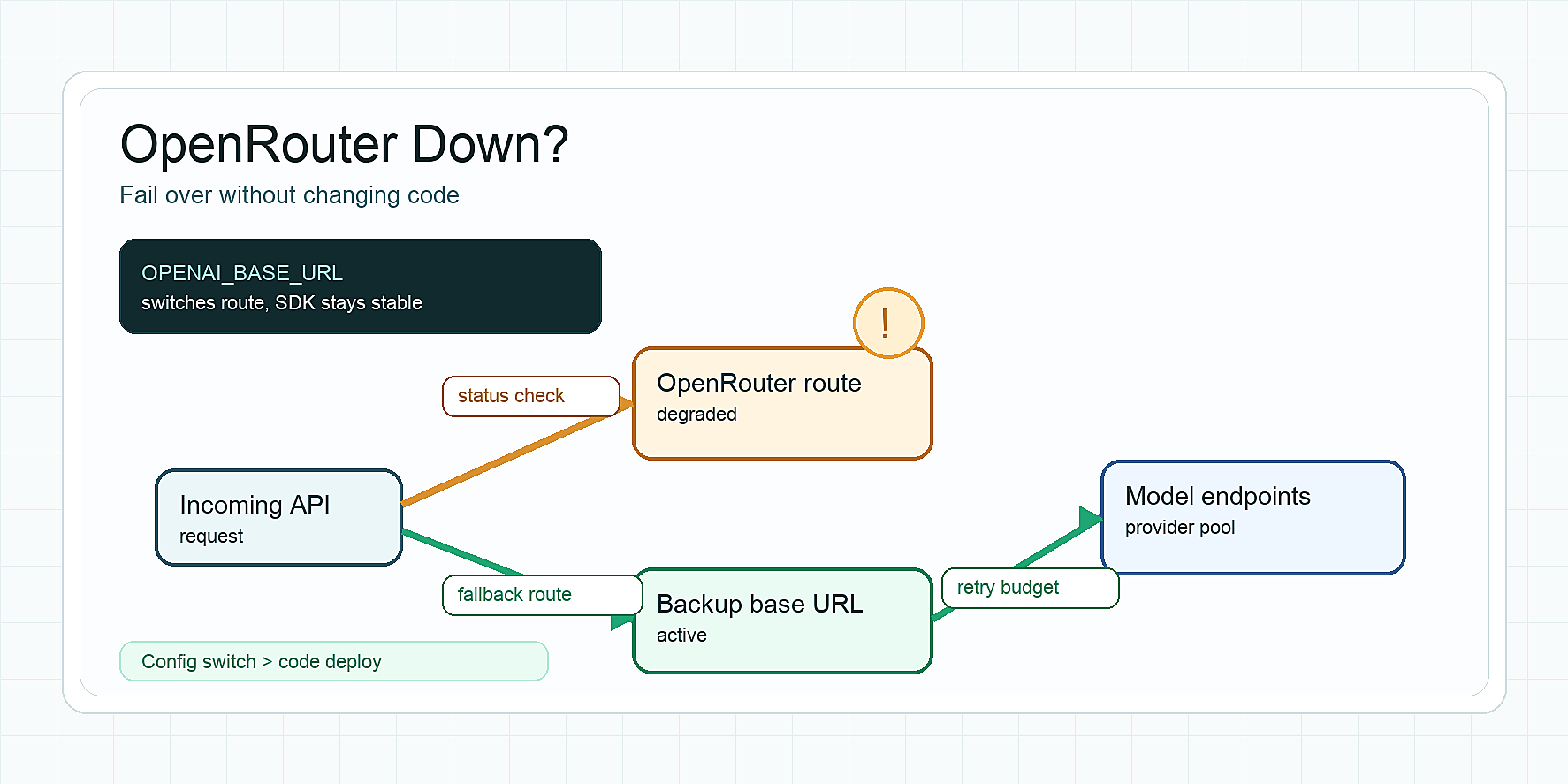
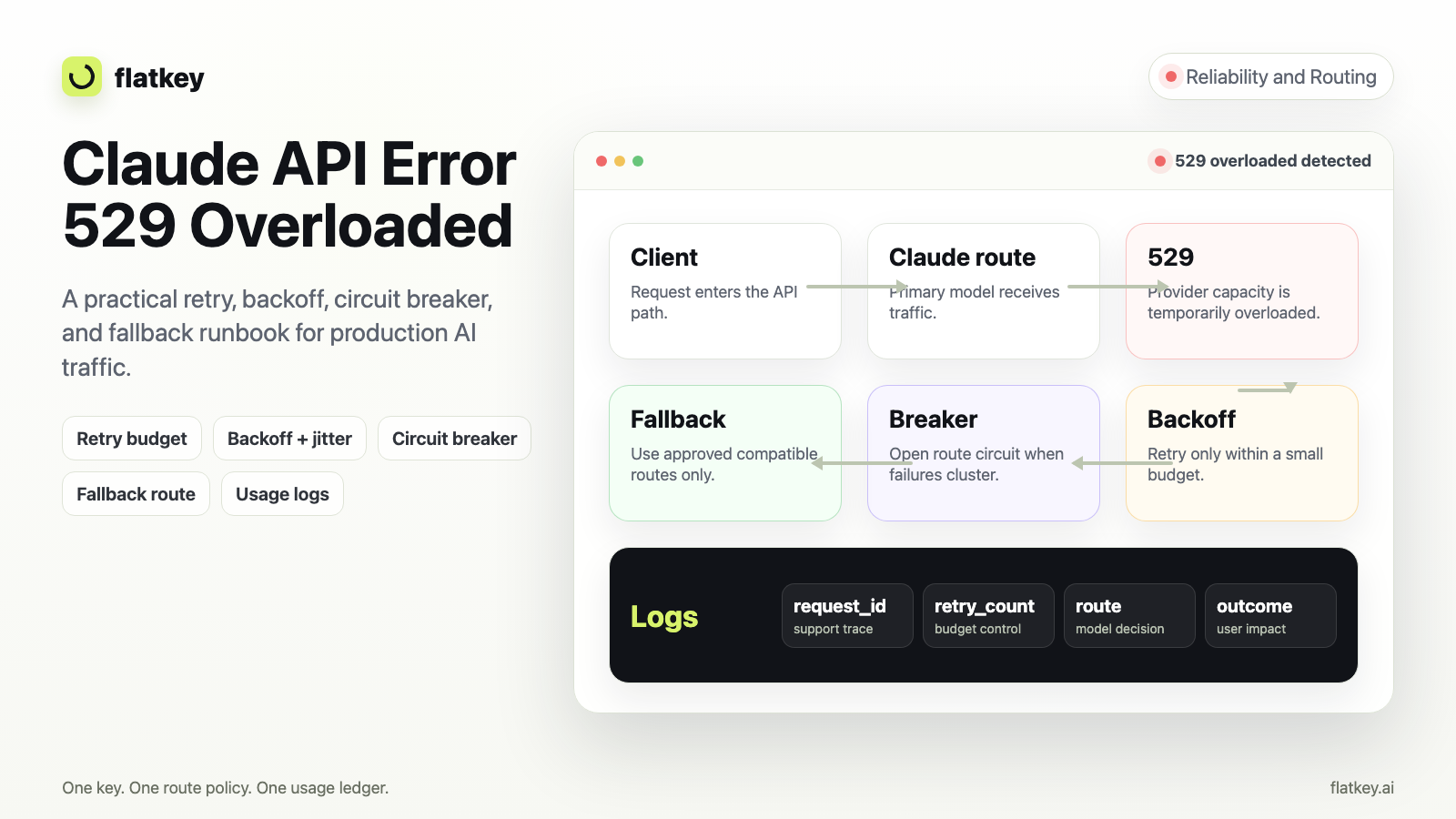
The safest fallback policy separates three decisions: retry the same route, switch to an approved backup model, or fail closed. A provider error may justify fallback. A malformed request, auth failure, policy block, unsupported tool, or exhausted budget usually should not.
Set A Regression Budget Before Testing
A fallback candidate should not be judged by a vague "looks fine" review. Start with a regression budget: the exact amount of quality, latency, cost, and behavior change that product and engineering accept for one workflow.
| Workflow | Regression Budget | Usually Acceptable Fallback | Usually Not Acceptable |
|---|---|---|---|
| Classification or routing label | Small accuracy drop only if high-risk classes stay protected. | Cheaper model with strong label-level evals. | Any fallback that confuses escalation, compliance, billing, or abuse classes. |
| Support answer draft | No unsupported claims, no lost required steps, tone within review range. | Same family or reviewed lower-cost model for low-risk categories. | Different model family for refunds, policy decisions, or sensitive customers without human review. |
| Tool-using agent | No invalid tool arguments, duplicate side effects, or hidden refusal behavior. | Fallback that passes the full tool loop in staging. | Plain text model used as a backup for tool execution without contract tests. |
| Finance extraction | Required fields, amounts, currency, dates, and provenance remain correct. | Fallback with field-level ground truth and manual review for exceptions. | Any fallback that raises hallucinated totals or silently drops uncertainty. |
| Safety or policy review | Safety posture must be equal or stricter than the primary route. | Fail closed or queue for human review. | Routing around a refusal, moderation outcome, DLP block, or access decision. |
This is where model fallback quality testing becomes a launch control. The budget decides whether the backup is automatic, manual, canary-only, staging-only, or blocked.
Build The Eval Set From Production Shapes
OpenAI's eval guidance frames evaluations as tests for model outputs against style and content criteria, especially when trying or upgrading models. Use the same idea for fallback: collect examples that represent the workflow, then compare primary and fallback outputs under repeatable criteria.
A practical fallback eval set should include:
-
Golden examples: normal requests, edge cases, high-value customers, and examples the primary route handles well.
-
Known failures: hallucinations, invalid JSON, missed citations, poor refusals, tool misuse, overlong responses, and brittle prompts.
-
Ground truth: labels, expected fields, required facts, allowed source set, or reviewer-approved answers.
-
Human review lanes: examples where automated graders cannot judge correctness or business impact.
-
Stop conditions: the failures that block automatic fallback even if aggregate pass rate looks acceptable.
Run the primary model, the cheaper candidate, the faster candidate, and any provider-level fallback through the same set. Model fallback quality testing should compare outcomes side by side: pass rate, error class, reason for failure, token usage, latency, and reviewer severity.
Test Tool Calls And Structured Outputs Separately
Do not treat schema success as full quality success. OpenAI's Structured Outputs documentation says schema-based outputs are designed to make responses adhere to a supplied JSON Schema, while also noting that structured outputs can still contain mistakes. The function-calling guide describes tool calling as a multi-step flow: the model receives tools, returns a tool call, your application executes code, and the model receives the tool output before a final answer.
That means fallback tests need separate gates for format, tool behavior, and semantic correctness:
-
Tool choice: the fallback chooses the same required tool or explicitly declines when it should.
-
Arguments: required fields, enums, IDs, and nested objects validate under the same schema.
-
Side effects: duplicate refunds, emails, tickets, and writes are impossible or idempotent.
-
Parallel calls: the fallback handles parallel tool calls, or the policy serializes them safely.
-
Final answer: the user-visible response reflects the tool output and does not invent unsupported facts.
-
Refusals: safety or policy refusals are detectable and do not get bypassed by routing to a weaker fallback.
If a workflow uses tool calls, model fallback quality testing should replay the full loop. A single prompt-output comparison is not enough.
Measure Cost And Latency As First-Class Quality Signals
Cheaper and faster are not the same constraint. A low-cost fallback can be too slow for a chat experience. A fast fallback can spend through a premium quota, use a larger context window, or change modality pricing. Review the current Flatkey pricing page and your usage logs before moving fallback into production.
For each candidate route, capture:
-
Input tokens, output tokens, reasoning tokens when applicable, cache behavior, and max output limits.
-
Provider, model, endpoint family, account owner, team owner, environment, and quota owner.
-
p50, p95, and timeout behavior for normal and degraded paths.
-
Max attempts per request and the worst-case cost if every attempt runs.
-
Whether a fallback is cheaper per unit but more expensive after longer outputs or repeated attempts.
OpenTelemetry's metrics specification describes metrics as a way to capture measurements and connect them with other signals such as traces and logs. Apply that pattern to fallback: the quality result, route attempt chain, latency, usage, and error class should be joinable during an incident review.
Define Streaming And Partial-Output Boundaries
Fallback is cleanest before the user sees output. After the first visible token, a silent route switch can merge two model voices and hide the incident. After a tool side effect, blind replay can create a duplicate action.
Use this default policy:
-
Before first output: fallback can proceed if the error is eligible and the backup passed review.
-
After first output: stop streaming, mark the answer incomplete, and let the user retry explicitly.
-
After a tool side effect: fail closed or use an idempotent recovery path.
-
After a safety or policy block: fail closed. Do not use fallback to bypass the decision.
Pair this with the broader model fallback checklist and the staged rollout approach in LLM router canary release. Fallback quality should be proven in staging and then released gradually, not enabled across all customer traffic in one step.
Keep A Reviewable Attempt Chain
A final 200 response is not enough evidence. Vercel's model-fallback docs show provider metadata with model attempts, provider attempts, status codes, response time, and the successful provider. Cloudflare's fallback docs show a response header that indicates which step succeeded. Those are useful public examples of the evidence shape production teams need.
Your own model fallback quality testing record should preserve at least these fields:
| Field | Why It Matters |
|---|---|
| Policy ID and version | Shows which approved rule allowed or blocked fallback. |
| Requested model and selected model | Separates user intent from router decision. |
| Attempt chain | Shows primary failure, fallback candidate, provider, account, and final disposition. |
| Eval result and reviewer severity | Connects operational success to answer quality. |
| Usage and cost | Lets finance and platform teams see the real price of reliability recovery. |
| Partial-output and side-effect state | Prevents hidden route switches after the user saw output or a tool already ran. |
| Final disposition | One of: primary success, fallback success, queued, user retry required, or fail closed. |
A Flatkey Rollout Plan For Fallback Quality
Use Flatkey as the shared place to review model access, pricing, usage, and routing context, then keep the fallback approval artifact next to the route decision. A conservative rollout looks like this:
-
Pick one workflow: do not approve a fallback model globally because it passed one task.
-
Verify current model and pricing facts: use Flatkey pricing and current route evidence on the day you approve the policy.
-
Choose candidates: include the primary route, a same-family fallback, a cheaper fallback, and a faster fallback when relevant.
-
Run the eval set: compare outputs, schema behavior, tool calls, cost, and latency with the same inputs.
-
Review failures: tag each failure as quality, tool, policy, cost, latency, or observability.
-
Canary the policy: start in staging, then limited internal traffic, then a small production segment if the route has stop conditions.
-
Keep rollback simple: disable fallback automatically or manually if the regression budget is exceeded.
The comparison guides for Claude vs GPT API routing and Gemini vs Claude API routing can help teams think through model-family differences before treating a backup as equivalent.
Fallback Quality Test Record Template
This template is not a Flatkey API contract. It is a review record your team can adapt for a routing policy.
{
  "policy_id": "support-summary-fallback-v1",
  "workflow": "support-summary",
  "environment": "staging",
  "primary_model": "primary-approved-model",
  "fallback_candidate": "cheaper-or-faster-candidate",
  "fallback_scope": {
    "traffic": "internal-canary",
    "max_attempts": 1,
    "allowed_before_first_output_only": true,
    "tool_side_effect_replay": "blocked"
  },
  "regression_budget": {
    "quality_drop_allowed": "none for required facts; minor tone variance allowed",
    "schema_failures_allowed": 0,
    "policy_bypass_allowed": false,
    "max_cost_per_request": "approved-by-owner",
    "p95_latency_limit_ms": "approved-by-owner"
  },
  "test_results": {
    "eval_dataset_version": "2026-07-12",
    "primary_pass_rate": "recorded",
    "fallback_pass_rate": "recorded",
    "critical_failures": [],
    "reviewer": "owner-name"
  },
  "launch_decision": "blocked | staging_only | canary | production",
  "rollback_trigger": "quality, cost, policy, latency, or observability gate fails"
}
Go/No-Go Rule
Approve fallback only when the backup model is good enough for that workflow, not when it is merely available. If the fallback is cheaper but loses required facts, block it. If it is faster but breaks tool calls, block it. If it preserves quality but crosses a policy or budget boundary, block it until the owner approves that boundary.
Model fallback quality testing gives engineering, product, finance, and security the same evidence packet: what changed, why it is allowed, how it will be observed, and when it rolls back.
Flatkey gives teams a practical place to centralize model access, pricing, usage review, and routing operations. Before you turn a fallback path into production behavior, get a key, verify the current model and pricing facts, and attach a fallback quality record to the route.
Sources To Review
-
Flatkey homepage for current one-key gateway, usage, pricing, and routing positioning.
-
Flatkey pricing for current model access and pricing review before fallback approval.
-
OpenAI evals guide for output criteria and model-change evaluation patterns.
-
OpenAI Structured Outputs guide for schema adherence and refusal/mistake handling.
-
OpenAI function calling guide for tool-call flow and schema-based tool definitions.
-
Cloudflare AI Gateway fallbacks and Vercel AI Gateway model fallbacks for public fallback-routing evidence patterns.
-
OpenTelemetry Metrics for metrics, traces, logs, and raw measurement concepts.
FAQ
What is model fallback quality testing?
Model fallback quality testing is the evaluation process for deciding whether a backup model, provider, or route can safely handle a specific production workflow when the primary route fails or is unavailable.
How is fallback quality testing different from uptime testing?
Uptime testing checks whether a request can still be served. Fallback quality testing checks whether the served answer preserves required facts, output shape, tool behavior, cost limits, policy boundaries, and user experience.
Should cheaper or faster fallback models be automatic?
Only after they pass the workflow's regression budget. A cheaper or faster model may be automatic for low-risk classification, but blocked or human-reviewed for policy, finance, support, or tool-using workflows.
What evidence should teams keep?
Keep the eval dataset version, pass/fail criteria, reviewer notes, pricing snapshot, usage estimate, route attempt chain, streaming boundary, tool-call transcript, and rollback trigger. That evidence makes fallback decisions reviewable after an incident.