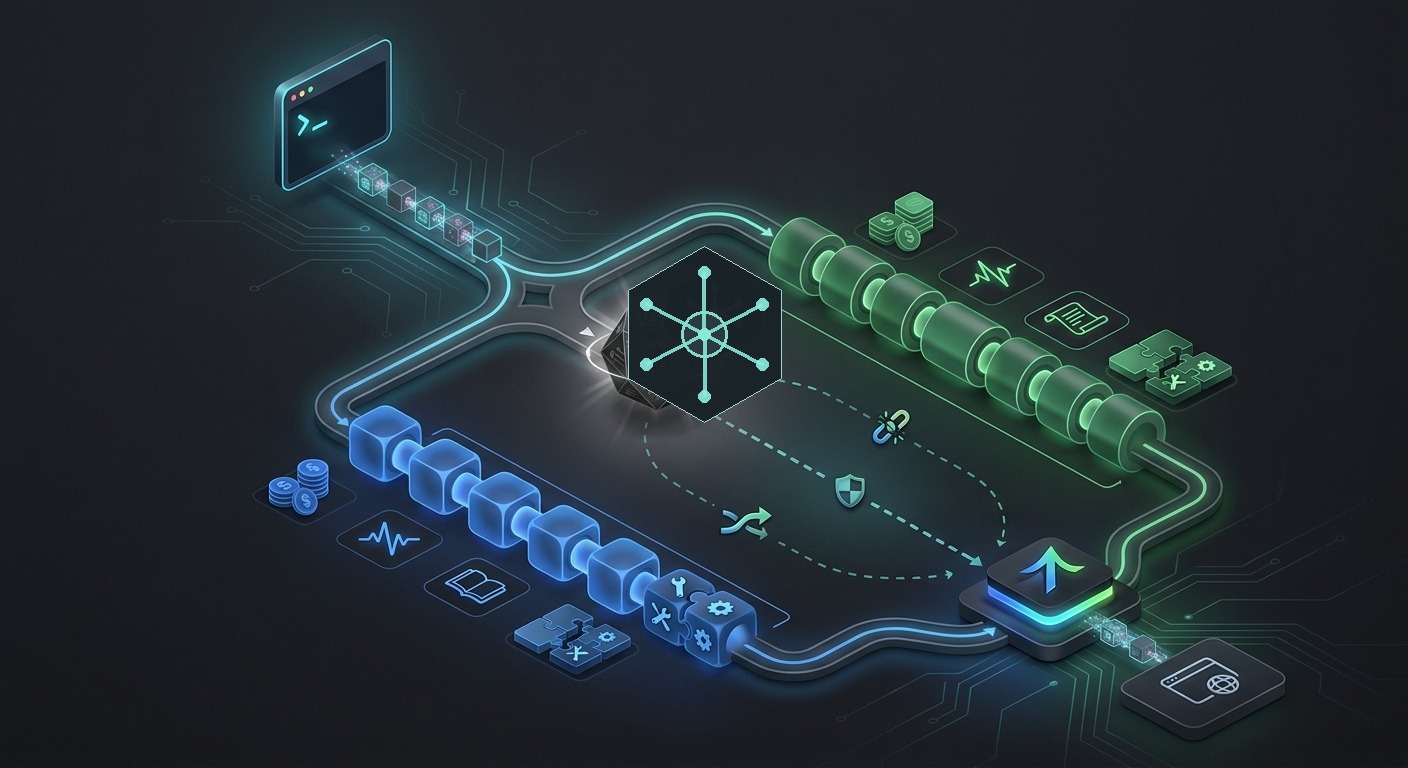
Claude vs GPT API Routing: When to Prefer Provider-Specific Models or a Gateway is not just a model-quality question. It is a production routing question: which requests should stay on a provider-native API, which can run through an OpenAI-compatible route, and which should sit behind a gateway so model choice, billing, logs, and fallback do not spread across every service.
Use direct provider APIs when the workload depends on native behavior from Anthropic or OpenAI. Use a gateway when the bigger problem is operational sprawl: too many keys, invoices, model IDs, status checks, retry rules, and usage reports across teams.
Flatkey fits the gateway pattern. Its docs describe an OpenAI-compatible REST base URL at https://router.flatkey.ai/v1, one API key, one model catalog, and usage logs for reviewing model calls. That makes it useful when Claude, GPT, Gemini, DeepSeek, Qwen, image models, video models, and agent tools are part of the same operating surface.
The safe answer is usually hybrid. Route native features natively until the gateway proves compatibility. Route standard chat, evaluation, internal automations, and multi-model experiments through a gateway when shared access and observability matter more than provider-specific control.
Quick answer: direct Claude, direct GPT, or gateway?
| Routing choice | Prefer it when | Verify before launch |
|---|---|---|
| Direct Claude API | The product depends on Anthropic Messages API behavior, Claude model IDs, Claude tool use, prompt caching, Message Batches, or Anthropic account controls. | Current model ID, request shape, streaming events, tool-use flow, cache behavior, batch fit, rate limits, data settings, status page, and billing units. |
| Direct GPT/OpenAI API | The product depends on OpenAI Responses API behavior, hosted tools, Structured Outputs, Chat Completions compatibility, service tiers, or OpenAI project controls. | Current model ID, Responses versus Chat Completions shape, tool calls, schema handling, streaming event consumer, storage settings, rate limits, status page, and usage reporting. |
| Gateway route | The product needs multi-provider access, one base URL, one usage view, simpler model evaluation, fallback policy, and billing review across teams. | Supported endpoint family, model availability, feature parity, fallback behavior, usage log fields, pricing unit, quota ownership, and rollback path. |
That is the practical decision behind Claude vs GPT API Routing: When to Prefer Provider-Specific Models or a Gateway. Do not ask which provider is better in the abstract. Ask which route gives a specific workload the right feature support, observability, cost control, and recovery path.
Why Claude vs GPT API routing gets messy
A prototype usually asks, "Which model gave the better answer?" A production system asks harder questions:
- Does this workflow need a native provider API shape?
- Will the route preserve tool calling, structured output, streaming, cache behavior, and stop reasons?
- Who owns the API key, quota, provider account, and invoice?
- Can finance connect a usage spike to a model, team, environment, or customer?
- What happens when a model alias changes, a provider rate limit tightens, or a route starts returning
429? - Can the team roll back without editing every service?
Claude and GPT routes can both be good choices, but the route itself becomes part of the product. A strong model behind an unobservable route can still create operational risk.
Prefer direct Claude API when Claude-native behavior is the requirement
Choose direct Claude API access when your workload is intentionally built around Anthropic-native behavior.
That can be the right choice when you need:
- Anthropic Messages API request and response semantics as the source of truth.
- Claude model IDs and aliases exactly as Anthropic documents them.
- Claude tool-use behavior, including
tool_useandtool_resulthandling. - Prompt caching behavior for repeated context.
- Message Batches for offline workloads that do not need immediate responses.
- Anthropic-specific rate limits, usage reporting, data controls, and account support.
The direct route is also simpler during incident review when you need Anthropic-native request details, support paths, billing evidence, or account settings.
The tradeoff is scope. If the same product also uses GPT, Gemini, open-source inference, image generation, video generation, and agent tools, every direct provider route adds another key, console, invoice, status page, limit policy, and usage export.
Prefer direct GPT/OpenAI API when OpenAI-native features define the workflow
Choose direct OpenAI API access when the workload depends on OpenAI-native API behavior.
That can be the right choice when you need:
- The OpenAI Responses API for reasoning, tools, stateful flows, or multimodal inputs.
- OpenAI-hosted tools such as web search, file search, code interpreter, image generation, computer use, or remote MCP.
- Structured Outputs under OpenAI's current schema controls.
- OpenAI model IDs, project settings, service tiers, storage settings, and usage reporting.
- Direct provider support for launch-critical behavior.
The direct GPT route can be the cleanest path when your application is already written around OpenAI's current API surface and you need feature-level fidelity more than multi-provider abstraction.
The tradeoff is the same as direct Claude: provider-native control comes with provider-native operations. You own the account, keys, quotas, logs, invoice path, status checks, and fallback logic for that route.
Prefer a gateway when the route is an operations problem
Use a gateway when the team needs one operating layer across many models more than it needs every native provider feature on every route.
In Claude vs GPT API Routing: When to Prefer Provider-Specific Models or a Gateway, a gateway is useful when:
- Developers need to test Claude, GPT, Gemini, DeepSeek, Qwen, image, or video models without opening separate provider accounts for every experiment.
- Existing OpenAI-compatible clients should keep a stable base URL while model choice changes by workload.
- Finance wants one place to review request-level usage and billing evidence.
- Platform teams need shared key ownership, quota review, route checks, and rollback plans.
- Agent builders need a consistent way to test chat, streaming, tool calls, and usage logs.
- Procurement wants a clear list of approved models, pricing units, and internal owners before a new route goes live.
Flatkey's positioning is built around that pattern: one key, one balance, one invoice, official model access, usage logs, and an OpenAI-compatible router. The important caveat is simple: a gateway should not be treated as automatic feature parity. If a workload depends on a provider-native behavior, test that exact behavior through the gateway before sending production traffic.
For the broader migration pattern, pair this guide with Flatkey's OpenAI API alternative checklist and the unified AI API workflow.
A Claude vs GPT API routing decision matrix
Use this matrix during implementation review.
| Decision area | Direct Claude API | Direct GPT/OpenAI API | Gateway route |
|---|---|---|---|
| Native feature dependence | Strong fit for Anthropic Messages API, Claude tool use, prompt caching, and Message Batches. | Strong fit for OpenAI Responses API, hosted tools, Structured Outputs, and OpenAI project controls. | Good fit after the exact feature set passes a route smoke test. |
| SDK migration | Best when the app already uses Anthropic SDK/request patterns. | Best when the app already uses OpenAI SDK/request patterns. | Best when the app can use one OpenAI-compatible base URL across supported models. |
| Model evaluation | Good for deep Claude-specific tests. | Good for deep GPT/OpenAI-specific tests. | Good for comparing supported models under one logging and billing wrapper. |
| Billing review | Provider-specific bill and usage data. | Provider-specific bill and usage data. | Shared usage and billing review when gateway logs expose the needed fields. |
| Fallback | Your app owns retry and fallback logic. | Your app owns retry and fallback logic. | Gateway can simplify route switching, but your app still needs validators and stop conditions. |
| Status checks | Anthropic status plus app logs. | OpenAI status plus app logs. | Provider status, gateway status, and app-level route logs. |
| Compliance review | Direct provider controls are easier to map. | Direct provider controls are easier to map. | Useful for central controls, but buyers still need provider and gateway evidence. |
The core rule: route native features natively; route operational complexity through a gateway.
Match the route to the workload
Do not choose one global answer for every request. Start with the workload.
| Workload | Route that often fits first | Why |
|---|---|---|
| Provider-native agent using Anthropic tool behavior | Direct Claude API | The tool contract and response blocks may be the product requirement. |
| OpenAI Responses workflow with hosted tools | Direct GPT/OpenAI API | The workflow depends on OpenAI-native tools, state, and schema behavior. |
| Standard chat or summarization across several models | Gateway route | The request shape is usually easier to compare behind one route layer. |
| Offline evaluation or backfill | Gateway route or provider batch API | The best answer depends on batch support, accepted-output cost, and delay tolerance. |
| Finance-sensitive multi-team usage | Gateway route | One usage view and one invoice path can matter more than native provider consoles. |
| Regulated or vendor-reviewed workload | Direct provider or hybrid | Direct evidence may be required until gateway controls are approved. |
For adjacent model-comparison thinking, see Flatkey's Gemini vs Claude API routing article and the AI model catalog guide.
Preflight checklist before moving traffic
Before changing production Claude vs GPT API Routing: When to Prefer Provider-Specific Models or a Gateway, save evidence for each candidate route.
- Model ID and alias: Capture the exact model ID, provider, endpoint family, and date checked.
- Endpoint shape: Confirm whether the route uses Anthropic Messages, OpenAI Chat Completions, OpenAI Responses, or another API family.
- Feature fit: Test tools, structured output, streaming, vision, files, prompt caching, hosted tools, MCP, or batch only if the workload needs them.
- Usage readback: Confirm where input tokens, output tokens, cached tokens, request counts, media units, latency, errors, and costs appear.
- Pricing unit: Check whether the route bills by token, request, image, second, batch unit, cache read/write, or another unit.
- Status and health: Save provider status and gateway route-health evidence at launch time.
- Failure behavior: Record
401,403, model-not-found,429, timeout, tool-call failure, schema failure, and streaming interruption behavior. - Fallback rule: Define when to retry, switch models, queue, degrade output, or stop.
- Owner: Assign an owner for keys, quotas, budget review, and route changes.
- Rollback: Keep a tested path back to the prior route until the new route has production evidence.
This checklist matters because Claude vs GPT API routing usually fails in ordinary ways: an outdated model alias, a base URL mismatch, a parser expecting the wrong event shape, or a finance review with no request-level evidence.
A route scorecard you can copy
Use this scorecard after the preflight smoke test. Score each route from 1 to 5 for the same workload.
| Criterion | Weight | Direct Claude | Direct GPT/OpenAI | Gateway | Notes |
|---|---|---|---|---|---|
| Native feature fit | 20% | Does the route support the exact API behavior required? | |||
| Accepted output rate | 20% | Does the output pass the workload validator? | |||
| Cost per accepted output | 15% | Include retries, fallback, cache, tools, and rejected outputs. | |||
| Latency and timeout rate | 15% | Measure p50, p90, p99, and streaming first-token behavior. | |||
| Observability | 15% | Can engineering and finance inspect the same request evidence? | |||
| Fallback and rollback | 10% | Can the system recover without hidden quality loss? | |||
| Governance | 5% | Are keys, owners, budgets, and approved models clear? |
The winner is the route that passes the workload, not the provider with the loudest model release.
route_review:
  workload: support_summary
  candidates:
    - direct_claude
    - direct_openai
    - flatkey_gateway
  required_features:
    - streaming
    - json_schema_output
    - usage_readback
  launch_rule:
    minimum_score: 4
    accepted_output_rate: ">= target set by owner"
    rollback_path_required: true
If you are measuring the route after launch, use Flatkey's AI routing API metrics framework as the next step.
How Flatkey changes the workflow
Flatkey does not remove the need to choose the right model. It changes where the access, usage, and billing burden sits.
With Flatkey, a team can test an OpenAI-compatible route like this:
curl https://router.flatkey.ai/v1/chat/completions \
  -H "Authorization: Bearer $FLATKEY_API_KEY" \
  -H "Content-Type: application/json" \
  -d '{
    "model": "your-verified-model-id",
    "messages": [
      { "role": "user", "content": "Run a smoke test for this route." }
    ]
  }'
That path is useful when the application already speaks an OpenAI-compatible chat-completion shape and the team wants one place to evaluate supported models. It is also useful when finance and platform teams need shared cost visibility before experiments become production defaults.
Before launch, still verify the model in the current Flatkey catalog, pricing page, and usage dashboard. Check endpoint family, availability, pricing unit, request logs, quota owner, and fallback behavior. Do the same for any direct Claude or direct GPT route you keep outside the gateway.
Safe migration pattern
A clean Claude vs GPT API routing migration is staged.
- Baseline the current route: Save prompts, model IDs, expected outputs, token usage, latency, error rate, and current cost assumptions.
- Run provider-native tests: Test direct Claude and direct GPT behavior for the features your workload actually uses.
- Run gateway tests: Send the same representative cases through the Flatkey route and compare output shape, errors, latency, and usage logs.
- Move low-risk traffic first: Start with internal tools, evaluation jobs, or a small percentage of non-critical traffic.
- Watch route evidence: Compare accepted output rate, request count, token usage, cost,
429s, timeouts, and model-not-found errors. - Document stop conditions: Define the exact signal that sends traffic back to the prior route.
- Promote only after readback: Do not call the migration complete until usage, billing, and route evidence are visible to the teams that own them.
This keeps the model decision and the route decision separate. A model can be strong while the route is not ready. A gateway can be operationally useful while one native feature still deserves a direct provider path.
Common mistakes
| Mistake | Why it hurts | Better route decision |
|---|---|---|
| Treating OpenAI-compatible as universal feature parity | Chat text may work while tools, streaming, structured output, or multimodal inputs differ. | Smoke-test the exact feature set before launch. |
| Copying model IDs from old content | Model IDs, aliases, and availability can change by provider and gateway. | Copy IDs from the current provider docs, console, or Flatkey catalog. |
| Comparing only answer quality | Billing, logs, key ownership, quota, fallback, and status handling become production costs. | Compare route operations alongside output quality. |
| Moving all traffic at once | A parser, model alias, or quota issue can become a full outage. | Canary the route and keep rollback ready. |
| Letting every team choose its own provider account | Finance and platform teams lose visibility. | Use a shared gateway or approval workflow for production routes. |
Source checks to keep open
Use live docs when finalizing a route:
- OpenAI models, tools, and Structured Outputs docs.
- OpenAI API pricing for current pricing units and model rows.
- Claude models, tool use, prompt caching, and Message Batches docs.
- Flatkey quickstart, REST API overview, and OpenAI SDK guide.
- Flatkey's current model catalog, pricing page, and status page.
Do not hardcode volatile model prices from a blog post into production policy. Save the current provider or gateway source row at the time you approve the route.
Final recommendation
For Claude vs GPT API Routing: When to Prefer Provider-Specific Models or a Gateway, start with the workload and its API dependencies.
- If the workload depends on Anthropic-native behavior, use direct Claude until a gateway proves the same behavior.
- If the workload depends on OpenAI-native Responses, hosted tools, or Structured Outputs behavior, use direct OpenAI until a gateway proves the same behavior.
- If the workload is standard chat, evaluation, internal automation, or multi-model exploration, use a gateway when one key, one base URL, usage logs, billing review, and fallback policy matter more than native-provider specificity.
Flatkey is worth evaluating when the team pain is not "Which model exists?" but "How do we safely operate many models without multiplying accounts, keys, invoices, and route checks?"
Start with the model catalog, pricing page, and usage logs. Run the preflight checklist. Promote the route only when the output passes your workload validator and the usage evidence is visible to the people who own engineering, platform, and finance.
FAQ
Is Claude vs GPT API routing only about model quality?
No. Model quality matters, but Claude vs GPT API routing also includes endpoint shape, tool behavior, structured output, streaming, pricing units, status pages, quotas, logs, and rollback.
When should I avoid a gateway?
Avoid routing a workload through a gateway until you have verified every provider-specific feature it depends on. Direct provider APIs are safer for first launches that depend on native behavior not yet tested through the gateway.
Can I keep both direct provider routes and Flatkey?
Yes. Many teams should. Keep direct Claude or direct GPT routes for feature-specific workloads, and use Flatkey for multi-model access, evaluation, billing visibility, and operational control where the tested route supports the workload.
What is the first test for a Flatkey route?
Start with a small chat-completion smoke test, then verify model ID, endpoint family, usage log, pricing unit, error handling, and rollback. Do not move production traffic until the teams responsible for platform and finance can read the same evidence.
Which Flatkey links should support this decision?
Use the model catalog, pricing page, unified AI API guide, OpenAI API alternative guide, and AI routing API metrics article when you build the route review.