Multi-upstream account pooling is the practice of letting one application route model traffic across more than one upstream model account, key, provider group, or gateway lane. It can improve resilience when a single upstream hits errors, rate limits, quota exhaustion, or maintenance. It can also multiply the blast radius if every account in the pool shares the same weak health check, billing owner, or failure policy.
The reliability question is not "can the router send traffic somewhere else?" The real question is whether every upstream in the pool is safe to receive the same production workload. Before sharing model traffic, platform teams need health checks, rate-cap awareness, quota isolation, invoice evidence, and fail-closed rules that are visible to engineering, product, finance, and security.
Flatkey's public pages checked on July 12, 2026 position the product around one key, the https://router.flatkey.ai/v1 base URL, model routing, model health visibility, usage analytics, cost control, prepaid balance, and one invoice across providers. Use those surfaces as the beginning of the review, not the end of it: multi-upstream account pooling still needs a release gate for each workflow.
Quick Answer: Pool Readiness Gate
Use this gate before enabling multi-upstream account pooling for any customer-facing workflow.
| Check | Pass Condition | Block Pooling If | Evidence To Keep |
|---|---|---|---|
| Pool membership | Every upstream account is approved for the workflow, environment, data class, model family, and owner. | The account exists only as spare capacity, has unclear ownership, or is outside the approved vendor/account boundary. | Pool inventory, account owner, provider, endpoint family, environment, approval date. |
| Health state | Each upstream has recent success, latency, timeout, and error-class checks before it receives traffic. | Health is inferred only after live user requests fail, or an unhealthy account has no cooldown. | Health-check result, cooldown state, last failure class, last recovery check. |
| Rate and quota scope | Requests per minute, tokens per minute, daily quota, concurrent requests, and spend guardrails are tracked per upstream and per tenant. | The pool hides shared provider limits, or one tenant can consume all pooled capacity. | Limit table, current usage, owner escalation, throttle policy. |
| Failure isolation | 429, 5xx, timeout, auth, policy, budget, and malformed-request failures have separate actions. | Every error retries into the pool, including errors that should fail closed. | Error taxonomy, retry/fallback policy, max attempts, stop conditions. |
| Billing attribution | Each request can be tied to selected upstream, model, token usage, cost, team, customer, and invoice path. | Finance cannot see where fallback or pooled usage landed. | Request log, usage row, pricing snapshot, cost center, invoice owner. |
| Data boundary | Provider, account, region, retention, logging mode, and customer commitments match the workload. | A fallback path crosses a vendor, account, region, retention, or customer boundary without approval. | Data-classification note, allowed route list, reviewer signoff. |
| Tool and streaming boundary | The pool changes route only before user-visible output or tool side effects unless a safe replay rule exists. | A route switch can merge partial streams, repeat side effects, or bypass a policy refusal. | Stream state, tool transcript, idempotency rule, final disposition. |
| Readback and audit | Operators can reconstruct requested model, selected upstream, attempts, failures, usage, latency, cost, and final outcome. | A final 200 hides failed attempts, cost shifts, or why an upstream was skipped. | Request ID, route policy version, attempt chain, metrics, incident link. |
If any row is missing, keep multi-upstream account pooling in staging or canary mode. A pool that cannot explain its own decisions is not ready for shared production traffic.
Why Account Pooling Breaks Without Guardrails
An LLM provider account pool creates a new control plane. Instead of one app calling one provider key, the app depends on a router, health state, rate-limit counters, model names, billing records, provider status, and policy boundaries. That is useful infrastructure, but it changes the failure mode.
The most common mistake is treating availability as the only signal. If account A returns 429, send to account B. If provider B times out, send to provider C. That may preserve uptime, but it can also send regulated data to an unapproved account, spend from the wrong budget, call a model with different tool behavior, or retry after a side effect has already happened.
Multi-upstream account pooling should separate capacity from permission. Capacity asks whether another upstream can take the request. Permission asks whether it should. The pool is production-ready only when both answers are visible.
Map The Pool Before Sharing Traffic
Start with an inventory. A vague label like "backup OpenAI" or "Claude spare key" is not enough. Each upstream needs a record that product, platform, finance, and security can read.
| Field | Why It Matters |
|---|---|
| Upstream account or provider group | Shows the real boundary that owns quota, support, billing, and policy. |
| API key owner and rotation owner | Prevents orphaned credentials from becoming hidden production dependencies. |
| Endpoint family and model names | Separates chat, responses, messages, image, video, and provider-specific surfaces. |
| Enabled models and status | Prevents a route from selecting a model that is listed but not healthy for this account. |
| Limit scope | Confirms whether requests, tokens, daily quota, or concurrency limits are shared. |
| Billing owner | Shows which team or invoice absorbs normal usage, retries, and fallback attempts. |
| Data boundary | Captures approved provider, region, retention, logging, and customer commitments. |
| Failure action | Names whether the upstream retries, cools down, falls back, queues, or fails closed. |
Flatkey's public pricing API snapshot checked on July 12, 2026 returned success: true, 158 model rows, 48 vendor records, endpoint families for anthropic, image-generation, openai, openai-response, openai-video, and video, and availability states including available, official_unsupported, and unknown_failure. Treat that as dated public catalog evidence. For production AI API account pooling, confirm your own account-visible model list and route behavior on launch day.
Health Checks Should Run Before User Traffic Fails
Health checks are the first reliability line for multi-upstream account pooling. They should answer a narrow question: is this upstream currently eligible for this workflow?
LiteLLM's official health-check docs describe checking configured LLMs, and its health-check-driven routing docs describe routing away from broken deployments with cooldown behavior. Cloudflare AI Gateway and Vercel AI Gateway also document fallback concepts that preserve evidence about which step or model handled a request. Those public docs are useful patterns: a pool needs proactive checks, not just reactive retries.
For each upstream, track:
- Recent success: lightweight request success for the same endpoint family and model class.
- Error class: separate 429, 401/403, 404 model-not-found, 408/timeout, 5xx, malformed request, policy block, and budget block.
- Latency: p50, p95, first-token latency when streaming, and timeout rate.
- Cooldown: when an upstream leaves the pool and what must pass before it returns.
- Scope: whether the check proves only authentication, the selected model, tool calling, structured output, streaming, or the full production path.
Do not use one generic prompt as proof for every workload. A health check for plain chat does not prove a tool-using agent, structured-output extraction job, or streaming support flow is safe.
Rate Limits And Quotas Need Pool-Aware Counters
Provider limits are not interchangeable. OpenAI's rate-limit guide describes limits such as requests per minute and tokens per minute, and notes that unsuccessful requests can count toward limits. Anthropic's rate-limit docs use concepts such as RPM, input tokens per minute, output tokens per minute, and acceleration limits. Gemini's rate-limit docs describe project and tier-based RPM, TPM, and RPD limits.
That means multi-upstream account pooling cannot rely on one global "available capacity" number. The pool needs counters that match provider semantics:
| Limit Type | Pooling Question |
|---|---|
| Requests per minute | Can this upstream accept another request without triggering 429s for other traffic? |
| Tokens per minute | Will long prompts or large completions exhaust shared token capacity? |
| Daily request or token quota | Is the fallback path spending tomorrow's capacity today? |
| Concurrent requests | Will batch jobs crowd out interactive traffic? |
| Budget or balance | Is the route allowed to spend from this account or cost center? |
| Tenant quota | Can one customer consume the shared LLM provider account pool? |
Keep tenant, environment, and workflow limits above provider limits. Provider limits protect the provider account. Product limits protect your customers, budgets, and incident response.
Billing Evidence Is A Reliability Signal
Pooling advice often stops at uptime, but finance sees the next failure. When traffic spreads across upstream accounts, retries and fallbacks can move spend into a different invoice, prepaid balance, vendor contract, or team budget.
Flatkey's pricing page checked on July 12, 2026 describes prepaid top-ups, usage analytics and cost controls, one balance across model families, request logs, and one invoice across providers. For AI gateway upstream accounts, use that kind of evidence trail to review the pool:
- Which upstream handled the request?
- Which model and endpoint family were selected?
- How many input, output, cache, image, video, or other billable units were used?
- Did retries or fallback attempts add cost before the final answer?
- Which team, customer, app, environment, and budget owner should receive the usage?
- Does the invoice path match the procurement approval for this workload?
If a request succeeds but nobody can attribute the cost, the pool is not reliable. It is only hiding failure from the user and moving it to finance.
Failure Isolation: Retry, Switch, Queue, Or Fail Closed
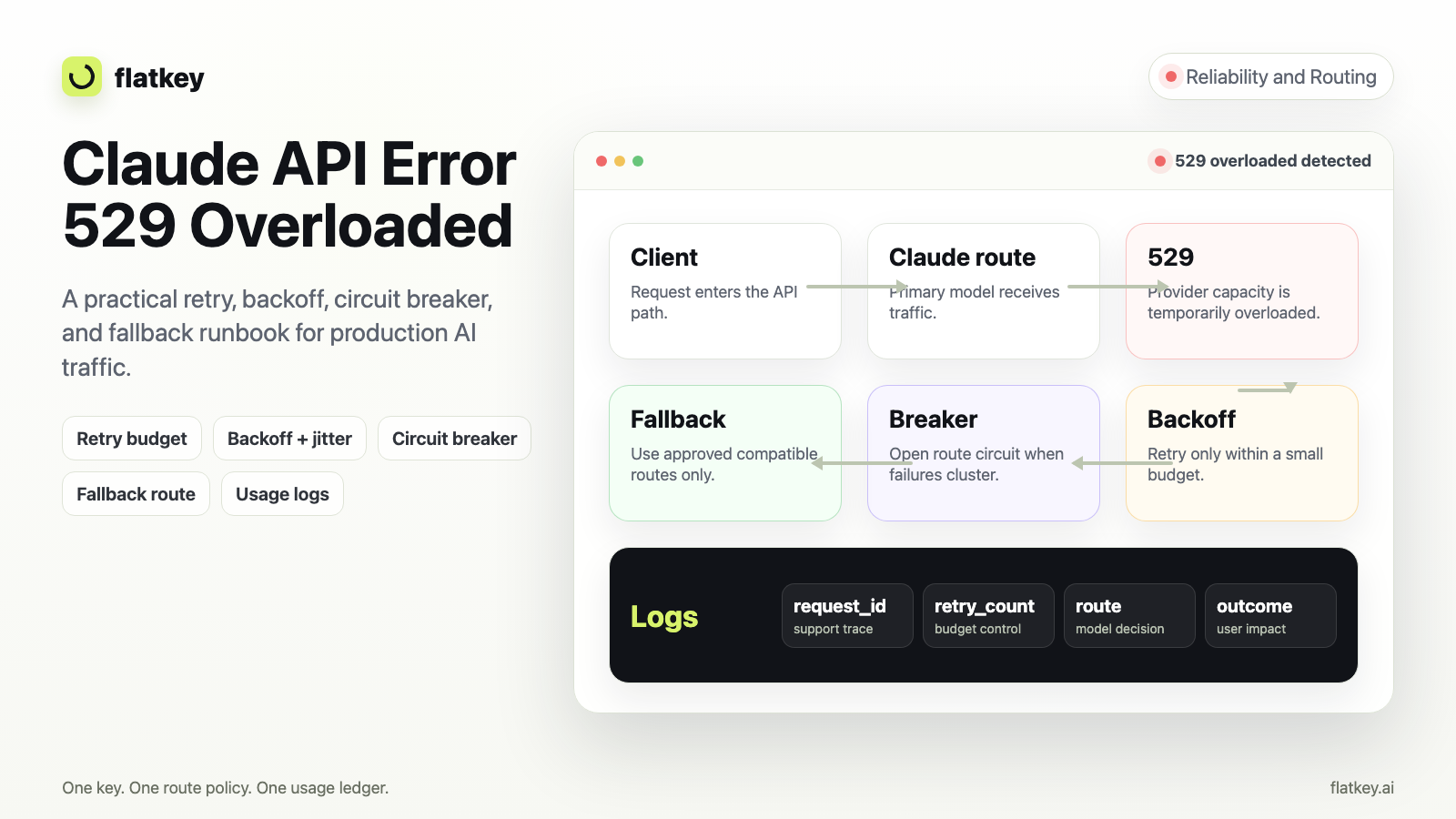
Multi-upstream account pooling needs a failure policy that treats errors differently. A timeout can be eligible for retry. A provider 5xx can be eligible for fallback. A malformed request should usually return to the caller. A policy block, data-boundary mismatch, exhausted budget, or post-tool side effect should fail closed.
| Failure | Default Action | Why |
|---|---|---|
| Transient network error before output | Retry or switch to a healthy approved upstream. | No user-visible output or side effect exists yet. |
| Provider 5xx before output | Switch if the backup has passed the same workflow checks. | The primary route is degraded, but permission still matters. |
| 429 rate limit | Use a different upstream only if tenant, budget, and provider-policy limits allow it. | Pooling should not bypass an approved limit. |
| Auth failure | Fail closed and page the owner. | Another key should not hide broken ownership or revoked access. |
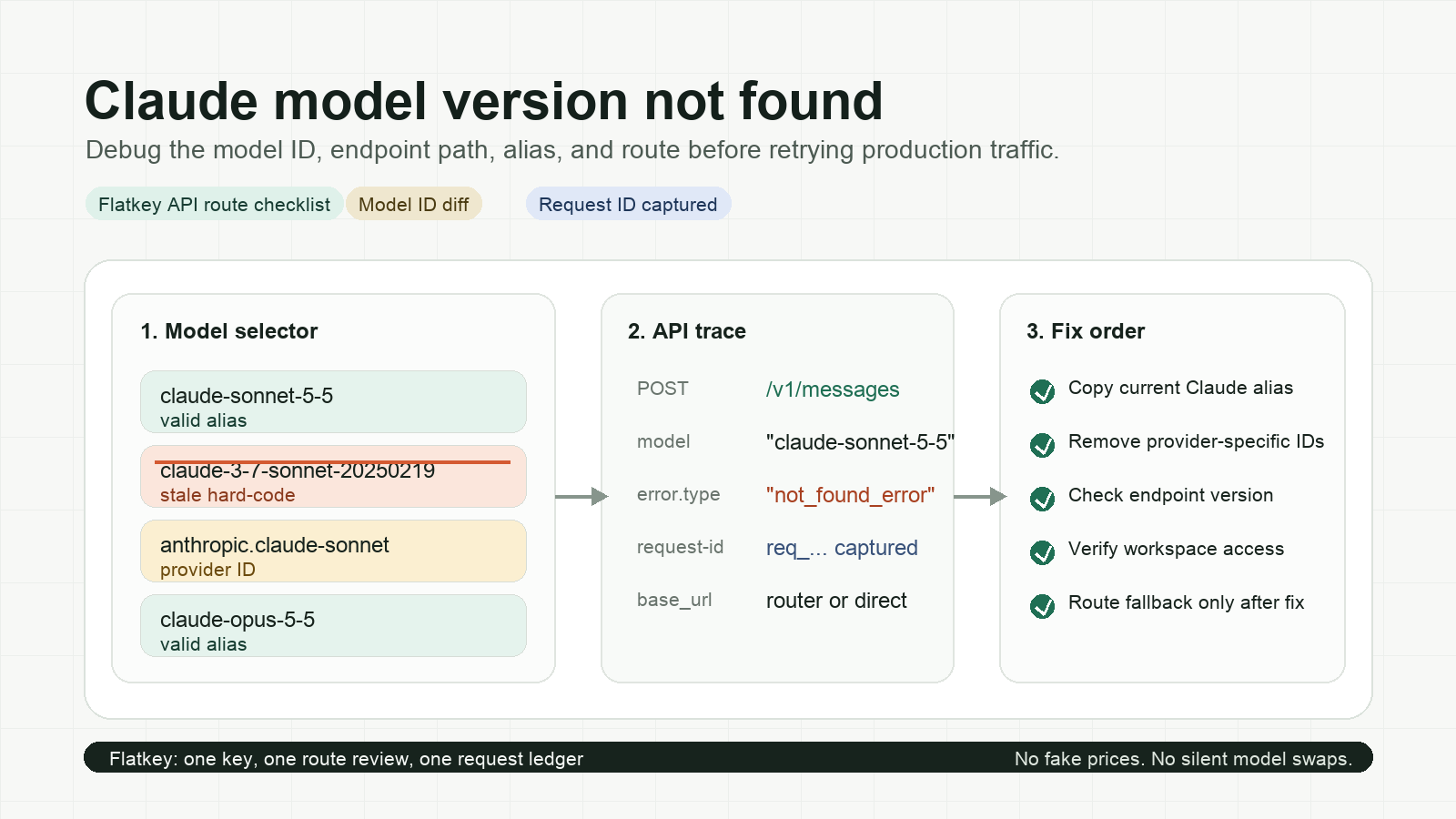
| Model not found | Fail closed or use a named migration rule. | Silent model substitution can change quality and cost. |
| Policy or safety block | Fail closed. | The pool must not route around policy decisions. |
| Budget or balance block | Fail closed or queue for owner approval. | Reliability should not spend from an unapproved account. |
| After first streamed token | Stop, mark incomplete, and let the client retry explicitly. | Silent route switching can merge outputs. |
| After tool side effect | Fail closed or run an idempotent recovery path. | Blind replay can duplicate writes, tickets, refunds, or emails. |
The policy should be versioned. During an incident, operators need to know which rule allowed a request to leave one upstream and enter another.
Test Account Pooling With Representative Workflows
Do not approve an upstream pool globally. Test it per workflow. A support draft, coding assistant, extraction job, image generation task, and tool-using agent have different risk.
Run the same workflow through every candidate upstream:
- Baseline the primary path. Capture model, endpoint family, token usage, latency, cost, output shape, tool calls, and failure rate.
- Run each candidate. Use the same prompts, files, tool schemas, streaming mode, and stop conditions.
- Compare quality. Confirm factuality, JSON shape, tool arguments, refusal behavior, tone, latency, and cost.
- Force failures. Simulate 429, timeout, invalid model, auth failure, provider 5xx, exhausted budget, and partial stream.
- Check observability. Reconstruct the attempt chain from logs without using private memory or guesswork.
- Canary the pool. Start with internal traffic, then a low-risk production slice, then expand only if the evidence stays inside the regression budget.
Pair this with the existing AI API load balancing and failover, AI API rate limit handling, model fallback evaluation checklist, and model routing policy design guides. The missing piece in many routing plans is the upstream account evidence packet.
Pool Readiness Record Template
Use this record before a route starts sharing production traffic. It is a review template, not a Flatkey API contract.
{
  "pool_id": "support-chat-primary-pool-v1",
  "workflow": "support-chat",
  "environment": "production",
  "policy_version": "2026-07-12",
  "allowed_before_first_output_only": true,
  "upstreams": [
    {
      "label": "primary-approved-account",
      "provider_group": "approved-group",
      "endpoint_family": "openai-compatible-chat",
      "model_scope": ["approved-model-alias"],
      "owner": "platform-ai",
      "billing_owner": "support-ops",
      "data_boundary": "approved-customer-data",
      "limit_scope": {
        "rpm": "recorded",
        "tpm": "recorded",
        "daily_quota": "recorded",
        "budget": "approved"
      },
      "health_state": {
        "last_check": "2026-07-12T08:00:00Z",
        "status": "healthy",
        "cooldown_until": null
      }
    }
  ],
  "failure_policy": {
    "retryable": ["timeout_before_output", "provider_5xx_before_output"],
    "fail_closed": ["auth_failure", "policy_block", "budget_block", "after_tool_side_effect"],
    "max_attempts_per_request": 2
  },
  "observability": {
    "required_fields": [
      "request_id",
      "requested_model",
      "selected_upstream",
      "attempt_chain",
      "error_class",
      "latency_ms",
      "usage",
      "cost",
      "final_disposition"
    ]
  },
  "launch_decision": "blocked | staging | canary | production"
}
Go/No-Go Rule
Approve multi-upstream account pooling only when every upstream is healthy, permitted, observable, attributable, and rollback-ready for the exact workflow. Do not approve it because there are spare keys. Do not approve it because another team uses the same provider. Do not approve it because the final request can return 200.
Approve it when the pool can answer these questions:
- Which upstreams are allowed for this workflow?
- What limits and budgets apply to each account?
- Which failures retry, switch, queue, or fail closed?
- How will finance see pooled usage and retries?
- How will operators reconstruct the attempt chain?
- What disables the pool if quality, cost, quota, or policy gates fail?
Flatkey gives teams a practical place to centralize one-key model access, routing context, usage review, pricing review, and billing evidence. Before you share production traffic across upstream accounts, get a key, verify the current model and pricing facts, and attach a pool-readiness record to the route.
Sources To Review
- Flatkey homepage for current one-key routing, model health, and reliability positioning.
- Flatkey pricing for current prepaid balance, usage analytics, request logs, cost-control, and invoice positioning.
- OpenAI rate limits for requests-per-minute, tokens-per-minute, usage tier, and unsuccessful-request guidance.
- Anthropic rate limits for RPM, ITPM, OTPM, and acceleration-limit concepts.
- Gemini API rate limits for project, tier, RPM, TPM, and RPD concepts.
- Cloudflare AI Gateway fallbacks and Vercel AI Gateway model fallbacks for public fallback-routing evidence patterns.
- LiteLLM health checks, health-check-driven routing, and load balancing for public examples of health and routing controls.
- OpenTelemetry metrics for metrics, logs, traces, and measurement concepts used in pool observability.
FAQ
What is multi-upstream account pooling?
Multi-upstream account pooling means routing model requests across more than one upstream model account, key, provider group, or gateway lane. The goal is usually better availability, quota coverage, or cost control, but the pool needs workflow-specific reliability and governance checks.
Is account pooling the same as load balancing?
No. Load balancing distributes traffic. Multi-upstream account pooling also has to manage account ownership, provider limits, data boundaries, billing attribution, credential scope, and failure isolation.
Should every 429 trigger another upstream?
Not automatically. A 429 may mean an upstream is temporarily full, but it may also represent a tenant, budget, or provider-policy boundary. Switch only when the fallback route is approved for the same workload and budget.
What evidence should finance review?
Finance should see selected upstream, model, endpoint family, token or request units, retries, fallback attempts, request cost, cost center, invoice owner, and balance impact. A final success status is not enough.
How does Flatkey fit into multi-upstream account pooling?
Flatkey can centralize model access, routing context, pricing review, usage analytics, request logs, and billing evidence through one gateway. Teams should still verify current account-visible models, route status, limits, and ownership before enabling pooled production traffic.