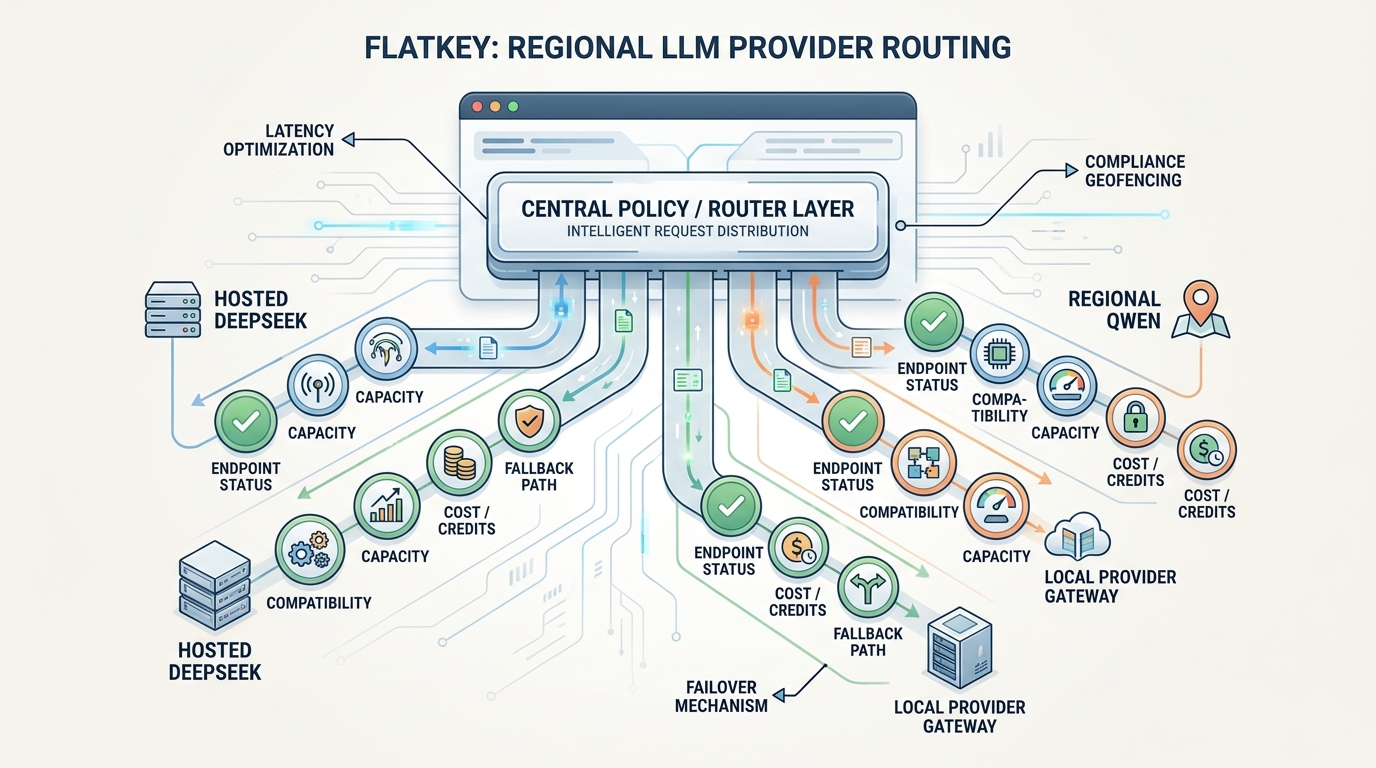
If you are planning regional LLM provider routing, the risky part is not finding another OpenAI-compatible endpoint. The risky part is deciding when a DeepSeek route can be treated like a hosted cloud provider, when a Qwen route needs region-bound endpoint checks, and when a local provider needs infrastructure checks before it can receive production traffic.
That is why regional LLM provider routing should start with provider class, not model leaderboard language. DeepSeek, Qwen, and local runtimes can all look familiar at the SDK layer, but they do not share the same region contract, lifecycle risk, capacity signal, or fallback safety rules.
This guide gives AI product teams a practical policy for regional LLM provider routing across DeepSeek, Qwen, and local provider gateways. Use it before you move production traffic, add fallback, or standardize a shared AI gateway across teams.
The Quick Answer
A safer regional LLM provider routing policy separates routes into three provider classes before it compares model names:
| Provider class | First checks | Why it needs a separate policy |
|---|---|---|
| DeepSeek | API format, model alias, feature support, token pricing unit, concurrency limit | DeepSeek exposes OpenAI and Anthropic-compatible paths, but route safety still depends on model lifecycle, pricing mode, and account-level capacity. |
| Qwen / Alibaba Cloud Model Studio | Region endpoint, workspace domain, region-bound API key, OpenAI-compatible feature caveats | Qwen routing is regional by design; the endpoint, workspace ID, and API key region can be part of whether a call works. |
| Local provider gateway | Host reachability, model pinning, local hardware headroom, compatibility gaps, fallback isolation | A local route fails like infrastructure you operate, not like a hosted API account. |
Flatkey fits this workflow as the shared gateway layer: one key, one model catalog, one OpenAI-compatible route surface, and one usage view for supported models and tools. But a gateway should not erase provider-specific checks. It should make those checks explicit, observable, and easier to review.
What Regional LLM Provider Routing Is Really Optimizing
Good regional LLM provider routing does not ask only which model scores highest on a benchmark. It asks which provider class can safely own a request under the current product, region, and fallback policy.
In production, regional LLM provider routing usually balances six things at once:
- Endpoint geography: some providers expose different base URLs by region, and that can change latency, account setup, residency review, and failover design.
- Compatibility depth: OpenAI compatibility can cover chat completions while still differing on tools, streaming, vision, audio, reasoning controls, or usage fields.
- Lifecycle stability: model aliases, preview models, retired routes, and compatibility shims can change the request even if the SDK call still succeeds.
- Capacity model: account-level concurrency is different from rate limits, and both are different from a local GPU or CPU bottleneck.
- Fallback safety: a backup route only helps if it preserves the same region, feature, data, and quality contract.
- Cost visibility: teams need to compare cost per accepted response, not just headline token prices.
That is the real job of regional LLM provider routing. It is not one universal endpoint abstraction. It is a provider-check policy that decides which routes are eligible for which workload.
Start Chinese LLM API Routing By Separating Provider Classes
The first mistake in Chinese LLM API routing is treating every China-linked or Asia-hosted route as one bucket. That collapses too many operational differences.
DeepSeek and Qwen both matter for Chinese LLM API routing, but their routing checks are not the same. DeepSeek's public API docs emphasize OpenAI and Anthropic-compatible access with specific model names and account-level concurrency. Alibaba Cloud Model Studio's Qwen docs emphasize OpenAI-compatible access through region-specific endpoints, workspace-specific domains, and API keys bound to the region where they were created.
Use this split before you route traffic:
| Route question | DeepSeek | Qwen / Model Studio | Local provider gateway |
|---|---|---|---|
| Is the endpoint regional? | Validate the official base URL and any gateway route. | Validate the exact region endpoint and workspace-specific domain. | Validate host, private network, or local runtime address. |
| Is the API key region-bound? | Check account and model access. | Check that the API key was created in the same region as the endpoint. | Check local auth, network access, and machine permissions. |
| Is compatibility complete enough? | Test chat, tools, reasoning, Anthropic format, vision, and Responses API only if your workload uses them. | Test chat, tools, streaming, multimodal support, and model-family caveats by selected model. | Treat compatibility as partial until your own smoke tests pass. |
| What is the capacity signal? | Account-level concurrency and 429 behavior. | Region, workspace, quota, endpoint health, and provider limits. | GPU/CPU/RAM headroom, daemon health, queue depth, and model load time. |
| What fallback is allowed? | A hosted route with matching feature and policy class. | Another approved route in the same regional policy, or an approved hosted fallback. | A second local node or a pre-approved cloud route with explicit data-policy review. |
If you skip this split, regional LLM provider routing becomes guesswork. The same workload may move between three very different provider classes with no one able to explain what checks were applied.
DeepSeek Needs Separate Checks Even When The SDK Looks Familiar
DeepSeek's official documentation makes migration approachable: the API uses a format compatible with OpenAI and Anthropic, with https://api.deepseek.com for OpenAI-format calls and https://api.deepseek.com/anthropic for Anthropic-format calls. That compatibility is useful, but it does not remove the need for DeepSeek-specific checks.
For DeepSeek Qwen routing, DeepSeek should be checked separately for four reasons.
First, model aliases and lifecycle notes affect route safety. As of September 12, 2026, DeepSeek's docs list deepseek-flash and deepseek-v4-pro as the current model names. The docs also note that legacy deepseek-v4-flash and deepseek-v4-flash-vision-exp names are still accepted, but requests are served by the newer Flash model and billed at the Flash price. That is exactly the kind of lifecycle detail a router should surface instead of hiding.
Second, feature support is model-specific. DeepSeek's pricing table lists JSON output, tool calls, Responses API, Anthropic API, beta chat prefix completion, beta FIM, and vision support by model. That means your regional LLM provider routing policy should test only the features the workload actually uses and should not assume every DeepSeek route is interchangeable.
Third, pricing is provider-native. DeepSeek publishes pricing in units of 1M tokens and separates cache hit, cache miss, output, peak, and off-peak rates. Product teams do not need every price hardcoded into routing logic, but they do need the router to log enough usage to compare DeepSeek against Qwen, GPT, Claude, Gemini, or local routes on cost per accepted response.
Fourth, capacity is account-level. DeepSeek's rate-limit page says concurrency limits are calculated at the account level regardless of API key, and requests above the concurrency limit return HTTP 429. Health checks for regional LLM provider routing therefore need to include concurrency headroom, not just whether a small test request returned 200.
The lesson is simple: do not start DeepSeek Qwen routing from "both are OpenAI-compatible." Start from the provider-specific lifecycle, feature, price, and capacity checks that decide whether a route is safe for the workload.
Qwen Needs Separate Checks Because Region Is Part Of The API Contract
Alibaba Cloud Model Studio's Qwen documentation is a strong example of why Chinese LLM API routing needs regional checks. The OpenAI-compatible guide says Qwen models on Model Studio support OpenAI-compatible interfaces and that teams can migrate existing OpenAI code by changing the API key, base URL, and model name.
But the same guide also makes the region contract explicit. It lists different base URLs for Singapore, Virginia, Beijing, Hong Kong, and Japan. It also says Model Studio introduced workspace-specific domain names for Beijing, Singapore, and Hong Kong, and that {WorkspaceId} should be replaced with the actual workspace ID.
That means regional LLM provider routing for Qwen is not just "choose a model name." It must check:
- which region endpoint the workload is allowed to call
- whether the workspace-specific domain is required
- whether the API key was created in the same region as the endpoint
- whether a cross-region mismatch returns an authentication error
- whether the selected Qwen or third-party model supports the exact protocol features the workload uses
The Qwen compatibility guide also states that supported OpenAI-compatible models include Qwen large language models, Qwen-VL, Qwen-Coder, Qwen-Omni, Qwen-Math, DeepSeek, Kimi, GLM, and MiniMax. It separately notes that Qwen-Audio does not support the OpenAI-compatible protocol and should use the DashScope protocol instead.
That caveat matters for DeepSeek Qwen routing. A model family can sit near the same catalog or cloud console and still need a different protocol path. If your product uses tools, streaming, audio, vision, or multimodal inputs, Qwen routing needs feature-level smoke tests before production traffic shifts.
A Local LLM Provider Gateway Needs Infrastructure Checks
The third mistake in regional LLM provider routing is assuming a local provider gateway behaves like another hosted provider. It does not.
Ollama's OpenAI compatibility docs show why. Ollama exposes local OpenAI-compatible Chat Completions through http://localhost:11434/v1, and its docs describe that support as initial and experimental. That is useful for local development and controlled internal workflows, but it should not be treated as the same risk class as a hosted route.
With a local provider gateway, your routing checks change:
- Can the workload reach the local host or private network route from the environment where it runs?
- Is the model version pinned, or can a developer or package update change it?
- Does the local route support the same request features as the cloud route?
- Is there enough GPU, CPU, memory, and queue headroom for real bursts?
- Does the route expose latency, error, and saturation signals the same way as hosted providers?
- Is fallback to a cloud provider allowed under the customer's data policy?
Those checks are infrastructure checks, not just API checks. A local LLM provider gateway can be the right answer for privacy, offline work, or cost control, but only when regional LLM provider routing treats local health, capacity, feature support, and version drift as first-class constraints.
Use A Provider-Check Matrix Before You Move Traffic
A durable regional LLM provider routing rollout needs a matrix that engineering, product, security, and finance can all read.
| Check class | DeepSeek route | Qwen route | Local provider route |
|---|---|---|---|
| Endpoint | Confirm official or gateway base URL. | Confirm region endpoint and workspace-specific domain. | Confirm localhost, private endpoint, or local gateway URL. |
| API key | Confirm account and model access. | Confirm API key region matches endpoint region. | Confirm local auth and environment access. |
| Compatibility | Test OpenAI format, Anthropic format, Responses API, tools, vision, and thinking controls only where needed. | Test OpenAI-compatible chat plus model-family caveats, especially audio, vision, tools, and streaming. | Test the exact request/response shape; assume partial compatibility until proven. |
| Capacity | Track account concurrency, 429 rate, latency, and request duration. | Track region quota, endpoint health, 401/403/404 causes, and provider throttle behavior. | Track machine saturation, queue depth, model load time, and daemon restarts. |
| Cost | Normalize cache hit, cache miss, output, peak, and off-peak economics into cost per accepted response. | Normalize token cost plus region/workspace behavior into cost per accepted response. | Include hardware, operations, queue delay, and cloud fallback cost. |
| Lifecycle | Watch model aliases, legacy names, preview status, and feature changes. | Watch regional endpoint changes, model family support, and protocol exceptions. | Watch runtime version, model weights, quantization, and local package updates. |
| Fallback | Use only approved hosted routes with matching feature and policy class. | Use only region-approved or policy-approved alternatives. | Use only a second local node or approved cloud route after data-policy review. |
This matrix keeps DeepSeek Qwen routing from becoming a one-line model switch. The route is eligible only when its provider class passes the checks that matter for the workload.
A Practical Decision Tree For Regional LLM Provider Routing
Use this workflow whenever a new workload asks for DeepSeek, Qwen, or a local provider:
- Classify the workload: chat, code, extraction, agent tool use, vision, audio, batch, or multimodal.
- Identify the data policy: allowed region, retention sensitivity, customer contract, and whether local-only handling is required.
- Pick eligible provider classes before model names.
- Run the provider-class check: endpoint, key, compatibility, capacity, lifecycle, and fallback.
- Run a workload-specific smoke test using real prompts and parsers.
- Route a small staging or canary slice.
- Measure accepted response rate, p95 latency, fallback rate, 429/401/403/404 rate, and cost per accepted response.
- Approve the route only for the workload classes it passed.
- Keep a rollback path until the route has production evidence.
Here is the same logic as policy data:
regional_llm_provider_routing:
  classify:
    inputs:
      - workload_type
      - required_features
      - data_region
      - customer_policy
      - latency_budget
  provider_classes:
    deepseek:
      checks:
        - base_url_or_gateway_route
        - model_alias_lifecycle
        - required_feature_support
        - account_concurrency_headroom
        - cost_per_accepted_response
    qwen:
      checks:
        - region_endpoint
        - workspace_domain
        - api_key_region_match
        - required_feature_support
        - quota_and_error_classification
    local_gateway:
      checks:
        - host_reachability
        - model_version_pin
        - hardware_headroom
        - compatibility_smoke_test
        - approved_cloud_fallback_policy
  fallback:
    allowed_only_when:
      - same_workload_contract
      - same_data_policy
      - required_features_supported
      - retry_budget_remaining
    otherwise: manual_review
  observe:
    log:
      - route
      - provider_class
      - model
      - endpoint_region
      - status
      - latency_ms
      - input_tokens
      - output_tokens
      - cost
      - fallback_reason
This is the core of regional LLM provider routing. Build the policy once, then map models into it as providers add, rename, or retire routes.
Where Flatkey Fits
Flatkey is useful when the operational problem is no longer one API call. The problem is scattered provider keys, model catalogs, tool calls, usage review, and fallback policy across teams and agents.
Flatkey's current public homepage describes one key behind official GPT, Claude, Gemini, DeepSeek, Qwen, and GLM APIs, plus more than 100 frontier models and more than 1,000 AI tools. The Flatkey model directory is designed to expose live model availability, pricing, endpoint support, and model detail pages. The docs show the common migration pattern: keep your OpenAI-compatible request shape and point the SDK at https://router.flatkey.ai/v1.
For this topic, the current Flatkey catalog and pricing feed sampled on September 12, 2026 showed available DeepSeek and Qwen examples in the China LLM group, including deepseek-v4-pro, deepseek-v4-flash, deepseek-v3.2-thinking, deepseek-v3.2, qwen3.8-max, qwen3.7-max, qwen3.7-plus, qwen3.6-max-preview, and multiple Qwen 3.5 routes. Treat those examples as a dated catalog snapshot, not a permanent availability promise.
The right Flatkey role in regional LLM provider routing is the control plane:
- Compare supported hosted routes in one model directory.
- Keep a stable OpenAI-compatible base URL for application code.
- Track model, endpoint type, status, token usage, latency, and cost in one place.
- Make provider-class routing and fallback decisions easier to review.
- Preserve separate checks for DeepSeek, Qwen, and local provider gateways instead of hiding them.
If you are already using Flatkey, start by reviewing the model directory, the pricing page, and the Flatkey API quickstart. For routing-adjacent context, pair this guide with the unified AI API workflow, OpenAI API alternative migration guide, multimodal fallback routing playbook, and AI routing API metrics framework.
Launch Checklist
Before you move regional LLM provider routing into production, confirm these items:
- DeepSeek, Qwen, and local routes are separate provider classes in routing policy.
- Qwen endpoint region, workspace domain, and API key region are validated before traffic moves.
- DeepSeek model aliases, feature support, token pricing units, and concurrency behavior are reviewed.
- Local routes have host reachability, model version pinning, hardware headroom, and queue monitoring.
- Tool use, streaming, vision, audio, reasoning controls, and structured output are tested only where the workload requires them.
- Fallback routes preserve the same workload contract and data policy.
- Logs include provider class, endpoint region, final model, status, latency, tokens, cost, and fallback reason.
- Product and finance review cost per accepted response, not just headline token price.
- Rollback remains available until the route has real production evidence.
When those checks are in place, regional LLM provider routing becomes a repeatable operating model instead of a hidden set of provider exceptions.
FAQ
What is regional LLM provider routing?
Regional LLM provider routing is the policy layer that decides which provider class should handle an AI request based on endpoint region, API-key scope, compatibility, capacity, lifecycle risk, cost, and fallback safety.
Why does Chinese LLM API routing need separate checks?
Chinese LLM API routing needs separate checks because DeepSeek, Qwen, and other regional providers can differ on endpoint geography, API-key region, compatibility depth, model lifecycle, quota behavior, and pricing units even when they expose OpenAI-compatible interfaces.
Why is DeepSeek Qwen routing not just one model comparison?
DeepSeek Qwen routing is not just one comparison because DeepSeek and Qwen have different operational contracts. DeepSeek checks center on model aliases, feature support, token pricing, and account concurrency. Qwen checks center on region endpoint, workspace domain, API-key region, and model-family protocol support.
When does a local LLM provider gateway make sense?
A local LLM provider gateway makes sense when privacy, offline operation, development control, or cost constraints justify running models locally and your team can own the extra health, capacity, compatibility, and version-drift checks.
Can an OpenAI-compatible route skip provider-specific QA?
No. OpenAI compatibility can reduce integration work, but every route still needs workload-specific QA for tools, streaming, structured output, multimodal inputs, error handling, usage fields, rate limits, and fallback behavior.
The Bottom Line
The right regional LLM provider routing strategy is less about one universal endpoint and more about disciplined provider checks. That is especially true when Chinese LLM API routing includes both DeepSeek and Qwen, and when a local provider gateway sits beside hosted routes for privacy, offline, or cost-control workflows.
Treat DeepSeek Qwen routing as a provider-policy problem first. Then validate live endpoint, key, compatibility, capacity, lifecycle, and cost evidence before you move production traffic.
Flatkey helps when you want one key, one model catalog, one OpenAI-compatible base URL, and one usage surface for supported hosted routes. Use the gateway to centralize operations, but keep the separate provider checks that make regional routing safe.