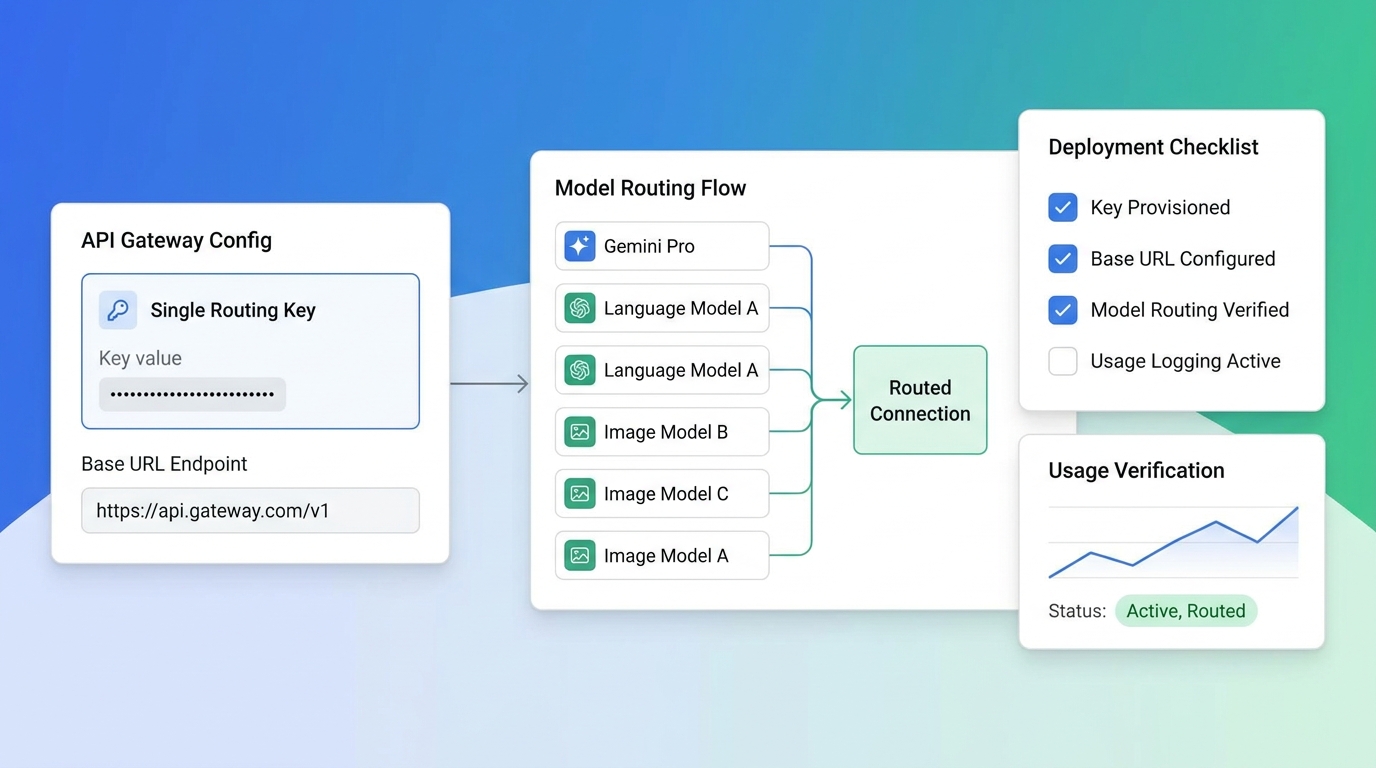
If your team already uses CC Switch or a NewAPI-style control plane, the fastest way to turn on Gemini is not adding one more provider credential everywhere. It is defining one upstream route, one model naming rule, one usage check, and one production review gate before rollout.
Google now documents Gemini access through OpenAI libraries by changing the API key, base URL, and model name. For direct Gemini access, the OpenAI-compatible base URL is https://generativelanguage.googleapis.com/v1beta/openai/. For teams that want one operational layer across Gemini and other providers, Flatkey exposes one OpenAI-compatible route at https://router.flatkey.ai/v1, and the current homepage language emphasizes one key, one base URL, and keeping your existing SDK.
This guide is for production apps, not hobby demos. The goal is to help you connect Gemini in a way that is reviewable by engineering, operations, and security before traffic shifts.
Quick answer: what should change in production?
For a production Gemini API rollout, lock five things before you save the upstream:
| Item | Direct Gemini setup | One-gateway setup for CC Switch or NewAPI-style clients |
|---|---|---|
| Auth source | Gemini API key from Google AI Studio or imported Google Cloud project | One gateway key managed in one place |
| Base URL | https://generativelanguage.googleapis.com/v1beta/openai/ | https://router.flatkey.ai/v1 |
| Protocol mode | OpenAI-compatible | OpenAI-compatible |
| Model policy | Approved Gemini model list | Approved Gemini model list plus cross-provider fallback policy |
| Verification | Google-side usage and billing checks | Gateway request log, quota, model mapping, and downstream review |
If your app already supports OpenAI-compatible upstreams, Gemini is usually a routing and policy task, not a full SDK rewrite.
Why this checklist matters on Friday, July 17, 2026
Three current facts make a production checklist more important than a quickstart:
- Google's Gemini docs now explicitly support OpenAI-library access, which makes it easy for teams to switch endpoints without tightening review discipline.
- Google also states that new AI Studio keys are created as auth keys by default and that standard keys will be rejected in September 2026, so key type and project ownership are part of the rollout decision.
- Flatkey's live public setup language focuses on one key, one base URL, and keeping the existing SDK, which is useful only if the team also standardizes field mapping, logging, and rollback.
Before you start
Do not open CC Switch or NewAPI first. Start with the contract you want the upstream to satisfy.
Use this minimum preflight list:
| Check | What to confirm | Why it matters |
|---|---|---|
| Owner | The team knows who owns Gemini key creation, rotation, and quota | Prevents shared-account drift |
| Route type | You are using an OpenAI-compatible upstream, not a mixed custom adapter | Keeps field mapping simple |
| Model list | You have an approved list of Gemini model IDs for this app | Prevents silent alias drift |
| Logging | You know where request logs, usage, and billing review will happen | Needed for cutover evidence |
| Rollback | You can switch the upstream or model policy back quickly | Required for staged rollout |
If you do not have these answers, you are not ready to treat the setup as production-ready.
Field mapping for CC Switch or NewAPI-style upstreams
Different clients label fields differently, but the production mapping should stay consistent.
| Upstream field | Value for this rollout | Review note |
|---|---|---|
| Provider type | OpenAI-compatible | Use the generic OpenAI-compatible mode unless the client has a validated Gemini-native mode you intend to operate |
| API key | Flatkey key or approved upstream key | Keep it in one secret source, not per-user local copies |
| Base URL | https://router.flatkey.ai/v1 | Use one route for centralized control |
| Model source | Manual allowlist or fetch after route save | Review returned model IDs before exposing them to the app |
| Default model | Approved Gemini production model | Do not point production at a preview model by accident |
| Fallback model | Optional and deliberate | Only enable after model naming and log checks pass |
| Headers | Standard bearer auth unless your client documents extra fields | Avoid one-off header hacks that break portability |
| Usage review | Request log plus quota or billing dashboard | Must be part of the sign-off |
This is the key operational difference between a direct Gemini setup and a gateway setup: the gateway path reduces credential sprawl, but it increases the need for a clean review gate because more apps may inherit the same upstream.
Step 1: decide whether this app needs direct Gemini or one gateway
Use direct Gemini if the app is isolated, the owner is clear, and you do not need cross-provider routing right now.
Use one gateway if any of these are true:
- The same client already touches multiple providers.
- More than one engineer or team will manage the integration.
- You want one place to verify usage, quotas, or request logs.
- You expect model substitution, fallback, or provider expansion later.
For CC Switch and NewAPI-style teams, the second path is usually easier to support over time because the client keeps one OpenAI-compatible shape while the route policy stays upstream.
Step 2: lock the exact Gemini model IDs you will allow
Do not use "Gemini" as a vague requirement. Approve exact model IDs for this app and environment.
That review should answer:
- Which Gemini model is the production default?
- Which models are allowed only for testing?
- Are preview models allowed in production at all?
- Will the app expose a model picker or one fixed model?
- If fallback is enabled, which non-Gemini models are permitted and under what condition?
This is where many teams create avoidable incidents. They save the upstream correctly, then leave model naming loose enough that testing and production behave differently.
If you need help aligning model names after the route is live, review the existing OpenAI-Compatible API Migration guide before exposing the integration to users.
Step 3: save one upstream and run a smoke test before model fetch
After you enter the API key and base URL, do one smoke test before you import or expose the full model list.
Your smoke test should confirm:
| Test | Expected result |
|---|---|
| Auth | The upstream accepts the key without local credential errors |
| Route | A simple chat completion request returns from the configured base URL |
| Model | The exact Gemini model ID resolves successfully |
| Logging | You can find the request in the review surface you chose |
| Billing or quota | The request is visible where the team expects usage evidence |
For teams standardizing on one gateway, this matters more than model fetch. Fetching a model list proves the client can see names. It does not prove the production request path is reviewable.
Step 4: review key type and project ownership
This step is easy to skip because the request may already work.
Google's current key guidance is the reason not to skip it. Google AI Studio now creates auth keys by default, unrestricted standard keys are already restricted more aggressively, and Google states the Gemini API will reject standard keys in September 2026. That means production teams should treat key type as part of rollout readiness, not a later cleanup task.
Use this short review:
| Question | Acceptable answer |
|---|---|
| Who owns the Gemini project? | Named owner or team |
| What key type is in use? | Auth key preferred for new production setups |
| Where is the key stored? | Central secret manager or controlled platform secret |
| How will it rotate? | Documented owner and process |
| What happens if usage spikes? | Billing alert or quota review path exists |
If you centralize through one gateway, do the same review for the gateway key and the downstream provider account.
Step 5: decide whether the app should expose Gemini directly to users
Do not assume the answer is yes.
In many production apps, the better pattern is:
- Route Gemini upstream first.
- Validate logs, latency, and usage review.
- Keep the model behind a feature flag or internal allowlist.
- Expose it to end users only after the review gate passes.
This is especially useful in CC Switch and NewAPI-style environments where one configuration change can affect multiple operators or app paths.
Step 6: add a production review gate
This is the part most setup guides leave out. Before traffic moves, require a short review gate that someone can approve in one pass.
Use this exact checklist:
| Review gate item | Pass condition |
|---|---|
| Field mapping | API key source, base URL, provider mode, and default model are documented |
| Smoke test evidence | One successful request is recorded with the final route |
| Model allowlist | Only approved Gemini model IDs are available to the app |
| Usage visibility | Request log or billing review path is confirmed |
| Secret ownership | Key owner and rotation path are named |
| Rollback | Previous upstream or model policy can be restored quickly |
| Scope | Team knows whether this change affects one app, one workspace, or many clients |
This is the shortest setup document that still protects the rollout.
Step 7: decide how fallback should work before you enable it
If you are using one gateway, the temptation is to turn on fallback immediately. Do not do that unless you can answer two questions:
- What failure condition should trigger fallback?
- Is the fallback model behavior acceptable for the same user-facing task?
For Gemini production rollouts, fallback is often safer after the first cutover, not during it. First prove the primary route, then add fallback with its own test evidence.
Step 8: validate the route from the app, not only from a local script
A local curl test is necessary. It is not sufficient.
Run one validation from the real application path and confirm:
- The app uses the intended upstream.
- The returned model is the expected Gemini model.
- Observability shows the same request.
- Any app-level timeout, retry, or quota behavior still works.
This is where production issues appear when the app has old environment variables, cached model names, or a different secret source than the engineer who ran the first test.
Recommended rollout for CC Switch and NewAPI-style teams
Use a staged rollout that keeps the control plane simple:
- Add one OpenAI-compatible Gemini-capable upstream.
- Test one approved Gemini model.
- Confirm logs and usage review.
- Expose the model to internal users only.
- Add fallback only after the primary route is stable.
- Expand to more apps only after the first app passes the review gate.
Flatkey's live routing message is useful here because the same base URL can stay in place while your model policy gets stricter over time. If you are comparing cost or procurement impact before rollout, the live pricing page is the right next check.
Short-form setup doc you can approve internally
If you want a reviewable handoff, copy this structure into your internal setup note:
| Field | Value |
|---|---|
| App name | |
| Upstream owner | |
| Provider mode | OpenAI-compatible |
| Base URL | https://router.flatkey.ai/v1 |
| API key source | |
| Approved Gemini model IDs | |
| Fallback enabled | Yes or No |
| Usage review surface | |
| Billing or quota review surface | |
| Rollback action | |
| Reviewer | |
| Approval date |
That is enough structure to approve a Gemini rollout without turning the setup into a long architecture memo.
If your team also uses Claude Code in the same control plane, the live CC Switch Claude Code setup with Flatkey and NewAPI article is a useful companion because it shows the same operational pattern from the client side.
FAQ
What is the safest base URL pattern for a production Gemini rollout in an OpenAI-compatible client?
The safest pattern is one reviewed base URL per environment. For direct Gemini access, Google documents https://generativelanguage.googleapis.com/v1beta/openai/. For a centralized gateway rollout, use the single approved gateway route and keep that value under configuration control.
Should I use a separate Gemini credential for every CC Switch or NewAPI client?
Usually no. For production teams, one controlled secret source is safer than scattered local credentials. The tradeoff is that you must add a review gate because more clients may inherit the same route.
Do I need to replace my SDK to use Gemini in an OpenAI-compatible app?
Not usually. Google's current Gemini docs explicitly support OpenAI libraries by changing the key, base URL, and model name. The real work is validating route policy, model naming, logging, and ownership.
What changed about Gemini API keys in 2026?
As of Friday, July 17, 2026, Google AI Studio creates new keys as auth keys by default, warns that unrestricted standard keys are not acceptable for long-term use, and states that the Gemini API will reject standard keys in September 2026. Teams should review key type before production cutover.
When should I turn on fallback for Gemini?
After the primary Gemini route is stable. First verify one approved Gemini model through the final application path. Then add fallback only if the trigger condition and backup model behavior are acceptable for the same workflow.
What should I inspect before approving the setup doc?
Inspect the exact base URL, the key source, the approved Gemini model IDs, one successful request log, the usage review surface, and the rollback action. If any of those are missing, the setup is not ready for production approval.