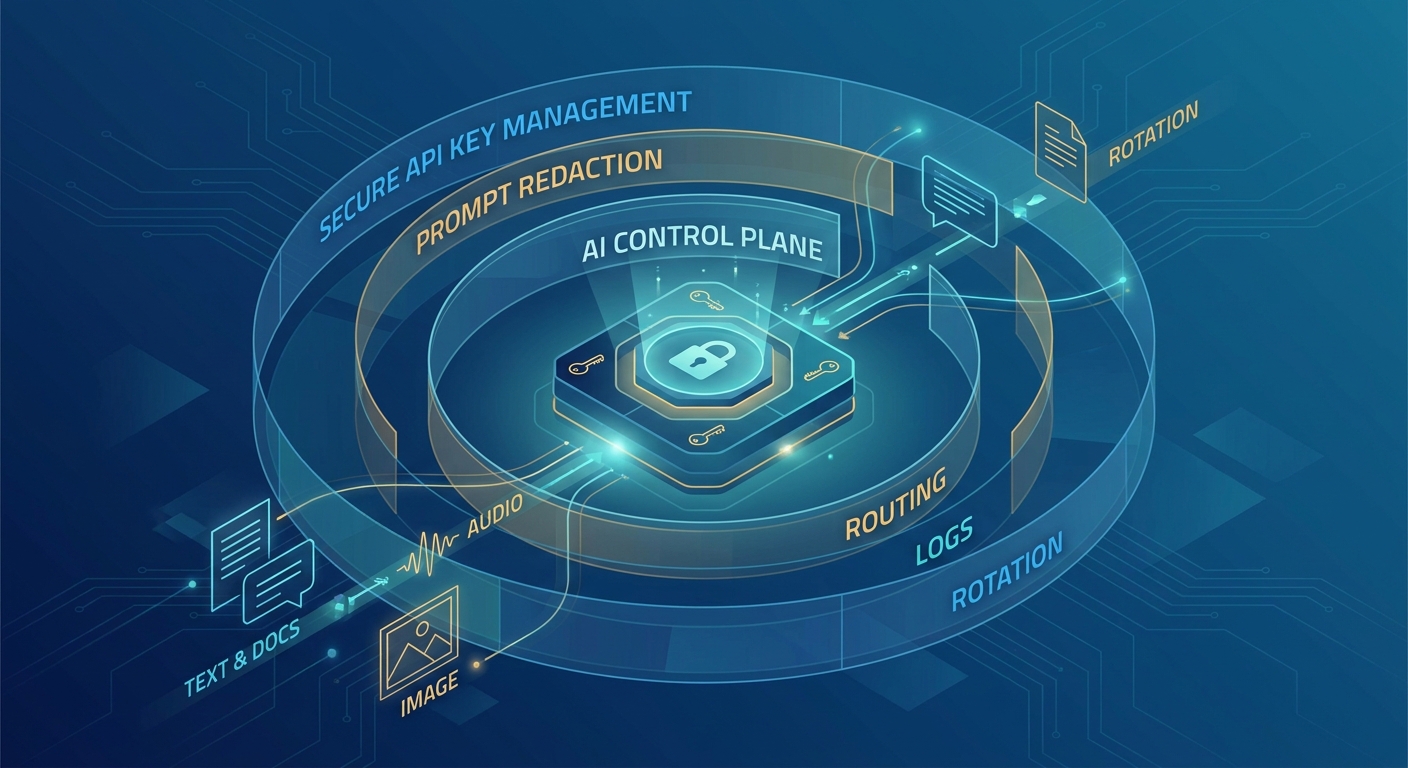
An AI API access review is the control that proves every gateway key still has the right owner, scope, environment, rotation plan, and offboarding path. It is not only a secrets scan. It is the recurring review that asks whether each key should still exist, who is accountable for it, what it can reach, what spend it can create, what logs prove its use, and what happens when a person, vendor, project, or workload leaves.
This matters more for AI gateways than for ordinary single-service API keys. One gateway credential can reach many models, providers, endpoint families, budgets, and products. A stale key might keep a retired automation alive. A broadly scoped key might let a sandbox job call production models. A departed contractor's key might still send requests through a shared integration. A fallback route might keep using a provider that procurement no longer approves.
Use this AI API access review to turn gateway access into a buyer-owned evidence file. The review should let security, platform, procurement, finance, and product teams answer the same questions later: who owns this key, why does it exist, which scopes are allowed, when was it rotated, which routes can it call, and what offboarding event revokes it?
For Flatkey buyers, the review belongs around the gateway account and the key/route surface. Flatkey's current public site positions the product as one AI API gateway for model access, routing, billing, usage analytics, and operational controls, with one API key, one base URL, and one dashboard. That makes the gateway a useful place to centralize access evidence. It does not remove the need to verify account-specific roles, logs, raw payload handling, provider terms, and offboarding procedures before production use.
What an AI API access review must decide
An AI API access review should approve the credential and the route it can reach. If the review stops at "the key still works," it misses the governance risk.
| Review area | Decision to make | Evidence to keep | Fail condition |
|---|---|---|---|
| Business purpose | What product, workflow, or team needs this key? | Use-case record, owner approval, environment tag | No current business owner |
| Human owner | Who accepts risk and budget for this key? | Named owner, backup owner, manager or team mapping | Owner is departed, unknown, or shared mailbox only |
| Technical owner | Who can rotate, disable, and troubleshoot the key? | Runbook, on-call group, key vault path | No one can safely rotate it |
| Environment | Is this dev, staging, production, CI, vendor, or break-glass access? | Environment tag, project boundary, route config | Non-production key can call production routes |
| Scope | Which models, endpoints, tools, files, prompts, usage exports, admin APIs, or routes can it use? | Scope list, role mapping, provider settings | Scope is broader than the workload requires |
| Budget and quota | What spend, token, rate, and model limits apply? | Quota policy, alert owner, finance reviewer | Key can spend without a named owner |
| Logging and audit | What events prove usage and changes? | Request metadata, route-change logs, key-change logs, usage rows | Usage cannot be tied to key, owner, route, and time |
| Rotation | How will the old key be replaced without downtime? | Rotation date, second-key cutover, last-used check, deletion proof | Key has no rotation or expiry trigger |
| Offboarding | What event revokes access? | HR/vendor/project exit trigger, group removal, key disable record | Key survives user, vendor, or project exit |
The output is an access register plus action list: keep, narrow, rotate, reassign, disable, delete, or escalate.
Build the key register first
Do not start an AI API access review by rotating keys blindly. Build a register that describes the key's actual role in production.
Each gateway key should have these fields:
| Field | Why it matters |
|---|---|
| Key alias or ID | Lets reviewers discuss the key without exposing the secret value |
| Gateway project or workspace | Separates product, environment, customer, or team boundaries |
| Owner and backup owner | Prevents orphaned access and stalled rotation |
| Workload or integration | Shows why the key exists and where it is deployed |
| Environment | Stops dev, test, CI, and production from sharing credentials |
| Allowed routes and models | Makes AI access review specific to model and endpoint behavior |
| Allowed endpoints and tools | Captures whether the key can call chat, images, video, files, tool execution, or admin APIs |
| Scope or role | Proves least privilege rather than inherited admin access |
| Secret storage location | Shows whether the key is in a vault, CI secret store, local file, or unsupported location |
| Last used and usage pattern | Separates active keys from stale or leaked credentials |
| Cost owner and quota | Ties model spend to a budget owner |
| Rotation date and method | Shows when and how the key can be replaced |
| Offboarding trigger | Defines what change revokes or narrows access |
The register should not include secret values. It should include enough metadata to rotate and revoke the key quickly.
Assign owners before scopes
An AI API access review fails when every key belongs to "engineering" or "the platform team." Shared ownership makes access linger after employees, contractors, vendors, and projects move on.
Use four owner roles:
| Owner role | Accountable for | Should approve |
|---|---|---|
| Business owner | Whether the workflow still needs AI access | Keep, retire, or transfer the key |
| Technical owner | Rotation, storage, deployment, rollback, and incident response | Rotation plan and cutover evidence |
| Security owner | Scope, least privilege, logging, data exposure, and offboarding | Scope changes and exception handling |
| Finance or ops owner | Spend, quota, usage anomaly, and invoice reconciliation | Budget and quota policy |
The business owner and technical owner should not be the same placeholder unless the team is very small. A production key needs someone who accepts business risk and someone who can change the credential safely.
For human-owned keys, require a named person plus team. For service-owned keys, require a service account, workload identity, repository, deployment pipeline, and owner group. For vendor keys, require contract owner, data owner, expiration date, and removal plan.
Review scopes against the actual workload
Least privilege is the core of an AI API access review. The question is not "does this user need AI?" The question is "what exact API actions does this workload need?"
OpenAI's RBAC guidance is a useful model because it separates organization roles, project roles, groups, permissions, project API keys, project administration, and service accounts. It also notes that project boundaries can isolate experiments, staging, and production. Use the same thinking for any AI gateway: scope the key to the smallest project, route, endpoint, model class, and action set that supports the workload.
OpenAI's workload identity federation docs add another important pattern: external identities can be mapped to a specific service account, project, and optional API permissions, and those mapping permissions cannot grant access beyond the mapped service account. That is the right mental model for gateway access: a CI job, server workload, or automation should not inherit a human owner's broad console access.
For each key, record whether it can:
- Make model requests.
- Use only approved models or fallback routes.
- Call file, vector, prompt, eval, batch, image, audio, video, or admin endpoints.
- Read usage exports or billing data.
- Change routes, quotas, keys, roles, logs, or provider settings.
- Access raw prompts, outputs, tool arguments, files, traces, or only metadata.
Then compare actual scope with needed scope:
| If the key only needs to... | It should not also be able to... |
|---|---|
| Call one production chat route | Manage keys, users, routes, billing, or provider accounts |
| Run staging evals | Call production routes or customer data sources |
| Generate images in a batch job | Read unrelated files, prompts, or usage exports |
| Export usage for finance | Change models, prompts, quotas, or gateway routes |
| Run CI smoke tests | Use long-lived human credentials |
| Support a vendor integration | Access internal routes or other customer environments |
If a provider or gateway does not expose granular scopes, compensate with project separation, route separation, quota limits, IP or workload restrictions, shorter rotation cadence, and stronger monitoring.
Rotate keys with a cutover plan
Rotation is a reliability task, not only a security task. AWS's access key update guidance describes the practical pattern: create a second key while the first key is still active, update applications to use the new key, check usage of the old key, deactivate it before deletion, wait long enough to catch missed callers, and then delete it. That sequence is useful for AI gateway keys because sudden deletion can break model calls, background jobs, and customer-facing agents.
Google Cloud's service account key guidance also treats service account keys as sensitive credentials and recommends more secure authentication alternatives where possible. Its key rotation documentation reinforces that rotation should be planned, not improvised after exposure.
Use this rotation lane:
| Step | Action | Evidence |
|---|---|---|
| 1. Prepare | Confirm owner, workload, key location, routes, quotas, and rollback path | Register row and runbook |
| 2. Create replacement | Generate a new key or workload mapping without deleting the old one | New key ID, creation time, owner |
| 3. Deploy | Update vault, CI secret, runtime secret, or gateway integration | Deployment record or change ticket |
| 4. Smoke test | Send controlled requests through every approved route | Request ID, route, model, status, cost sample |
| 5. Watch old key | Check last-used data, logs, and error alerts for old-key traffic | Last-used screenshot or API readback |
| 6. Deactivate | Disable the old key before deleting it when the platform supports that state | Disabled timestamp and owner |
| 7. Delete | Remove the old key after the observation window | Deletion proof |
| 8. Close | Update the register and next review date | Access review record |
Emergency rotation skips the long observation window but does not skip evidence. If a key is leaked, revoke it, rotate dependent workloads, search code and logs for the exposed secret, and record which systems were tested afterward. OWASP's Secrets Management Cheat Sheet is useful here because it treats auditing, rotation, revocation, deletion, and lifecycle detection as part of secrets management.
Offboarding must revoke more than user login
Offboarding is where many AI API access review programs fail. Removing a person from SSO does not always remove service keys, CI secrets, shared vendor credentials, local .env files, model provider console keys, or gateway keys created under that person's account.
Create offboarding triggers for:
- Employee departure.
- Contractor or vendor departure.
- Team transfer.
- Project shutdown.
- Repository archival.
- Customer environment migration.
- Provider account replacement.
- Gateway route decommissioning.
- Security incident or suspected key exposure.
For each trigger, decide what must happen:
| Offboarding trigger | Required action | Evidence to keep |
|---|---|---|
| Human owner leaves | Reassign business and technical owner; rotate user-created keys | HR/IdP removal, owner update, rotation log |
| Contractor leaves | Remove project roles, revoke vendor keys, rotate shared integration keys | Vendor offboarding ticket |
| Service account retired | Disable route, revoke key, remove CI secret, delete unused vault entry | Route readback and secret deletion proof |
| Project shuts down | Disable all project keys and archive usage/billing evidence | Project closeout checklist |
| Provider changes | Rotate provider-side key and gateway-side secret | Provider console evidence and gateway test |
| Route decommissioned | Remove model route, fallback, quota, alerts, and exposed key | Route deletion proof |
| Key leak suspected | Immediate revoke, rotate, search, incident review | Incident timeline and post-rotation test |
Do not wait for quarterly review to handle offboarding. The quarterly AI API access review should verify that offboarding triggers worked.
Use a gateway-specific evidence file
For AI gateways, a normal IAM review is not enough. The evidence file has to connect key access to AI route behavior, model spend, and provider boundaries.
| Evidence item | What reviewers need to see |
|---|---|
| Key ID or alias | Stable, non-secret identifier |
| Owner mapping | Business owner, technical owner, security reviewer, finance reviewer |
| Route list | Approved gateway routes, models, providers, endpoint families, and fallbacks |
| Scope list | Actions the key can perform and actions explicitly denied |
| Environment boundary | Dev, staging, production, CI, vendor, or customer environment |
| Secret location | Vault, CI secret store, cloud secret manager, or other approved location |
| Last used | Recent usage by route, model, and workload |
| Change events | Who created, rotated, disabled, deleted, or changed the key |
| Cost evidence | Usage rows, quota, balance, invoice owner, alert threshold |
| Data evidence | Whether prompts, outputs, files, traces, and metadata are stored or exported |
| Rotation record | New key creation, old key deactivation, old key deletion, smoke tests |
| Offboarding trigger | User, team, vendor, workload, or project condition that revokes access |
| Exceptions | Temporary broad access, expiry date, approver, and compensating controls |
Connect this file with the enterprise AI API gateway checklist, audit logs for AI API usage, and the AI API vendor risk assessment. The access review decides who can call the gateway. The audit log proves what changed. The vendor risk review proves which upstream provider boundaries still apply.
API key access review checklist
Run this checklist for every production gateway project, high-risk staging project, vendor integration, and CI automation that can call AI models.
- Export the key inventory.
Pull every gateway key, provider key, service account, workload identity mapping, CI secret, and vendor credential that can initiate AI requests.
- Confirm active owners.
Match each key to a business owner, technical owner, security reviewer, and cost owner. Reassign or disable orphaned keys.
- Confirm workload purpose.
Tie the key to a product feature, automation, repository, vendor, customer environment, or operational workflow.
- Verify environment separation.
Confirm that development, staging, production, CI, vendor, and break-glass access do not share the same key.
- Review scopes and routes.
Compare allowed scopes, models, endpoint families, fallback routes, provider accounts, tool permissions, files, prompts, and admin abilities with actual workload needs.
- Review usage and last-used evidence.
Look for unused keys, unusual traffic, unexpected models, off-hours bursts, new geographies, or spend patterns that do not match the owner.
- Review logging and data handling.
Confirm which metadata, prompts, outputs, files, traces, and billing rows are stored. Use the AI API data retention checklist if payload and metadata retention are not clear.
- Rotate or narrow access.
For each key, choose keep, narrow, rotate, reassign, disable, delete, or escalate. Track the action to closure.
- Test offboarding.
Pick recent employee, vendor, project, and route exits. Verify that access was removed and that stale keys did not survive the exit.
- Set the next trigger.
Define review cadence and event-based triggers: owner change, route change, model change, scope change, provider change, key leak, incident, vendor offboarding, or cost anomaly.
Route policy example
The AI API access review should produce a policy engineers can implement. The exact schema depends on your gateway, but the control shape should be explicit.
key_id: support-agent-prod-gateway

owners:

  business: support_ops

  technical: ai_platform

  security: appsec

  finance: finops

environment: production

workload:

  service: support-agent-api

  repository: support-platform

  deployment: production

routes:

  allowed:

    - support-summary-prod

    - support-classification-prod

  denied:

    - experimental-tools

    - unrestricted-admin

models:

  allowed_groups:

    - approved-support-models

  fallback_requires_same_data_policy: true

scopes:

  allow:

    - model_request

    - usage_metadata_read

  deny:

    - key_management

    - route_management

    - raw_payload_export

    - admin_api

quotas:

  monthly_budget_usd: 500

  alert_owner: finops

  burst_limit: controlled

logging:

  request_metadata: enabled

  raw_payload_storage: verify_in_account

  audit_events_required:

    - key_created

    - key_rotated

    - key_disabled

    - route_changed

rotation:

  cadence: 90d_or_owner_change

  method: create_second_key_cutover_deactivate_delete

  last_completed: 2026-07-04

offboarding:

  triggers:

    - owner_departure

    - vendor_exit

    - service_retirement

    - route_decommission

    - suspected_exposure

exceptions:

  allowed: false
This policy forces the access review to become operational. If the gateway cannot express a decision directly, keep the decision in the evidence file and add compensating controls such as separate projects, narrow route configuration, lower quota, shorter rotation, and stronger alerting.
How this fits with Flatkey
Flatkey can be the operating surface for an AI API access review because the public product surface centers on unified model access, one key, one OpenAI-compatible base URL, routing, billing, usage analytics, quota limits, and a dashboard for keys and routing. The current homepage shows the router pattern using https://router.flatkey.ai/v1/chat/completions, while the pricing and models pages describe model access, provider coverage, prepaid balance, usage analytics, and production API billing.
Use Flatkey to centralize the review, then verify these account-specific details before relying on the control:
- Which roles can create, view, rotate, disable, or delete gateway keys.
- Whether keys can be separated by project, environment, workload, vendor, and customer.
- Which models, providers, endpoint families, and fallback routes each key can call.
- Which quotas, balances, and usage alerts apply per key or route.
- Which audit events exist for key changes, route changes, quota changes, logging changes, and provider changes.
- Whether raw prompts, outputs, files, tool arguments, traces, or only metadata are retained.
- Whether offboarding can be tied to users, teams, vendors, projects, and service accounts.
The advantage of the gateway is evidence centralization. The buyer still owns the AI API access review.
Access review cadence
Set both scheduled and event-based reviews.
| Review type | Trigger | Minimum action |
|---|---|---|
| Monthly operational review | Production gateway keys | Review owner, last used, spend, failed calls, new routes |
| Quarterly security review | All production and vendor keys | Reconfirm owner, scope, rotation, offboarding, exceptions |
| Release review | New route, model, endpoint, provider, or fallback | Approve key scope before launch |
| Offboarding review | Employee, vendor, project, or service exit | Reassign, rotate, disable, or delete affected keys |
| Incident review | Leak, anomaly, unexpected spend, abuse, policy bypass | Revoke, rotate, investigate, and update controls |
| Renewal review | Contract, DPA, provider terms, model availability, pricing change | Revalidate provider and gateway evidence |
The most important rule: every exception must expire. Broad keys, shared keys, emergency keys, and vendor keys need explicit owners, expiry dates, and review triggers.
FAQ
What is an AI API access review?
An AI API access review is a recurring governance check that confirms every AI gateway or provider key still has a valid owner, purpose, scope, route boundary, usage pattern, rotation plan, audit trail, and offboarding trigger.
How is an AI API access review different from API key rotation?
Rotation replaces a credential. An AI API access review decides whether the credential should exist, who owns it, what it can access, how it spends money, what logs prove usage, and which event should revoke it.
Who should own AI gateway keys?
Every production key should have a business owner, technical owner, security reviewer, and finance or operations owner. Human-owned keys should not be the long-term credential for production services; service-owned keys need workload identity, repository, deployment, and owner-group evidence.
How often should AI API keys be rotated?
Rotation cadence depends on risk, platform capability, and compliance requirements, but production keys should have a planned cadence plus event-based triggers. Rotate immediately after suspected exposure, owner departure, vendor exit, scope change, provider account change, or project shutdown.
What should offboarding include for AI API keys?
Offboarding should remove user roles, reassign or rotate user-created keys, revoke vendor credentials, remove CI secrets, disable retired service accounts, and verify gateway/provider logs for stale usage after removal.
How does an AI gateway help access reviews?
An AI gateway can centralize keys, route policy, usage, quota, billing, and change evidence across providers. It does not replace least-privilege review or account-specific verification. Use the gateway as the evidence surface, then verify provider and buyer-account behavior.
Conclusion
An AI API access review should make every gateway credential explainable. Keep a register, assign real owners, narrow scopes, rotate with a cutover plan, test offboarding, and close every exception with evidence. When you are ready to centralize AI model access, routing, usage, and billing behind one gateway, review Flatkey's current pricing and model catalog, then get a key.