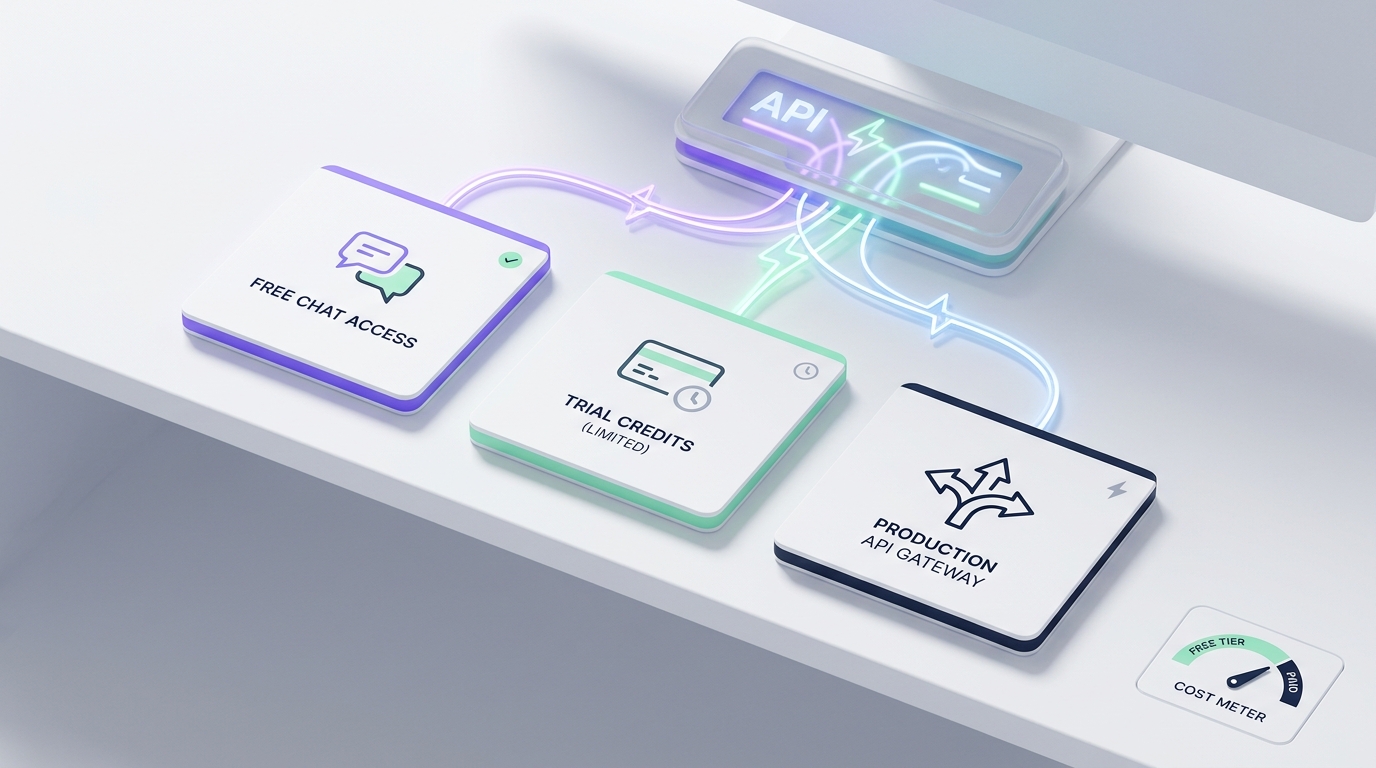
If you searched for How to Access DeepSeek V4 Flash Free, the important first answer is this: "free" can mean four different things, and only one of them behaves like production API access.
You may see free DeepSeek access through a chat UI, a temporary demo, a hosted playground, or a promotional credit balance. Those are useful for evaluation, but they are not the same as a permanent free API tier. For API work, DeepSeek's official docs price the current Flash route by tokens. Flatkey gives new users a small free credit to test the route, then usage is billed from plan credits or wallet balance after that.
This guide shows how to try DeepSeek V4 Flash safely, what "free" usually includes, what it does not include, and how to avoid building on a route that disappears after a promo expires.
The quick answer
As of September 22, 2026, the current official API model name for the latest Flash line is deepseek-flash, which maps to DeepSeek-V4.1-Flash. DeepSeek's pricing page says the old names deepseek-v4-flash and deepseek-v4-flash-vision-exp are still accepted for compatibility, but those previous models are retired; requests are served by DeepSeek-V4.1-Flash and billed at the Flash price.
So if you want How to Access DeepSeek V4 Flash Free in 2026, treat the route this way:
| Access path | What is free | What is not free | Best use |
|---|---|---|---|
| Chat or app UI | Manual evaluation if your account can use it without payment | API automation, request logs, quotas, keys, production traffic | Taste tests and prompt exploration |
| DeepSeek granted balance | API calls until the grant is exhausted | Ongoing API traffic after credits run out | Provider-direct smoke tests |
| Flatkey free credit | Flatkey's starting credit for testing routes through one key | Sustained production usage after credit/plan balance is consumed | Indie-hacker API trials across DeepSeek and other models |
| Local/open-weight route | No per-token API bill if you run it yourself | Hardware, deployment, ops, latency, maintenance | Experiments where infrastructure control matters more than speed |
The safe rule: use free access to answer "does this model fit my workload?" Do not assume "DeepSeek V4 Flash free" means unlimited API calls, stable production SLA, or no billing controls.
Step 1: Use the current model name, not stale V4 Flash aliases
The phrase "DeepSeek V4 Flash" is now slightly stale in API copy. DeepSeek's September 10, 2026 change log says DeepSeek-V4.1-Flash is available on the DeepSeek API and that developers should change the model name to deepseek-flash. It also says the previous-generation V4 Flash and V4 Flash Vision Exp names are temporarily routed to V4.1 Flash.
For new code, start with:
deepseek-flashIf a gateway or catalog still exposes:
deepseek-v4-flash
deepseek-v4-flash-vision-exp
verify whether those are compatibility aliases, archived route names, or gateway-specific aliases before you commit production traffic. This is the first place many "free DeepSeek V4 Flash" posts go wrong: they show a route name that worked for a beta or demo, but not the current production model.
Step 2: Separate free chat from free API
Free chat access is not the same as a free API tier.
A chat product can be free because the provider controls the UI, rate limits, prompt length, user identity, abuse controls, and product behavior. An API key is different: it can be embedded into tools, scripts, agents, CI jobs, and products that send traffic continuously. That is why API access usually needs a balance, granted credit, or paid plan.
When a page says "DeepSeek V4 Flash free," ask which surface it means:
- Can I call it from code?
- Do I receive an API key?
- Is there a documented token price?
- Is the free amount a one-time credit, daily quota, demo pool, or unlimited chat use?
- Can I see usage logs and per-request cost?
- Does the route support streaming, tool calls, JSON output, vision, and the context length I need?
If those answers are missing, treat it as a demo, not an API plan.
Step 3: Check what the official DeepSeek API free balance actually covers
DeepSeek's pricing docs do not describe a permanent unlimited free API tier. They do describe token billing and a deduction rule: fees are deducted from topped-up balance or granted balance, and granted balance is used first when both balances exist.
For deepseek-flash, the official pricing table lists:
| Unit | Off-peak | Peak |
|---|---|---|
| 1M input tokens, cache hit | $0.003 | $0.006 |
| 1M input tokens, cache miss | $0.15 | $0.30 |
| 1M output tokens | $0.60 | $1.20 |
Peak hours are listed as 01:00-04:00 and 06:00-10:00 UTC, Monday through Friday, excluding Chinese public holidays. All other hours are off-peak. DeepSeek also says product prices may vary and recommends checking the pricing page regularly.
For an indie hacker, the practical takeaway is simple: if your account has a granted balance, you can use it for tests. Once the grant is gone, the same API workload is token-priced.
Step 4: Test through Flatkey if you want one key and one cost ledger
Flatkey's pricing page currently says new users start with $1 free credit. That is enough for a meaningful smoke test of a low-cost text route, but it is not a promise of unlimited free DeepSeek traffic.
The Flatkey workflow is:
- Create an account and API key.
- Set your OpenAI-compatible client
base_urltohttps://router.flatkey.ai/v1. - Choose the DeepSeek Flash route from the live model directory.
- Send a tiny request first.
- Open Usage Logs and confirm model, token counts, latency, and cost.
Minimal Python setup:
import os
from openai import OpenAI

client = OpenAI(
    api_key=os.environ["FLATKEY_API_KEY"],
    base_url="https://router.flatkey.ai/v1",
)

response = client.chat.completions.create(
    model="deepseek-v4-1-flash",
    messages=[
        {"role": "user", "content": "Return one sentence explaining what this model is good for."}
    ],
    max_tokens=80,
)

print(response.choices[0].message.content)
Before using that exact route in production, confirm the current Flatkey model-directory row because gateways can expose provider-native names, compatibility aliases, or launch-specific names differently from the upstream provider.
Step 5: Run a small route check before spending credits
Use this route review record before you move from free testing to real traffic:
deepseek_flash_route_review:
  date_checked: 2026-09-22
  target_query: "How to Access DeepSeek V4 Flash Free"
  provider_current_name: "deepseek-flash"
  provider_model_version: "DeepSeek-V4.1-Flash"
  legacy_aliases_to_verify:
    - "deepseek-v4-flash"
    - "deepseek-v4-flash-vision-exp"
  access_path:
    direct_provider: "granted balance or topped-up balance"
    flatkey: "new-user free credit, then plan credits or wallet balance"
  smoke_test:
    prompt_size: "small"
    max_tokens: 80
    expected_checks:
      - request succeeds
      - usage log appears
      - token counts are visible
      - cost is visible
      - model route matches intended DeepSeek Flash route
  production_gate:
    - verify current model directory
    - set a budget cap
    - keep a fallback model ready
    - re-check pricing before launch
This is the part most free-tier tutorials skip. A free credit is helpful, but cost control comes from limiting request size, watching usage logs, and checking the exact route before an agent or batch job starts looping.
What the free tier really includes
For How to Access DeepSeek V4 Flash Free, the cleanest mental model is:
- Free chat can answer "do I like the model's behavior?"
- Granted balance can answer "does the official API fit my code?"
- Flatkey free credit can answer "does this route work inside my multi-model setup?"
- Local/self-hosted access can answer "can I run compatible weights under my own infrastructure constraints?"
It usually does not include:
- Unlimited API usage.
- Guaranteed production uptime.
- Unlimited concurrency.
- A fixed price forever.
- A promise that old
deepseek-v4-flashaliases will remain the best route name. - Spend controls unless your provider or gateway gives you a ledger, quotas, or alerts.
If you are building a side project, that distinction matters. Free access is enough for a landing-page demo, a prompt benchmark, or a tiny prototype. It is not enough for unattended coding agents, background jobs, high-volume summarization, or customer-facing automation unless you add budgets and monitoring.
When to use direct DeepSeek vs Flatkey
Use DeepSeek directly when:
- You only need DeepSeek.
- You want provider-native account controls.
- You do not need one invoice across providers.
- You are comfortable monitoring DeepSeek billing directly.
Use Flatkey when:
- You want one OpenAI-compatible base URL for multiple models.
- You are comparing DeepSeek against Qwen, Gemini, Claude, GPT, GLM, or Kimi.
- You want a single usage ledger while you test.
- You want to keep the model route configurable without rewriting SDK code.
- You are using agents or scripts that may need fallback routes later.
For an indie hacker, the practical move is to keep the first experiment small. Use the free credit or granted balance to validate model fit, then decide whether direct DeepSeek billing or Flatkey's one-key routing is simpler for your product.
FAQ
Is DeepSeek V4 Flash free?
DeepSeek V4 Flash can be free to try in some contexts, but the official API is token-priced. DeepSeek's docs describe granted balance and topped-up balance, not an unlimited permanent free API tier.
What model name should I use now?
Use deepseek-flash for the current official DeepSeek-V4.1-Flash API route. Treat deepseek-v4-flash as a compatibility alias unless your gateway explicitly documents it as the active route name.
Does Flatkey make DeepSeek V4 Flash free forever?
No. Flatkey currently gives new users $1 free credit for testing, then usage is billed from plan credits or wallet balance. Use the credit for smoke tests, not unlimited production traffic.
Why do some pages still say DeepSeek V4 Flash instead of V4.1 Flash?
The name has changed quickly. DeepSeek released DeepSeek-V4-Flash first, then released DeepSeek-V4.1-Flash and moved the current API model name to deepseek-flash. Older posts may still rank for the old query.
What should I check before production use?
Check the current model name, token price, peak/off-peak window, route availability, usage logs, budget caps, and fallback route. That protects you from stale free-tier claims and alias changes.
Bottom line
How to Access DeepSeek V4 Flash Free is best understood as a testing workflow, not a permanent pricing plan. Start with a free chat session or granted balance if you want provider-direct evaluation. Use Flatkey's free credit if you want to test DeepSeek Flash through one API key, one base URL, and one usage ledger. Then re-check the live model directory and pricing page before putting real traffic behind the route.
Useful next reads: