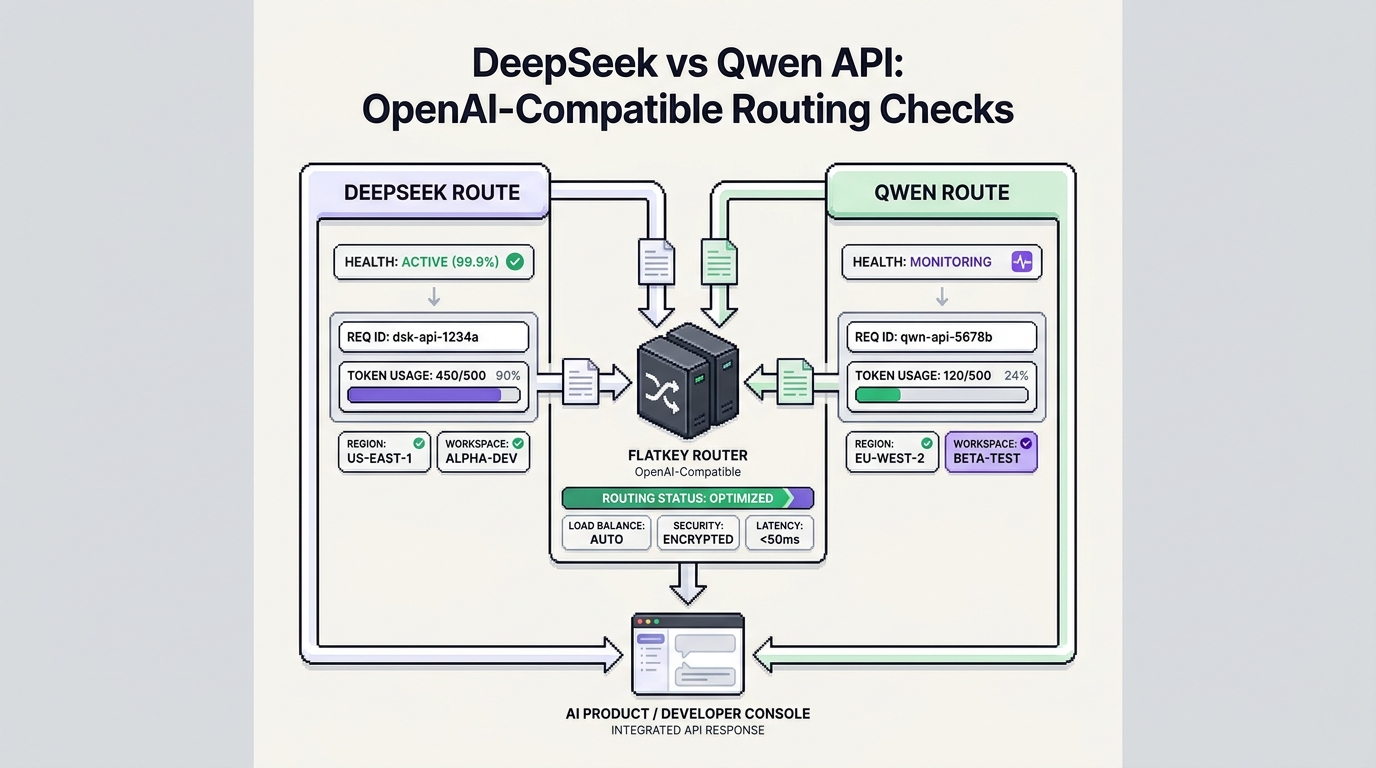
The DeepSeek vs Qwen API: OpenAI-Compatible Routing Checks question is not just a model comparison. For a production team, it is a route-readiness question: which endpoint family your client calls, which account owns the key, which model ID is current, which features behave like your parser expects, and where you can inspect usage after traffic moves.
That framing matters because both providers can look familiar at the SDK layer. DeepSeek documents an OpenAI-compatible API surface with https://api.deepseek.com as the OpenAI-format base URL. Alibaba Cloud Model Studio documents OpenAI-compatible Qwen access, but its base URL can depend on region and workspace. If you use Flatkey, your application can keep the OpenAI SDK shape and point at https://router.flatkey.ai/v1, but you still need to verify the exact DeepSeek or Qwen route before you call it production-ready.
Use this DeepSeek vs Qwen API: OpenAI-Compatible Routing Checks guide as a practical checklist before you switch workloads, add fallback, or standardize a shared gateway.
Quick Answer: DeepSeek vs Qwen API Routing Checks
| Route choice | Prefer it when | Verify before launch |
|---|---|---|
| Direct DeepSeek API | You need DeepSeek-native behavior, DeepSeek's current model IDs, and a focused OpenAI-compatible endpoint. | Base URL, model ID, alias lifecycle, JSON output, tool calls, streaming, vision support, context length, concurrency, 429 handling, and pricing units. |
| Direct Qwen API through Model Studio | You already operate inside Alibaba Cloud, need Qwen model families, or must control region and workspace setup directly. | Region endpoint, workspace-specific domain, region-bound API key, selected Qwen family, tool/streaming compatibility, token tiers, cache rules, and authentication errors. |
| Flatkey gateway route | You want one key, one OpenAI-compatible base URL, shared usage review, and simpler routing across multiple model families. | Current Flatkey model row, endpoint family, route health, request log, token/cost fields, feature pass-through, fallback policy, and rollback route. |
The practical DeepSeek vs Qwen API: OpenAI-Compatible Routing Checks answer is often hybrid. Use direct provider routes when you need provider-specific controls you have not proven through a gateway. Use Flatkey when the bigger operational problem is scattered provider keys, fragmented billing, and repeated SDK changes across teams or agents.
Provider Facts To Check First
Start every DeepSeek vs Qwen API: OpenAI-Compatible Routing Checks review with current provider documentation, not an old model list.
DeepSeek currently documents that its API uses a format compatible with OpenAI and Anthropic. Its first-call documentation lists https://api.deepseek.com for OpenAI-format calls and https://api.deepseek.com/anthropic for Anthropic-format calls. Its current models and pricing table lists deepseek-flash and deepseek-v4-pro as the active rows, with model versions, feature support, context length, max output, and concurrency limits on the same page.
The DeepSeek lifecycle note is important: legacy names such as deepseek-v4-flash and deepseek-v4-flash-vision-exp are still accepted, but DeepSeek says those retired names are served by the newer Flash model and billed at the Flash price. If your code, gateway policy, or evaluation sheet still uses an old alias, update the route check before you compare outputs.
Qwen through Alibaba Cloud Model Studio starts from a different contract. Model Studio says Qwen models support OpenAI-compatible interfaces and that existing OpenAI code can migrate by changing the API key, base URL, and model name. But the same documentation ties the base URL to region and, for several regions, to a workspace-specific domain. It also says a Model Studio API key is bound to the region where it was created; calling another region's endpoint with that key can return an HTTP 401 authentication error.
That is the core difference. With DeepSeek, the first question is usually "which current DeepSeek model ID and feature mode?" With Qwen, the first question is often "which region, workspace domain, API key, and model family?"
OpenAI-Compatible Does Not Mean Identical
The phrase "OpenAI-compatible" is a migration accelerator. It is not a promise that every endpoint, field, stream, error, or tool-call edge case behaves identically.
| Check | DeepSeek direct route | Qwen direct route | Flatkey route |
|---|---|---|---|
| Base URL | OpenAI-format base URL is https://api.deepseek.com. |
Compatible-mode base URL varies by region and may include {WorkspaceId}. |
OpenAI-compatible base URL is https://router.flatkey.ai/v1. |
| Chat endpoint | Direct cURL examples use /chat/completions. |
Compatible-mode examples use /chat/completions. |
OpenAI-compatible traffic uses /v1/chat/completions. |
| Model IDs | Current docs center deepseek-flash and deepseek-v4-pro; legacy Flash names are accepted but mapped forward. |
Current docs show Qwen rows such as qwen3.8-max, qwen3.7-plus, and qwen3.8-flash, with family-specific behavior. |
Use the exact model ID visible in the Flatkey model directory or account route. |
| Streaming | Test streamed chunks, idle waits, cancellation, and final usage handling. | Model Studio examples show stream=True and stream_options={"include_usage": True}. |
Confirm your SDK parser handles chunks and final usage through the gateway. |
| Tool calls | DeepSeek documents tool calls as a supported feature for current rows. | Model Studio documents function calling, but also notes that tools cannot be used with stream=True simultaneously in the OpenAI-compatible parameter section. |
Run a real tool-call test before an agent depends on the route. |
| JSON output | DeepSeek lists JSON output support for current rows. | Qwen-compatible parameters include response formatting and model-specific support notes. | Test schema parsing, invalid JSON behavior, and fallback. |
| Vision/audio | DeepSeek's table marks vision support for deepseek-flash and not for deepseek-v4-pro. |
Model Studio lists Qwen-VL and Qwen-Omni as supported model families, but says Qwen-Audio does not support the OpenAI-compatible protocol and should use DashScope. | Do not assume multimodal parity from a text chat pass. |
| Capacity/errors | DeepSeek documents account-level concurrency and HTTP 429 when exceeded. | Qwen region/key mismatches can return HTTP 401; quotas and throttles should be tested per region/account. | Log provider class, status code, retry, fallback reason, latency, tokens, and cost. |
This is the central DeepSeek vs Qwen API: OpenAI-Compatible Routing Checks rule: prove the route you will actually run, not the one implied by a provider name.
Pricing Checks Before You Compare Routes
A route can be compatible and still be financially wrong for the workload. Do not compare DeepSeek vs Qwen API: OpenAI-Compatible Routing Checks with one input-token headline.
DeepSeek's current pricing documentation bills in units of one million tokens and separates cache-hit input, cache-miss input, and output tokens. It also distinguishes peak and off-peak rates and places concurrency limits beside model rows. Its rate-limit documentation says concurrency is calculated at the account level and excess concurrency returns HTTP 429. That makes DeepSeek cost review straightforward only if your logs separate input, output, cache behavior, request duration, and 429 rate.
Model Studio says model API calls are pay-as-you-go by default and that its pricing document lists standard prices, with promotions handled separately in the console. It also states that some models use tiered pricing based on the total number of input tokens in a single request, and that context cache and batch discounts have separate rules. That means a short chat request, a 100K-token retrieval request, a cached repeated-context request, and a batch job can belong in different Qwen cost buckets.
Use this cost normalization table before promoting a route:
| Cost field | Why it changes the decision | What to log |
|---|---|---|
| Input tokens | Qwen tiers and DeepSeek cache-miss inputs can change effective cost. | Prompt tokens, input tier, cache miss tokens, model ID. |
| Cached tokens | Cache discounts only help when the workload repeats stable context and the route exposes evidence. | Cache hit tokens, cache write tokens, cache policy, request family. |
| Output tokens | Long answers and reasoning/thinking outputs can dominate the bill. | Completion tokens, reasoning/thinking tokens if returned, output limit. |
| Peak/off-peak or promotion state | Published provider pages can separate standard prices from time-based or console promotions. | Billing time, price source date, route owner. |
| Retry/fallback cost | Failed attempts and fallback attempts can erase apparent token savings. | Attempt count, retry reason, fallback model, accepted response flag. |
For Flatkey, keep the same discipline: check the current model directory and pricing page, then verify request-level usage in logs. A public model mention is useful discovery. A production decision needs a successful route test and a readable ledger.
Flatkey Route Checklist
Flatkey changes the operating workflow around DeepSeek vs Qwen API: OpenAI-Compatible Routing Checks. It can let teams keep one OpenAI-compatible client surface, one Flatkey key, and one usage review layer across supported models and tools. The Flatkey quickstart shows the OpenAI-compatible request path, and the OpenAI SDK guide shows the base_url setup. Flatkey should not hide provider-specific requirements.
Use this sequence before a Flatkey route receives production traffic:
- Open the current Flatkey model directory and search the exact DeepSeek or Qwen model ID.
- Confirm the endpoint family is appropriate for the workload, usually OpenAI-compatible chat for this article.
- Confirm the model appears in the current account route, not only in an old article or screenshot.
- Send a plain chat request through
https://router.flatkey.ai/v1/chat/completions. - Send the same plain request through the direct provider route when you have direct credentials.
- Repeat with streaming, one tool call, one JSON-output test, one long-context sample, and one forced error.
- Save request ID, provider class, model ID, status code, latency, usage fields, cost fields, fallback reason, key owner, and rollback model.
Here is the minimal Flatkey smoke test:
curl -X POST "https://router.flatkey.ai/v1/chat/completions" \
  -H "Authorization: Bearer $FLATKEY_API_KEY" \
  -H "Content-Type: application/json" \
  -d '{
    "model": "your-verified-deepseek-or-qwen-model-id",
    "messages": [
      {
        "role": "user",
        "content": "Return one sentence confirming this route is alive."
      }
    ]
  }'
If that request fails with model-not-found, unsupported endpoint, HTTP 401, HTTP 429, timeout, or parser failure, the test still helped. It tells you the account, model ID, endpoint family, key scope, quota, or request shape needs correction before real traffic moves.
DeepSeek Route Checks
Use this checklist when DeepSeek is the candidate route:
| Check | Pass condition |
|---|---|
| Current model ID | The route uses deepseek-flash or deepseek-v4-pro, or the team has explicitly accepted DeepSeek's legacy-name mapping behavior. |
| Endpoint family | The app calls the intended DeepSeek endpoint family: OpenAI-format or Anthropic-format. |
| Feature support | JSON output, tool calls, Responses API, Anthropic API, beta prefix completion, FIM, and vision are tested only where the workload uses them. |
| Thinking/non-thinking behavior | The selected mode is explicit enough for evaluation and logging. |
| Concurrency | Account-level concurrency and per-user isolation behavior are understood; 429 handling is tested. |
| Long request behavior | Timeout, streaming, keep-alive, and max-output behavior are tested with real workload sizes. |
| Usage and cost | Input, output, cache hit/miss, peak/off-peak state, retries, and accepted response are logged. |
DeepSeek is the cleaner direct-provider path when your product wants DeepSeek-native behavior and the route checks above pass. It is not automatically safer just because the base URL is simple.
Qwen Route Checks
Use this checklist when Qwen through Model Studio is the candidate route:
| Check | Pass condition |
|---|---|
| Region | The workload's allowed region matches the Model Studio endpoint you call. |
| Workspace domain | {WorkspaceId} is replaced with the real workspace ID where required, and old/global domains are not carried forward blindly. |
| API key locality | The API key was created in the same region as the endpoint; region mismatch failures are classified separately from invalid-key failures. |
| Model family | The selected Qwen model family supports the request shape, context length, and output mode your app uses. |
| Tool and streaming behavior | Function calling and streaming are tested separately, especially because Model Studio notes that tools cannot be used with stream=True simultaneously. |
| Multimodal protocol | Qwen-VL, Qwen-Omni, and Qwen-Audio are checked by protocol; Qwen-Audio is not treated as an OpenAI-compatible chat route. |
| Pricing unit | Input token tier, output tokens, context cache, batch discount eligibility, and promotion state are logged. |
Qwen is often the stronger direct route when the team already runs on Alibaba Cloud or needs Model Studio's region/account model. It needs more setup proof because region, workspace, and key scope are part of the API contract.
Decision Matrix
Use this matrix when a stakeholder asks for a winner.
| Decision area | Prefer DeepSeek API | Prefer Qwen API | Prefer Flatkey |
|---|---|---|---|
| Direct setup | You want a focused DeepSeek account and current DeepSeek model family. | You already use Alibaba Cloud Model Studio. | You want one OpenAI-compatible base URL across multiple model families. |
| Regional control | Direct DeepSeek account controls are enough for the workload. | Region, workspace, and regional API-key ownership matter. | You want gateway-level policy, logs, and shared team ownership. |
| Tool/JSON behavior | DeepSeek's tool calls and JSON output pass your parser tests. | Qwen function calling and structured output pass your parser tests. | The same tests pass through the exact Flatkey route. |
| Multimodal routing | You only need the DeepSeek features supported by the selected row. | You need Qwen-VL, Qwen-Omni, or another Model Studio family and have checked its protocol. | You want to compare text, image, video, or tool routes in one operating layer. |
| Capacity | DeepSeek account-level concurrency fits the workload. | Model Studio quotas and regional health fit the workload. | You want observable retry/fallback policy across providers. |
| Finance review | DeepSeek cache/peak/output units are easy to model for the workload. | Qwen tiers, cache, batch, and console pricing fit the workload. | Finance needs one usage view and one billing/recharge trail across routes. |
There is no universal DeepSeek vs Qwen API: OpenAI-Compatible Routing Checks winner. There is a route that fits the workload, region, parser, cost model, and operating contract.
Migration Plan For Teams Already Shipping
Move in stages so model quality and route readiness stay separate.
- Baseline the current route: Save model IDs, prompts, parser expectations, latency, token usage, error classes, cost, and owner.
- Re-open current docs: Check DeepSeek model/pricing, first-call, feature, and rate-limit pages; check Qwen OpenAI-compatible, model, pricing, and feature pages.
- Run direct-provider tests: Use the same prompts and parsers against direct DeepSeek and direct Qwen if you have credentials.
- Run Flatkey tests after route lookup: Confirm the exact model appears in Flatkey, then test through
https://router.flatkey.ai/v1. - Compare behavior, not only answers: Review chunks, tool-call JSON, JSON-output validity, context errors, 401/429 behavior, timeout behavior, and usage fields.
- Move low-risk traffic first: Start with internal tools, eval jobs, batch summaries, or a small non-critical product slice.
- Promote after readback: Do not call the migration complete until product, platform, and finance can inspect the same route evidence.
This staged plan prevents a common mistake: declaring a model winner while the route itself is still unproven.
Common Mistakes
| Mistake | Why it hurts | Better check |
|---|---|---|
| Using old DeepSeek aliases without a date check | Alias mapping can hide behavior changes and confuse cost reviews. | Verify current model names and legacy-name behavior before migration. |
| Treating all Qwen endpoints as one endpoint | Region, workspace domain, and API-key locality can decide whether the call works. | Record endpoint region, workspace ID, and key region. |
| Comparing one token price | Cache hit, cache miss, output length, thinking mode, input tiers, retries, and promotions change real cost. | Review cost per accepted response by workload. |
| Assuming tool parity | Tool-call shape and streaming behavior can differ by provider and model. | Test one real tool call and one streaming run through each route. |
| Publishing a gateway route from a catalog mention | Public catalog discovery is not the same as account-level route readiness. | Run a live Flatkey route test and save the request evidence. |
Final Recommendation
For DeepSeek vs Qwen API: OpenAI-Compatible Routing Checks, start with provider truth and finish with route evidence.
Use DeepSeek direct when your workload fits DeepSeek's current model family, OpenAI-compatible endpoint, feature set, pricing units, and concurrency behavior. Use Qwen direct when you need Model Studio's Qwen families, regional endpoints, workspace domains, or Alibaba Cloud account controls. Use Flatkey when the bigger problem is one key, one OpenAI-compatible base URL, shared usage evidence, quota review, and unified billing across models.
The next step is not a slogan. Check the current provider docs, check Flatkey's model directory and pricing page, run the smoke tests above, and then get a Flatkey key when you are ready to verify a DeepSeek vs Qwen API: OpenAI-Compatible Routing Checks workflow through one gateway. For adjacent rollout work, pair this checklist with the Flatkey API quickstart, unified AI API workflow, OpenAI API alternative migration guide, regional LLM provider routing, and AI routing API metrics.
FAQ
Is DeepSeek vs Qwen API only a model-quality decision?
No. DeepSeek vs Qwen API: OpenAI-Compatible Routing Checks also include endpoint shape, model aliases, region, workspace, API-key locality, token tiers, cache behavior, tool calls, JSON output, streaming parser behavior, rate limits, logs, and billing evidence.
Which API is cheaper, DeepSeek or Qwen?
It depends on the exact model, prompt length, output length, cache behavior, token tier, thinking mode, retries, route, and billing time. Use the current official pricing pages and your actual usage logs instead of copying a static winner.
Can I use an OpenAI SDK with both providers?
Yes. DeepSeek and Model Studio both document OpenAI-compatible usage, but the base URL, model names, extra parameters, feature caveats, and account setup differ. Flatkey also supports the OpenAI SDK pattern through https://router.flatkey.ai/v1 for supported models.
Does Qwen's OpenAI-compatible route support every Qwen model family?
No. Alibaba Cloud Model Studio says supported OpenAI-compatible models include Qwen large language models, Qwen-VL, Qwen-Coder, Qwen-Omni, Qwen-Math, DeepSeek, Kimi, GLM, and MiniMax, but it separately says Qwen-Audio does not support the OpenAI-compatible protocol and should use DashScope instead.
What is the first Flatkey test for DeepSeek vs Qwen API routing?
Start with a plain chat completion through https://router.flatkey.ai/v1, then verify model ID, status, usage fields, pricing unit, streaming, tool calls, JSON output, error behavior, fallback, and rollback path.