DeepSeek V4 vs GPT-5: The Cheapest Frontier Option?
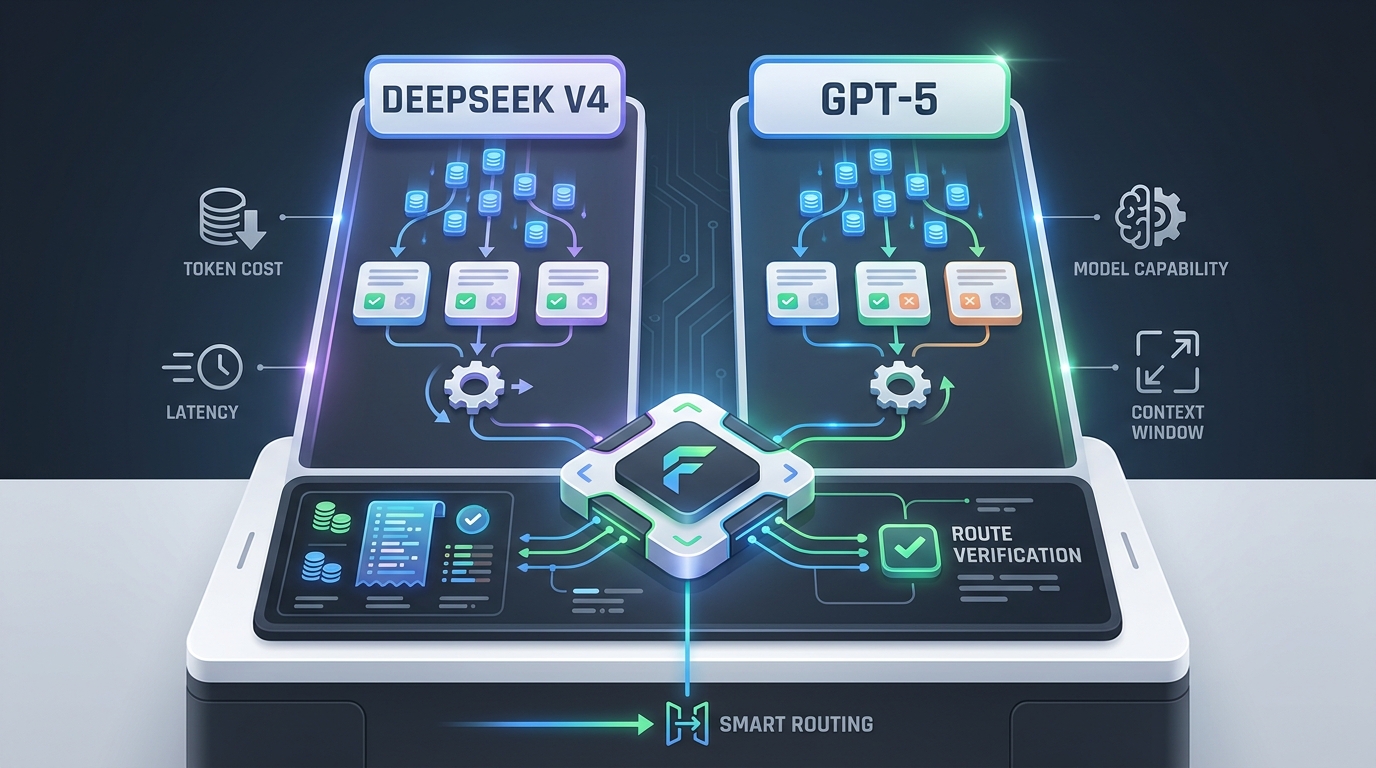
DeepSeek V4 vs GPT-5: The Cheapest Frontier Option? is the wrong question if you only compare one headline token price. It is the right question if you compare a real workload: uncached input, cached input, output length, retries, feature support, and the route you can verify in production.
The short answer: DeepSeek's current V4 API routes are usually cheaper than GPT-5 on published token rates, especially when you can use deepseek-flash or run during DeepSeek's off-peak window. But "cheapest frontier option" should not mean "always pick DeepSeek." GPT-5 still belongs in the comparison when you need OpenAI-specific tooling, image input through the GPT route, Responses API behavior, or a known GPT evaluation baseline. Treat DeepSeek V4 vs GPT-5 as a routing decision, not a brand decision.
As of this source check on September 22, 2026, DeepSeek's API docs list deepseek-flash as DeepSeek-V4.1-Flash and deepseek-v4-pro as DeepSeek-V4-Pro-0813. OpenAI's official GPT-5 page lists gpt-5 at $1.25 per 1M input tokens, $0.125 per 1M cached input tokens, and $10 per 1M output tokens. That makes the published price gap real, but the safe production answer is still to normalize by accepted output.
Quick Answer: DeepSeek V4 vs GPT-5
If your workload is cost-sensitive text generation, coding assistance, long-context review, or agent routing, start by testing DeepSeek V4.1 Flash against GPT-5. If the route passes your feature smoke tests and accepted-output threshold, it is likely the lower-cost default. If the workload depends on GPT-specific tool behavior, OpenAI model baselines, or a direct OpenAI support path, keep GPT-5 in the candidate set.
| Decision point | DeepSeek V4 route | GPT-5 route |
|---|---|---|
| Lowest published token cost | Usually deepseek-flash, especially off-peak | Not the cheapest by token price |
| Higher-quality DeepSeek candidate | deepseek-v4-pro | Compare against gpt-5 or a newer GPT route if your benchmark allows it |
| Context and output headroom | DeepSeek docs list 1M context and 384K max output for current DeepSeek API models | OpenAI docs list a 400K context window, 272K max input, and 128K max output for GPT-5 |
| Cached-input comparison | DeepSeek cache-hit rates are very low in the official pricing table | GPT-5 cached input is $0.125 per 1M tokens |
| Feature checks | JSON, tool calls, Responses API, Anthropic API, thinking mode, and model-specific vision support | Chat Completions, Responses, streaming, structured outputs, function calling, prompt caching, image input, and supported Responses tools |
| Best first Flatkey action | Verify deepseek-flash and deepseek-v4-pro in the model directory and /v1/models | Verify gpt-5 availability and the exact GPT model row you intend to call |
The practical takeaway: DeepSeek V4 vs GPT-5 is a cost win for DeepSeek only after your parser, tool calls, latency target, and fallback policy still pass.
Current Official Pricing Snapshot
DeepSeek prices are per 1M tokens and split by cache hit, cache miss, output, and peak/off-peak windows. OpenAI prices GPT-5 text tokens with input, cached input, and output rows.
| Model route | Input cache hit | Input cache miss / input | Output | Notes |
|---|---|---|---|---|
deepseek-flash off-peak | $0.003 | $0.15 | $0.60 | DeepSeek-V4.1-Flash |
deepseek-flash peak | $0.006 | $0.30 | $1.20 | DeepSeek-V4.1-Flash |
deepseek-v4-pro off-peak | $0.022 | $0.66 | $1.98 | DeepSeek-V4-Pro-0813 |
deepseek-v4-pro peak | $0.044 | $1.32 | $3.96 | Peak uncached input can be slightly above GPT-5 input |
gpt-5 standard | $0.125 cached input | $1.25 input | $10.00 | OpenAI GPT-5 standard token pricing |
That table answers the narrow token-rate question. DeepSeek Flash is cheaper than GPT-5 on all listed token-rate rows. DeepSeek V4 Pro is cheaper than GPT-5 on cached input and output, and cheaper on off-peak uncached input, but its peak uncached input row is slightly higher than GPT-5 input. So the accurate DeepSeek V4 vs GPT-5 answer is not "DeepSeek always wins." It is "DeepSeek usually wins the token-rate comparison, but check the exact mix."
The Cost Formula That Matters
Use accepted-output cost, not raw token price:
accepted_output_cost =
  (
    uncached_input_tokens * input_price
    + cached_input_tokens * cached_input_price
    + output_tokens * output_price
    + retry_tokens
    + fallback_tokens
  )
  / accepted_outputs
For example, a request with 100K uncached input tokens and 20K output tokens costs about:
| Route | Price window | Approximate request cost before retries |
|---|---|---|
deepseek-flash | off-peak | $0.027 |
deepseek-flash | peak | $0.054 |
deepseek-v4-pro | off-peak | $0.1056 |
deepseek-v4-pro | peak | $0.2112 |
gpt-5 | standard | $0.325 |
The same math becomes more favorable to DeepSeek when cache-hit input dominates. It becomes less favorable if your DeepSeek route needs more retries, produces more rejected JSON, or falls back to another model more often.
That is why the DeepSeek V4 vs GPT-5 decision should be logged per workload. A cheap answer that your app rejects is not cheap.
Why Peak And Off-Peak Change The Answer
DeepSeek's pricing page says off-peak rates are half of peak rates. It defines peak hours as 01:00-04:00 and 06:00-10:00 UTC, Monday through Friday, excluding Chinese public holidays. All other hours are off-peak, including weekends and Chinese public holidays.
If your traffic is batchable, queued, or agentic rather than user-blocking, off-peak scheduling can materially change the DeepSeek V4 vs GPT-5 result. For interactive traffic, assume some requests will land in peak windows and budget against the higher row.
Use this rule:
| Workload type | Safer pricing assumption |
|---|---|
| Real-time chat, coding assistant, user-facing agent | Budget DeepSeek at peak rates unless your traffic data proves otherwise |
| Batch summarization, nightly evals, enrichment jobs | Consider off-peak scheduling, then verify actual usage logs |
| Mixed agent workflows | Separate foreground and background routes |
| Enterprise budgeting | Record both peak and off-peak rows in the model scorecard |
Feature Fit Before Price Fit
A price table cannot tell you whether a model route fits your product. Before moving production traffic, test the features your app actually uses.
| Feature | DeepSeek V4 route check | GPT-5 route check |
|---|---|---|
| Chat completions | Short non-streaming and streaming prompts | Short non-streaming and streaming prompts |
| Responses API | Confirm supported parameters and ignored fields | Confirm Responses behavior and tool outputs |
| JSON / structured output | Validate against your schema and repair path | Validate against your schema and repair path |
| Tool calls | Parse tool-call arguments and retries | Parse tool-call arguments and retries |
| Long context | Test real long inputs, not synthetic token stuffing | Test real long inputs, not synthetic token stuffing |
| Vision | DeepSeek docs list vision for Flash and not Pro | OpenAI docs list image input for GPT-5 |
| Usage readback | Confirm model, token counts, cost, status, and latency | Confirm model, token counts, cost, status, and latency |
Do not assume OpenAI-compatible means identical behavior. It means the integration surface can be similar enough to test quickly. The DeepSeek V4 vs GPT-5 decision still has to survive your parser, your tool layer, and your user acceptance bar.
Direct Provider Or Flatkey Router?
You can compare DeepSeek V4 and GPT-5 directly with provider keys. You can also route both through Flatkey when you want one OpenAI-compatible client, one balance, one model catalog, and one usage review path.
Flatkey's quickstart shows the OpenAI SDK pointed at:
https://router.flatkey.ai/v1The operational advantage is not that a router magically makes every model equivalent. The advantage is that you can keep the client stable while changing the model ID, then review token usage and cost in one place.
Use this route record before testing:
route_test:
  question: "DeepSeek V4 vs GPT-5"
  base_url: "https://router.flatkey.ai/v1"
  candidates:
    - deepseek-flash
    - deepseek-v4-pro
    - gpt-5
  required_checks:
    - account_accessible_model_ids
    - pricing_units
    - feature_smoke_tests
    - usage_log_readback
    - accepted_output_cost
    - fallback_policy
  launch_rule: "Promote only if accepted-output cost and quality both pass"
For setup details, use the DeepSeek API access guide and the Flatkey API quickstart. If you are replacing old DeepSeek model strings, use the DeepSeek V4 migration checklist before changing production config.
A Practical Scorecard
Use this scorecard instead of a one-line "cheapest model" conclusion.
| Criterion | Weight | How to score it |
|---|---|---|
| Accepted-output cost | 30% | Cost after retries, rejected outputs, and fallback |
| Feature compatibility | 20% | Streaming, tools, JSON, image input, long context, Responses API |
| Latency and concurrency | 15% | p50, p90, timeout rate, provider limits |
| Quality on your task | 20% | Eval pass rate, human review, bug rate, customer acceptance |
| Operational control | 10% | Usage logs, rollback, allowlists, billing review |
| Vendor or compliance requirement | 5% | Contract, data controls, direct-provider requirement |
DeepSeek should usually win the first row. GPT-5 may win or remain necessary in feature, baseline, or vendor-control rows. Flatkey helps when your real problem is switching routes without rewriting the application every time a model changes.
When DeepSeek V4 Is The Better Default
Choose DeepSeek V4 first when:
- You are price-sensitive and can evaluate accepted-output quality quickly.
- Your workload is text-heavy, coding-heavy, or long-context-heavy.
- Your app can route batch work into off-peak windows.
- You can tolerate testing feature behavior before launch.
- You want a low-cost candidate beside Qwen, Gemini, Claude, and GPT routes.
This is where DeepSeek V4 vs GPT-5 becomes a strong SEO answer and a practical product answer: DeepSeek is the route to test first when cost pressure is real.
When GPT-5 Still Belongs In The Test
Keep GPT-5 in the comparison when:
- Your existing eval baseline was built on GPT-5.
- You depend on OpenAI-specific Responses API tools or image-input behavior.
- You need direct OpenAI support, procurement, or documentation alignment.
- Your product already exposes a GPT route to customers.
- A newer OpenAI model is the real target, but GPT-5 remains the legacy comparison point.
One important caveat: OpenAI's current GPT-5 documentation describes GPT-5 as its previous model for coding, reasoning, and agentic tasks and recommends GPT-6 Astra as the latest model. If your buyer is asking for the newest OpenAI frontier route rather than GPT-5 specifically, do not silently pretend GPT-5 is the latest OpenAI option. Keep the article title match, but update the buyer conversation.
Final Recommendation
For most cost-sensitive API workflows, DeepSeek V4 vs GPT-5 starts with a DeepSeek win on published token prices. Use deepseek-flash as the low-cost first test, add deepseek-v4-pro when you need a higher DeepSeek candidate, and keep gpt-5 as the GPT baseline when OpenAI-specific behavior matters.
Then make the final call from logs:
- Verify model IDs through the provider docs or Flatkey model directory.
- Run the same prompt set through DeepSeek and GPT-5.
- Measure accepted-output cost, not raw token cost.
- Check usage logs for model, token counts, cost, status, and latency.
- Promote the cheapest route only if quality, parser behavior, and fallback risk pass.
Flatkey's role is to make that test reversible: one OpenAI-compatible base URL, one key, one model catalog, and one place to review usage. That is the safest way to answer DeepSeek V4 vs GPT-5: The Cheapest Frontier Option? without turning a pricing article into an unsupported benchmark claim.
Frequently Asked Questions
Is DeepSeek V4 cheaper than GPT-5?
On current published token rates, DeepSeek Flash is cheaper than GPT-5 across the listed token rows, and DeepSeek V4 Pro is cheaper on output and cached input. DeepSeek V4 Pro peak uncached input is slightly higher than GPT-5 input, so the precise answer depends on your input, cache, output, and peak/off-peak mix.
Is DeepSeek V4 Pro the same as DeepSeek V4.1 Flash?
No. DeepSeek's current pricing table lists deepseek-flash as DeepSeek-V4.1-Flash and deepseek-v4-pro as DeepSeek-V4-Pro-0813. Treat them as separate model routes with separate prices and feature checks.
Should I replace GPT-5 with DeepSeek V4?
Replace only after a workload test. DeepSeek may be the cheaper route, but you still need to check output acceptance, tool calls, JSON behavior, latency, usage logs, and rollback.
Can I compare both through one OpenAI-compatible client?
Yes. With Flatkey, point the OpenAI SDK at https://router.flatkey.ai/v1, use a Flatkey API key, and change the model parameter to the candidate route you are testing. Verify available model IDs before launch.
What internal Flatkey pages should I read next?
Start with DeepSeek API access, DeepSeek V4 migration, DeepSeek V4 Pro vs Flash, Claude vs GPT API routing, and the AI model catalog guide.