Sovereign AI Infrastructure: Models, Data Residency, and Compute Control (2026 Guide)
Sovereign AI infrastructure is the combination of compute, data, models, and operations that a country or organization controls under its own laws, rather than depending on foreign-controlled services. In practice it means four things: GPUs located in a chosen jurisdiction, data that stays there, models you can run and audit yourself (usually open-weight), and operators who are bound by local law. Most enterprises do not need full sovereignty; they need the right level of control for each workload.
This guide is for enterprise AI, infrastructure, and procurement teams that have been asked to "make our AI sovereign." It defines the term, explains the regulations driving it as of October 2026, lays out five levels of control from public APIs to air-gapped clusters, and gives a sizing and cost example for an in-country GPU deployment.
What is sovereign AI?
NVIDIA describes sovereign AI as countries building AI "using national infrastructure, data, talent and business networks, in ways that fit their language, culture and regulations," with models "hosted and run on local infrastructure, subject only to local laws" (NVIDIA). Red Hat frames it from the enterprise side: control over where AI runs, who can access it, and which components you can inspect and replace.
The term covers two related goals:
- National sovereign AI: a country building domestic compute, local-language models, and talent so that critical services do not depend on foreign providers.
- Enterprise sovereign AI: an organization keeping regulated data, models, and AI operations under jurisdictions and contracts it chooses.
Both rest on the same infrastructure layers.
The four layers of sovereign AI infrastructure
| Layer | What "sovereign" means | Typical controls |
|---|---|---|
| Compute | GPUs in a chosen country, operated by an entity under that country's law | In-country data centers, dedicated or private GPU clusters, sovereign cloud regions |
| Data | Training data, prompts, outputs, logs, and backups stay in the jurisdiction | Data residency contracts, regional storage, encryption with customer-held keys |
| Models | You can run, inspect, fine-tune, and keep using the model without a foreign vendor's consent | Open-weight models (Llama, Mistral, Qwen, DeepSeek) self-hosted; or contractual guarantees for closed models |
| Operations | Admins, support staff, and subprocessors are local and auditable | Local support personnel, access logging, independent audit rights, exit plans |
A deployment is only as sovereign as its weakest layer. In-country GPUs do not help if prompts are logged to a monitoring service abroad, and a local model does not help if the only admin access is through a foreign provider's support team.
Why sovereignty is on the agenda in 2026
Three forces make this a procurement question rather than a policy debate:
- EU AI Act deadlines. According to the AI Act implementation timeline (last updated August 31, 2026), most remaining provisions began applying on August 2, 2026; providers of general-purpose AI models already on the market before August 2, 2025 must comply by August 2, 2027; and obligations for Annex III high-risk systems start on December 2, 2027. Organizations need audit trails and documentation they control.
- Cross-border data rules. Under GDPR, personal data can flow freely only to countries with an EU adequacy decision; other transfers need safeguards. Meanwhile the US CLOUD Act (March 2018) gives US authorities a path to request data held by US-based providers, which is why EU buyers ask who operates a service, not just where it runs.
- Vendor and supply risk. Model deprecations, price changes, usage-policy changes, and GPU export controls can all disrupt a product built on one foreign API.
Cloud providers have responded with sovereign offerings: AWS launched the AWS European Sovereign Cloud as an independent cloud for Europe; Microsoft's EU Data Boundary commits to storing and processing customer data for its enterprise services within the EU; Oracle markets sovereign cloud options with location, access, and operational controls.
Five levels of AI sovereignty
Choose a level per workload, not one level for the whole company.
| Level | Setup | Data residency | Model control | Ops control | Good for |
|---|---|---|---|---|---|
| 1. Public API | Global endpoint of a model provider | Provider's choice | None | Provider | Public content, prototypes |
| 2. Regional API | Same provider with regional or in-country processing (e.g. Claude's US-only inference at 1.1x, OpenAI regional data residency endpoints at +10%) | Contracted region | None | Provider | Most internal business data |
| 3. Sovereign cloud | Model hosting in a sovereign region operated by a local entity | In-country | Limited (catalog models) | Local operator | Regulated industries, public sector |
| 4. Dedicated GPUs in-country | Rented or reserved GPU cluster in your chosen country, running open-weight models you deploy | In-country, your storage | Full | You, plus data-center operator | Health, finance, defense suppliers, national LLMs |
| 5. On-prem or air-gapped | Your own hardware, no external network | Your premises | Full | You | Classified or highly restricted workloads |
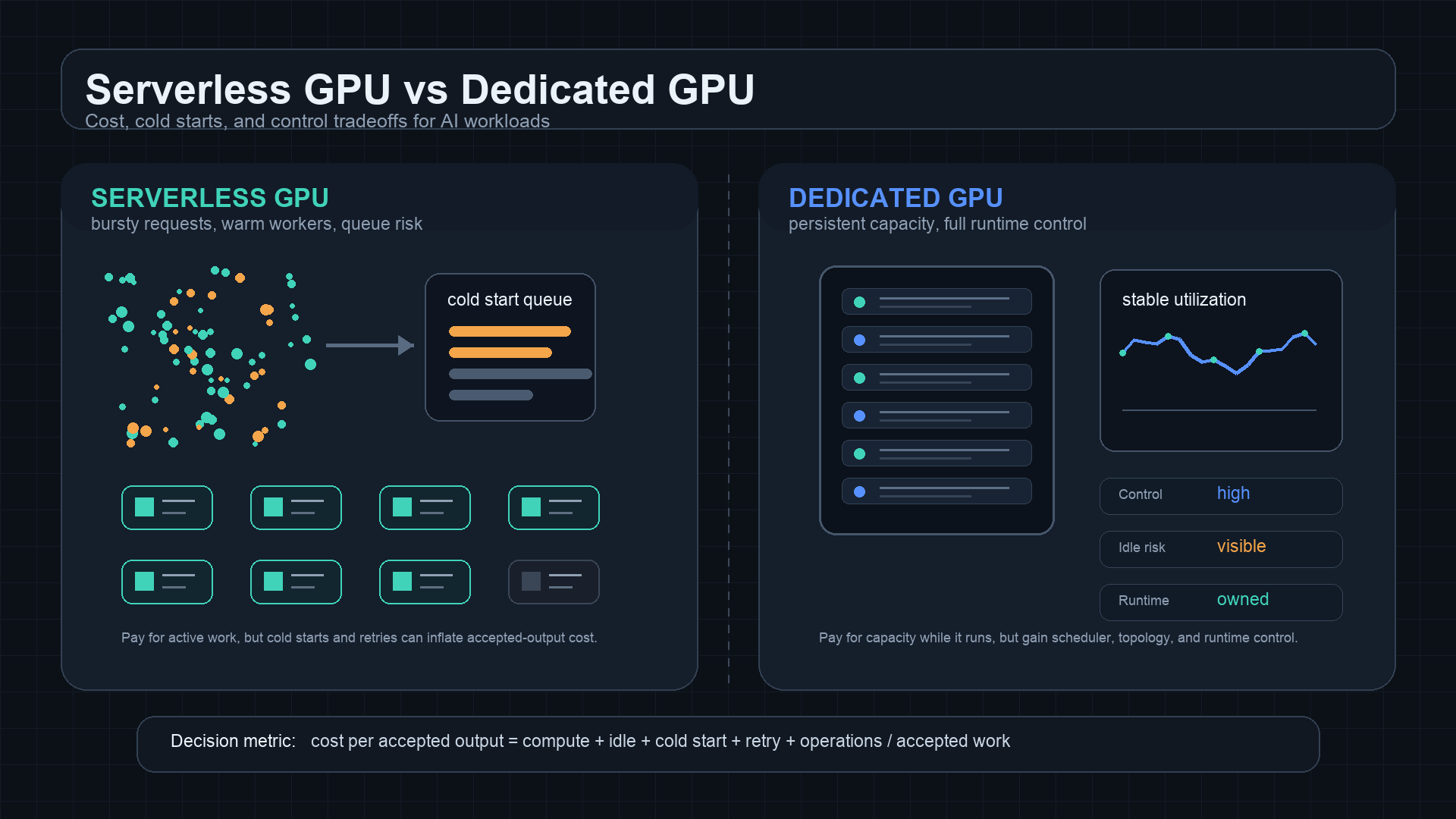
The pricing figures in level 2 come from the official Claude pricing page and OpenAI's pricing page as of October 2026: regional processing usually costs about 10 percent more than global processing. Levels 4 and 5 trade that premium for GPU capacity you must keep busy.
Designing a sovereign AI stack
Compute
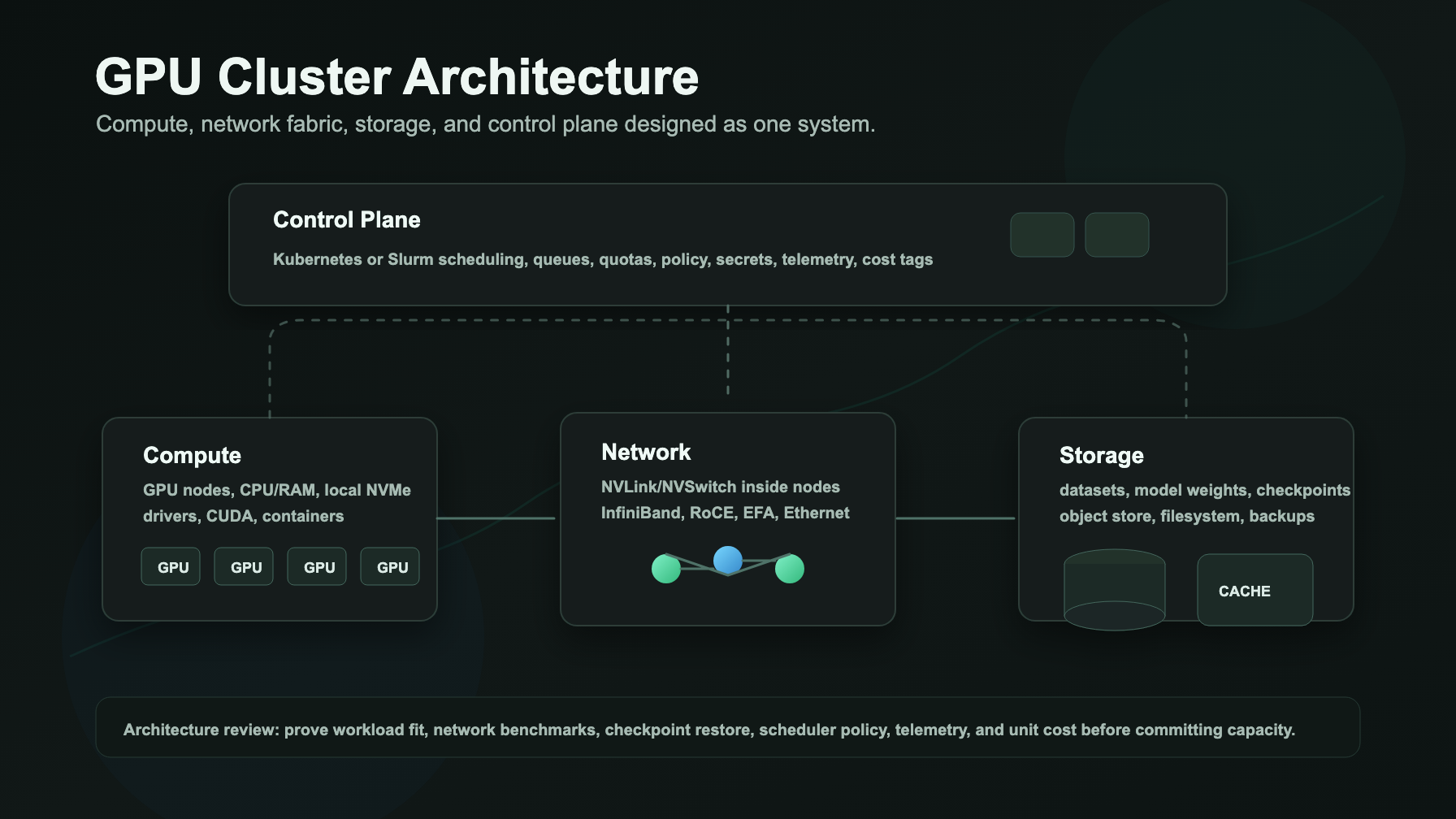
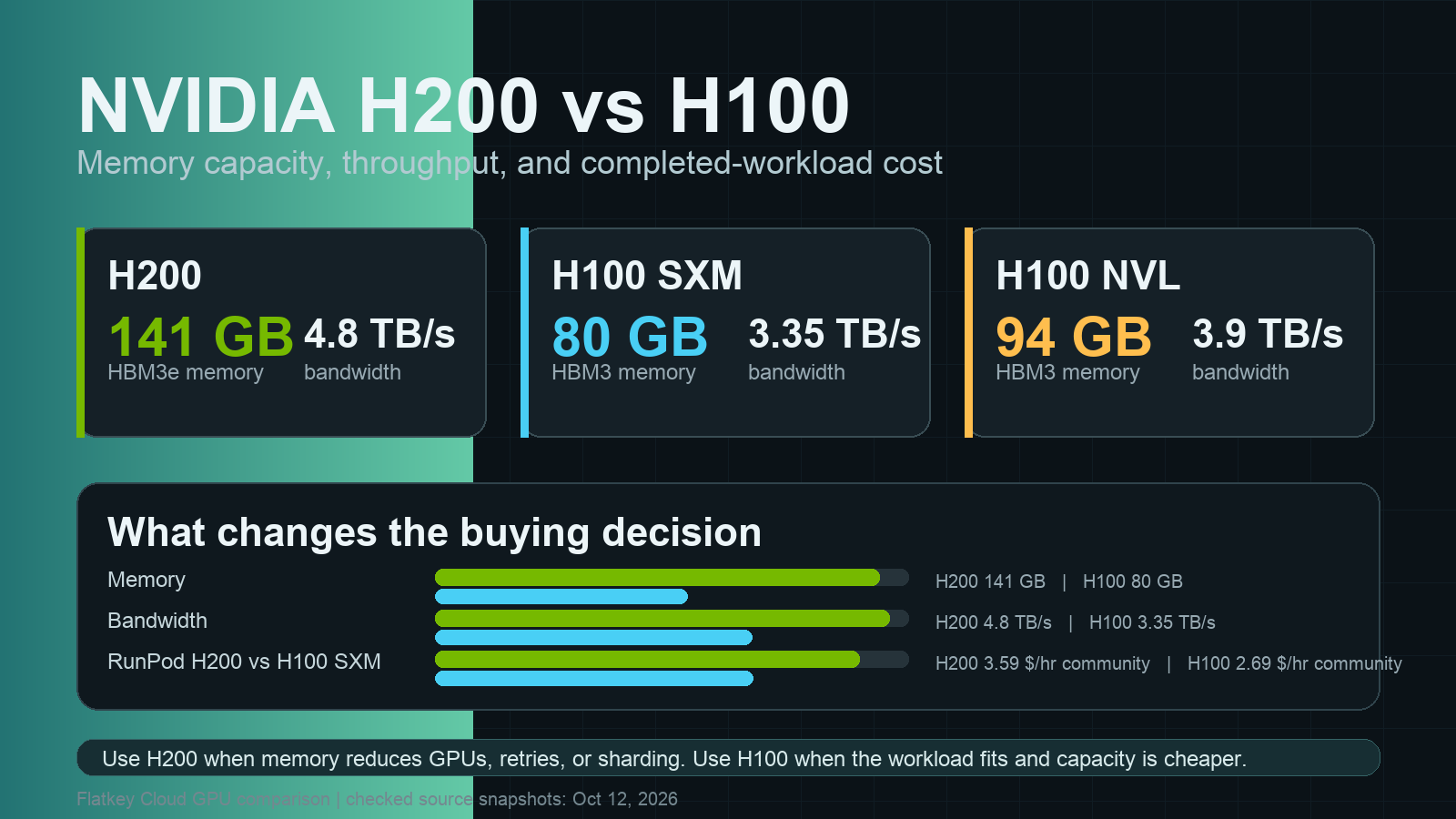
For self-hosted inference and fine-tuning, the practical choices in October 2026 are NVIDIA H100, H200, B200, and B300, plus AMD MI300-series accelerators. Memory decides how large a model fits on each GPU; see our H200 vs H100 comparison and LLM GPU memory requirements. For cluster design (networking, storage, scheduling), see GPU cluster architecture and private GPU cloud.
Questions to ask any GPU provider for a sovereign deployment:
- Which legal entity operates the data center, and under which country's law?
- Can you name the exact facility and region in the contract?
- Who has physical and remote administrative access, and is it logged?
- Where do backups, logs, and monitoring data go?
- Can you take your data and disks with you at exit?
Models
Open-weight models are the backbone of level 4 and 5 sovereignty because you can host them anywhere and keep using them if the vendor changes terms. Common choices include Mistral models (developed in France), Meta's Llama family, and Qwen and DeepSeek open releases. Check each license for commercial-use limits, and evaluate local-language quality on your own data.
Serving
An OpenAI-compatible inference server lets applications switch between a sovereign self-hosted model and a public API by changing one URL. With vLLM:
docker run --gpus all -p 8000:8000 \
  -v /data/models:/models \
  vllm/vllm-openai:latest \
  --model /models/your-open-weight-model \
  --tensor-parallel-size 2 \
  --max-model-len 32768
from openai import OpenAI

# Sovereign endpoint inside your in-country cluster
client = OpenAI(base_url="http://inference.internal:8000/v1", api_key="local-token")
r = client.chat.completions.create(
    model="/models/your-open-weight-model",
    messages=[{"role": "user", "content": "Summarize this contract clause."}],
)
print(r.choices[0].message.content)
Keep the base URL in configuration so non-sensitive workloads can use a regional or public API while regulated workloads stay on the sovereign endpoint. Our guide to OpenAI-compatible inference servers compares vLLM, SGLang, and others.
Data and operations
- Keep prompts, outputs, vector databases, and logs in the same jurisdiction as the model.
- Use customer-managed encryption keys stored in-country.
- Send observability data to a locally hosted stack, not a foreign SaaS.
- Document subprocessors; our AI gateway DPA checklist lists clauses to ask for.
Cost example: a sovereign 70B-class inference service
Using the Flatkey Compute market index on October 23, 2026 (updated 02:01 UTC), H200 capacity referenced at $3.65 per GPU-hour on demand and $2.74 on a 1-year term, and H100 at $2.64 and $1.98.
A 70B-class open-weight model in FP8 needs about 70GB for weights. One H200 (141GB) leaves room for KV cache; for redundancy you would run at least two replicas.
| Option | GPUs | Hourly (index) | Monthly (730 hours) |
|---|---|---|---|
| 2x H200, on demand | 2 | $7.30 | about $5,329 |
| 2x H200, 1-year term | 2 | $5.48 | about $4,000 |
| 4x H100 (2 replicas x 2 GPUs), 1-year term | 4 | $7.92 | about $5,782 |
Add storage, networking, monitoring, and staff time; our GPU cluster TCO guide has a full worksheet. Compare that with your expected API spend at level 2: if a regional API would cost less than the cluster and meets your legal requirements, it is usually the better choice. Index prices are references; actual in-country prices vary by country and term and are confirmed on a quote.
Sovereign AI readiness checklist
- Classify workloads by data sensitivity and legal requirement, then assign each a sovereignty level.
- Map every data flow: prompts, outputs, embeddings, logs, backups, telemetry.
- Pick models you can legally run in the target jurisdiction and test their local-language quality.
- Choose compute with a named facility, operator, and exit terms.
- Put an OpenAI-compatible endpoint in front of each model so apps can move between levels.
- Keep audit evidence (access logs, model versions, evaluation results) under your own control for AI Act and sector audits.
- Review the plan every six months; regional API options and GPU prices change quickly.
FAQ
What is sovereign AI?
It is AI built and run on infrastructure, data, and models that a country or organization controls under its own laws. It spans in-country compute, data residency, models you can run and audit (often open-weight), and locally accountable operations.
What is sovereign AI infrastructure?
The physical and software layers that make sovereign AI possible: in-country GPU data centers, regional storage and networking, model serving stacks, and the operational controls and contracts that keep access under local jurisdiction.
Which countries have sovereign AI programs?
Many. NVIDIA's examples include France (public-service AI agents for the Ministry of Economy and Finance), India (Sarvam's multilingual models on domestic infrastructure, alongside the government's IndiaAI program), and Brazil (legal-services AI in Rio Grande do Sul). Countries across Europe, the Middle East, and Asia are funding national compute and local-language models.
Who are the top AI infrastructure companies?
Commonly cited leaders are NVIDIA and AMD for accelerators; AWS, Microsoft Azure, Google Cloud, and Oracle for cloud and sovereign-cloud regions; and GPU specialists such as CoreWeave and Lambda for dedicated capacity. For sovereign projects, the operator's jurisdiction matters as much as the brand.
Is data residency the same as data sovereignty?
No. Data residency means data is stored in a specific location. Data sovereignty means the data is subject to that location's laws and controlled by parties under them. A US-operated service can offer EU residency but still be reachable by US legal process.
Do I need my own GPUs for sovereign AI?
Not always. Regional API endpoints or sovereign cloud regions are enough for many workloads. Dedicated in-country GPUs make sense when you need full model control, must keep all data and operations local, or have steady volume that keeps the cluster busy.