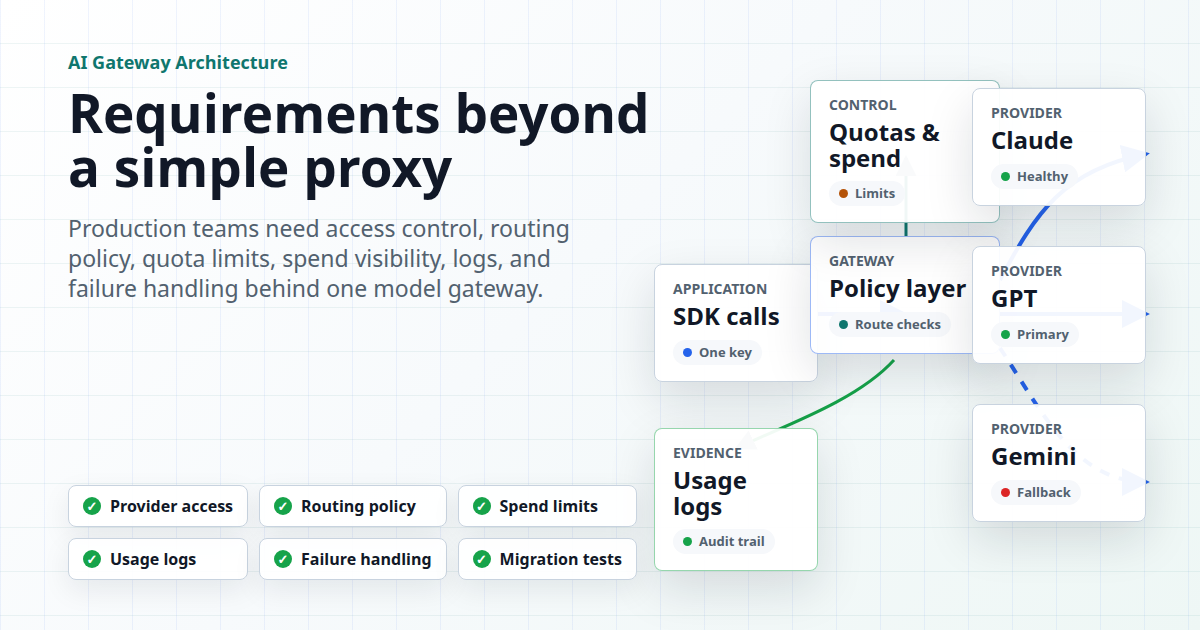
A reverse proxy and an API gateway can occupy the same position in a network diagram: both receive a client request before a backend does. The difference is the job you expect that layer to perform. A reverse proxy is a useful front door for forwarding, load distribution, TLS termination, and origin protection. An API gateway treats the request as an API operation and can add identity, authorization, quotas, route policy, observability, and a managed developer contract. Neither label guarantees a feature by itself; check the product and configuration you actually deploy.
For an AI application, that distinction becomes practical when several models, teams, credentials, and bills meet at one endpoint. This guide compares reverse proxy vs API gateway at the request path, shows when one is enough, and gives an evaluation checklist for an OpenAI-compatible model router.
The short answer
Use a reverse proxy when you need to expose one or a few backend services safely and your application already owns API authentication, usage policy, and billing. Consider an API gateway when several clients or services need a common API contract with centrally enforced access, rate or budget policy, routing, logs, and operational ownership. You can also put an API gateway behind a reverse proxy or CDN; these components are not mutually exclusive.
The NGINX reverse proxy guide describes forwarding requests to upstream servers and using the proxy for load balancing. The Amazon API Gateway overview describes a managed API front door with traffic management, authorization, monitoring, and API version management. Those are examples of capabilities, not a claim that every reverse proxy lacks policy features or every gateway enables them by default.
| Question | Reverse proxy | API gateway |
|---|---|---|
| What is the core job? | Receive and forward traffic to an origin or upstream pool. | Publish and operate an API contract in front of backends. |
| How is a route chosen? | Typically host, path, and upstream configuration. | API operation, identity, policy, and configured backend route may all matter. |
| Who owns authentication? | Often the app or a separately configured auth layer. | Can be enforced at the gateway, subject to its configured mechanism. |
| How do you see usage? | Access logs and proxy metrics. | API- or key-level metrics, logs, quotas, and sometimes billing records. |
| What is the operational work? | Proxy config, TLS, upstream health, scaling, and logging. | API definitions, keys or identities, policy, quotas, logs, versions, and incident response. |
Follow one request through each design
Suppose a product sends a chat request to a model-serving backend.
With a reverse proxy, the client connects to a public hostname. The proxy terminates TLS, selects an upstream from a configured pool, forwards the HTTP request, and returns the response. It may retry or balance traffic if configured to do so. The backend or another component still decides whether the user is authorized, which model they may call, how much they may spend, and how usage is attributed to a team.
With an API gateway, the same public hostname can additionally identify the caller, check a policy, choose an approved route, enforce a rate target, and emit request-level records. The backend still executes the inference, and the gateway still needs correct configuration. For example, AWS documents throttling with rate and burst settings, while noting that quotas are best-effort targets rather than absolute ceilings. Treat marketing words such as “rate limit” as a testable behavior, not an automatic guarantee.
There is overlap. NGINX can be configured with additional authentication and rate limiting, and an API gateway often uses reverse-proxy mechanics internally. The choice is therefore less about whether packets can be forwarded and more about where your team wants to define, enforce, observe, and own API policy.
Where a load balancer fits
A load balancer chooses among backend instances to keep a service available and distribute work. It might operate at a transport or application layer. A reverse proxy commonly performs load balancing, but a load balancer alone does not tell you which API key belongs to a customer or whether a model is approved for a team. An API gateway may include load balancing or delegate it to an upstream service.
Use this quick test: if replacing the component would remove only traffic distribution and TLS handling, you are primarily evaluating a proxy or load-balancing layer. If it would also remove caller policy, model routes, quotas, usage evidence, and an API contract, you are evaluating gateway responsibilities.
Why model APIs make the gap visible
Ordinary web traffic and model traffic share HTTP, but model requests
have extra operating questions. A single request may stream for a long
time, use many input and output tokens, call tools, or generate an
image. Two model routes can have different request shapes, latency,
availability, and cost units. A 200 from the proxy is not
enough to explain whether the customer received a useful answer or which
model was charged.
An AI API gateway evaluation should therefore record at least:
- Identity: which key, team, or service initiated the request; whether credentials can be rotated independently.
- Route: requested model alias, endpoint family, actual route, and what happens when it is unavailable.
- Outcome: HTTP status, provider or model error, cancellation, timeout, retry, and final accepted response.
- Usage: input and output units, billable events, and the cost source used for that route.
- Control: allowed models, budget or quota scope, enforcement timing, and the person who owns exceptions.
A reverse proxy can pass these fields through, but it does not create an agreed usage and billing model merely by forwarding bytes. You can build that layer yourself. The question is whether your team wants to own that build and its ongoing operation.
Three deployment patterns
1. Reverse proxy in front of one model service
This is a good starting point for a private service with one model, one trusted application, and policy handled in the application. Keep the proxy responsible for ingress, TLS, upstream health, and basic request logging. Keep secrets on the server. Define timeouts that respect streaming and long inference requests, and test cancellation so abandoned streams do not consume resources indefinitely.
The failure mode is letting the proxy become an undocumented collection of model aliases, per-team keys, retries, spend rules, and one-off headers. If those features accumulate, write down the contract and test it as a gateway.
2. Self-operated API gateway or model router
Choose this when the platform team needs custom policy, network placement, upstream account ownership, or deep control over logs and routing. Budget for credential storage, database or state requirements, upgrades, monitoring, backups, abuse controls, and an on-call owner. An OpenAI-compatible endpoint reduces client migration work, but it does not remove the gateway’s operating burden.
For a separate buy-versus-build comparison, see our managed AI gateway versus self-hosted LLM proxy guide. That guide discusses ownership and cost; the present comparison is about the network and API responsibilities.
3. Managed AI API gateway, optionally behind your edge proxy
This pattern makes sense when teams need one model access layer without operating the gateway service themselves. Flatkey’s documentation describes an OpenAI-compatible router, model access, key and usage controls, and billing visibility. A team can keep its own edge or application backend while using Flatkey as the upstream model API. Confirm the current account’s model aliases, endpoint support, limits, pricing, and policy behavior before production cutover.
The base URL is https://router.flatkey.ai/v1 for the
OpenAI-compatible route described in the Flatkey
quickstart. Put the Flatkey key in the backend environment, not the
browser. Run a small request, inspect Usage & Logs, then test
streaming, tools, errors, and fallback with the exact model route you
intend to use.
A migration test that exposes the real differences
Pick one production-shaped request and replay it through the candidate paths. Keep the prompt, model revision, output cap, client timeout, and offered load fixed. Record configuration and results, rather than comparing a proxy’s best-case latency with a gateway’s cold-start or an unrelated model.
| Check | What to record | Failure that matters |
|---|---|---|
| Authentication | Caller key, permission, rotation path | Wrong team can call a model or revoked key still works. |
| Routing | Requested and served model, endpoint shape | A fallback silently changes capability or cost. |
| Streaming | First token, complete response, cancel | Proxy buffers the stream or leaves work running after cancel. |
| Limits | Sustained rate, burst, budget, reset window | Overload reaches the model or a quota blocks healthy traffic. |
| Observability | Request ID, status, usage, cost, latency | You cannot explain a charge or a failed request. |
| Recovery | Timeout, upstream error, retry cap | A single request fans out into unbounded billable retries. |
Then measure cost per accepted response, p95 latency, error rate, and operational effort. A low proxy overhead is valuable, but it does not replace missing policy or usage evidence. A feature-rich gateway is valuable only when its controls match the workload and are actually enabled.
Frequently asked questions
Is an API gateway just a reverse proxy?
An API gateway usually forwards traffic, so it includes proxy behavior. The term also implies API-level responsibilities such as caller identity, policy, routing, monitoring, and lifecycle management. Actual capabilities vary by product and configuration.
Can NGINX be an API gateway?
NGINX can serve as the forwarding layer for API traffic and can be configured with gateway-like controls. Verify the exact authentication, quota, logging, and route features you need, then account for who maintains them. A product name alone does not prove the deployed policy.
Does an API gateway replace a load balancer?
Not necessarily. A gateway may select an upstream pool while another load balancer handles instance-level distribution. Draw the actual request path and identify which layer owns health checks, retries, TLS, and policy.
When is a plain reverse proxy enough for an AI API?
When one trusted backend owns authorization, model selection, usage metering, and billing, a reverse proxy can be enough for ingress. Revisit the design as soon as multiple teams, models, external clients, or spend policies need one common boundary.
The practical decision is to assign every responsibility to a named component. If your diagram cannot show where identity, route, usage, and cost are decided, adding another proxy box will not fix the missing contract.