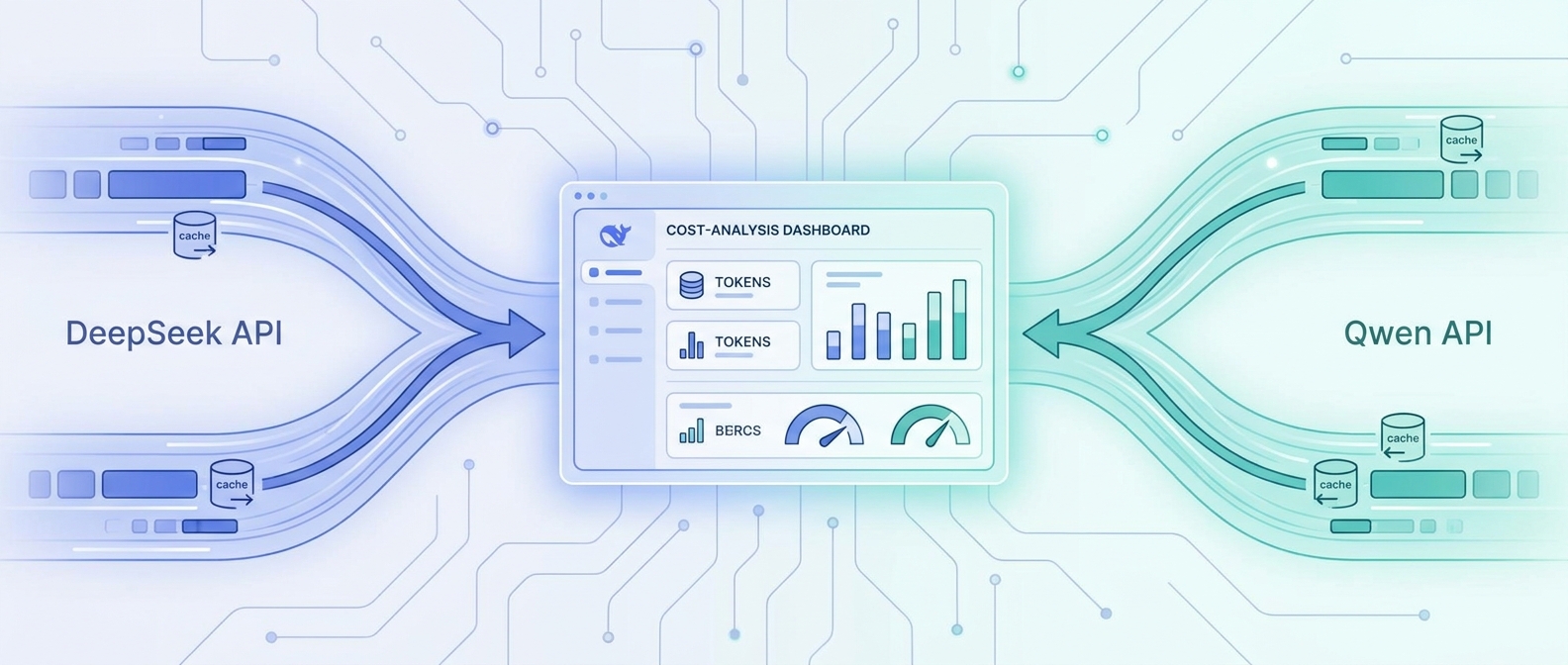
If your main constraint is API spend, the DeepSeek API vs Qwen API decision is no longer close enough to make from memory. Both providers have changed their low-cost model lines, and the cheapest route depends on four things: uncached input, cached input, output volume, and whether your workload can use batch inference.
This guide was checked against first-party pricing and model-lifecycle documentation on Tuesday, July 28, 2026. The short answer is:
- Qwen Flash has the lower raw list price for most uncached, cached, and batch text workloads.
- DeepSeek V4 Flash offers a very low cache-hit rate and a simpler global direct endpoint, but its higher cache-miss and output rates mean you need an unusually cache-heavy request mix before that advantage changes the bill.
- DeepSeek V4 Pro can be a cost-first reasoning candidate against higher-priced Qwen tiers, but model quality is not interchangeable. Test successful-task cost, not tokens alone.
- Do not start a new workflow on Qwen Turbo. Alibaba Cloud lists a retirement date of November 30, 2026 and recommends Qwen Flash as the replacement.
DeepSeek vs Qwen: cost verdict by workflow
| Workflow | Cost-first default | Why | Verify before production |
|---|---|---|---|
| Short chat or extraction | Qwen Flash | Lower input and output list prices | Region, exact model snapshot, quality floor |
| High-volume offline evaluation | Qwen batch inference | Eligible models receive 50% off input and output | Exact model and region support batch |
| Repeated long context | Qwen Flash in most cases | Qwen's lower base price outweighs DeepSeek's cache discount at ordinary hit rates | Measure cache-hit rate and cache creation/storage |
| Extremely cache-heavy input | Calculate both | DeepSeek cached input is cheap, but its misses and output cost more | Token ratio, hit rate, output volume |
| Reasoning-heavy tasks | Test DeepSeek V4 Pro and the relevant Qwen tier | DeepSeek Pro has lower published output pricing than Qwen 3.7 Plus | Accuracy, retries, tool use, latency |
| Fastest direct-provider setup | DeepSeek | One documented global OpenAI-compatible base URL | Data-region and procurement requirements |
| Frequent model switching | Shared gateway and logs | Operational switching cost can erase token savings | Routing, balances, observability, rollback |
This is a cost comparison, not a universal model ranking. A model that needs more retries, longer prompts, or human correction can lose despite a lower token price.
Current DeepSeek API pricing
DeepSeek's pricing page, updated July 28, lists two V4 text models. Prices are per one million tokens.
| Model | Cache-hit input | Cache-miss input | Output | Context | Max output |
|---|---|---|---|---|---|
deepseek-v4-flash |
$0.0028 |
$0.14 |
$0.28 |
1M |
384K |
deepseek-v4-pro |
$0.003625 |
$0.435 |
$0.87 |
1M |
384K |
DeepSeek documents automatic context caching and exposes separate hit and miss prices. It also provides an OpenAI-compatible endpoint at https://api.deepseek.com and an Anthropic-compatible endpoint at https://api.deepseek.com/anthropic.
The eye-catching number is the V4 Flash cache-hit price: it is only 2% of the cache-miss rate. But that discount should not be evaluated in isolation. A miss still costs more than six times Qwen Flash's first-tier standard input rate, and DeepSeek V4 Flash output also costs more.
Current Qwen API pricing
Alibaba Cloud Model Studio lists Qwen prices by model, input length, output mode, and deployment region. For a global deployment with input up to 128K tokens, the relevant low-cost row is:
| Model | Standard input | Output | Implicit cache hit | Explicit cache hit | Batch discount |
|---|---|---|---|---|---|
qwen3.5-flash |
$0.022 |
$0.216 |
20% of standard input | 10% of standard input | 50% for supported batch jobs |
For the Singapore deployment mode, the same page lists qwen-flash at $0.05 input and $0.40 output for prompts up to 128K. This regional difference is why a valid Qwen forecast must record the deployment mode and endpoint instead of copying one headline number.
Qwen caching also needs precise modeling:
- Implicit cache hits are billed at 20% of standard input price.
- Explicit cache hits are billed at 10% of standard input price.
- Explicit cache creation is billed at 125% of standard input price and cache storage is billed separately.
- Batch inference gives eligible models a 50% input and output discount, but do not assume discounts stack unless the provider documents that combination for your model and region.
Alibaba Cloud also notes that qwen-flash is a rolling alias. Pin a dated model ID when reproducibility matters, then schedule migration tests before that snapshot retires.
Three workload calculations
The formulas below use public list prices, not temporary promotions or negotiated contracts. They compare direct-provider token charges only and exclude taxes, network charges, cache storage, and engineering labor.
Scenario 1: short uncached chat
Assumptions:
- 10,000 requests
- 1,000 input tokens per request
- 500 output tokens per request
- No cache hits
- Qwen global
qwen3.5-flashfirst pricing tier
| Route | Input calculation | Output calculation | Estimated total |
|---|---|---|---|
| DeepSeek V4 Flash | 10M × $0.14 = $1.40 |
5M × $0.28 = $1.40 |
$2.80 |
| Qwen 3.5 Flash | 10M × $0.022 = $0.22 |
5M × $0.216 = $1.08 |
$1.30 |
For this request shape, Qwen costs about 54% less at published list prices. The result can change if you use a different Qwen region, exceed the first input tier, or need enough retries to erase the token advantage.
Scenario 2: repeated long context with 90% cache hits
Assumptions:
- 10,000 requests
- 10,000 input tokens per request
- 1,000 output tokens per request
- 90% of input tokens billed at the cache-hit rate
- Qwen uses implicit caching
| Route | Cache-miss input | Cache-hit input | Output | Estimated total |
|---|---|---|---|---|
| DeepSeek V4 Flash | 10M × $0.14 = $1.40 |
90M × $0.0028 = $0.252 |
10M × $0.28 = $2.80 |
$4.452 |
| Qwen 3.5 Flash | 10M × $0.022 = $0.22 |
90M × $0.0044 = $0.396 |
10M × $0.216 = $2.16 |
$2.776 |
DeepSeek has the lower cache-hit rate, but Qwen still wins this 90%-hit scenario because Qwen's miss and output prices are lower.
For input alone, DeepSeek V4 Flash becomes cheaper than Qwen's implicit-cache mix only when the cache-hit share is roughly 98.7% or higher. Once output tokens are included, the required hit rate is even higher. With Qwen explicit caching, the hit price itself is lower than DeepSeek's, although creation and storage charges must be included.
Scenario 3: offline batch processing
Assumptions:
- 100 million input tokens
- 20 million output tokens
- Qwen model and region are eligible for the published 50% batch discount
- DeepSeek is calculated at standard synchronous list price because its pricing page does not publish an equivalent batch discount
| Route | Calculation | Estimated total |
|---|---|---|
| DeepSeek V4 Flash | (100M × $0.14) + (20M × $0.28) |
$19.60 |
| Qwen 3.5 Flash batch | 50% × [(100M × $0.022) + (20M × $0.216)] |
$3.26 |
For delay-tolerant evaluation, labeling, summarization, or synthetic-data jobs, batch eligibility can matter more than small cache differences. Confirm that your exact model, deployment mode, and job type qualify before approving the forecast.
A better break-even formula
Use this worksheet instead of comparing one token-price cell:
monthly_cost =
  uncached_input_millions × uncached_input_rate
  + cached_input_millions × cached_input_rate
  + output_millions × output_rate
  + cache_creation_cost
  + cache_storage_cost
  + retry_cost
  + platform_or_network_fees
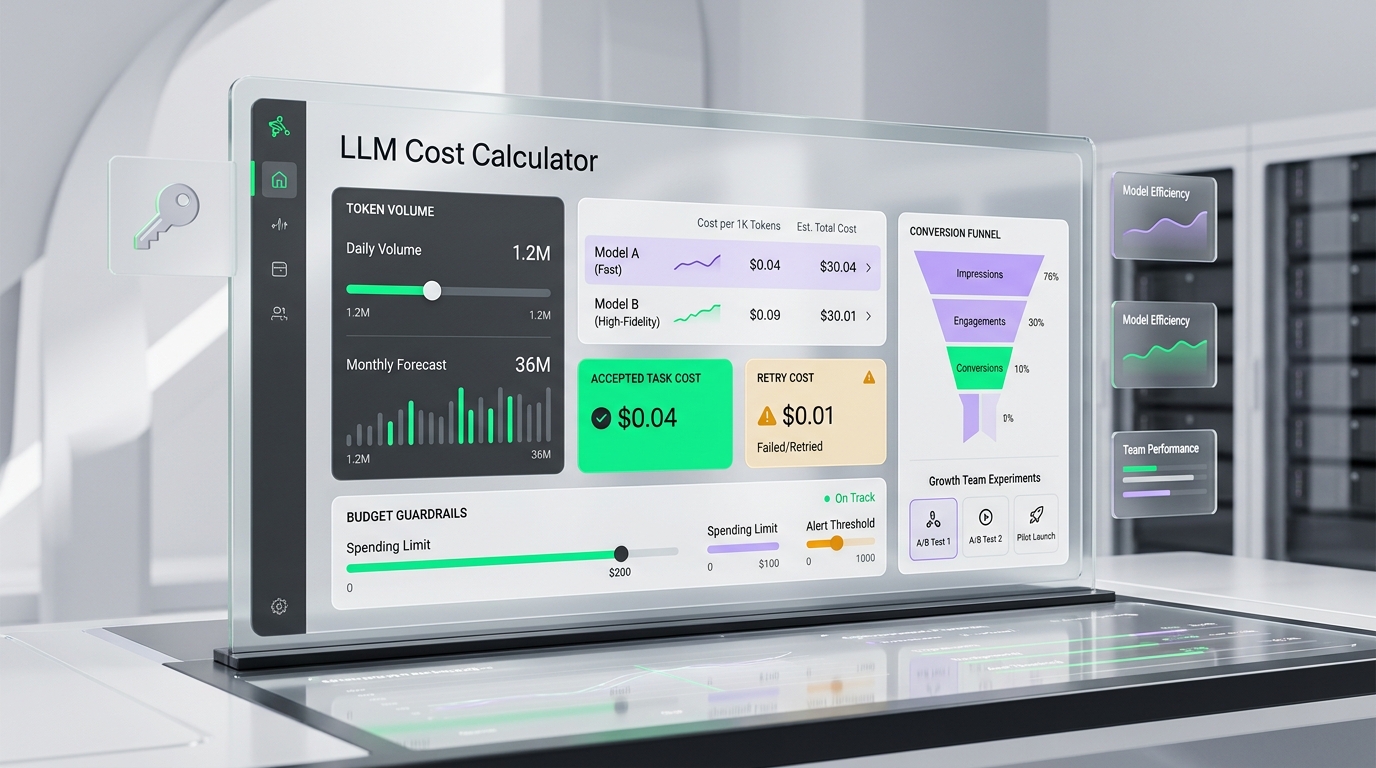
Then calculate cost per successful task:
successful_task_cost = monthly_cost / accepted_outputs
This second number catches the operational costs that token tables miss. If a cheaper route produces more invalid JSON, tool-call failures, long reasoning traces, or manual review, its real cost can be higher.
Operational differences that affect total cost
Region and endpoint design
DeepSeek documents one global direct endpoint. Qwen uses Alibaba Cloud Model Studio endpoints tied to deployment mode and region. Regional configuration can improve governance, but it also affects model availability, price rows, credentials, and failover design.
Record these fields in every approval:
- Provider and exact model ID
- Deployment region or mode
- Base URL
- Input-length tier
- Thinking or non-thinking output mode
- Cache method
- Batch eligibility
- Pricing check date
Model lifecycle
Qwen Turbo is scheduled to retire on November 30, 2026, and Alibaba Cloud recommends Qwen Flash as the replacement. New systems should not treat Turbo's familiar name or lower non-thinking output row as a durable savings plan.
Rolling aliases are convenient for experimentation but introduce silent-change risk. Pin dated versions in production, maintain a small evaluation set, and test the next version before retirement.
Quality and retry budget
Do not compare DeepSeek V4 Flash and Qwen Flash as if they produce identical outcomes. Evaluate each route on the actual task: extraction accuracy, code test pass rate, tool-call completion, structured-output validity, latency, and human acceptance.
A practical routing gate is:
- Reject models below the quality floor.
- Compare cost per accepted output among the survivors.
- Add retry and fallback cost.
- Canary the cheaper route with a rollback threshold.
- Recalculate after the first week of production traffic.
For a repeatable test harness, use the multi-model prompt testing workflow. For broader rate context, compare the current AI model pricing comparison and Flatkey pricing page.
When DeepSeek is the better choice
DeepSeek deserves the first test when:
- You want a simple global direct endpoint.
- Your workload has exceptionally high, measured cache reuse.
- DeepSeek V4 Pro meets the reasoning quality floor at a lower successful-task cost than the Qwen tier you tested.
- Your team already operates DeepSeek reliably and migration work would exceed the projected savings.
When Qwen is the better choice
Qwen deserves the first test when:
- Raw token cost is the primary constraint.
- You run short or medium uncached prompts.
- You have delay-tolerant jobs that qualify for batch inference.
- You can use explicit or implicit caching effectively.
- Alibaba Cloud's regional deployment model matches your compliance and operations requirements.
FAQ
Is DeepSeek cheaper than Qwen in 2026?
Not across the board. At the July 28 public list prices, Qwen 3.5 Flash is cheaper in the short uncached, 90%-cached, and eligible batch examples in this guide. DeepSeek may still win on successful-task cost, operational simplicity, or a specific higher-tier comparison.
Which API is better for high-volume automation?
Start by testing Qwen Flash if the work can use batch inference or has low latency sensitivity. Test DeepSeek alongside it if cache reuse is exceptionally high or its output quality reduces retries. Approve the route with the lowest cost per accepted result.
Does DeepSeek's cache price make it cheaper for RAG?
Not automatically. DeepSeek's cache-hit input price is very low, but its cache-miss and output rates are higher than Qwen 3.5 Flash's first-tier rates. Measure the actual hit ratio, prompt-to-output ratio, and Qwen cache method before deciding.
Should I use Qwen Turbo for a new application?
No. Alibaba Cloud lists Qwen Turbo retirement on November 30, 2026 and recommends migrating to Qwen Flash.
How often should API pricing be reviewed?
Review monthly for active production routes and immediately when a provider changes model IDs, retirement dates, cache rules, batch support, regional availability, or list prices.
Choose with production traffic, not a headline rate
For most cost-sensitive text workflows, Qwen Flash is the lower-priced starting point on July 28, 2026. DeepSeek remains worth testing where its endpoint simplicity, cache behavior, or task quality lowers the complete cost of operation.
Save the request-shape worksheet, pin exact model versions, and keep the route reversible. If you want one place to test both providers without rewriting client code, start with the Flatkey integration starter, run the same evaluation set, and route production traffic only after the cost-per-success numbers are stable.