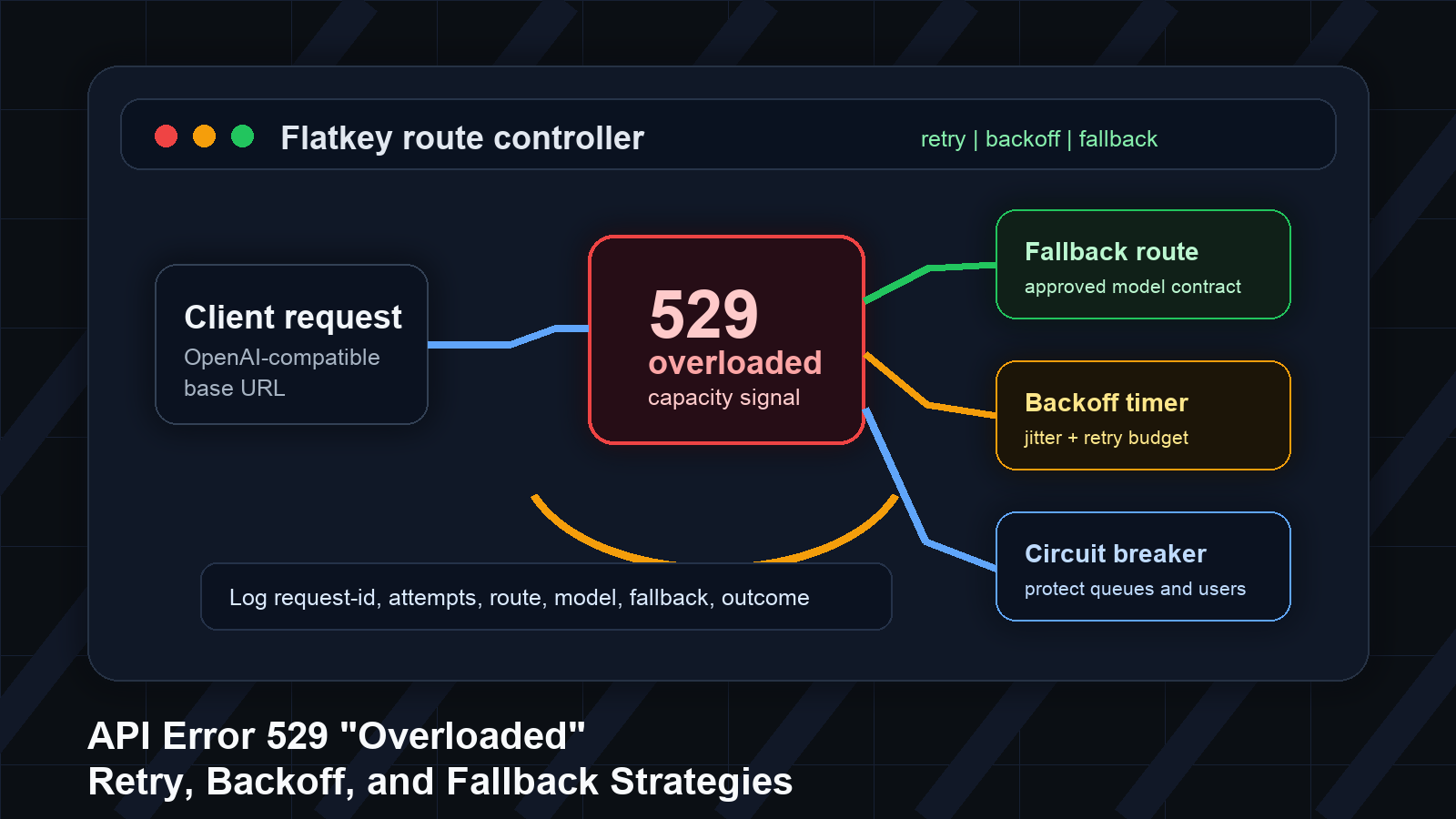
If your production logs show 529 overloaded_error, the provider is telling you the API is temporarily overloaded. In Anthropic's Claude API docs, 529 - overloaded_error means "The API is temporarily overloaded," and the docs note that 529 errors can happen during high traffic across all users.
That makes API Error 529 "Overloaded": Retry, Backoff, and Fallback Strategies different from a malformed request, bad API key, or normal quota problem. The first response should not be "change the prompt" or "buy more quota." The first response should be a controlled reliability playbook: classify the failure, retry only within a budget, protect users from retry storms, and decide when a fallback route is safer than waiting.
This guide is written for AI product and platform teams running LLM, agent, or multimodal workloads in production. It gives you a practical error-action matrix, a retry budget, a backoff pattern, and a fallback decision flow you can copy into an incident runbook.
Quick Answer
For API Error 529 "Overloaded": Retry, Backoff, and Fallback Strategies, use this default policy:
- Treat
529 overloaded_erroras a transient provider-capacity signal, not a client validation bug. - Retry idempotent or read-only requests with exponential backoff and jitter.
- Honor
retry-afterwhen the provider sends it. - Stop after a small retry budget, usually two or three attempts for interactive traffic.
- Do not blindly retry non-idempotent tool calls, write actions, purchases, emails, or anything that may have caused side effects.
- Open a circuit breaker when 529s cluster by provider, model, endpoint, or region.
- Fall back only when the alternate model can satisfy the same product contract.
- Log
request-id, model, route, retry count, final outcome, and user-visible impact.
In other words: retry briefly, slow down the herd, fail over when equivalence is acceptable, and stop when the request is no longer safe to repeat.
Why API Error 529 Overloaded Happens
529 overloaded_error is a capacity condition. It usually means your request reached the provider, but the provider side is too busy to serve it at that moment. Anthropic documents this separately from 429 rate_limit_error. That distinction matters:
| Error family | Typical meaning | First owner action |
|---|---|---|
400, 401, 403, 404 |
Request, credential, permission, or model-name problem | Fix the request; do not retry unchanged |
429 |
Rate limit, acceleration limit, or spend cap | Slow down, inspect quota and retry-after, change traffic shape |
500, 502, 503, 504 |
Provider or network/server-side failure | Retry with exponential backoff if safe |
529 overloaded_error |
Provider overloaded by high traffic | Retry with backoff, then circuit-break or fallback |
A 529 can appear during a provider-wide traffic spike even if your own workload did nothing unusual. But if you are launching a new feature, running a batch, or sending a sudden agent swarm, you should also check whether your traffic ramp caused local pressure or acceleration-limit behavior.
Error-Action Matrix
Use this matrix before changing code in a panic.
| Signal in logs | Retry? | Backoff? | Fallback? | What to record |
|---|---|---|---|---|
| Single 529 on a read-only chat request | Yes, briefly | Yes, with jitter | Not on first failure | request-id, model, route, attempt |
| Repeated 529s for one model | Yes, until budget expires | Yes | Yes, if alternate is contract-compatible | fallback model, quality gate, user impact |
| 529s across all Claude routes | Limited | Yes | Maybe, only to approved non-Claude route | provider status, circuit state |
| 529 after partial streaming output | Usually no transparent retry | No blind replay | Stop or ask user to regenerate | partial tokens, last event, user-visible copy |
| 529 during tool execution | Only if tool is idempotent | Yes | Not until side effects are reconciled | tool name, idempotency key, external state |
| 529 during background batch | Yes, more slowly | Yes, wider window | Yes, if SLA requires it | queue age, retry age, dropped count |
| 529 plus user deadline exceeded | No | No | Maybe, if still useful | timeout class, fallback reason |
This is the part most generic error pages miss: an overloaded model is not just an HTTP status. It is a product decision about duplicate work, latency, output quality, and user trust.
A Safe Retry Policy For 529
Start with separate retry budgets for interactive and background workloads.
| Workload | Suggested first policy |
|---|---|
| User-facing chat or autocomplete | 2 retries, capped under the user-facing timeout |
| Agent planning step | 2-3 retries, stop before tool execution becomes stale |
| Background summarization | 3-5 retries, queue-aware, with wider backoff |
| Batch evaluation | Retry from queue with age limits and dead-letter handling |
| Write-side tool call | Retry only with idempotency protection and reconciliation |
The simplest retry shape is exponential backoff with jitter:
function backoffMs(attempt: number) {
  const base = 250;
  const cap = 8_000;
  const exponential = Math.min(cap, base * 2 ** attempt);
  const jitter = Math.floor(Math.random() * exponential * 0.4);
  return exponential + jitter;
}
Use small values for interactive products. A chat message that retries for 60 seconds may be technically resilient but still feels broken to the user. For background queues, use a wider backoff window and preserve the work item for later processing instead of hammering the provider.
Respect Retry-After, But Do Not Depend On It
Some APIs send retry-after headers for rate limits or transient failures. Anthropic's docs say official SDKs retry transient failures with exponential backoff, twice by default, and honor retry-after when present. Your own controller should do the same when you bypass or wrap the SDK.
But do not build a policy that only works when retry-after exists. A 529 response may not always arrive with a useful wait time. Your fallback controller still needs:
- a maximum attempts value,
- a maximum wall-clock budget,
- a per-route circuit breaker,
- a queue age limit,
- and a final user-facing failure mode.
Avoid Retry Storms
The worst response to provider overload is synchronized retry traffic. If every worker retries immediately, you turn one provider incident into a larger incident.
Add these controls:
| Control | Why it matters |
|---|---|
| Jitter | Prevents all clients from retrying at the same instant |
| Per-route concurrency caps | Keeps one overloaded model from consuming all worker slots |
| Retry budget | Stops infinite loops and surprise spend |
| Circuit breaker | Moves repeated failures out of the hot path |
| Queue backpressure | Slows producers when consumers cannot make progress |
| User-visible state | Tells users when the system is retrying or degraded |
AWS's retry-with-backoff guidance makes the same operational point: retries help transient failures, but too many retries can increase contention and service degradation.
When To Fallback Instead Of Retry
Fallback is not the same as retry. A retry asks the same route to try again. A fallback changes the route, provider, model, region, or capability.
Use fallback when all four conditions are true:
- The primary route is failing repeatedly with 529 or related transient errors.
- The user or workload still benefits from a response after the added latency.
- The alternate route satisfies the same product contract.
- The request has not already produced partial output or uncertain side effects.
Use a route contract like this:
task: support_reply_draft
primary:
  model: claude-sonnet-current
  max_attempts: 2
  retry_on: [529, 500, 502, 503, 504, timeout]
  backoff: exponential_jitter
fallback:
  model: approved-general-chat-model
  allowed_when:
    - no_partial_stream_output
    - no_write_side_tool_executed
    - response_schema_compatible
    - latency_budget_remaining_ms > 3000
stop:
  user_message: "The model is overloaded. Please retry in a moment."
log:
  fields:
    - request_id
    - route
    - model
    - retry_count
    - fallback_used
    - final_status
If your product depends on exact model behavior, tool-call format, citation policy, safety behavior, or a long-context feature, cross-model fallback may be worse than a clear failure. For those workloads, fallback to the same provider/model in another route is safer than fallback to a different model family.
For the broader architecture behind this decision, pair this error page with Flatkey's LLM API fallback routing production playbook and the model fallback strategy workflow playbook. Those guides cover the larger controller pattern; this page stays focused on the 529 overloaded response.
Idempotency Rules For 529
Retry safety depends on idempotency. AWS guidance calls out that operations should be idempotent when you retry with backoff; otherwise partial updates can corrupt state. Stripe's low-level error guidance makes the same point for network and server errors: failed or unclear requests can leave the client uncertain about whether the server received or executed the request.
For AI products, apply that rule to tools and side effects:
| Operation | Safe 529 retry? | Notes |
|---|---|---|
| Generate a draft answer | Usually | Duplicate text is acceptable if you replace the old attempt |
| Stream a response after tokens started | Risky | The user may see duplicated or inconsistent output |
| Read a document | Usually | Use request IDs for traceability |
| Send an email | No, unless idempotent | Use an idempotency key and external-state reconciliation |
| Create a ticket | Only with idempotency | Reuse the same operation ID |
| Charge a card | No blind retry | Reconcile with payment provider before repeating |
| Execute a browser or agent action | Usually not blind | Check what the agent already did |
The practical rule is simple: if a repeated request could create duplicate external state, do not let a generic retry wrapper own it.
Circuit Breaker Thresholds
A circuit breaker turns repeated overload into a temporary route decision. You do not need a complex system to start.
Use a policy like:
- Open the circuit when 529s exceed 20% of attempts for a route over two minutes and at least 20 requests were attempted.
- Keep the circuit open for 60-180 seconds for interactive traffic.
- Send a small number of probe requests before closing the circuit.
- Reset slowly; do not send the entire queue back to the route at once.
- Track circuit state by provider, model, endpoint family, and region when possible.
Circuit breakers are especially important for agent systems because agents often retry at several layers: model SDK, orchestration library, job worker, and user command loop. Count every layer or you may accidentally multiply your retry budget.
Observability Checklist
For every 529 incident, log enough evidence to answer four questions: what failed, why it was retried, whether fallback happened, and what the user saw.
| Field | Why it matters |
|---|---|
request_id or provider request header |
Needed for support and provider-side lookup |
model and provider |
Groups failures by route |
endpoint_family |
Chat, batch, image, video, embeddings, tool call |
attempt_number |
Detects hidden retry multiplication |
retry_after_ms |
Confirms whether provider guidance was followed |
backoff_ms |
Helps find retry storms |
fallback_route |
Shows when quality or cost may differ |
partial_output_started |
Prevents unsafe replay |
tool_side_effect_state |
Prevents duplicate external actions |
user_visible_outcome |
Separates recovered failures from broken sessions |
Flatkey teams can use the same pattern with https://router.flatkey.ai/v1: route through one OpenAI-compatible base URL, keep model selection explicit, and review usage logs after the incident. Flatkey's quickstart documents the shared key, model catalog, router base URL, and Usage Logs as the places to verify request traffic and cost.
If you are still separating rate-limit handling from overload handling, use the LLM rate limits guide for 429/RPM/TPM policy and the AI routing API metrics guide for reliability reporting.
How Flatkey Fits A 529 Recovery Plan
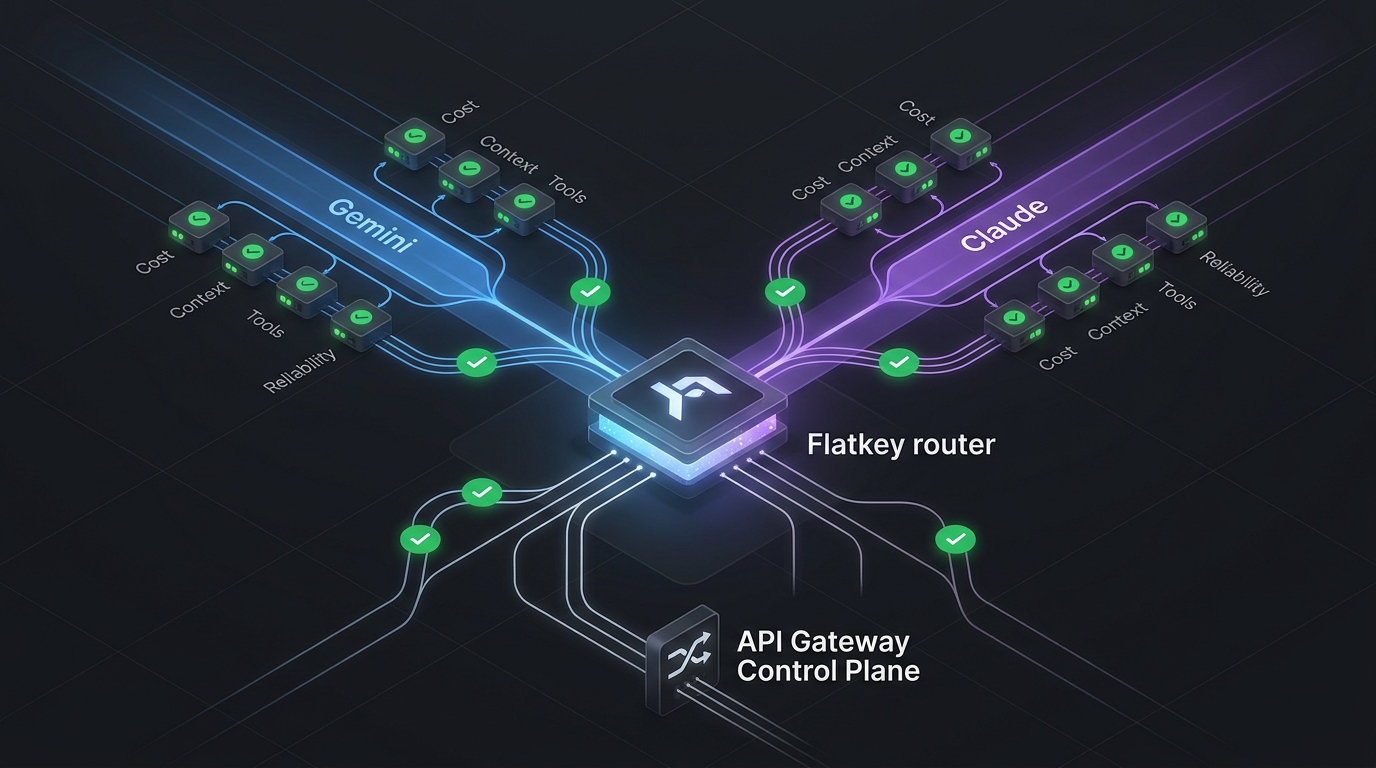
Flatkey should not be treated as a way to pretend overload cannot happen. Upstream model providers can still be busy. The useful role for a gateway is operational control:
- One OpenAI-compatible base URL for model traffic.
- A shared model catalog for approved fallback candidates.
- One usage and cost ledger for retries and recovered failures.
- Faster routing-policy changes without rewriting every application client.
- A cleaner audit trail when product, platform, and finance teams review the incident.
For a production team, this is often more valuable than a bigger retry loop. A bigger retry loop can hide incidents until they become expensive. A routed policy makes overload visible and controlled.
Production Runbook For API Error 529
Copy this into your incident process:
- Confirm the error class:
529 overloaded_error, provider, model, endpoint, timestamp, and request ID. - Check whether the request was read-only, streaming, or write-side.
- Apply the route's retry budget with exponential backoff and jitter.
- Stop retries if the request produced partial output or uncertain side effects.
- Open a circuit breaker if 529s cluster on the same provider/model route.
- Fall back only to an approved route with compatible output, safety, latency, and cost behavior.
- Show a user-facing message when latency budget expires.
- Review retry count, fallback count, recovered requests, failed requests, and duplicate-prevention evidence after the incident.
FAQ
Is API Error 529 the same as 429?
No. In Anthropic's docs, 529 means the API is temporarily overloaded, while 429 is a rate-limit error. Treat 529 as provider overload and 429 as a rate/quota/traffic-shape problem until your logs prove otherwise.
Should I retry API Error 529?
Yes, but only within a budget and only when the request is safe to repeat. Use exponential backoff with jitter, honor retry-after when present, and stop when partial output or external side effects make replay unsafe.
How many retries should I use for 529 overloaded errors?
For interactive AI features, start with two retries and a strict wall-clock deadline. Background jobs can use more retries, but should use queue age limits, dead-letter handling, and circuit breakers.
Should I automatically switch models after a 529?
Only when the fallback model can satisfy the same product contract. If model-specific behavior, tools, schema, safety policy, or context length matters, fallback may need a human-visible "regenerate with another model" action instead of transparent switching.
What should I show users during a 529 incident?
Use plain, temporary-state language: "The model is overloaded. We're retrying briefly." If the retry budget expires, offer a retry button or a degraded alternative. Do not expose provider internals unless your users are developers who need the detail.
Final Recommendation
The safest API Error 529 "Overloaded": Retry, Backoff, and Fallback Strategies plan is not a single while retry loop. It is a route policy: retry transient overload briefly, back off with jitter, protect non-idempotent work, circuit-break repeated failures, and fall back only when the alternate route preserves the user contract.
If your team already runs more than one model or provider, put that policy behind one gateway. With Flatkey, you can point OpenAI-compatible clients at https://router.flatkey.ai/v1, keep fallback candidates in one model catalog, and review recovered failures in Usage Logs after launch.
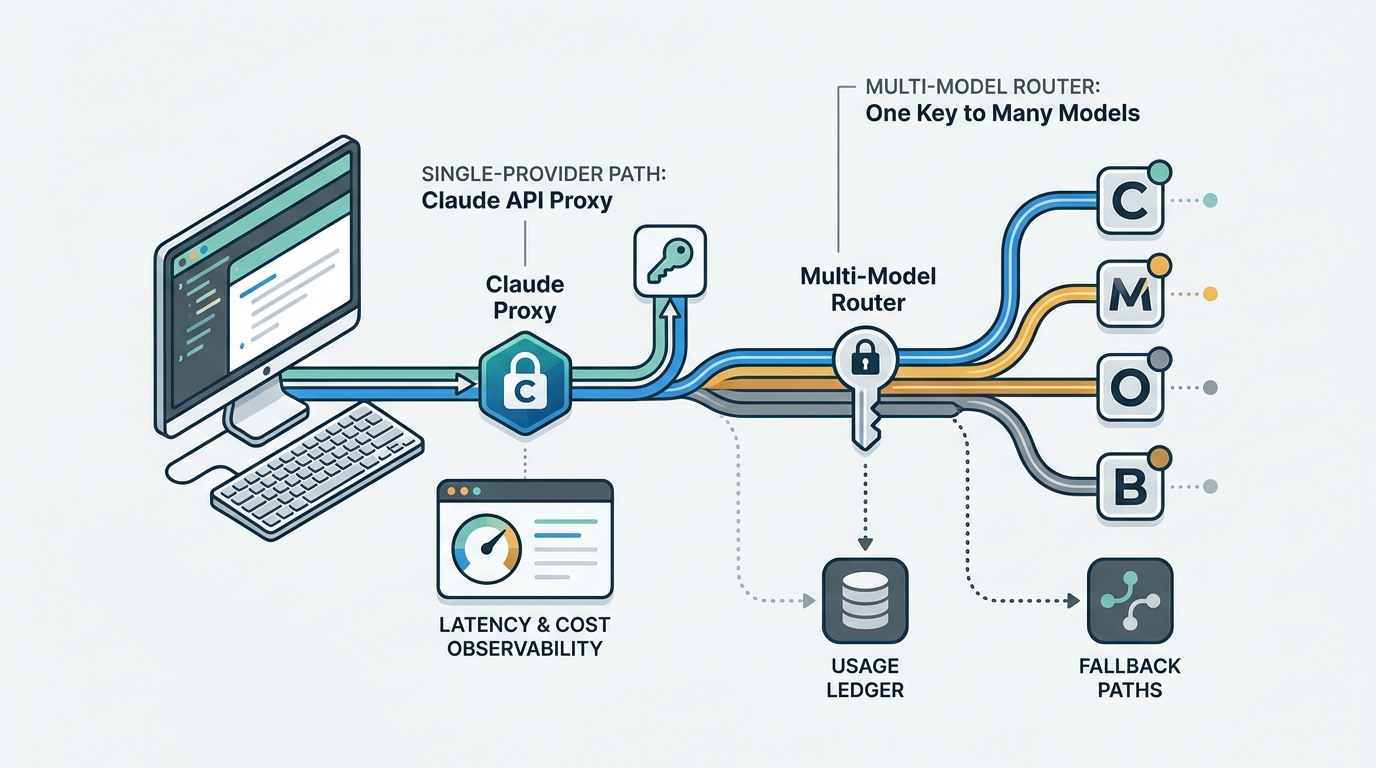
Start with the Flatkey API quickstart if you need a first-call path, or compare workload-level routing choices in Claude API proxy vs multi-model router.
Sources Checked
- Anthropic Claude API errors: https://platform.claude.com/docs/en/api/errors
- AWS Prescriptive Guidance, retry with backoff pattern: https://docs.aws.amazon.com/prescriptive-guidance/latest/cloud-design-patterns/retry-backoff.html
- Stripe advanced error handling and idempotency: https://docs.stripe.com/error-low-level
- Flatkey documentation index: https://docs.flatkey.ai/index.md
- Flatkey quickstart: https://docs.flatkey.ai/quickstart.md
- Flatkey product overview:
/Users/solveainc/.11agents/flatkey/knowledge_base/information/what-we-do/product-overview.md - Flatkey marketing strategy:
/Users/solveainc/.11agents/flatkey/knowledge_base/marketing/strategy.md