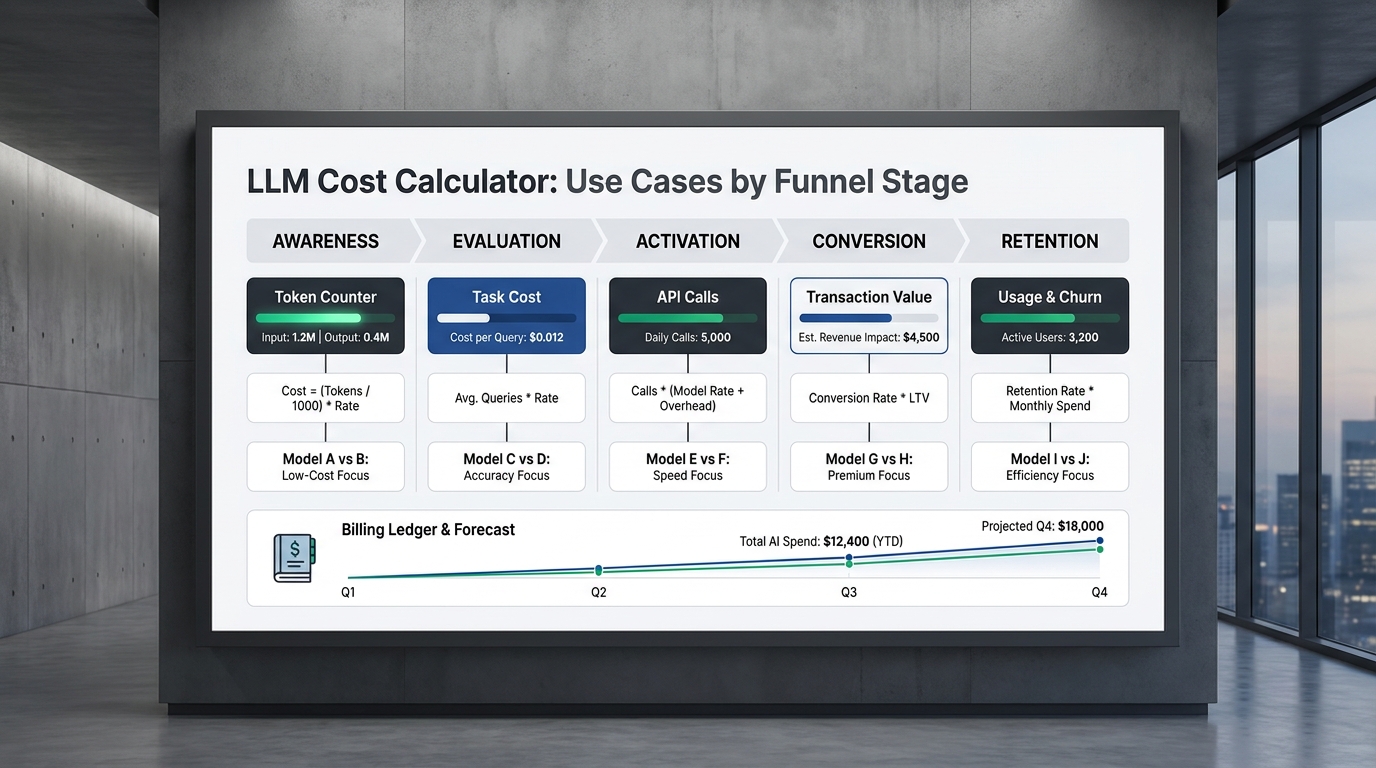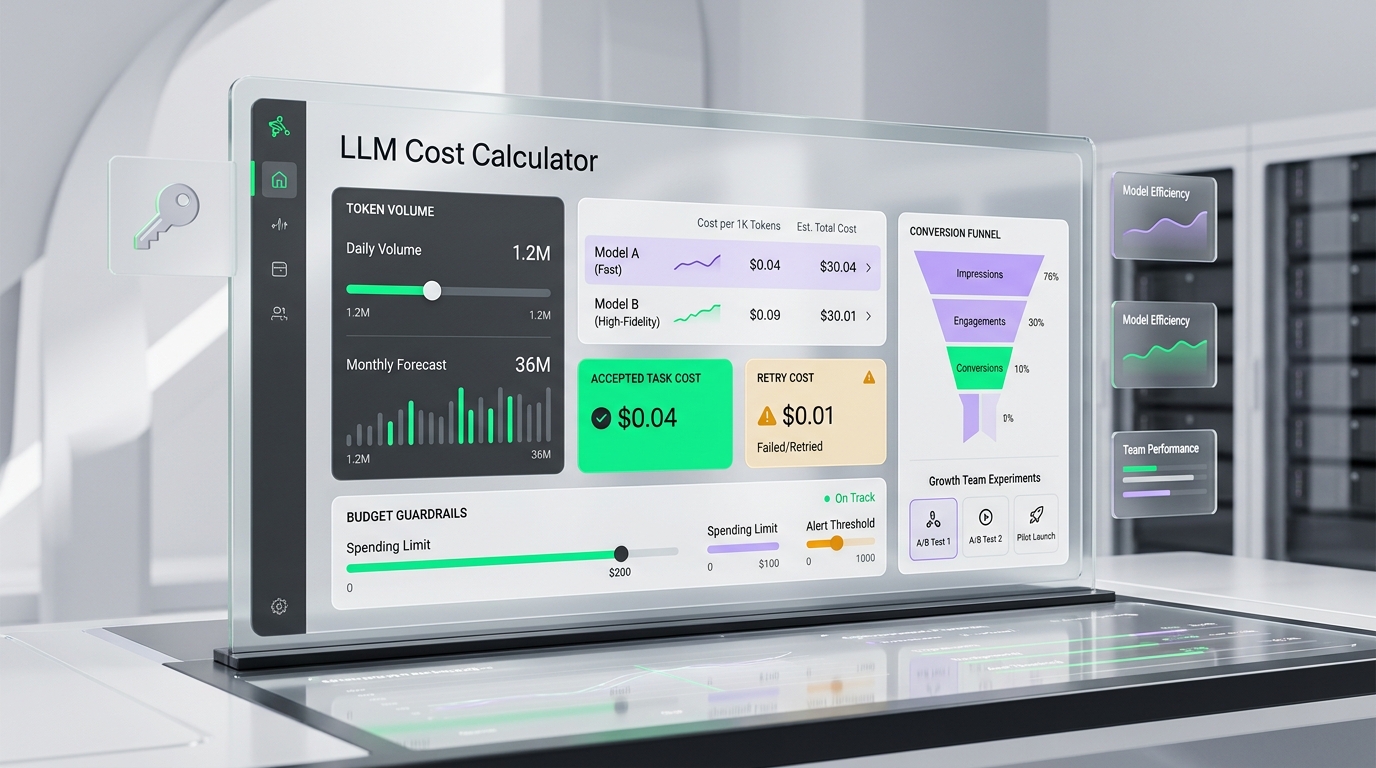
AI API Cost Optimization: 7 Strategies, 5 Alternatives, and a Cost Calculator
AI API cost optimization is not the same as finding the model with the lowest price per million tokens. A cheap model can become expensive when it produces longer answers, misses structured-output requirements, triggers retries, or sends more work to human reviewers. A premium model can be economical when it completes the task correctly on the first attempt.
The useful unit is cost per accepted task: the total cost of producing an output that your application can actually use.
This implementation guide explains how to calculate that number, reduce it with seven practical strategies, compare five architecture alternatives, benchmark them with the same 100-task workload, and run a 30-day optimization sprint without weakening output quality or reliability.
Pricing note: Provider documentation and Flatkey's public pricing catalog were rechecked on August 4, 2026. Model names, context tiers, cache discounts, batch rates, regional availability, and gateway multipliers can change. Recheck the linked pricing pages before making a purchasing decision.
The quick answer
For most production teams, the fastest path to lower AI API cost is:
- Measure cost per accepted task by use case.
- Route simple work to a smaller model and difficult work to a stronger model.
- Reduce repeated input with prompt compaction and caching.
- Cap output length and stop unnecessary generation.
- Separate retries from model fallback.
- Use batch or asynchronous execution for non-interactive workloads.
- Enforce budgets by feature, tenant, and environment.
If you use only one model and have a small workload, direct provider access may remain the simplest choice. If you regularly compare providers, need fallback capacity, or want one OpenAI-compatible integration, a hosted gateway can reduce engineering and operational overhead. If policy requires direct provider contracts or full infrastructure control, BYOK or self-hosting may fit better.
Why token price is an incomplete cost metric
Start with the visible API charge:
request cost = input tokens × input rate
             + cached input tokens × cached rate
             + output tokens × output rate
             + tool, image, audio, or search charges
Then add the costs created around the request:
cost per accepted task =
  (model spend
   + retry and fallback spend
   + gateway or infrastructure cost
   + human review cost
   + failure remediation cost)
  ÷ accepted tasks
Suppose Model A costs half as much per token as Model B. If Model A needs 1.8 attempts on average and sends 12% of outputs to manual review while Model B averages 1.05 attempts and 3% review, Model B may have the lower effective cost.
That is why a useful AI API pricing comparison should be paired with workload evaluation, not used as a standalone buying decision.
Copyable AI API cost calculator
Build the baseline at the workflow level, not as one blended account average. A support reply, coding-agent turn, extraction job, and video generation request have different quality thresholds and failure costs.
Use this worksheet for each workflow:
| Input | How to measure it |
|---|---|
| Requests started | Count all production attempts, including retries |
| Tasks accepted | Count outputs that passed automated or human acceptance |
| Input cost | Include ordinary and cached input separately |
| Output cost | Include generated text, image, audio, or video charges |
| Tool cost | Add search, code execution, storage, and other metered tools |
| Retry and fallback cost | Attribute every repeat attempt to the originating task |
| Review cost | Reviewer minutes × loaded hourly rate |
| Infrastructure cost | Gateway, proxy, queue, database, monitoring, and on-call allocation |
| Failure remediation | Refunds, reruns, support time, or downstream repair |
Then calculate:
acceptance rate = accepted tasks ÷ requests started

cost per accepted task =
  (input + output + tools + retries + review + infrastructure + remediation)
  ÷ accepted tasks
Track p50 and p95 cost per accepted task as well as the average. Averages can hide rare retry storms, oversized contexts, or fallback loops that create the largest budget incidents.
Break-even test for an optimization
An optimization is financially useful only when its recurring savings repay the implementation and operating cost within an acceptable period.
monthly net savings =
  baseline monthly total cost
  - optimized monthly total cost
  - new monthly operating cost

break-even months = one-time implementation cost ÷ monthly net savings
Reject changes that lower token spend but reduce acceptance enough to increase review, retries, churn, or incident cost. Validate savings against the same evaluation set and production traffic slice.
AI API cost optimization comparison table
The seven strategies below attack different parts of the bill. The best sequence is usually measurement first, routing second, then prompt and execution changes.
| Optimization strategy | Primary cost reduced | Engineering effort | Main risk | Best fit |
|---|---|---|---|---|
| Task-based model routing | Input and output token rates | Medium | Quality regressions on misclassified tasks | Mixed workloads with clear complexity bands |
| Prompt compaction and caching | Repeated input tokens | Low–medium | Removing context the model actually needs | Long system prompts, RAG, coding agents |
| Output controls | Output tokens and latency | Low | Truncating useful detail | Extraction, classification, tool calls |
| Retry and fallback policy | Duplicate calls and failure cost | Medium | Unsafe replay after partial side effects | Production APIs with intermittent errors |
| Batch and asynchronous execution | Provider execution rate | Low–medium | Increased completion time | Evals, enrichment, summarization, backfills |
| Usage budgets and quotas | Runaway or unowned spend | Medium | Blocking legitimate bursts | Multi-tenant products and internal platforms |
| Continuous price-performance evaluation | Model selection and migration cost | Medium–high | Benchmark drift | Teams with meaningful monthly AI spend |
1. Route by task, not by application
Many teams choose one model for an entire product because it simplifies implementation. That convenience can make every request pay the flagship-model rate.
Instead, classify work by the capability it needs:
- Low complexity: classification, tagging, routing, short extraction, format repair.
- Medium complexity: summarization, grounded question answering, routine code edits.
- High complexity: multi-step reasoning, difficult coding, ambiguous tool use, sensitive decisions.
Use the least expensive model that meets a defined acceptance threshold for each class. Keep the classifier deterministic where possible: endpoint, feature, prompt type, expected schema, token length, and risk tier are often enough.
A routing policy should have a quality floor. If the budget model falls below that floor, promote the request to a stronger model rather than silently accepting a weak result.
2. Compact prompts and reuse repeated context
Input cost grows quietly because system instructions, tool definitions, retrieved documents, and conversation history repeat on every call.
Reduce repeated input by:
- removing duplicated instructions and examples;
- sending only tools available for the current step;
- retrieving fewer, higher-quality context chunks;
- summarizing old conversation turns;
- storing stable state outside the prompt;
- using provider prompt caching when the workload and provider support it.
Caching is most useful when a large prefix remains identical across many requests. It is less useful when prompts change constantly or when cache retention and regional rules do not match the application.
OpenAI, Anthropic, and Google publish separate documentation for token pricing, cached input or context caching, and batch execution. Treat these as workload-specific levers rather than assuming every request receives the lowest advertised rate.
3. Control output length deliberately
Output tokens often cost more than input tokens. They also increase latency and make downstream parsing harder.
For machine-consumed responses:
- request a strict schema;
- return identifiers instead of repeated descriptions;
- set an appropriate maximum output limit;
- stop generation after the required fields are complete;
- avoid chain-of-thought collection when a concise answer or tool call is enough;
- reject verbose formats during evaluation.
Do not minimize output blindly. The target is the shortest response that preserves task success. A truncated answer that triggers a second call is not an optimization.
4. Separate retries from fallback
Retries and fallback solve different problems:
- Retry: Repeat a request after a transient failure, ideally to an equivalent endpoint.
- Fallback: Change model, provider, region, or capability tier when the original path cannot complete the task.
Unbounded retries can multiply spend during an outage. Use a small retry budget, exponential backoff with jitter, and circuit breakers. Before replaying tool-using or state-changing requests, verify whether the previous attempt created a side effect.
Cross-model fallback also needs contract checks. The next model must support the required context length, structured output, tools, modality, and safety policy. The LLM API fallback routing playbook explains how to separate safe retries, equivalent failover, and cross-model fallback.
5. Move non-interactive work to batch execution
Interactive chat and agent loops need low latency. Many other workloads do not:
- nightly document enrichment;
- bulk classification;
- offline evaluation;
- embeddings backfills;
- support-ticket summarization;
- catalog or metadata generation.
Providers may price batch or asynchronous execution differently from real-time requests. Even when the token rate is unchanged, batching can reduce connection overhead, smooth rate-limit demand, and prevent expensive emergency capacity changes.
The tradeoff is latency and operational complexity. Use a queue, idempotency key, completion deadline, and dead-letter path so cheaper execution does not create invisible failures.
6. Add budgets, quotas, and ownership
Optimization fails when spend cannot be assigned to a feature or owner. Track at least:
- provider and model;
- application and environment;
- feature or workflow;
- tenant, workspace, or customer plan;
- input, cached input, and output tokens;
- retry and fallback attempts;
- accepted or rejected outcome;
- estimated and reconciled cost.
Then set controls at the same levels. Useful controls include daily warning thresholds, monthly hard caps, per-request token limits, tenant quotas, model allowlists, and automatic downgrade policies for non-critical workloads.
The goal is not merely to stop spending. It is to preserve high-value traffic while shedding low-value or anomalous traffic first. See the AI API cost tracking guide and AI API spend management playbook for the telemetry and finance operating model.
7. Evaluate price and quality continuously
Provider prices change. Models improve, regress, or disappear. A routing decision that was efficient three months ago may no longer be efficient.
Maintain a compact evaluation set for each important workflow. Record:
- acceptance rate;
- schema-valid rate;
- tool-call success rate;
- p50 and p95 latency;
- average input and output tokens;
- average attempts per accepted task;
- human-review rate;
- cost per accepted task.
Run the suite when a model version, prompt, tool schema, retrieval system, or routing policy changes. This turns model replacement into a controlled buying decision rather than an emergency migration.
Use LLM API observability to connect traces and token usage to validated outcomes. Without the acceptance signal, a dashboard can prove that spend fell without proving that the product still works.
Five AI API alternatives compared
“Alternative” can mean an alternative model, provider, or access architecture. For cost optimization, architecture matters because it changes platform fees, engineering effort, fallback coverage, and operational ownership.
| Alternative | Billing model | Switching effort | Fallback options | Operational burden | Best when |
|---|---|---|---|---|---|
| One direct provider | Provider list price | High after deep integration | Usually within one provider | Low | One model family satisfies nearly all workloads |
| Multiple direct providers | Separate provider bills | Medium–high | Strong, but you build routing | Medium–high | Volume justifies direct contracts and custom control |
| Hosted multi-model gateway | Unified balance or bill plus gateway terms | Low with compatible SDK | Strong across providers and models | Low–medium | You need fast model comparison, routing, and one integration |
| BYOK gateway or proxy | Direct provider cost plus proxy/platform cost | Low–medium | Depends on connected keys | Medium | Direct provider billing or data terms are required |
| Self-hosted open-source gateway | Provider cost plus your infrastructure and labor | Medium | You implement and operate it | High | Control and policy outweigh platform simplicity |
Architecture decision matrix
Score each option from 1 to 5 against your actual constraints. Weight cost, reliability, compliance, and engineering capacity before multiplying the scores. Do not let the lowest visible token rate automatically win.
| Decision factor | Single direct provider | Several direct providers | Hosted gateway | BYOK proxy | Self-hosted gateway |
|---|---|---|---|---|---|
| Fast initial integration | High | Low | High | Medium | Low |
| Unified billing | High | Low | High | Low | Depends on implementation |
| Cross-provider routing | None | Custom | Built in or configured | Configured | Fully custom |
| Provider contract control | High | High | Varies | High | High |
| Infrastructure ownership | Low | Medium | Low | Medium | High |
| Migration flexibility | Low–medium | High | High | High | High |
| Internal operations load | Low | High | Low–medium | Medium | High |
Choose a single direct provider when one model family meets the workload and simplicity matters most. Choose several direct providers when provider-specific features or contracts justify separate integrations. Choose a hosted gateway when fast multi-model testing, one interface, unified operations, and fallback capacity outweigh the platform fee. Choose BYOK when direct billing or contracts are mandatory but a shared control plane is still useful. Choose self-hosting when data-plane control and custom policy are strategic enough to fund a platform team.
Run a 100-task AI API alternatives benchmark
A feature checklist tells you what an alternative claims to support. A traffic replay tells you what it costs to operate for your workload. Before changing providers or gateway architecture, run the same representative task set through every viable option.
The benchmark should include at least 100 tasks sampled across the workflows that drive most of your spend. Preserve difficult examples, long contexts, structured outputs, tool calls, and requests that previously required retries. Do not build an evaluation set made only of easy prompts; it will overstate the savings from weaker models.
Step 1: freeze the acceptance contract
Define the pass condition before running any alternative. Depending on the workflow, acceptance may require:
- valid JSON or schema conformance;
- exact extraction fields;
- passing unit or integration tests;
- grounded answers with required citations;
- successful tool execution without duplicate side effects;
- human approval under a documented rubric.
Use one acceptance contract for every candidate. If each provider receives a different quality bar, the cost comparison is not valid.
Step 2: hold the workload policy constant
Keep prompts, tool definitions, temperature, output caps, retry budget, timeout, and fallback rules as similar as the APIs allow. Record any provider-specific exception because it creates migration and maintenance cost.
Run candidates in shadow mode or against non-production copies of the same inputs. For side-effecting agents, mock writes or use idempotency keys so a benchmark cannot send duplicate emails, create duplicate records, or execute a purchase twice.
Step 3: capture one row per task and alternative
Use this copyable ledger:
| Field | What to record |
|---|---|
| Workflow and task ID | Stable identifiers for matched comparison |
| Access alternative | Direct, multi-direct, hosted gateway, BYOK, or self-hosted |
| Provider and model | The model that actually served the request |
| Input, cached, and output tokens | Separate token classes instead of one total |
| Attempts | Initial call, retries, and model fallbacks |
| Model and platform cost | Keep provider cost and gateway/infrastructure cost visible |
| Latency | End-to-end p50 and p95, not only provider processing time |
| Accepted | Pass or fail under the frozen contract |
| Review minutes | Human effort needed before acceptance |
| Failure reason | Schema, grounding, timeout, refusal, tool, or policy failure |
The minimum comparison metric remains:
benchmark cost per accepted task =
  (model cost
   + gateway or infrastructure cost
   + retry and fallback cost
   + review cost
   + failure remediation)
  ÷ accepted tasks
Pair the ledger with an AI API cost tracking guide so the benchmark fields can become production telemetry rather than a one-time spreadsheet.
Step 4: score total operating fit
Cost should lead the decision, but it should not erase reliability, control, or migration risk. Assign each factor a weight totaling 100%, score every candidate from 1 to 5, and keep the raw benchmark metrics beside the score.
| Factor | Suggested weight | Evidence |
|---|---|---|
| Cost per accepted task | 35% | Matched 100-task benchmark |
| Acceptance rate | 20% | Automated and human evaluation |
| p95 latency | 10% | End-to-end traces |
| Failure recovery | 10% | Timeout, rate-limit, and provider-outage tests |
| Engineering effort | 10% | Estimated migration and maintenance hours |
| Billing and spend controls | 5% | Exports, budgets, quotas, ownership tags |
| Security and compliance fit | 10% | Contract, logging, retention, region, and key review |
weighted alternative score = Σ(score from 1 to 5 × factor weight)
Treat the weighted score as a decision aid, not a substitute for hard gates. A candidate that violates a required data region, contract term, or acceptance floor should be rejected even if its total score is high.
Step 5: apply a switching threshold
Small benchmark differences often disappear after migration work, traffic variability, and price changes. Require a clear margin before switching.
annual net benefit =
  (current cost per accepted task - candidate cost per accepted task)
  × forecast annual accepted tasks
  - annual added operating cost

payback months = migration cost ÷ (annual net benefit ÷ 12)
For a reversible model-routing change, a short payback period may be reasonable. For a provider contract, data-plane migration, or self-hosted gateway, require a larger margin and a longer shadow period. Document the threshold before seeing the results to reduce decision bias.
False savings to reject
An AI API alternative is not cheaper when the apparent saving comes from moving cost outside the model invoice. Reject a result when:
- token spend falls but accepted-task volume falls faster;
- retries are excluded from the candidate total;
- gateway fees are counted but internal infrastructure labor is not, or vice versa;
- review time is treated as free;
- cached-input or batch discounts are assumed without measuring eligibility and hit rate;
- the benchmark ignores rate limits, outages, or fallback behavior;
- introductory credits are treated as a durable unit cost;
- the cheaper path depends on an unsupported model alias or undocumented routing behavior.
Use a prompt caching cost and ROI guide for cache-specific economics and the LLM API fallback routing playbook to test failure cost without creating retry amplification.
Alternative 1: stay with one direct provider
This is often cheapest operationally at low scale because there is no extra routing layer to manage. It also provides direct access to provider-specific features.
The drawback is concentration. If another model becomes better or cheaper, migration can require SDK changes, new schemas, new observability fields, and new reliability behavior. Single-provider access is a strong baseline, not automatically the lowest long-term total cost.
Alternative 2: integrate several providers directly
Direct multi-provider access can minimize intermediary fees and support enterprise agreements. It gives engineering teams full control over selection and failover.
The hidden cost is duplicated integration work: authentication, SDK differences, model names, error normalization, rate limits, usage reconciliation, safety behavior, and regional availability. This approach works best when the team has platform-engineering capacity and enough volume to justify it.
Alternative 3: use a hosted multi-model gateway
A hosted gateway provides one API surface across model families. An OpenAI-compatible base URL can reduce migration effort for applications that already use the OpenAI SDK pattern.
Flatkey's current public catalog groups models across standard, economy, and official-resource routes. That lets teams compare model and routing options behind one integration, while current model access and multipliers remain visible on the Flatkey pricing page.
Compare gateways on more than headline markup. Review model coverage, routing transparency, fallback controls, usage exports, privacy terms, support, credit policy, and whether the gateway exposes the provider and model that actually served each request. The AI gateway pricing guide provides a fuller buying checklist.
Alternative 4: bring your own provider keys
A BYOK gateway or proxy keeps provider billing attached to your accounts while adding a common interface, logging, policy, or routing layer.
This can fit teams that need direct contracts or provider-specific data controls. It does not remove key management, provider quotas, fragmented invoices, or minimum commitments. You also need to confirm how the proxy handles prompts, logs, credentials, and failover.
Alternative 5: self-host an open-source gateway
Self-hosting can provide maximum control over routing logic, deployment region, telemetry, and data handling. The software license may be free, but the system is not free to operate.
Include engineering time, upgrades, security patches, secrets management, high availability, incident response, metering, dashboards, and billing reconciliation in the comparison. Self-hosting is economical when those capabilities already exist internally or are strategic requirements—not simply because the proxy has no per-token platform fee.
A practical 30-day optimization plan
Week 1: establish the baseline
Instrument requests by workflow, model, tokens, attempts, latency, and accepted outcome. Reconcile estimated cost with provider or gateway usage records. Select the three workflows with the highest total spend or worst cost per accepted task.
Week 2: fix obvious waste
Remove duplicated prompt content, limit output, disable unnecessary tools, cap retries, and move eligible jobs to asynchronous execution. Add alerts for context growth, retry amplification, and unowned spend.
Week 3: create routing tiers
Benchmark at least one budget, balanced, and high-capability model on your own evaluation set. Route by workflow and add a quality-triggered escalation path. Shadow the new route before sending production traffic.
Week 4: enforce and review
Add budgets, alerts, and owner tags. Compare direct-provider, gateway, BYOK, and self-hosted total cost using the same traffic sample and acceptance criteria. Roll out gradually and retain a fast rollback path.
Production rollout gates
Do not ship a cost change based only on an offline token estimate. Require these gates:
- Quality gate: acceptance rate and critical error rate remain inside the agreed tolerance.
- Reliability gate: timeout, retry, and fallback behavior pass failure-injection tests.
- Latency gate: p95 latency remains suitable for the workflow.
- Cost gate: cost per accepted task improves on a representative traffic sample.
- Safety gate: tool permissions, structured outputs, and sensitive workflows retain their controls.
- Rollback gate: the previous model and routing policy can be restored quickly.
For instrumentation details, use the AI API cost tracking guide and the LLM API observability guide. For repeated prompts, calculate the real break-even point with the prompt caching cost and ROI guide.
AI API cost optimization checklist
- [ ] Cost is measured per accepted task, not only per token.
- [ ] Input, cached input, and output tokens are tracked separately.
- [ ] Each workflow has an explicit quality threshold.
- [ ] Smaller models handle tasks they can complete reliably.
- [ ] Retry budgets and fallback policies are separate.
- [ ] Output limits match the response contract.
- [ ] Batch execution is used for eligible workloads.
- [ ] Spend is attributed to a feature, tenant, environment, and owner.
- [ ] Estimates are reconciled against billed usage.
- [ ] Model price-performance tests run after meaningful changes.
- [ ] p50 and p95 cost per accepted task are reviewed separately.
- [ ] Every optimization has a break-even estimate and rollback owner.
- [ ] Routing changes pass quality, reliability, latency, cost, and safety gates.
Frequently asked questions
What is the best metric for AI API cost optimization?
Use cost per accepted task or cost per validated business outcome. Token cost is still useful for diagnosis, but it does not include retries, weak outputs, review labor, or failure remediation.
Is the cheapest AI model always the most cost-effective?
No. The cheapest model is cost-effective only when it meets the required quality, latency, reliability, and tool-use threshold with an acceptable number of attempts.
Does an AI API gateway reduce cost?
It can reduce integration, routing, fallback, and operational cost. Whether it reduces the final bill depends on gateway pricing, model selection, traffic shape, retries, and the value of unified operations. Compare total cost, not only platform markup.
When should a team self-host an AI gateway?
Self-host when infrastructure control, custom policy, deployment location, or compliance requirements justify owning uptime, upgrades, security, metering, and incident response. It is rarely the simplest option for a small team.
How often should model costs be reevaluated?
Reevaluate after pricing changes, model releases, prompt changes, tool-schema changes, or meaningful workload shifts. For material AI spend, a monthly price-performance review is a practical minimum.
What is the fastest low-risk way to reduce LLM API cost?
Start with output caps, duplicate-context removal, retry limits, and moving eligible offline jobs to batch execution. These changes are usually easier to validate than a model migration. Then test smaller models and routing policies against a representative evaluation set.
How should a team compare AI API alternatives?
Replay the same traffic sample through each architecture and compare cost per accepted task, p95 latency, failure recovery, integration effort, billing operations, compliance fit, and migration risk. A provider or gateway comparison without an acceptance metric is incomplete.
Choose the lowest total cost, not the lowest rate
AI API cost optimization is an engineering and product discipline. The winning setup is the one that produces reliable accepted outcomes at the lowest total cost while preserving the latency, privacy, and control your application requires.
Start with measurement. Then optimize model routing, context, outputs, retries, execution mode, and budgets. Only after that should you compare access alternatives using the same workload and acceptance criteria.
If you want to test multiple model families without rebuilding every integration, review Flatkey's current model access and pricing and use one compatible endpoint to benchmark the options against your own production tasks.