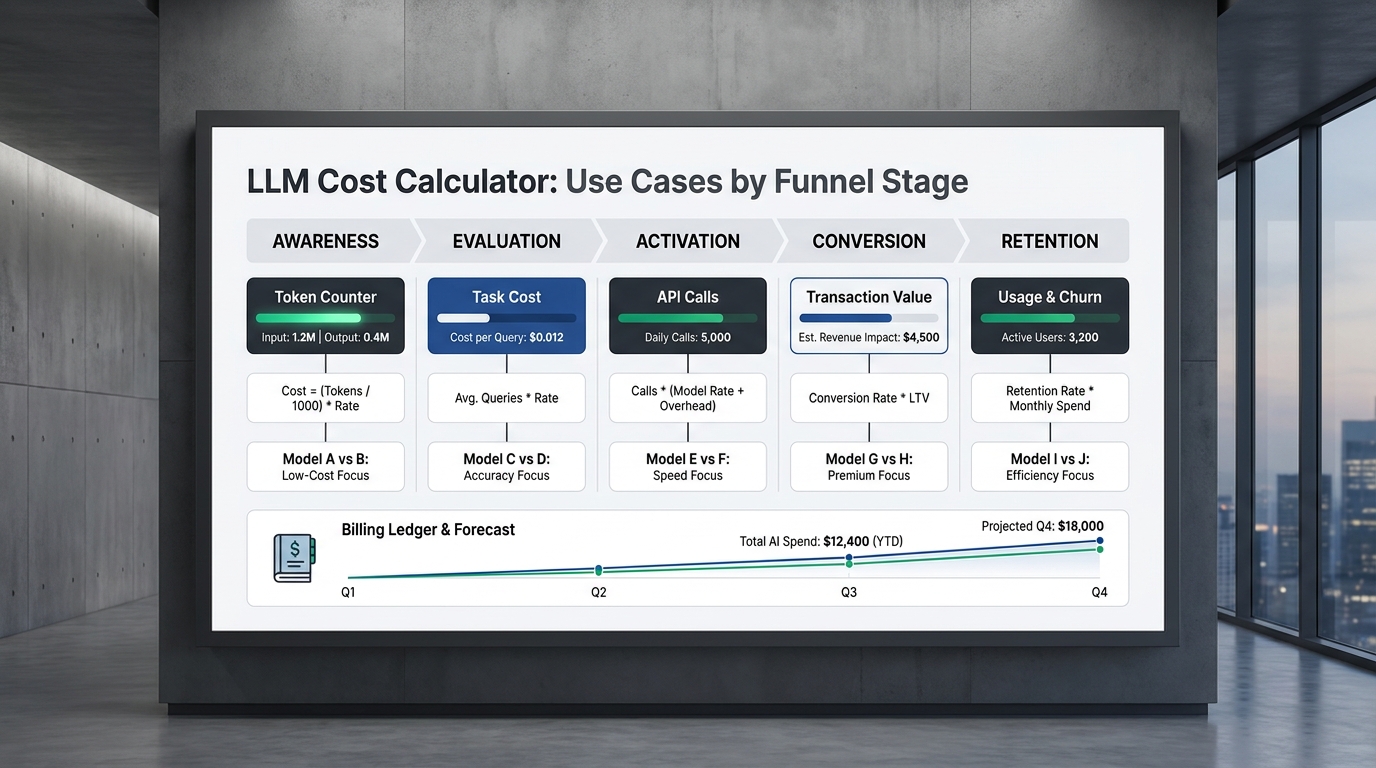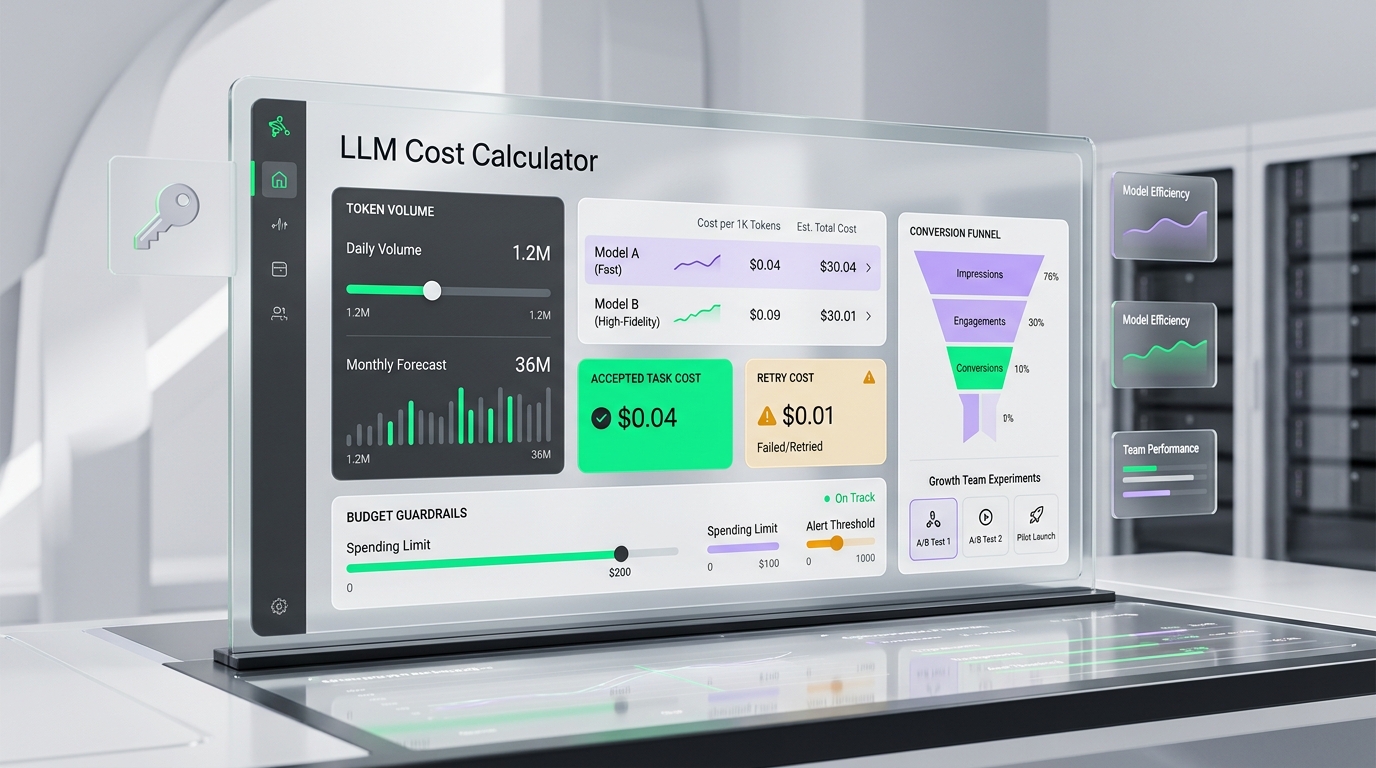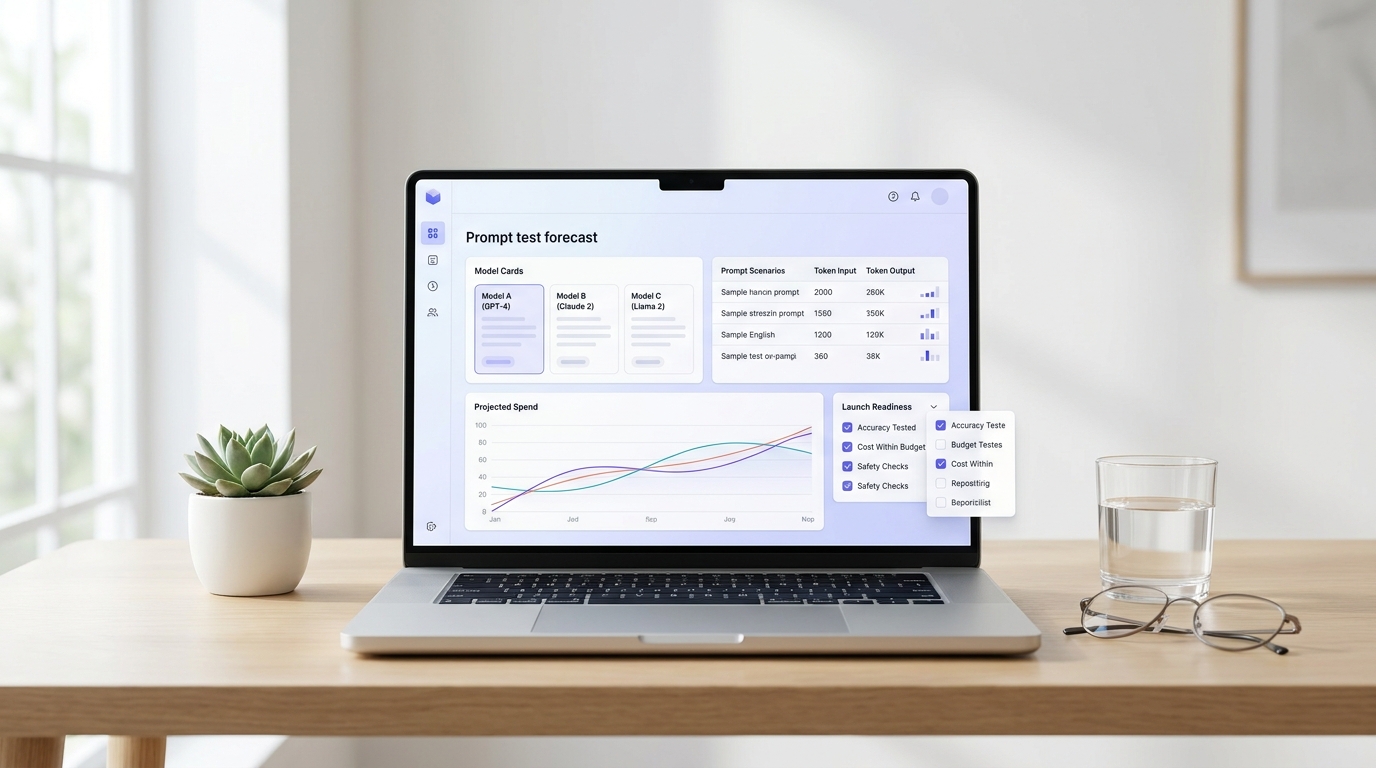
If you are testing prompts across more than one model, cost forecasting breaks the moment you treat every request like plain chat tokens. One team may run short text prompts on gpt-5-mini, longer evaluation sweeps on claude-sonnet-4-6, image variants on gpt-image-2, and then a few video tests before launch. That is not one bill shape. It is a stack of different unit types, retry patterns, and approval loops.
This guide gives you a practical multi-model prompt testing workflow for AI API spend forecasting before traffic ramps. The goal is not perfect finance precision on day one. The goal is to stop launch-week surprises by turning prompt tests into a small forecast worksheet that founders, operators, and engineering leads can all read.
On Sunday, July 19, 2026, Flatkey's public homepage still described the product as official APIs only, verified hourly, with 160+ frontier models behind one key and one OpenAI-compatible base URL at https://router.flatkey.ai/v1. The public pricing page also still said:
- every top-up earns bonus credit:
+$3on$10,+$8on$20, and+$100on$200 - one balance can route across GPT, Claude, Gemini, DeepSeek, image, audio, and video models
- usage is metered by model, token type, and request logs
That product shape matters because a good forecasting workflow is not just a pricing table. It needs a live source for model rows, a shared balance view, and logs that show where prompt tests are actually burning money.
The short answer
Use this order:
- Split the forecast into text, image, and video lanes before you compare prices.
- Estimate prompt-testing traffic separately from real-user traffic.
- Forecast one baseline model, one fallback model, and one approval-loop multiplier for each lane.
- Add a buffer for retries, cache misses, and rejected creative before you top up.
- Recheck the live pricing page before launch, then lock quota limits and watch request logs after traffic starts.
That is the core multi-model prompt testing workflow. Most teams skip step two or four, then act surprised when a cheap-looking benchmark turns into an expensive approval loop.
Why most prompt testing forecasts fail
Founders usually start with a simple question: "How much will this model cost if we run it at launch?"
That question is too broad. A useful forecast has to answer five smaller questions:
| Question | What it changes |
|---|---|
| Are these internal prompt tests or real-user requests? | Test volume is usually bursty and repetitive; launch traffic is steadier and harder to predict. |
| Is the lane text, image, or video? | The billing unit changes, so one blended sheet gets misleading fast. |
| How many variants do you approve before one output ships? | Creative review loops can multiply spend faster than token growth alone. |
| Which model is the default and which one is fallback? | Reliability policy can change your blended cost even when traffic stays flat. |
| What percentage of requests are expected to be retries, cache misses, or rejects? | This is where clean demo math usually breaks. |
If you skip those questions, you do not have a forecast. You have a hopeful average.
The publish-day source snapshot
The workflow below uses only public Flatkey surfaces rechecked on Sunday, July 19, 2026.
| Source | Checked on | Useful fact |
|---|---|---|
https://flatkey.ai/ |
July 19, 2026 | Public homepage still says official APIs only, verified hourly, one key, and 160+ frontier models. |
https://flatkey.ai/pricing |
July 19, 2026 | Public pricing page still says top-up bonus credit is permanent, one balance covers text/image/audio/video, and usage is metered by model, token type, and request logs. |
https://router.flatkey.ai/api/pricing |
July 19, 2026 | Public pricing API returned pricing_version: group-model-ratio-v1, 176 rows, 175 token-style rows, 1 fixed-price row, and supported endpoint families for openai, anthropic, gemini, image-generation, openai-response, openai-video, and video. |
The homepage live board on July 19, 2026 also exposed example input-side rates that are useful for rough text-lane budgeting:
| Model | Public homepage input rate |
|---|---|
gpt-5.5 |
$3.33 / M in |
claude-sonnet-4-6 |
$2.00 / M in |
gpt-5.4 |
$1.67 / M in |
claude-opus-4-8 |
$3.33 / M in |
deepseek-v4-flash |
$0.056 / M in |
Treat those as publish-day examples, not eternal constants. This is a forecasting article, so the process matters more than any single day of prices.
The multi-model prompt testing workflow
Step 1: Split test traffic from launch traffic
Do not mix internal testing with public traffic. Your prompt lab often has:
- more repeated prompts
- more manual reruns
- more long prompts
- more rejected outputs
Launch traffic often has:
- shorter or more normalized prompts
- steadier volume
- fewer manual reruns
- stronger quota requirements
Start with two separate sheets:
| Sheet | Purpose | Typical owner |
|---|---|---|
| Prompt test forecast | Pre-launch experiments, model comparisons, approval loops | Product, ops, AI engineer |
| Launch traffic forecast | Expected user volume after release | Founder, finance, engineering lead |
If you only build one sheet, your test budget usually gets hidden inside your production budget.
Step 2: Split by modality before doing any math
This is where many teams make the first real mistake. Text, image, and video workflows should not share one simple "cost per request" column.
| Lane | Primary unit | Forecast driver |
|---|---|---|
| Text prompts | input tokens, output tokens, cached tokens | prompt length, response length, fallback rate |
| Image generation | model-specific image pricing plus rerender count | concepts per approved image, edit loops, resolution choices |
| Video generation | seconds or provider-specific generation units | clip duration, rerenders, queue failures, approval loops |
Flatkey's own public pages reinforce this separation. The pricing page says one balance can route across text, image, audio, and video, but that does not mean one forecasting formula should cover all of them.
Step 3: Define the test matrix before estimating cost
A real multi-model prompt testing workflow starts with a test matrix, not a price table.
Use a table like this:
| Lane | Goal | Default model | Fallback model | Daily tests | Approval or retry factor |
|---|---|---|---|---|---|
| Text | compare instruction quality | claude-sonnet-4-6 |
gpt-5.4 |
500 | 1.10 |
| Text | low-cost bulk eval sweep | deepseek-v4-flash |
gpt-5-mini |
2,000 | 1.05 |
| Image | creative concept tests | gpt-image-2 |
second image model from live pricing page | 80 | 2.50 |
| Video | launch trailer prompt sweep | live video row from /pricing |
backup video row from /pricing |
12 | 1.80 |
The point is simple: forecast the actual workflow you will run, not a fantasy where every model is called once and always accepted.
Step 4: Use text-lane baseline math first
For text prompts, start with a conservative input-side estimate. It is faster and usually enough to catch obvious budget problems before you build a fully detailed token model.
Baseline text formula
baseline text spend
= requests
× average input tokens
× input-side price per 1M
÷ 1,000,000
× approval or retry factor
Example 1: 500 daily test prompts on Claude Sonnet 4.6
500 requests
× 1,800 input tokens
× $2.00 / 1M input
÷ 1,000,000
× 1.10 retry factor
= $1.98 per day baseline input spend
Example 2: 2,000 daily low-cost eval prompts on DeepSeek V4 Flash
2,000 requests
× 1,800 input tokens
× $0.056 / 1M input
÷ 1,000,000
× 1.05 retry factor
= about $0.21 per day baseline input spend
That does not replace full token accounting. It gives you a quick screen. If the baseline already looks too high, the full forecast will not save you.
Step 5: Add the full text forecast only after the baseline passes
Once the baseline looks acceptable, move to the full token sheet.
| Variable | Meaning |
|---|---|
| uncached input tokens | prompt tokens that are billed at normal input rate |
| cached input tokens | reusable prompt context billed at cache rate when supported |
| output tokens | generated tokens |
| fallback share | percent of requests sent to the backup model |
| retry factor | extra runs caused by failures, QA reruns, or prompt rewrites |
Full text formula
daily text spend
= requests
× (
  uncached input tokens × uncached input rate
  + cached input tokens × cache rate
  + output tokens × output rate
)
÷ 1,000,000
× retry factor
Flatkey's public pricing API is useful here because the row structure already exposes separate fields for token-style cost components. On July 19, 2026, for example:
| Model | Input-side field | Output-side field | Cache field |
|---|---|---|---|
gpt-5-mini |
0.02 |
8 |
0.12 |
claude-sonnet-4-6 |
1.5 |
5 |
0.1 |
gpt-image-2 |
3.325 |
6 |
0.251127819549 |
Use the live row for the exact model you are testing. Do not borrow a nearby row because it "looks close enough."
Step 6: Forecast image tests as approval loops, not single outputs
Image costs are where many operators under-budget. One finished image can hide several rejected attempts.
Use this worksheet:
| Input | Example |
|---|---|
| concepts to test | 20 |
| average renders per concept | 3 |
| average edits per approved concept | 2 |
| total image operations | 100 |
| live price row | pull from /pricing on publish day |
| buffer for rejected runs | 15% |
Image forecast formula
image test spend
= total image operations
× live image-model price
× rejection buffer
The important operating rule is this: do not force image forecasts into the text token table. Flatkey's public pages make clear that one balance can span text and image, but your internal budget still needs separate approval-loop math.
Step 7: Forecast video tests by duration and rerender factor
Video prompt testing is even easier to undercount because each approved clip often sits on top of several failed or revised generations.
On the public homepage checked on July 19, 2026, Flatkey still described video generation as being metered per second on the same prepaid balance as text models. That means your video worksheet should look like this:
| Input | Example |
|---|---|
| concepts to test | 6 |
| average clips per concept | 2 |
| average duration | 8 sec |
| rerender factor | 1.8 |
| live per-second price | pull from /pricing on launch week |
Video forecast formula
video test spend
= concepts
× clips per concept
× seconds per clip
× live per-second price
× rerender factor
Again, keep video separate. Do not pretend a clip is just another request in a text model sheet.
Step 8: Add the launch buffer before topping up
After you total text, image, and video test spend, add a launch buffer. The pricing page checked on July 19, 2026 is explicit that Flatkey is prepaid and usage is metered through request logs. That makes a buffer operationally useful, not just financially tidy.
Use a buffer table like this:
| Risk | Suggested buffer |
|---|---|
| text retries and cache misses | 10% |
| image rejections or extra edits | 15% to 30% |
| video rerenders | 20% to 40% |
| launch-week unknowns | 10% |
Then choose a top-up amount that matches the total:
| Top-up option | Public pricing page value on July 19, 2026 |
|---|---|
$10 |
pay $10, get $13 credit |
$20 |
pay $20, get $28 credit |
$200 |
pay $200, get $300 credit |
For small prompt labs, the right question is not "what is the cheapest top-up?" It is "what top-up keeps the test loop moving without forcing an ops stop in the middle of launch prep?"
A simple calculator table you can reuse
Copy this into a sheet before every serious prompt test cycle.
| Lane | Model | Test volume | Unit input | Rate source | Retry factor | Estimated spend |
|---|---|---|---|---|---|---|
| Text | primary model | avg input/output tokens | live pricing row | |||
| Text | fallback model | avg input/output tokens | live pricing row | |||
| Image | primary image model | operations per approved asset | /pricing |
|||
| Video | primary video model | seconds per approved clip | /pricing |
|||
| Buffer | all lanes | subtotal × risk factor | internal rule |
If this table is incomplete, your launch forecast is incomplete.
What to inspect after the first live traffic day
The pricing page says usage is metered by model, token type, and request logs. That means your first-day review should answer:
- Which model actually handled the most requests?
- Did fallback traffic match the expected share?
- Were output tokens materially larger than the test assumption?
- Which prompt family generated the most reruns?
- Did image or video approval loops cost more than the text lane?
That feedback loop is what turns a multi-model prompt testing workflow into a repeatable cost-governance practice instead of a one-off spreadsheet.
Common mistakes
| Mistake | Why it hurts |
|---|---|
| blending text and media into one average cost per request | hides the real drivers of image and video spend |
| forecasting only the default model | ignores what fallback does to the bill |
| using test volume as if it were launch volume | mixes internal burst behavior with real user behavior |
| ignoring approval loops | underestimates image and video cost fastest |
| topping up with no risk buffer | creates avoidable launch-week interruptions |
FAQ
Should I start with the cheapest model?
Not automatically. Start with the model that best matches the job, then test whether a cheaper model can carry part of the traffic without increasing retries, QA work, or fallback volume.
Why keep media costs outside the token worksheet?
Because image and video approvals multiply differently. A text prompt may need one retry. A video concept may need several rerenders before anyone approves it.
When is the forecast good enough to launch?
When you have:
- a baseline and full text estimate
- separate image and video worksheets where relevant
- a named fallback model for each important lane
- a prepaid balance decision
- quota and usage-log review ready for day one
Where should I compare model rows before the final decision?
Use the live Flatkey pricing page for current route and billing context, then compare adjacent options in the existing AI model pricing comparison guide. The first page helps you launch. The second helps you decide which rows deserve testing.