If your application calls only one AI model, the integration can look deceptively simple: store an API key, send a request, and display the response.
The complexity arrives when the product adds a second provider, a fallback model, usage limits, cost reporting, or a requirement to keep prompts out of logs. Soon, every service handles model access differently.
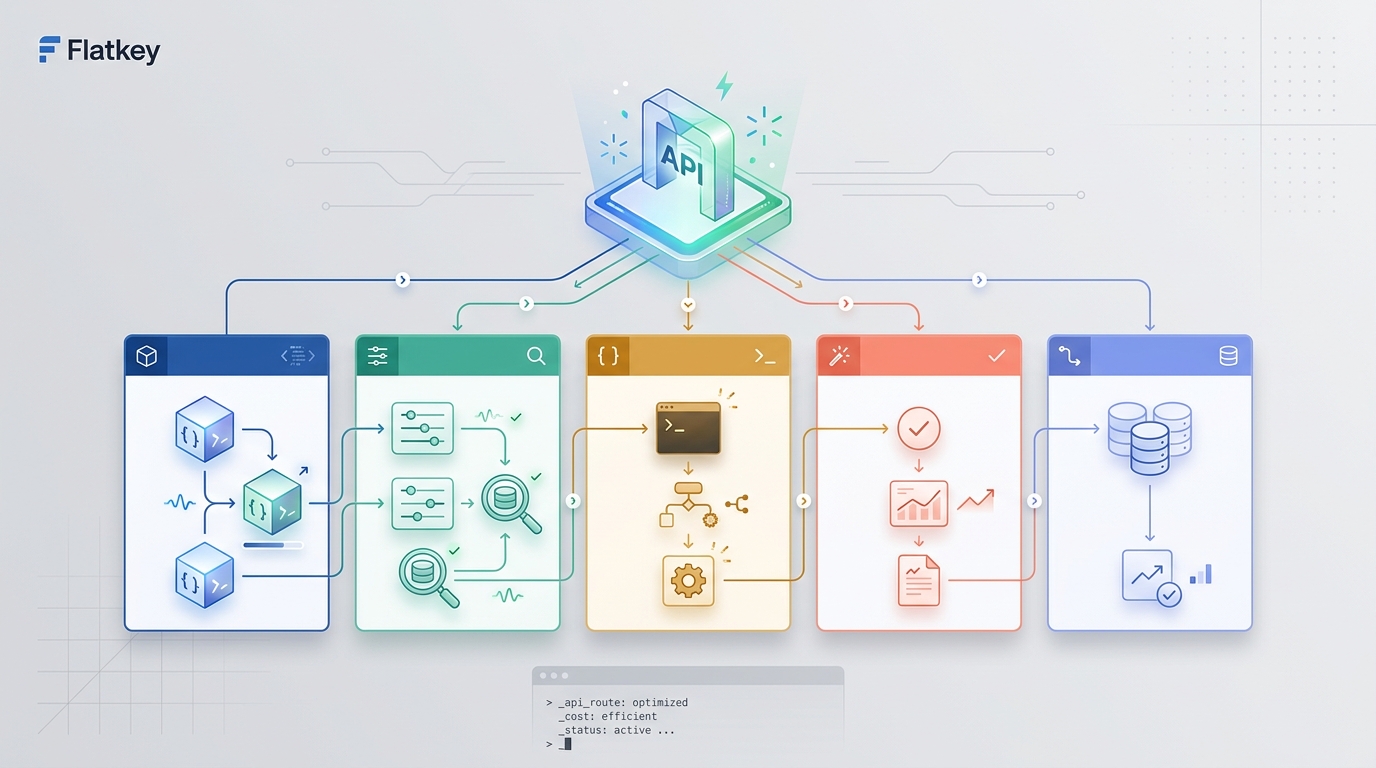
An LLM gateway creates one controlled entry point between your application and one or more model providers. It can centralize authentication, routing, retries, rate limits, observability, and policy enforcement so those concerns do not have to be rebuilt in every application.
This beginner guide explains what an LLM gateway is, how a request moves through one, which features matter, and when a gateway is worth adding.
LLM gateway definition
An LLM gateway is an infrastructure layer that receives requests from an application, applies shared controls, sends each request to an appropriate large language model endpoint, and returns the response in a consistent format.
It is also called an AI gateway, GenAI gateway, or LLM API gateway. Vendors use these labels differently, but the core idea is the same: move provider-specific access and operational controls behind a shared interface.
A useful mental model is:
Your application
      ↓
LLM gateway
  ├─ authentication and policy
  ├─ routing and fallback
  ├─ rate and budget controls
  └─ logs, metrics, and traces
      ↓
Model providers and model endpoints
The gateway does not replace the model. It manages how your application reaches models.
Why teams use an LLM gateway
Direct provider integrations are often the fastest way to launch a first prototype. The problem is that operational logic tends to spread as the product grows.
Without a shared gateway, separate services may each implement their own:
- API keys and secret rotation
- provider SDK configuration
- timeout and retry behavior
- fallback rules
- rate-limit handling
- request logs
- token and cost calculations
- safety or data-handling checks
That duplication creates inconsistent behavior. One service may retry a timeout three times while another fails immediately. One may record token usage while another does not. A model change can require edits across several repositories.
An LLM gateway gives the team a central place to standardize those decisions. The application calls the gateway, and the gateway handles provider access according to an agreed policy.
How an LLM gateway works, step by step
The exact flow varies by product, but a typical request passes through six stages.
1. The application sends a model request
The client sends a prompt, messages, model name, tool definitions, or media input to the gateway. Some gateways expose their own API. Others provide an OpenAI-compatible interface so existing clients can change a base URL rather than adopt a completely new request format.
2. The gateway authenticates the caller
The gateway checks the application key, user identity, workload identity, tenant, or project. It may also verify whether that caller is allowed to use the requested model, region, or spending tier.
3. Shared policies run
Before forwarding the request, the gateway can apply controls such as:
- request-size limits
- token quotas
- model allowlists
- content or data-loss checks
- prompt-injection screening
- per-user or per-project budgets
- caching rules
Not every gateway supports every policy. Treat each control as a capability to verify, not as part of the definition.
4. The gateway selects a route
The simplest route sends a named model to one configured endpoint. More advanced routing may select an endpoint according to region, availability, latency, price, capacity, or workload type.
The routing rule should be explicit. “Choose the cheapest model” is not enough unless the team also defines acceptable quality, context length, tool support, data residency, and latency.
5. The provider returns a response
The gateway receives the provider response and may normalize fields into a common schema. For streaming requests, it relays partial output while preserving time-to-first-token and completion events.
6. The gateway records operational data
A useful gateway records request status, route, model, provider, latency, token usage, retries, fallback reason, and cost attribution. Sensitive prompts and responses should not automatically become required log fields.
For a production telemetry design, see the LLM API observability guide.
The most important LLM gateway features
An LLM gateway can be a thin proxy or a full control plane. These are the features beginners are most likely to encounter.
Unified authentication
The application uses one gateway credential while provider credentials remain behind the gateway. This reduces the number of provider secrets distributed across services.
It does not eliminate secret-management work. The gateway key still needs safe storage, scoping, rotation, revocation, and leak response. The API key management guide covers those controls in detail.
Model routing
Routing maps an incoming request to a model endpoint. Common routing dimensions include:
- the model requested by the application
- geography or data-residency requirements
- provider availability
- latency targets
- workload type
- capacity and quotas
- cost or budget policy
Routing becomes especially useful when more than one endpoint can serve the same product capability.
Fallback and failover
A fallback sends a request to another approved route after a defined failure. The trigger might be a timeout, capacity error, provider outage, or rate-limit response.
Fallback is not automatically safe. A replacement model may have different output quality, tool behavior, safety characteristics, context limits, or structured-output reliability. Teams should define which failures permit fallback and validate the fallback model against the same application contract.
Load balancing
Load balancing distributes traffic across multiple eligible deployments or endpoints. It can reduce pressure on one quota pool and improve resilience.
For LLM traffic, simple round-robin distribution may be insufficient. Requests vary significantly in input length, expected output, streaming duration, and token cost. Good load-balancing policy accounts for capacity and workload characteristics rather than counting requests alone.
Rate limiting and quotas
Gateways can enforce limits before requests reach a provider. Controls may apply by application, user, team, model, or time window.
Provider limits still matter. A gateway cannot create capacity that an upstream provider has not granted. It can, however, queue, reject, reroute, or shape traffic consistently. Learn the underlying units in LLM rate limits explained.
Observability
Observability connects application behavior to gateway and provider attempts. Useful signals include:
- validated success rate
- end-to-end latency
- time to first token
- provider latency
- retries and fallback rate
- input, output, and cached tokens
- cost per request or accepted task
The OpenTelemetry project maintains semantic conventions for generative AI spans, events, and metrics, which can help teams avoid inventing an incompatible telemetry vocabulary.
Usage and billing controls
A gateway may consolidate usage records across providers and assign them to projects, teams, features, or customers. Depending on the gateway, it may also provide a shared balance, budget alerts, hard quotas, or invoice exports.
Do not assume that “unified billing” means every cost is comparable. Check how the platform handles provider prices, platform fees, cached tokens, failed requests, retries, currency, taxes, and price changes. The AI gateway pricing guide provides a comparison framework.
Caching
Exact-match caching can reuse a previous result when the input and relevant settings are identical. Semantic caching attempts to reuse results for sufficiently similar inputs.
Caching can reduce latency and cost for repeatable workloads, but it creates freshness, privacy, tenant-isolation, and correctness questions. Define what can be cached, how keys are constructed, how long entries live, and when they must be invalidated.
Safety and policy enforcement
A gateway is a convenient policy point because traffic passes through it. Possible controls include content filtering, prompt-injection detection, sensitive-data checks, model allowlists, and region restrictions.
However, gateway checks do not replace application-level authorization or output validation. The application still understands user permissions and business rules better than a generic infrastructure layer does.
LLM gateway vs. API gateway vs. model router
These terms overlap, but they are not identical.
| Layer | Primary job | Typical concerns |
|---|---|---|
| Traditional API gateway | Manage access to general APIs and services | Authentication, routing, quotas, transformations, API analytics |
| LLM gateway | Manage access to generative AI models | Model routing, token-aware limits, fallback, prompt policies, model usage and cost |
| Model router | Select a model or endpoint | Quality, price, latency, capability, capacity, availability |
An LLM gateway may use a traditional API gateway underneath and include a model router as one component. The difference is specialization: LLM gateways understand model-specific concerns such as tokens, streaming, context windows, tool calls, model fallbacks, and prompt data.
OpenAI compatibility: what it means and what it does not
An OpenAI-compatible LLM gateway exposes request and response shapes that common OpenAI clients can use. In a simple migration, the application changes the API key, base URL, and model identifier while keeping much of the client code.
A minimal Python pattern looks like this:
from openai import OpenAI

client = OpenAI(
    api_key="YOUR_FLATKEY_API_KEY",
    base_url="https://router.flatkey.ai/v1",
)

response = client.chat.completions.create(
    model="YOUR_SELECTED_MODEL",
    messages=[
        {"role": "user", "content": "Explain this error in plain English."}
    ],
)

print(response.choices[0].message.content)
Compatibility reduces integration work, but it does not guarantee identical behavior across models. Providers can differ in supported parameters, tool-call formats, structured outputs, streaming events, token accounting, errors, and safety behavior.
Before migrating production traffic, use an OpenAI-compatible gateway migration checklist and a repeatable multi-model prompt testing workflow.
When should you use an LLM gateway?
Consider a gateway when at least one of these conditions is true:
- Your product uses or evaluates multiple model providers.
- Provider keys and SDK settings are duplicated across services.
- You need a tested fallback for important workflows.
- Teams need shared rate limits, budgets, or model allowlists.
- Engineering and finance cannot reconcile model usage consistently.
- You need route-level latency, retry, and cost visibility.
- You want to change providers without rewriting every integration.
- You need one enforcement point for model-access policy.
A gateway becomes more valuable as coordination costs rise. The trigger is not necessarily high request volume. A small team can benefit if multi-provider access is already difficult to explain or control.
When might you not need one yet?
Direct integration may be simpler when:
- the product uses one provider and one model endpoint
- only one service makes model calls
- existing provider logs and limits meet the need
- there is no immediate requirement for fallback or consolidated billing
- the gateway would add more operational complexity than it removes
A gateway is another production dependency. It introduces its own authentication, availability, latency, configuration, and data-handling surface. Do not add one only because the architecture diagram looks cleaner.
How to evaluate an LLM gateway
Use a test workload rather than a feature checklist alone.
1. Define your application contract
Write down the behavior that must remain true:
- required model capabilities
- maximum latency
- accepted output format
- tool-call or structured-output rules
- data-residency requirements
- quality threshold
- cost budget
- allowed fallback behavior
2. Verify protocol compatibility
Test the exact endpoints and SDK features your application uses. Include streaming, tool calls, errors, timeouts, large inputs, and cancellation—not only a basic chat request.
3. Test failure behavior
Force timeouts, rate limits, invalid credentials, unavailable models, and malformed responses. Confirm which errors are retried, which routes are eligible for fallback, and how the final error reaches the application.
4. Inspect telemetry and billing
Check whether you can trace one user request across every gateway and provider attempt. Reconcile token counts and charges against a controlled sample. Verify that retries and fallbacks are visible rather than silently inflating cost.
5. Review security and data handling
Ask where prompts and outputs are processed, what is logged, how long data is retained, who can access it, how credentials are protected, and which controls can be disabled or scoped.
6. Measure overhead
Compare direct and gateway routes for time to first token, total latency, success rate, and output correctness. Run enough requests to observe variation, not just one successful demo.
A practical beginner checklist
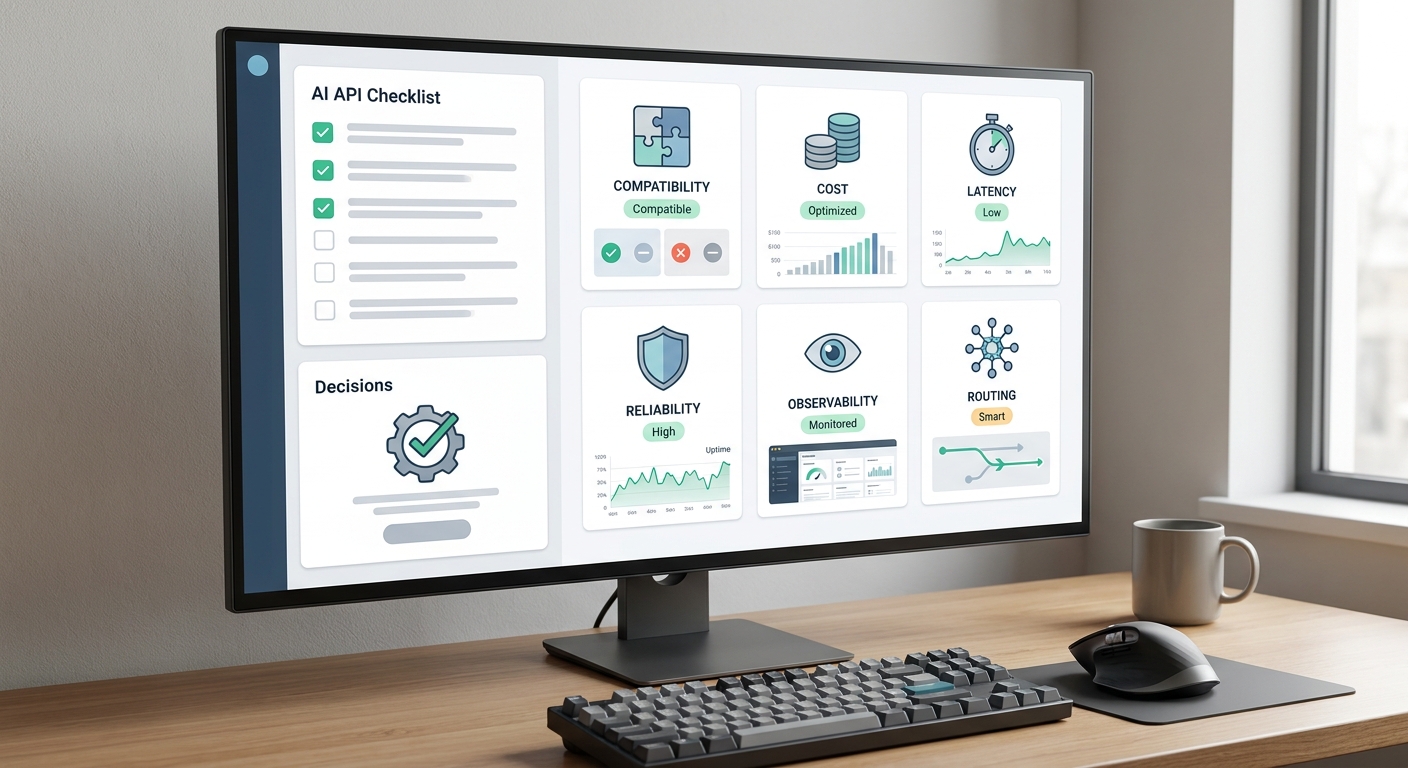
Before adopting a gateway, you should be able to answer these questions:
- Which applications and users may call it?
- Which models and providers are approved?
- Is the API compatible with the client features we use?
- What happens on a timeout, 429, or provider outage?
- Which model changes are allowed without application approval?
- How are prompts, responses, and credentials logged or retained?
- Can usage be attributed to a team, feature, or customer?
- Can billing records be reconciled with provider behavior?
- What latency does the gateway add?
- How do we exit or bypass the gateway if necessary?
If a vendor cannot answer these questions clearly, the longest model catalog in the market will not compensate for the operational uncertainty.
Where Flatkey fits
Flatkey is positioned as a unified access layer for developers: one API key, one bill, and an OpenAI-compatible endpoint for multiple text, image, and video models.
For a developer already using an OpenAI client, the intended onboarding pattern is straightforward:
- Create a Flatkey key.
- Change the client base URL to
https://router.flatkey.ai/v1. - Select an available model for the workload.
- Test compatibility, quality, limits, and failure behavior before moving production traffic.
Start with the current model and pricing catalog, then evaluate the exact routes your application needs. A beginner-friendly integration is still a production dependency, so the same security, testing, and observability standards should apply.
Frequently asked questions
Is an LLM gateway the same as an AI gateway?
Usually, yes. “AI gateway,” “GenAI gateway,” and “LLM gateway” are often used for the shared layer that controls application access to generative AI models. Product scope varies, so compare capabilities rather than labels.
Does an LLM gateway host the models?
Not necessarily. Some gateways only proxy or route requests to external providers. Others are part of an inference platform that also hosts models. Ask which entity serves each model and where requests are processed.
Does an LLM gateway make every model interchangeable?
No. A common API can normalize transport, but models still differ in quality, context limits, tools, structured output, safety behavior, latency, and price. Model changes require evaluation.
Can an LLM gateway prevent provider outages?
No. It can reduce the impact of some failures through routing and fallback, but only when an approved alternative is available and the gateway itself remains healthy.
Will a gateway reduce LLM costs?
It can improve cost visibility and enable routing, quotas, or caching, but savings are not automatic. Measure cost per accepted application outcome, including retries, fallback attempts, and quality failures.
Is an OpenAI-compatible gateway a drop-in replacement?
It can minimize code changes, but “compatible” is not the same as behaviorally identical. Test every feature and model your application depends on.
Conclusion
An LLM gateway is a shared access and control layer between applications and model providers. Its job is to make authentication, routing, fallback, limits, observability, and policy more consistent as a product’s AI usage grows.
For a single prototype, a direct provider integration may be enough. For a multi-model product or a team that needs reliable controls, the gateway becomes a practical way to stop rebuilding the same infrastructure in every service.
The right first step is not choosing the gateway with the most features. Define your application contract, test the failure paths, verify the data and billing model, and confirm that the gateway removes more complexity than it adds.