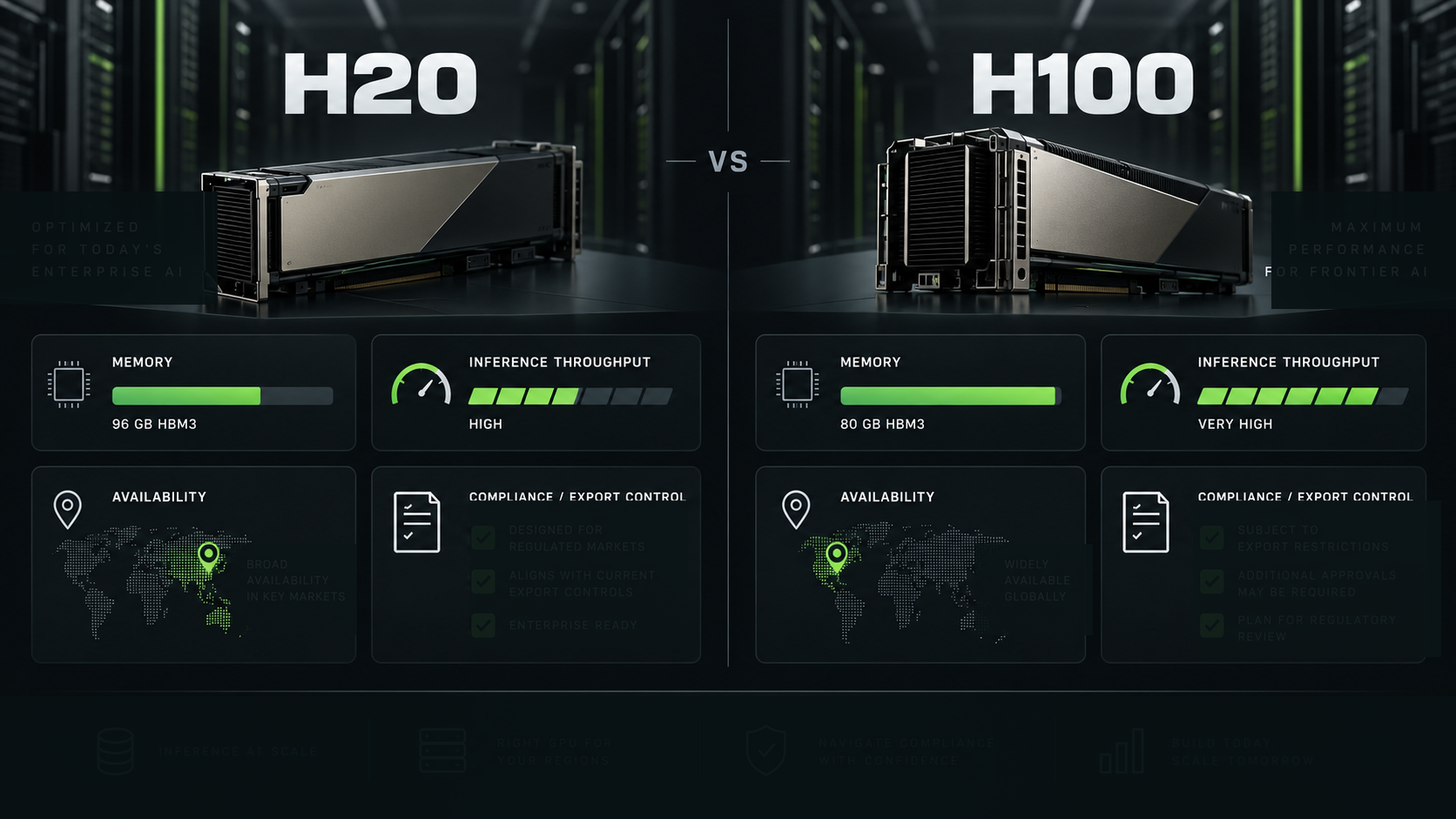
If you are comparing H20 vs H100, the short version is this: H100 is the stronger default when you can legally procure it, source it reliably, and keep it utilized. H20 only becomes attractive when export-control constraints, China-market availability, or local procurement rules make H100 impractical.
That makes NVIDIA H20 vs H100 less like a normal spec-table comparison and more like a compliance-aware capacity decision. H100 is the better-known Hopper GPU for training and inference. H20 is a constrained Hopper-family route that buyers evaluate when the procurement context is shaped by export licensing, PRC-market rules, and provider-specific SKU availability.
For enterprise AI teams, the useful h20 vs h100 question is not "which GPU is faster?" It is: which route can deliver accepted inference output at the lowest total risk after memory fit, queue time, compliance approval, and availability are included?
H20 vs H100: quick answer
Choose H100 when:
- You can procure or rent H100 capacity in the deployment region without export-control blockers.
- Your workload needs a mature Hopper baseline for training, fine-tuning, or high-throughput inference.
- You need strong software maturity, broad cloud support, and predictable benchmark references.
- Your model does not require a China-specific GPU procurement path.
Choose H20 only when:
- The deployment has to fit a restricted market or customer location where H100 is unavailable or difficult to license.
- The provider can show the exact H20 SKU, memory size, interconnect, driver image, and commercial terms.
- Compliance, customer location, resale, and end-use checks are already part of the buying process.
- You are benchmarking a real inference workload, not relying on third-party peak spec tables.
For most teams, H20 vs H100 is decided by availability and compliance before raw inference performance. If both are available on acceptable legal and commercial terms, H100 is the safer default.
NVIDIA H20 vs H100 specs that matter
The hard part of a NVIDIA H20 vs H100 specs comparison is that H100 has a public product page, while H20 public data is more fragmented. NVIDIA's public H100 page lists the H100 Tensor Core GPU as a Hopper data-center GPU with HBM memory options and published peak AI/HPC figures. NVIDIA AI Enterprise documentation publicly lists H20 variants in the Hopper vGPU support matrix, including H20 SXM5 profiles with 96GB and 141GB framebuffer entries.
Treat this table as a procurement checklist, not a final quote sheet.
| Spec area | H100 | H20 |
|---|---|---|
| Public positioning | Mainstream Hopper data-center GPU for AI, HPC, training, and inference | Hopper-family data-center GPU route evaluated in restricted procurement contexts |
| Public NVIDIA product page | Yes, H100 has a dedicated product page | No equivalent broad public H20 product page used for final buyer specs |
| Public memory signal | H100 SXM is commonly evaluated around 80GB HBM3; H100 NVL appears in LLM-serving contexts with larger memory | NVIDIA AI Enterprise vGPU docs list H20 SXM5 96GB and 141GB framebuffer profiles |
| Inference takeaway | Stronger default for raw performance, ecosystem support, training, and general inference | Evaluate only with exact SKU benchmarks; memory capacity can be attractive, but compliance and availability dominate |
| Procurement risk | Availability and cloud price vary, but the product is broadly supported | Export licensing, PRC-market rules, and provider-specific supply can determine whether a quote is usable |
The right way to read nvidia h20 vs h100 specs is to separate three layers:
- Confirmed public NVIDIA facts, such as H100 product documentation and NVIDIA AI Enterprise H20 support entries.
- Provider quote facts, such as exact H20 memory, interconnect, driver, node shape, region, and warranty.
- Your workload facts, such as tokens per second, time to first token, queue delay, failure rate, and cost per accepted output.
Do not merge those layers into one synthetic "winner" score.
NVIDIA H20 vs H100 performance: what changes in inference
For nvidia h20 vs h100 performance, benchmark inference in two phases: prefill and decode.
Prefill is sensitive to prompt length, batch strategy, attention implementation, and memory bandwidth. Decode is sensitive to concurrency, KV cache pressure, scheduler behavior, and serving-stack efficiency. A procurement team that only asks for peak tensor-core numbers will miss the real cost drivers.
Use H100 as the baseline when:
- You are serving 7B to 70B models with mature vLLM, TensorRT-LLM, SGLang, or managed Kubernetes images.
- You need a clean comparison against existing H100, H200, or B200 cloud capacity.
- You plan to reuse benchmark work from broader H100 fleets.
- Training or fine-tuning remains part of the workload mix.
Use H20 only after a live test when:
- H100 cannot be purchased, imported, deployed, or approved for the target environment.
- The H20 node has enough memory for the model and context length without forced quality compromises.
- The provider can prove stable drivers, container images, and support for your serving framework.
- Compliance review accepts the end user, end use, region, and transfer path.
In practice, H20 vs H100 is rarely a fair lab benchmark. It is usually "H100 in an unrestricted region" versus "H20 or another local option in a restricted procurement environment." That is why the benchmark must include legal availability and queue time, not just tokens per second.
Memory: when H20 can look interesting
Memory is the one area where H20 deserves careful verification. NVIDIA AI Enterprise docs list H20 SXM5 vGPU profiles with 96GB and 141GB framebuffer entries. Those public entries are useful because they show that H20 conversations should not assume a single fixed memory size.
For LLM inference, memory affects:
- Whether the model fits without aggressive quantization.
- How much KV cache can be held per replica.
- Whether longer context or higher concurrency is practical.
- Whether a workload needs tensor parallelism across multiple GPUs.
- How often production prompts trigger out-of-memory retries.
That means a larger-memory H20 configuration can sometimes be operationally interesting even if H100 is the stronger general accelerator. But a larger memory figure does not automatically make H20 faster or cheaper. The node still has to pass inference benchmarks, availability checks, compliance review, and total-cost modeling.
If the workload is memory-bound and H100 is available, compare H100 against H200 as well. The broader H200 vs H100 decision is often a cleaner memory upgrade path than relying on an H20 supply path built around export constraints.
Availability and compliance are first-order requirements
For NVIDIA H20 vs H100, compliance is not a footnote. NVIDIA's latest public SEC filing describes a series of export-control restrictions affecting A100, H100, H20, H200, B200, GB200-class products, and related systems. It states that H100 products were impacted by earlier China-related restrictions, that H20 exports to China and D:5 countries became subject to licensing requirements in April 2025, and that later licenses did not translate into unconstrained H20 sales because PRC-side restrictions also affected sales.
For buyers, that creates three practical rules:
- Do not treat H20 availability as a normal inventory question.
- Do not assume a license, quote, or marketplace listing is enough for your end customer.
- Do not model H20 capacity without a fallback route.
Ask vendors these questions before accepting an H20 quote:
- What exact H20 SKU is being quoted?
- Which country, region, data center, and legal entity will host the GPUs?
- Is the buyer, end user, workload, parent company, or customer location subject to any export-control review?
- Are resale, transfer, remote access, or cloud-service restrictions relevant?
- Is the GPU available now, reserved, pending license, pending import, or dependent on a future allocation?
- What happens if a license, tariff, inspection, or government rule changes before deployment?
- Can the same workload run on H100, H200, L40S, local alternatives, or a model API if H20 is delayed?
That checklist matters more than another synthetic nvidia h20 vs h100 performance comparison.
H20 vs H100 vs H200
Many teams search h20 vs h100 vs h200 because the real decision is not binary. Use this simpler framing:
| GPU path | Best default use | Main buyer question |
|---|---|---|
| H100 | Mature Hopper baseline for training, fine-tuning, and inference | Can we source enough capacity at a price and region we can use? |
| H200 | Memory-heavy inference, longer context, larger batch, memory-bound HPC | Does larger HBM3e memory reduce GPU count, sharding, or retries enough to justify the premium? |
| H20 | Restricted procurement contexts where H100/H200 are not straightforward | Can this exact H20 deployment pass compliance, availability, and workload benchmarks? |
If the team only needs model output, add a fourth path: a managed model API. Hardware ownership is justified when you need private weights, custom kernels, fixed dedicated capacity, or low-level serving control. If you do not, a model API baseline may beat GPU rental after idle time, queue management, driver work, and failed jobs are included.
Flatkey is useful for that baseline: one key, one balance, OpenAI-compatible routing, usage visibility, and access to many official model APIs without operating GPU servers. It does not replace H20 or H100 for teams that must own the hardware layer, but it gives procurement a realistic "do we need GPUs at all?" comparison.
Related planning guides:
- GPU rental prices explained
- GPU cloud hidden costs
- GPU cluster TCO
- GPU cloud vs model API
- Best GPU for LLM inference
- GPU cloud comparison 2026
Benchmark checklist for H20 vs H100 inference
Run the same workload on the exact deployment shape you plan to buy. For h20 vs h100 inference, use production-shaped prompts and measure accepted output.
| Metric | Why it matters |
|---|---|
| Time to first token | Captures user-visible latency and prefill behavior |
| Inter-token latency | Shows decode speed under real concurrency |
| Tokens per second per GPU | Useful, but incomplete without utilization and acceptance rate |
| Maximum stable concurrency | Exposes KV cache and scheduler pressure |
| Memory allocated and reserved | Shows whether the model actually fits with production prompts |
| Queue delay | Turns scarce capacity into real user latency |
| OOM and retry rate | Converts memory limits into cost and reliability impact |
| Cost per accepted output | Normalizes GPU-hour, utilization, failures, and engineering time |
| Compliance approval time | Critical for H20 and any restricted-region deployment |
| Fallback path | Protects launch dates when supply or licensing changes |
The important procurement metric is not "H20 vs H100 peak performance." It is the completed-workload cost after availability, failed attempts, queueing, compliance review, and operations are included.
Procurement decision matrix
Use this matrix in the buying meeting.
| If this is true | Prefer | Why |
|---|---|---|
| H100 is legally available, capacity is real, and price is acceptable | H100 | It is the cleaner Hopper baseline with broad support |
| The workload is memory-bound and H200 is available | Test H200 against H100 | The memory upgrade may be more direct than using H20 |
| The deployment must serve a restricted market where H100/H200 are blocked | Test H20 plus fallback | The compliance path may drive the hardware choice |
| The model is small or medium and traffic is bursty | Model API or serverless GPU | Avoid idle dedicated GPU capacity |
| The team needs custom kernels, private weights, and sustained utilization | Direct GPU capacity | Hardware control may justify the operational burden |
| Supply, licensing, or geopolitical rules may change before launch | Keep two routes alive | Do not commit a product roadmap to one restricted SKU |
Common mistakes in NVIDIA H20 vs H100 planning
The first mistake is treating H20 as "just a slower H100." The real difference is procurement context. If your legal, compliance, and availability constraints do not require H20, the H100 baseline is usually simpler.
The second mistake is copying public nvidia h20 vs h100 specs without checking the exact SKU. H20 references can vary by memory size and deployment shape. Your quote should state the GPU, memory, interconnect, node design, driver image, service terms, and region.
The third mistake is ignoring H200. If the problem is H100 memory pressure, H200 may be the more natural comparison. Use H20 when the procurement context forces the path, not simply because one memory number looks attractive.
The fourth mistake is forgetting the model API baseline. If the workload only needs reliable model outputs, not direct GPU control, the simpler route may be an API with usage tracking, fallback, and pay-per-call economics.
Final recommendation
For H20 vs H100, choose H100 when it is available and compliant for your deployment. It remains the safer Hopper baseline for most training, fine-tuning, and inference work.
Choose H20 only when the procurement environment makes it necessary and the exact H20 deployment passes three tests: the model fits, the inference benchmark works under production-shaped load, and compliance can approve the end user, region, and transfer path.
Then compare both against H200 and a model API baseline. The winning route is the one that produces accepted output reliably, not the one with the most interesting spec table.
FAQ
Is H20 better than H100 for inference?
Usually no. H100 is the stronger default when it is available and compliant. H20 can be relevant when H100 is blocked by procurement, export-control, or regional availability constraints. Benchmark the exact H20 SKU before assuming it is a good inference substitute.
What is the main NVIDIA H20 vs H100 difference?
The main difference is procurement context. H100 is a broadly supported Hopper data-center GPU. H20 is evaluated in restricted procurement contexts where export licensing, PRC-market rules, exact SKU availability, and compliance review can determine whether the capacity is usable.
How should I compare NVIDIA H20 vs H100 specs?
Compare exact SKU, memory, interconnect, node shape, driver image, region, warranty, and compliance status. Do not rely only on third-party spec tables. For production, validate with real prompts, target concurrency, and cost per accepted output.
Should I compare H20 vs H100 vs H200?
Yes. If the workload is memory-bound and H200 is available, H200 may be a cleaner upgrade from H100. H20 is more relevant when compliance or regional procurement blocks H100/H200.
When should I use a model API instead of H20 or H100?
Use a model API when you do not need custom kernels, private weights, or fixed dedicated capacity. For bursty product traffic, a model API can reduce idle GPU spend and operations work while preserving usage visibility and routing flexibility.