Grok 4.3 vs GPT-5: Benchmarks, Pricing, and When to Route Each is a legacy-model routing question in September 2026. OpenAI's current documentation describes GPT-5 as a previous reasoning model and recommends GPT-6 Astra for new work. xAI's release notes now list Grok 4.7 as the current frontier Grok route. Still, many teams need to compare Grok 4.3 and GPT-5 because older agents, dashboards, benchmarks, and procurement notes were built around those names.
The short answer: use Grok 4.3 first when a workload benefits from its lower listed output price, larger documented context window, and xAI-compatible reasoning controls. Use GPT-5 first when your application depends on OpenAI-native Responses API behavior, hosted tools, prompt caching, Chat Completions compatibility, or an existing OpenAI evaluation baseline. Use a router when the real problem is not model quality alone, but switching models without spreading keys, invoices, logs, and fallback code across every service.
Do not make this decision from public benchmark labels alone. Compare the models on your workload, then route by cost per accepted output.
Quick comparison: Grok 4.3 vs GPT-5
| Decision area | Grok 4.3 | GPT-5 | Routing note |
|---|---|---|---|
| Freshness status | Older Grok route; xAI release notes now highlight Grok 4.7 as current. | OpenAI docs call GPT-5 a previous model and recommend GPT-6 Astra. | Treat both as pinned legacy routes unless your product specifically needs them. |
| Model ID | grok-4.3, alias grok-4.3-latest. | gpt-5, default snapshot gpt-5-2025-08-07. | Pin the exact model ID or snapshot for repeatable tests. |
| Input and output | Text and image input; text output. | Text and image input; text output. | Both can fit vision-assisted text workflows; neither is a video route. |
| Context | xAI lists a 1M context window, with long-context pricing above 200k prompt tokens. | OpenAI lists a 400k context window, 272k maximum input tokens, and 128k maximum output tokens. | Test usable context, not just the headline context number. |
| Listed text price | $1.25 / $0.20 cached / $2.50 output per 1M tokens below 200k prompt tokens; $2.50 / $0.40 / $5.00 at 200k+ prompt tokens. | $1.25 / $0.125 cached / $10 output per 1M tokens. | Grok 4.3 is cheaper on listed output price; GPT-5 has cheaper cached input. |
| Batch | xAI marks Grok 4.3 batch-enabled with a 20% batch discount. | OpenAI marks GPT-5 Batch as supported. | Batch only helps when delayed response is acceptable. |
| Tooling | xAI docs list function calling, structured outputs, reasoning, and reasoning-effort options. | OpenAI docs list streaming, structured outputs, function calling, file search, image input, web search, prompt caching, and supported Responses API tools. | GPT-5 is usually stronger when OpenAI-hosted tools are part of the requirement. |
That is the practical benchmark starting point for Grok 4.3 vs GPT-5: Benchmarks, Pricing, and When to Route Each. The public specs suggest different cost and context shapes, but the production winner is the route that passes your validator at the lowest accepted-output cost.
Benchmark the route, not the model name
Public model leaderboards are useful for discovery, but they rarely answer the production question. A benchmark score does not tell you whether a route preserves your exact schema, recovers from rate limits, logs usage in the right place, or stays inside the budget after retries.
Build a small benchmark pack before moving traffic:
| Benchmark track | What to test | Why it changes the route |
|---|---|---|
| Reasoning and coding | 50-200 real prompts from agent, coding, analysis, or support workflows. | A general benchmark win may not transfer to your prompt shape. |
| Structured output | Required JSON schema, enum fields, nested objects, and invalid-input cases. | The model that writes better prose can still fail your parser. |
| Tool calls | Required tool, no-tool, wrong-tool, and tool-error cases. | One bad action can cost more than a higher token price. |
| Long context | p50, p90, and worst-case retrieval packs. | A large context window is not the same as reliable recall. |
| Cost | Input tokens, cached tokens, output tokens, batch mode, retries, and rejected outputs. | Listed token price is incomplete without acceptance rate. |
| Latency | Time to first token, full response latency, timeout rate, and queueing behavior. | User-facing agents may need a faster route even if it costs more. |
| Fallback | Provider errors, 429, model-not-found, schema failure, timeout, and degraded output. | A route without a rollback rule is not production-ready. |
The route metric should be:
cost_per_accepted_output =
  (input_cost + cached_input_cost + output_cost + tool_cost + retry_cost + fallback_cost)
  / accepted_outputs
Use Grok 4.3 when it wins that formula for a workload with enough quality and latency headroom. Use GPT-5 when OpenAI-native behavior reduces implementation risk, validation failures, or integration cost enough to offset its listed output price.
Pricing: where Grok 4.3 is cheaper and where GPT-5 can still win
For short-context text requests, xAI lists Grok 4.3 at $1.25 input, $0.20 cached input, and $2.50 output per 1M tokens. At 200k or more prompt tokens, xAI lists higher long-context pricing: $2.50 input, $0.40 cached input, and $5.00 output per 1M tokens. xAI also marks Grok 4.3 as batch-enabled with a 20% batch discount.
OpenAI lists GPT-5 at $1.25 input, $0.125 cached input, and $10 output per 1M tokens. That makes GPT-5 more expensive on listed output tokens, but cheaper on cached input than Grok 4.3's short-context cached-input row.
The price decision changes with workload shape:
| Workload shape | Price pressure | Likely first test |
|---|---|---|
| Short prompt, long generated answer | Output price dominates. | Test Grok 4.3 first, then compare output acceptance rate. |
| Repeated large system prompt or policy pack | Cached input matters. | Test both; GPT-5's cached input can matter if cache hit rate is high. |
| Long retrieval pack over 200k prompt tokens | Long-context pricing applies. | Test Grok 4.3 with long-context price and latency included. |
| OpenAI-hosted tools or Responses API workflow | Tool and integration behavior matters. | Test GPT-5 first because direct feature support may reduce app complexity. |
| Offline evaluations or backfills | Batch economics matter. | Test both batch paths if delayed completion is acceptable. |
If you only compare listed input price, Grok 4.3 vs GPT-5: Benchmarks, Pricing, and When to Route Each becomes a misleading spreadsheet exercise. Output length, retry rate, tool failures, and human review can erase the apparent savings.
When to route to Grok 4.3
Start with Grok 4.3 when the workload is cost-sensitive, output-heavy, and not tied to OpenAI-native tools.
Good candidates include:
- Internal analysis tasks where text output is long and validation is straightforward.
- Long-context summarization where the 1M documented context window is useful and the long-context price still beats alternatives.
- Evaluation jobs where batch is acceptable and a 20% batch discount applies.
- Workflows that use function calling or structured outputs, but do not require OpenAI-hosted tools.
- Model experiments where you want a Grok-family route for comparison against GPT, Claude, Gemini, DeepSeek, or Qwen.
Before launch, verify the exact Grok route in the provider console or gateway catalog. xAI has newer Grok routes, and Flatkey's current local knowledge confirms grok-4.2 rather than grok-4.3, so do not assume Grok 4.3 is available through a gateway until the live catalog says so.
When to route to GPT-5
Start with GPT-5 when the workload depends on OpenAI's API surface or when your evaluation history already uses GPT-5 as the baseline.
Good candidates include:
- Existing OpenAI Chat Completions or Responses API applications that should not be rewritten for a model experiment.
- Workloads using OpenAI-hosted tools such as web search, file search, image generation, code interpreter, or MCP through the Responses API.
- Products that rely on OpenAI prompt caching, structured outputs, streaming, or OpenAI-specific project controls.
- Regression tests where prior GPT-5 snapshots are part of the acceptance baseline.
- Migration audits where GPT-5 is the stable reference route before moving to a newer model.
The caveat is freshness. OpenAI's current docs call GPT-5 a previous model. If you are starting a new project, compare the current OpenAI-recommended model as well. GPT-5 is still worth testing when a pinned legacy route is the question, but it should not be treated as the default new-build answer without a current model review.
When a router is the better answer
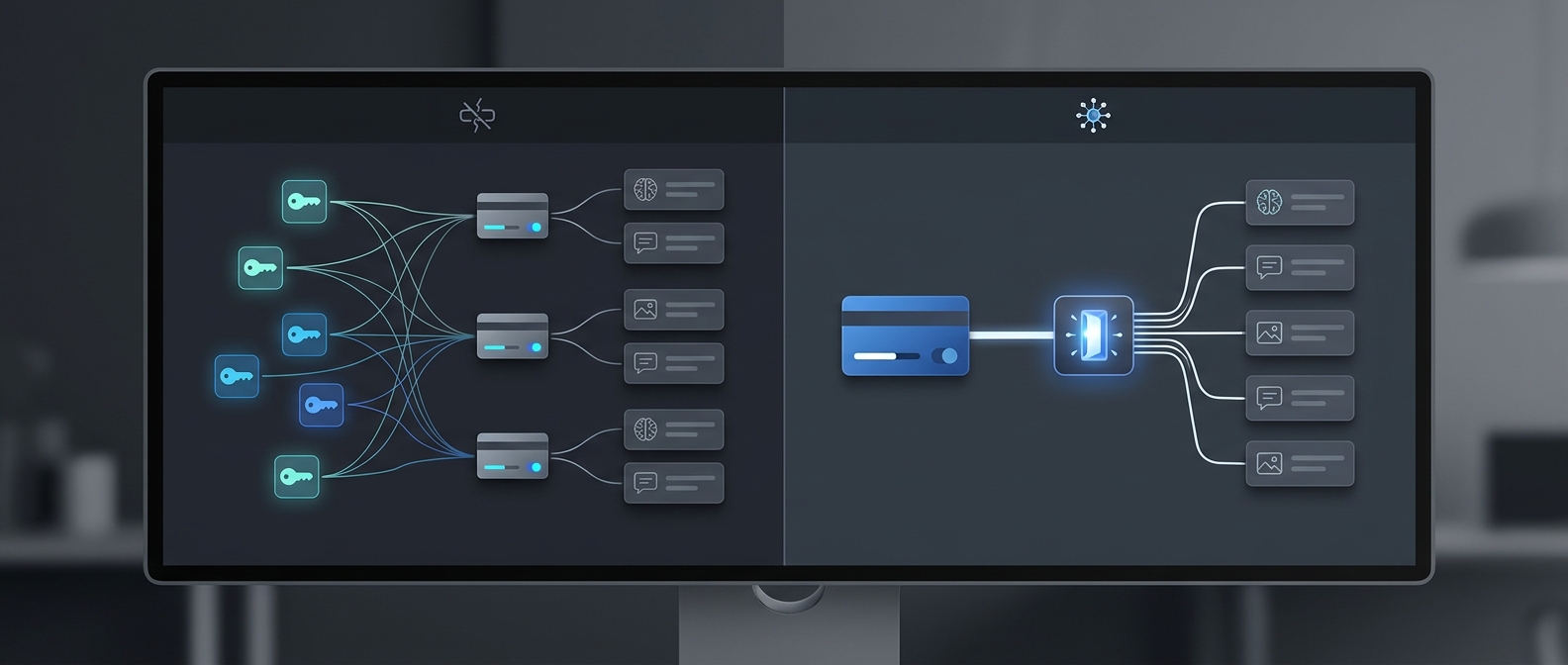
Teams often ask whether Grok 4.3 or GPT-5 is better, but the real bottleneck is operational sprawl:
- Separate provider keys.
- Separate dashboards and invoices.
- Separate rate-limit policies.
- Separate status checks.
- Separate usage exports.
- Different model IDs hardcoded across agents and services.
- No shared fallback rule when one provider degrades.
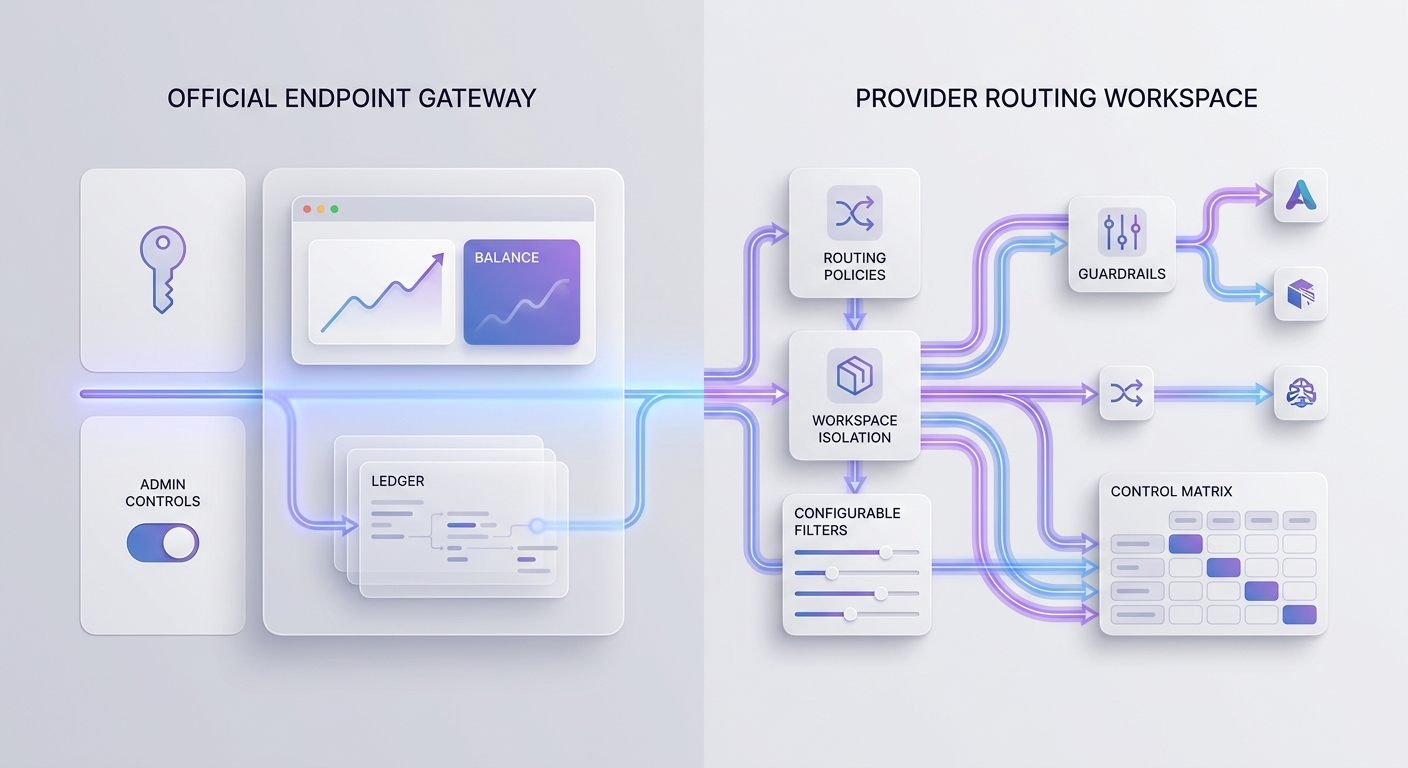
Flatkey's positioning is built for that layer: one key, one balance, one invoice, official model access, usage logs, and an OpenAI-compatible router. That does not mean every provider-native feature automatically works through every route. It means the team gets a single operating surface for comparing supported models and reviewing usage evidence.
Pair this article with the AI model catalog guide, the AI routing API metrics framework, and the Flatkey API quickstart before changing production traffic.
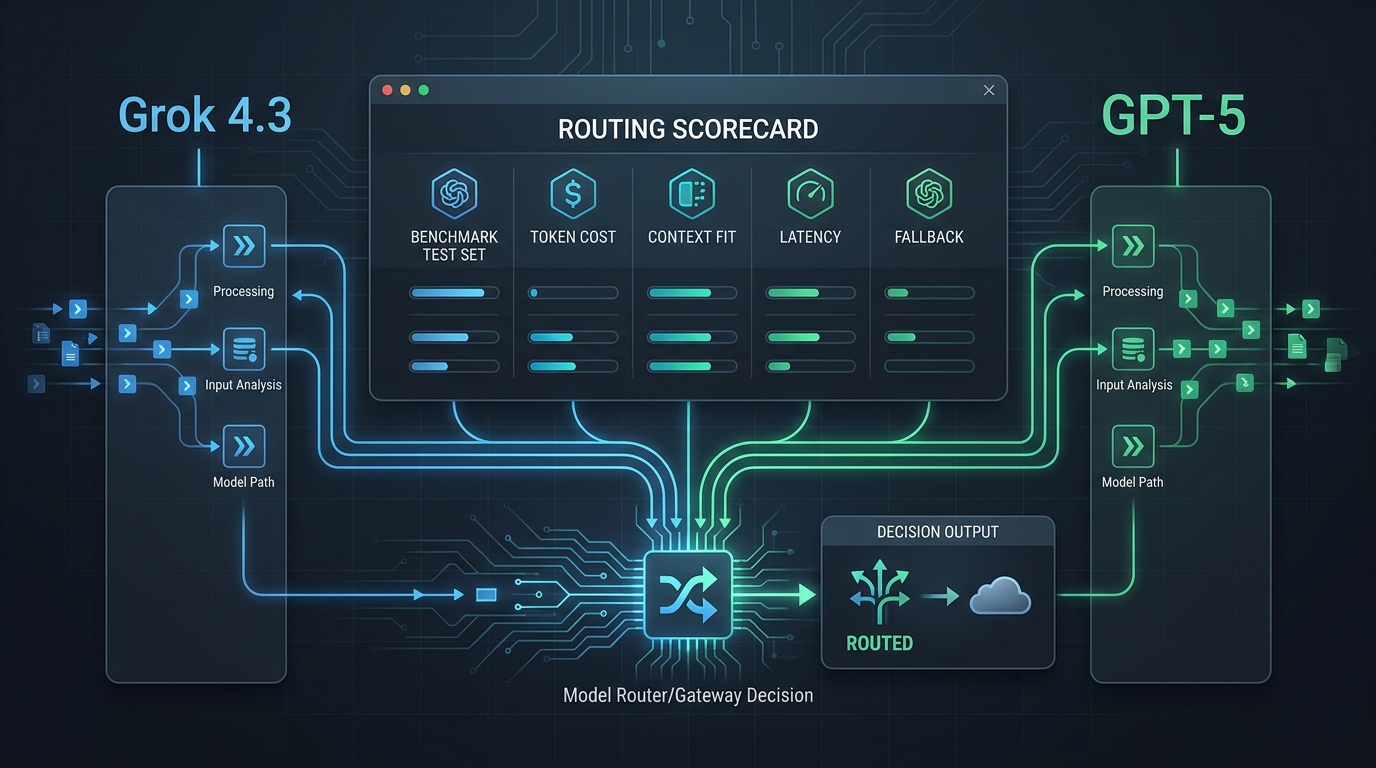
A practical routing scorecard
Use this scorecard for Grok 4.3 vs GPT-5: Benchmarks, Pricing, and When to Route Each. Score each route from 1 to 5 for the same workload.
| Criterion | Weight | Grok 4.3 | GPT-5 | Notes |
|---|---|---|---|---|
| Accepted output rate | 25% | Does the answer pass your validator or review rubric? | ||
| Cost per accepted output | 20% | Include prompt size, output length, cache, batch, tools, retries, and rejected outputs. | ||
| Tool and schema reliability | 15% | Count invalid JSON, wrong tool calls, missing fields, and unsupported parameters. | ||
| Context reliability | 15% | Test p50, p90, and worst-case retrieval packs. | ||
| Latency and timeouts | 10% | Measure TTFT, full completion time, and timeout rate. | ||
| Observability | 10% | Can engineering and finance inspect provider, model, tokens, cost, latency, and errors? | ||
| Fallback readiness | 5% | Is rollback tested and documented? |
Then write a route record:
route_review:
  workload: support_case_summarization
  candidates:
    - grok-4.3
    - gpt-5
  required_features:
    - structured_output
    - streaming
    - usage_readback
  launch_rule:
    minimum_score: 4
    accepted_output_rate: ">= target set by owner"
    rollback_path_required: true
  stop_conditions:
    - schema_failure_rate_above_threshold
    - timeout_rate_above_threshold
    - cost_per_accepted_output_above_budget
That policy is more useful than a screenshot of a leaderboard because it tells your application what to do when a model is unavailable, too slow, too expensive, or wrong for the task.
Preflight checklist before moving traffic
Run these checks before routing real users to either model:
1. Confirm model availability. Check the direct provider console and any gateway catalog on the same day you launch.
2. Pin model IDs. Use grok-4.3 or gpt-5-2025-08-07 intentionally; do not rely on an old alias without review.
3. Verify endpoint family. Confirm whether the workload uses xAI-compatible routes, OpenAI Chat Completions, OpenAI Responses, batch, or gateway endpoints.
4. Test required features. Tools, structured outputs, image input, streaming, caching, and batch should be tested only if your workload actually needs them.
5. Measure usable context. Check recall and citation discipline at realistic context sizes.
6. Calculate accepted-output cost. Include retries, rejected outputs, and human review.
7. Log every route. Record provider, model, request ID, input tokens, output tokens, cache tokens, latency, status, and cost.
8. Define fallback. Decide when to retry, switch routes, queue, degrade output, or fail closed.
9. Assign ownership. Give someone responsibility for keys, budget, quota, route health, and rollback.
10. Re-run after model changes. New Grok or GPT releases can make this comparison stale quickly.
Source checks to keep open
Use the live docs when finalizing a route:
- OpenAI GPT-5 model documentation for GPT-5 status, snapshot, context, endpoints, features, and pricing summary.
- OpenAI API pricing for current text-token price rows and regional/fast-mode caveats.
- xAI models and pricing for Grok 4.3 context, pricing, batch, modalities, and reasoning controls.
- xAI release notes for current Grok model freshness.
- Artificial Analysis model leaderboard for third-party model-discovery metrics, not as a replacement for your own route benchmarks.
The bottom line
For Grok 4.3 vs GPT-5: Benchmarks, Pricing, and When to Route Each, Grok 4.3 is usually the first pricing test when output tokens dominate and OpenAI-native tools are not required. GPT-5 is usually the first integration test when your application depends on OpenAI's Responses API, hosted tools, prompt caching, or an existing GPT-5 baseline.
For production, keep both decisions separate: first choose the model that passes your workload, then choose the route that gives you logs, cost control, fallback, and a clean rollback path. That is where a unified router earns its place.