Most RoCE vs InfiniBand arguments start in the wrong place. They compare protocol names instead of asking what the GPU cluster has to survive: tightly coupled training, sharded inference, shared storage traffic, mixed tenants, procurement limits, and the operations team that will tune the fabric after launch.
For multi-node GPU clusters, InfiniBand is usually the safer default when the workload is latency-sensitive, collective-heavy, and large enough to justify a purpose-built AI/HPC fabric. RoCE is usually the better starting point when the team already operates high-speed Ethernet, wants broader vendor choice, and can prove the lossless Ethernet design with real NCCL tests before committing.
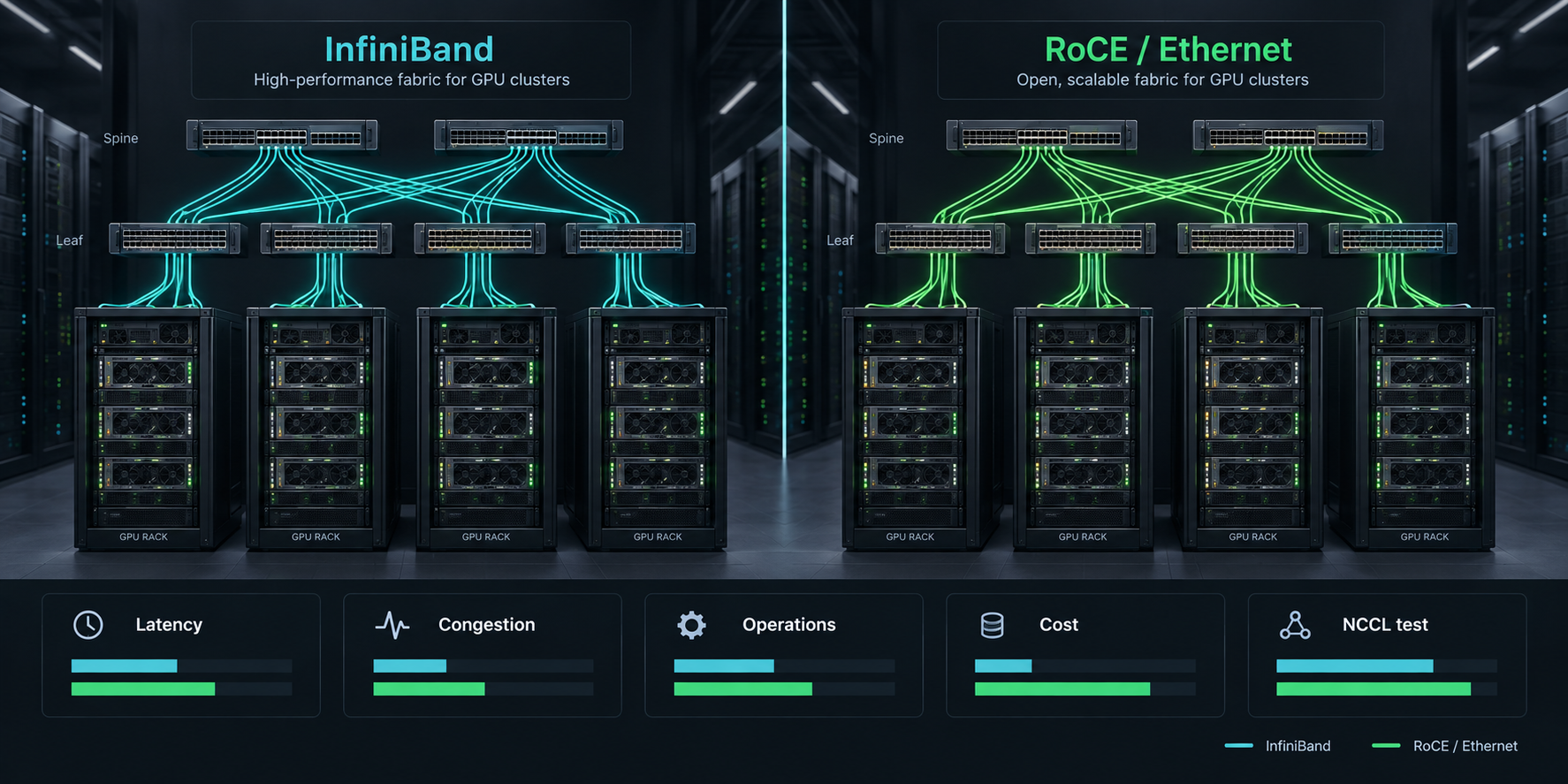
The hard part is that both can work, and both can fail. A well-built RoCE v2 fabric can run serious AI clusters. A poorly operated InfiniBand fabric can still miss the training window. This guide compares roce vs infiniband through latency, operations, and cost so platform teams can choose the fabric that matches the workload instead of the loudest vendor slide.
RoCE vs InfiniBand quick answer
Use this table as the first-pass decision filter.
| Situation | Usually start with | Why |
|---|---|---|
| Large distributed training with frequent all-reduce traffic | InfiniBand | It is a purpose-built switched fabric for low-latency, high-bandwidth HPC and AI communication. |
| GPU cluster quote already includes a validated NVIDIA Quantum or similar InfiniBand fabric | InfiniBand | The risk moves from design to acceptance testing and provider proof. |
| Enterprise network team already has deep Ethernet automation, monitoring, and procurement leverage | RoCE | RoCE keeps RDMA on Ethernet, but it needs disciplined congestion control and lossless behavior. |
| Mixed AI, storage, and ordinary data-center traffic on one operational model | RoCE or separate Ethernet plus dedicated AI fabric | RoCE can align with Ethernet operations, but shared fabrics must be designed carefully. |
| Small inference fleet, batch jobs, or workloads that do not scale across nodes | Neither fabric should drive the decision | GPU memory, utilization, queueing, and model/API alternatives matter more than the interconnect. |
| Procurement needs maximum vendor diversity and standard switch sourcing | RoCE | Ethernet sourcing can be broader, while InfiniBand clusters are more vertically specialized. |
| Team has no RDMA fabric experience and no benchmark window | Rent first, then decide | Do not sign a multi-node contract until NCCL, failure, and observability tests pass. |
The practical answer: choose InfiniBand when the application needs a dedicated AI/HPC fabric with the least protocol-level tuning risk. Choose RoCE when Ethernet standardization, procurement flexibility, or existing operations matter enough to justify the extra fabric engineering.
What InfiniBand means in a GPU cluster
InfiniBand is an industry-standard switched fabric architecture used to interconnect servers and storage. In GPU clusters, it is commonly associated with low latency, high bandwidth, RDMA, GPU Direct RDMA, adaptive routing, congestion management, and vendor-integrated AI/HPC tooling.
The important point is not just that InfiniBand is fast. The important point is that it is built as a fabric. Subnet management, fabric-level behavior, virtual lanes, quality of service, in-network acceleration, and switch/adapter integration are part of the design boundary. That matters when a training job spans hundreds or thousands of GPUs and every collective operation amplifies tail latency.
Cloud examples show why this fabric still dominates many large AI clusters. Azure's ND H100 v5 documentation describes eight H100 GPUs per VM, dedicated 400 Gbps NVIDIA Quantum-2 CX7 InfiniBand connectivity per GPU, 3.2 Tbps of interconnect bandwidth per VM, GPU Direct RDMA support, and NCCL-oriented scale-out clustering. Those details are not generic "fast network" language; they are cluster-shape facts that affect distributed training behavior.
For a buyer, the InfiniBand question should be specific:
- Which InfiniBand generation and switch platform is included?
- How many NICs or host channel adapters are attached per node?
- Is each GPU mapped to a dedicated network path or is traffic aggregated?
- Is GPUDirect RDMA enabled and tested?
- What placement guarantee keeps the nodes in the same fabric domain?
- What fabric management, telemetry, and remediation does the provider own?
If the seller only says "InfiniBand included," the quote is incomplete.
What RoCE means in a GPU cluster
RoCE means RDMA over Converged Ethernet. RoCE v2 carries RDMA over routable Ethernet/IP networks, which lets teams use Ethernet switching while still bypassing much of the CPU and kernel overhead associated with ordinary TCP paths.
That is the attraction. RoCE can let an AI platform team build RDMA-capable GPU clusters with Ethernet switches, Ethernet operational practices, and a wider procurement surface. For organizations that already run high-speed Ethernet at scale, RoCE can be easier to integrate into change control, telemetry, cabling, optics, and vendor management.
The tradeoff is that RoCE depends on the Ethernet fabric behaving well under load. GPU collectives create synchronized bursts. Checkpointing and storage traffic can collide with training traffic. Congestion can turn into latency spikes. Packet loss can be much more expensive for RDMA than for ordinary application traffic.
That is why RoCE cluster design usually includes:
- Priority Flow Control or another tested lossless strategy.
- Explicit Congestion Notification and congestion-control tuning.
- Data Center Bridging configuration across switches and NICs.
- Queue, class-of-service, and DSCP/priority mapping discipline.
- Per-priority counters for drops, pause frames, ECN marks, retransmits, and buffer pressure.
- Strict change control for firmware, switch OS, NIC drivers, MTU, and routing policy.
RoCE can be excellent, but "it is just Ethernet" is the wrong mental model. In a GPU cluster, RoCE is an engineered Ethernet fabric for RDMA traffic.
Latency: compare tail behavior, not only the median
In the roce vs infiniband decision, average latency is less useful than tail behavior under real collective load.
Distributed training often waits on the slowest participant. A small number of ranks with higher latency can hold back the whole step. For sharded inference, p95 and p99 network delay can show up as user-facing latency or lower batching efficiency. For storage-heavy training, checkpoint traffic can create bursts that are invisible in a clean microbenchmark.
Measure at four levels:
| Layer | What to measure | Why it matters |
|---|---|---|
| Link and fabric | Port errors, drops, ECN marks, pause frames, congestion events, route changes | Finds fabric health issues before blaming frameworks. |
| RDMA transport | Retransmits, completion latency, queue depth, NIC counters | Shows whether RDMA is stable under pressure. |
| NCCL collectives | all-reduce bandwidth, bus bandwidth, min/avg/max latency, per-iteration timing | Matches AI training communication patterns. |
| Application | step time, tokens/sec, request latency, checkpoint duration, failure recovery | Tells finance and product teams whether the fabric helps useful work. |
InfiniBand often has an advantage because many cluster designs are built and validated around collective-heavy workloads from the start. RoCE can close the gap when the Ethernet fabric is tuned, isolated, and proven. The test is not whether RoCE v2 can theoretically do RDMA. The test is whether this exact switch/NIC/cabling/driver/topology combination holds p95 and p99 behavior during the workload you will actually run.
Operations: InfiniBand is specialized, RoCE is integrated
Operations is where the roce vs infiniband comparison becomes less obvious.
InfiniBand gives platform teams a specialized fabric with mature AI/HPC assumptions. That can reduce tuning ambiguity. The downside is that the team needs InfiniBand-specific skills, fabric management tools, subnet-manager knowledge, and support paths. If the cluster is rented from a specialist provider or hyperscaler, much of that may be hidden behind the provider's service boundary. If the cluster is owned or colocated, the skill gap becomes real.
RoCE fits more naturally into many enterprise network organizations because it runs over Ethernet. Procurement, cabling, switch operations, monitoring, and change-management patterns may already exist. The risk is that ordinary Ethernet operations are not enough. RDMA traffic needs consistent end-to-end treatment. A routine switch policy change can break the fabric if PFC, ECN, queue mapping, MTU, hashing, or congestion controls drift.
Use this operating model checklist:
| Operating question | InfiniBand answer to demand | RoCE answer to demand |
|---|---|---|
| Who owns fabric design? | AI/HPC networking specialist or provider | Network team plus AI platform owner |
| Who validates topology? | Provider fabric report, subnet/fabric tools, NCCL tests | Switch/NIC config audit, telemetry, NCCL tests |
| What breaks most often? | Placement mismatch, firmware/driver drift, failed links, unsupported topology assumptions | Lossless config drift, congestion misconfiguration, shared-traffic interference, queue mapping errors |
| What must be monitored? | Link state, port errors, congestion, route health, GPU/NIC affinity, NCCL performance | Drops, pause/ECN behavior, PFC storms, retransmits, buffer pressure, NCCL performance |
| What skill is scarce? | InfiniBand fabric specialists | Engineers who understand both Ethernet operations and RDMA-sensitive AI traffic |
If your team already has strong Ethernet automation but no InfiniBand skills, RoCE may be operationally attractive. If your team wants the provider to own the AI fabric as a tested appliance-like layer, InfiniBand may lower delivery risk.
Cost: include fabric risk, not just switch price
RoCE is often framed as cheaper because Ethernet equipment can be broadly sourced and reused. InfiniBand is often framed as expensive because it is a specialized AI/HPC fabric. Those statements can be true and still lead to bad decisions.
For GPU clusters, the fabric cost is not just switch, NIC, optics, and cable price. It is the cost of useful work completed.
fabric_adjusted_gpu_cluster_cost =
  compute_capacity
  + network_adapters
  + switches
  + optics_and_cables
  + rack_power_and_space
  + storage_and_data_path
  + fabric_operations
  + failed_job_and_retry_waste
  + queue_delay_and_idle_gpu_time
  + support_and_escalation
Then normalize:
cost_per_accepted_training_run =
  fabric_adjusted_gpu_cluster_cost
  / accepted_training_runs_completed_on_time
or:
cost_per_accepted_output =
  fabric_adjusted_gpu_cluster_cost
  / accepted_inference_outputs_after_retries
RoCE can win when Ethernet sourcing, reuse, and operations reduce total cost without hurting job completion. InfiniBand can win when higher fabric cost avoids training delays, failed multi-node jobs, and weeks of tuning. A cheaper fabric that leaves expensive GPUs idle is not cheaper.
Tie the roce networking vs infiniband cost decision to three numbers:
- Useful GPU utilization after network stalls and failed jobs.
- Benchmark acceptance rate across the exact node count.
- Operations hours required to keep the fabric stable.
If those numbers are missing, the cost model is not ready.
Workload fit: training, inference, storage, and mixed clusters
The right roce vs infiniband comparison depends on the traffic pattern.
Distributed training
Distributed training is the strongest InfiniBand case. Large all-reduce and reduce-scatter operations, synchronized steps, and scale-out jobs punish jitter. If the job spans many nodes and the business cares about completing training windows on schedule, InfiniBand is often the lower-risk path.
RoCE can still be a valid choice, especially in organizations with strong Ethernet/RDMA practice. But it must be proven with the same model family, framework, precision, batch size, node count, and checkpoint pattern you plan to run.
Sharded and distributed inference
Inference is more mixed. If a model is split across GPUs or nodes, network latency matters. If the fleet is mostly independent replicas, GPU memory, batching, cache behavior, queueing, and autoscaling may matter more than the fabric.
For many production inference teams, the better first question is not InfiniBand vs RoCE. It is whether the workload needs direct GPU control at all. If a managed model API can hit the latency, quality, privacy, and cost target, compare that path before signing a cluster contract.
Related reading: Flatkey's guides on GPU cloud vs model API, best GPU for LLM inference, and vLLM deployment cover the serving-side cost boundary.
Storage-heavy workloads
Training runs that stage large datasets, write frequent checkpoints, or reload model weights can become storage-network problems. A fast GPU fabric will not fix slow dataset staging or a shared filesystem that saturates during checkpoints.
For both InfiniBand and RoCE, include storage in the benchmark:
- Dataset load time.
- Checkpoint write and restore time.
- Local NVMe spill behavior.
- Object storage path and egress.
- Shared filesystem contention.
- Recovery time after a node failure.
Mixed-tenant GPU clusters
Multi-tenant clusters need stronger isolation than a benchmark lab. Noisy neighbors, background storage jobs, user containers, and maintenance windows can change fabric behavior. InfiniBand and RoCE both need admission control, quotas, telemetry, and incident response. RoCE needs extra care when RDMA traffic shares operational boundaries with ordinary Ethernet traffic.
Acceptance test for either fabric
Do not accept a vendor's infiniband vs roce comparison as proof. Run the acceptance test on the exact cluster shape you will buy or rent.
1. Lock the test bill of materials
Record:
- GPU model, memory size, and GPUs per node.
- CPU, RAM, PCIe/SXM layout, NUMA, and local NVMe.
- NIC/HCA model, speed, firmware, and driver.
- Switch model, switch OS, and fabric generation.
- Optics, cable type, and link speed.
- MTU and queue configuration.
- Placement group, rack, zone, region, and node count.
- CUDA, NCCL, MPI, framework, container image, and kernel version.
If one of those changes after the benchmark, rerun the test.
2. Run NCCL tests across every node
NVIDIA's nccl-tests project is the practical baseline because it checks both performance and correctness of NCCL operations and supports multi-node MPI runs.
Example acceptance shape:
# Build with MPI support.
make MPI=1 MPI_HOME=/path/to/mpi CUDA_HOME=/usr/local/cuda NCCL_HOME=/usr

# Example: 8 nodes, 8 GPUs per node, 64 ranks total.
mpirun -np 64 -N 8 ./build/all_reduce_perf -b 8 -e 8G -f 2 -g 1 \
  -n 50 -w 10 -a 2 -S 1 -J all-reduce-64gpu.json
Track:
- Algorithmic bandwidth and bus bandwidth.
- Min, average, and max latency.
- Per-iteration p95/p99 if enabled.
- Rank outliers.
- Failed correctness checks.
- Variation across repeated runs.
- Performance after a node reboot, driver restart, or switch maintenance event.
3. Replay the actual workload
Microbenchmarks are necessary, not sufficient. Replay one real training or inference job:
- Same model family and sequence length.
- Same framework and distributed strategy.
- Same precision, quantization, and batch size.
- Same checkpoint cadence.
- Same data path.
- Same autoscaling or job scheduler policy.
Then compare step time, tokens/sec, queue delay, checkpoint duration, failure recovery, and cost per accepted output.
4. Inject failure and congestion
A fabric that passes only on a clean day is not production-ready.
Test:
- One node removed from the job.
- One link down or degraded.
- Storage checkpoint burst during training.
- Background inference load during a training job.
- Switch/NIC counter thresholds and alerts.
- Provider support response for a fabric incident.
The winner of roce vs infiniband is the fabric that keeps useful work predictable after these tests, not the fabric with the better theoretical line rate.
Procurement questions for InfiniBand suppliers
Ask these before signing:
- What exact InfiniBand generation, switch model, adapter model, and link speed are included?
- Is GPUDirect RDMA enabled and supported for the GPU, driver, and framework stack?
- Are all nodes guaranteed in one fabric domain or placement group?
- What NCCL all-reduce results can you provide for the same GPU count?
- Who owns subnet management, firmware updates, congestion tuning, and incident response?
- Are SHARP, adaptive routing, quality of service, or in-network features enabled and supported?
- What telemetry can the customer see: port counters, congestion events, HCA errors, route changes, and job-level fabric metrics?
- What happens financially if the quoted fabric cannot pass the agreed benchmark?
- Can the cluster expand without changing topology or oversubscription assumptions?
- What maintenance windows, spare parts, and replacement timelines apply?
Procurement questions for RoCE suppliers
Ask these before signing:
- Is the fabric RoCE v2, and is it routable across the needed topology?
- Which switch and NIC models are validated for this exact GPU cluster shape?
- What PFC, ECN, DSCP, queue, MTU, and congestion-control settings are required?
- Is RDMA traffic isolated from ordinary Ethernet traffic or shared?
- What counters prove the lossless configuration is healthy under NCCL load?
- How are PFC storms, pause-frame buildup, ECN misconfiguration, and buffer pressure detected?
- Who owns switch configuration drift and firmware compatibility?
- What NCCL results exist for the same node count and workload class?
- Can the network team reproduce the configuration from code?
- What support boundary applies when the issue spans GPU driver, NIC firmware, switch policy, and application framework?
Decision matrix
Use this matrix after the benchmark, not before it.
| Criterion | Favor InfiniBand when... | Favor RoCE when... |
|---|---|---|
| Latency sensitivity | Training step time is dominated by collectives or p99 jitter hurts inference | Tests show stable p95/p99 under real load |
| Scale | The cluster spans many nodes and needs predictable placement | The cluster is moderate scale or Ethernet fabric is already proven at similar scale |
| Operations | Provider or team has InfiniBand fabric expertise | Network team has strong Ethernet automation and RDMA-specific practice |
| Procurement | You can buy or rent a validated AI/HPC fabric | You need broader switch sourcing or Ethernet standardization |
| Cost | Avoiding failed jobs and tuning delay justifies specialized fabric cost | Ethernet savings survive after tuning, telemetry, and retry costs |
| Flexibility | Cluster is dedicated to AI/HPC workloads | Fabric must align with broader data-center networking practices |
| Risk | Project deadline is tight and fabric ambiguity is expensive | Team has time and skill to validate and operate lossless Ethernet |
If the matrix produces a tie, rent or benchmark both. Multi-node GPU networking is too expensive to decide from a protocol summary alone.
Copyable RoCE vs InfiniBand worksheet
Use this table in the procurement doc.
| Field | InfiniBand option | RoCE option |
|---|---|---|
| GPU model and node count | ||
| Fabric generation and link speed | ||
| NIC/HCA per node | ||
| Switch model and port count | ||
| Oversubscription ratio | ||
| Placement guarantee | ||
| GPUDirect RDMA support | ||
| NCCL all-reduce bus bandwidth | ||
| NCCL p95/p99 or max latency | ||
| Training step time | ||
| Checkpoint write/restore time | ||
| Fabric drops/congestion counters | ||
| Operations owner | ||
| Support SLA | ||
| Monthly fabric cost | ||
| Idle/retry waste estimate | ||
| Cost per accepted output | ||
| Expansion path | ||
| Exit risk |
The most important rows are not the listed fabric price. They are benchmark result, operations owner, idle/retry waste, and expansion path.
When a model API is the better answer
Some teams researching roce vs infiniband are not actually ready to buy a network fabric. They are trying to lower AI output cost, remove queue delay, or ship a product feature.
If the workload does not require custom weights, direct GPU scheduling, custom kernels, strict placement, or hardware-level isolation, compare a managed model API first. Flatkey gives teams one key, one balance, and one usage ledger across official models and AI tools, which can be simpler than owning a GPU cluster while the product is still changing.
Use the fabric route when you need hardware control. Use a model/API route when the business metric is accepted outputs, not network ownership.
Related Flatkey guides:
- GPU cluster TCO for cloud rental, colocation, and on-premises math.
- GPU cluster rental for provider evaluation and capacity contracts.
- GPU rental prices for on-demand, spot, reserved, and hidden costs.
- Serverless GPU vs dedicated GPU for cold starts, idle capacity, and control.
Official source checklist
Use official pages as source checks, then validate the exact cluster you are buying.
| Source | What to verify |
|---|---|
| InfiniBand Trade Association: About InfiniBand | InfiniBand as an industry-standard switched fabric for server and storage connectivity. |
| NVIDIA Quantum InfiniBand platform | InfiniBand switch, adapter, fabric-management, SHARP, and AI/HPC fabric positioning. |
| NVIDIA Spectrum-X Ethernet | Ethernet/RoCE-oriented AI networking positioning and congestion-management claims to validate. |
| Azure ND H100 v5 sizes | Example of cloud GPU clusters using dedicated per-GPU InfiniBand and GPUDirect RDMA. |
| AWS Elastic Fabric Adapter | Cloud alternative using OS-bypass, congestion control, Libfabric, NCCL, and GPUDirect RDMA support on selected instances. |
| Google Cloud GPUDirect documentation | Cloud GPU networking setup requirements for GPUDirect-enabled A3-family instances. |
| NVIDIA nccl-tests | Repeatable collective benchmark and correctness tests for the exact cluster shape. |
Do not treat these pages as a substitute for acceptance tests. Treat them as the minimum source list for a serious buyer review.
Frequently asked questions
Is InfiniBand always faster than RoCE?
No. InfiniBand is usually the lower-risk choice for purpose-built, latency-sensitive AI/HPC fabrics, but a well-designed RoCE v2 fabric can perform well. Compare the exact cluster using NCCL and application tests.
Is RoCE cheaper than InfiniBand?
RoCE can be cheaper when Ethernet sourcing, reuse, and existing operations reduce total cost. It is not cheaper if lossless Ethernet tuning, congestion incidents, failed jobs, or idle GPUs erase the savings.
What is the difference between RoCE v2 vs InfiniBand?
RoCE v2 carries RDMA over routable Ethernet/IP networks. InfiniBand is a dedicated switched fabric architecture commonly used for HPC and AI clusters. The operational difference is that RoCE inherits Ethernet design flexibility and tuning burden, while InfiniBand is more specialized around the fabric.
Which is better for distributed training?
For large, tightly coupled distributed training, InfiniBand is often the safer default. RoCE can be a strong option when the Ethernet fabric is isolated, tuned, monitored, and proven with the same training workload.
Which is better for inference?
It depends on the inference architecture. Sharded models and cross-node serving care about fabric latency. Independent replicas may care more about GPU memory, batching, cache hit rate, autoscaling, and cost per accepted output.
What should I benchmark before choosing?
Run NCCL all-reduce across the target node count, replay the real workload, include storage/checkpoint traffic, inject failures or congestion, and record fabric counters. The roce vs infiniband decision should follow those results.
Final recommendation
Do not choose roce vs infiniband from a generic benchmark. Choose from the workload, the operating model, and the acceptance test.
Pick InfiniBand when the cluster is a dedicated AI/HPC fabric, distributed training is the critical path, and missed training windows are expensive. Pick RoCE when Ethernet standardization, procurement flexibility, and existing operations matter, and the team can prove lossless RDMA behavior under real GPU workloads.
If the application only needs AI outputs, not direct GPU fabric control, compare Flatkey-managed model/API routes before renting or buying the cluster. The cheapest network is the one you do not have to operate.