NVIDIA L40S vs H100 for AI Inference: Throughput per Dollar
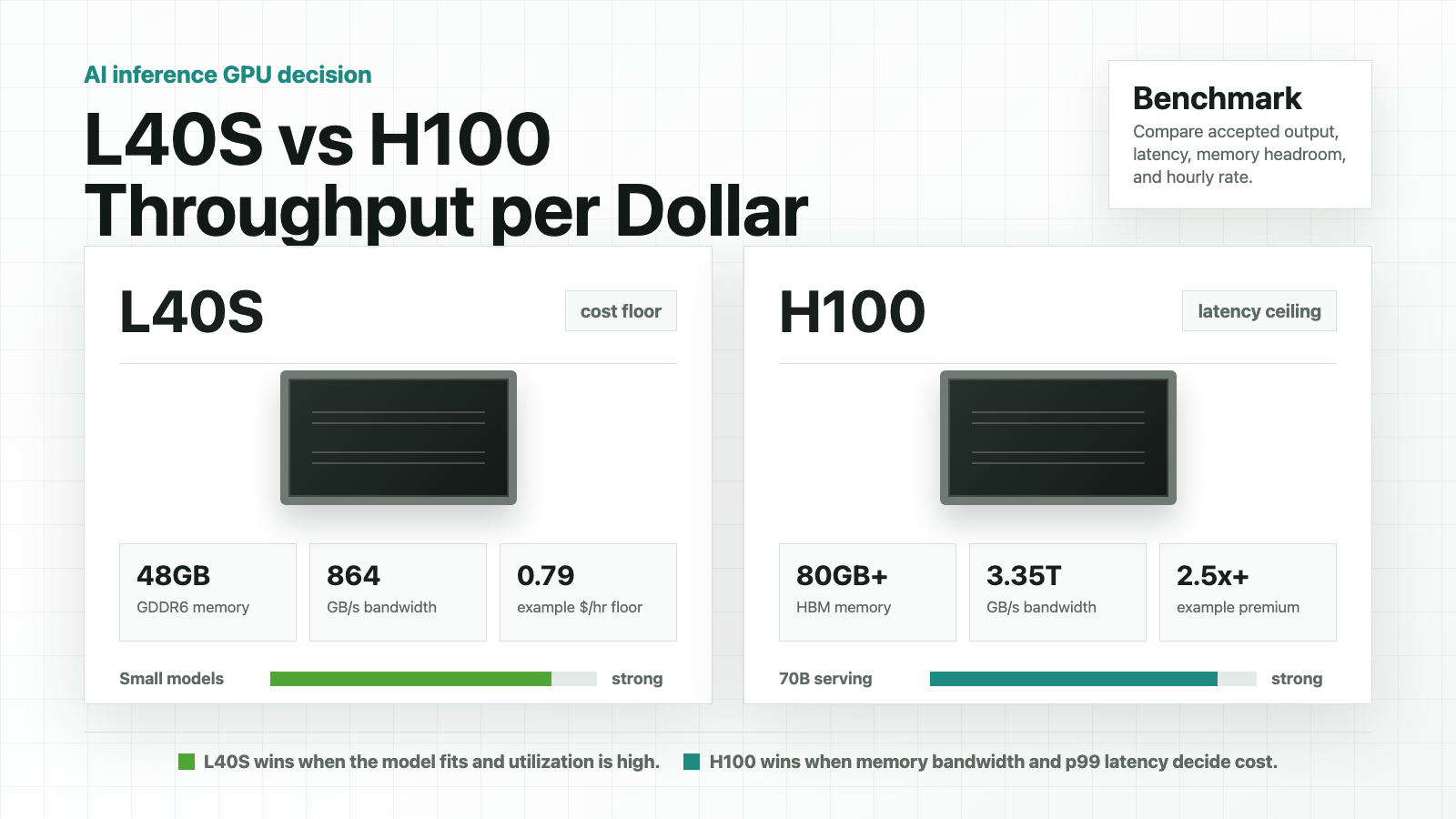
The short answer for L40S vs H100 is not "H100 is faster, so buy H100." H100 is the stronger AI accelerator. L40S is often the better throughput-per-dollar candidate when the model fits in 48 GB, latency targets are moderate, and the provider quote is much lower.
For AI inference teams, the useful question is:
Does H100 deliver enough accepted output per hour to overcome its price premium over L40S for this exact model, prompt mix, serving stack, and SLA?
This NVIDIA L40S vs H100 comparison focuses on inference economics: memory fit, prefill, decode, batching, latency, utilization, and cloud GPU pricing. Prices move often, so treat the public price rows below as examples checked on October 12, 2026, then rerun the same worksheet against your current provider quotes.
L40S vs H100: quick decision table
| Inference workload | Usually start with | Why |
|---|---|---|
| 7B to 13B chat, internal copilots, lightweight RAG | L40S | Lower hourly cost can beat H100 when latency is acceptable and the model fits with KV cache headroom. |
| 30B-class models with moderate context | Benchmark both | L40S can win on cost; H100 can win when tail latency or memory bandwidth dominates. |
| 70B-class serving with strict latency | H100, H100 NVL, H200, or multi-GPU | H100 has much higher HBM bandwidth, larger memory on common SXM/NVL configurations, NVLink options, and stronger production serving support. |
| Batch inference with relaxed SLA | L40S first | Queue-friendly workloads can use cheaper capacity if utilization stays high. |
| Long-context RAG | H100 first | Prefill and KV-cache pressure usually reward HBM bandwidth and more memory. |
| Multi-tenant infrastructure | H100 if MIG matters | NVIDIA lists MIG support on H100; NVIDIA lists no MIG support on L40S. |
| Multimodal workloads with rendering, image/video, or graphics | L40S can be attractive | L40S is positioned by NVIDIA as a universal GPU for AI, graphics, rendering, and media acceleration. |
| High-concurrency customer-facing LLM API | H100 first | Tail latency, batching headroom, and software optimization often justify the premium. |
The practical rule: choose L40S when the cost floor matters and the workload fits cleanly. Choose H100 when latency, bandwidth, concurrency, sharding simplicity, or multi-GPU topology affects revenue or reliability.
Core spec differences
NVIDIA positions L40S as an Ada Lovelace data center GPU for generative AI, LLM inference and training, 3D graphics, rendering, and video. NVIDIA lists L40S with 48 GB of GDDR6 ECC memory, 864 GB/s of memory bandwidth, PCIe Gen4 x16, 350W max power, fourth-generation Tensor Cores, FP8 support, no MIG, and no NVLink support. NVIDIA positions H100 as a Hopper data center GPU for large-scale AI and HPC, with a dedicated Transformer Engine, fourth-generation NVLink, MIG, and HBM memory. NVIDIA's H100 product specifications list H100 SXM with 80 GB memory, 3.35 TB/s bandwidth, up to 7 MIG instances, 900 GB/s NVLink, and up to 700W configurable TDP; H100 NVL is listed with 94 GB per GPU, 3.9 TB/s bandwidth, and 600 GB/s NVLink. Sources: NVIDIA L40S and NVIDIA H100.
| Area | NVIDIA L40S | NVIDIA H100 SXM / H100 NVL | Buyer implication |
|---|---|---|---|
| Architecture | Ada Lovelace | Hopper | H100 is the flagship AI/HPC accelerator generation; L40S is a universal data center GPU. |
| Memory | 48 GB GDDR6 ECC | 80 GB HBM on H100 SXM; 94 GB HBM on H100 NVL | H100 has more room for larger models, longer context, and higher concurrency. |
| Memory bandwidth | 864 GB/s | 3.35 TB/s on H100 SXM; 3.9 TB/s on H100 NVL | H100 has a large advantage for bandwidth-bound prefill, decode, and KV-cache movement. |
| FP8 Tensor Core peak with sparsity | 1,466 TFLOPS | 3,958 TFLOPS on H100 SXM; 3,341 TFLOPS on H100 NVL | H100 has a much higher ceiling when the serving stack and accuracy policy can use FP8. |
| Interconnect | PCIe Gen4 x16; no NVLink | PCIe Gen5 plus NVLink on SXM/NVL configurations | H100 is stronger for scale-up and multi-GPU inference. |
| MIG | No | Up to 7 MIG instances | H100 is better when you need hardware partitioning for utilization or isolation. |
| Max power | 350W | Up to 700W on SXM; 350-400W on NVL | L40S may be easier to place in lower-power servers; H100 can finish more work per GPU. |
These specs explain why a generic L40S vs H100 benchmark can mislead procurement. H100 has the technical ceiling. L40S may still win when H100 is priced several times higher and the application does not use the full ceiling.
Throughput per dollar formula
For inference, compare accepted output, not raw theoretical FLOPS:
accepted_output_per_dollar =
  accepted output tokens or accepted responses per hour
  / effective hourly cost
Then include hidden cost:
effective_hourly_cost =
  GPU hourly rate
  + storage and snapshot cost
  + network and egress cost
  + idle capacity cost
  + retry and failed request cost
  + orchestration or managed-service overhead
The break-even rule is simple:
H100 required speedup over L40S =
  H100 effective hourly cost / L40S effective hourly cost
If H100 costs 3x as much as L40S, H100 must deliver more than 3x accepted output per hour to win on throughput per dollar before you count business value from lower latency. If H100 costs 1.8x as much, the bar is lower. If L40S causes OOM retries, low batch size, or missed p99 latency, the cheaper hourly price is not the cheaper service.
For a broader hidden-cost worksheet, see Flatkey's guide to GPU rental prices.
Public price examples checked October 12, 2026
Public GPU prices are not permanent rate cards. They vary by provider, region, availability, security tier, reservation, billing unit, and whether the capacity is marketplace, dedicated, on-demand, or committed.
| Provider page | L40S example | H100 example | What it shows |
|---|---|---|---|
| RunPod pricing | L40S: Community Cloud $0.79/hr, Secure Cloud $1.09/hr | H100 PCIe: Community Cloud $1.99/hr, Secure Cloud $2.89/hr; H100 SXM: Community Cloud $2.69/hr, Secure Cloud $3.49/hr; H100 NVL: Community Cloud $2.59/hr, Secure Cloud $3.19/hr | Direct quote rows can make H100 about 2.5x to 3.4x the L40S hourly rate before hidden costs. |
| Lambda pricing | No direct L40S row found in the public pricing HTML checked for this article | H100 rows are exposed across self-serve and cluster configurations, including H100 SXM and H100 PCIe examples | Provider coverage differs; do not assume every GPU shortlist is available from every vendor. |
With RunPod Community Cloud examples, the break-even speedup looks like this:
| Comparison | H100 price | L40S price | H100 price premium | Break-even meaning |
|---|---|---|---|---|
| H100 PCIe vs L40S | $1.99/hr | $0.79/hr | 2.52x | H100 PCIe needs more than 2.52x accepted output per hour to win on raw GPU rent. |
| H100 SXM vs L40S | $2.69/hr | $0.79/hr | 3.41x | H100 SXM needs a large throughput gain or a latency/business reason to justify the premium. |
| H100 NVL vs L40S | $2.59/hr | $0.79/hr | 3.28x | H100 NVL needs its memory/interconnect advantage to matter in the workload. |
| Secure H100 SXM vs Secure L40S | $3.49/hr | $1.09/hr | 3.20x | Secure capacity changes the absolute rate, but the break-even idea stays the same. |
Do not use these rows as universal truth. Use them to understand the math: a NVIDIA L40S vs H100 inference performance decision changes when the quote changes.
Where L40S wins
L40S usually deserves the first benchmark slot when the workload is cost-sensitive and technically contained:
- The model is 7B, 8B, 13B, or a quantized 30B-class route that fits in 48 GB with KV-cache headroom.
- Traffic is batch-oriented, asynchronous, internal, or tolerant of higher p95 latency.
- You can keep L40S utilized with queues instead of overprovisioning for instant response.
- You need a universal GPU that can also handle rendering, media, image generation, or mixed creative workloads.
- Your provider quote makes H100 2.5x to 4x more expensive.
- Your serving framework shows acceptable p95/p99 latency on realistic prompts.
L40S is also attractive for teams building early inference products. If model choice, prompt shape, and traffic are still changing, a lower-cost GPU can make experimentation cheaper while you collect real demand data.
Where H100 wins
H100 usually deserves the first benchmark slot when latency, concurrency, memory bandwidth, or large-model serving drives the bill:
- Long-context RAG stresses prefill and KV-cache movement.
- p95 or p99 latency affects conversion, retention, or support load.
- The model is large enough that 48 GB on L40S forces aggressive quantization, small batch sizes, or tensor parallelism.
- You need MIG for multi-tenant isolation or higher utilization.
- You need NVLink, NVSwitch, or H100 NVL-style scaling for 70B-class inference.
- Your stack can exploit FP8 or Hopper-optimized kernels without quality regression.
- GPU count reduction offsets the hourly premium.
H100 is not only about peak speed. It can also simplify production when one H100 replaces multiple lower-end GPUs, avoids model sharding, or keeps tail latency inside the SLA.
The workload details that change the winner
The most common NVIDIA L40S vs H100 performance comparison mistake is testing one prompt length and one concurrency level. LLM serving has different bottlenecks:
| Workload dimension | Why it matters |
|---|---|
| Model size | A 7B model and a 70B model do not stress memory, bandwidth, or interconnect the same way. |
| Precision and quantization | FP8, FP16, BF16, INT8, AWQ, GPTQ, and other paths change both quality and throughput. |
| Context length | Long prompts shift cost toward prefill and KV-cache pressure. |
| Output length | Long answers shift cost toward decode throughput and scheduling. |
| Concurrency | A GPU that wins at batch size 1 may lose under real traffic. |
| Acceptance rate | Failed, timed-out, or low-quality outputs do not count as productive throughput. |
| Serving framework | vLLM, SGLang, TensorRT-LLM, NVIDIA NIM, and custom servers have different optimization paths. |
| Provider shape | CPU, RAM, local NVMe, network, image startup, and noisy-neighbor risk can dominate a cheap GPU listing. |
If you are choosing a serving stack at the same time, Flatkey's vLLM vs SGLang guide gives a separate framework for measuring throughput, latency, model support, and operations.
Benchmark plan for L40S vs H100 inference
Run the same replay on L40S and H100. Keep acceptance criteria fixed.
| Step | What to measure | Why |
|---|---|---|
| 1. Freeze the workload | Model ID, quantization, context distribution, output cap, quality checks | Prevents fake apples-to-apples results. |
| 2. Freeze the serving stack | vLLM, SGLang, TensorRT-LLM, NIM, CUDA, driver, container image | Software changes can hide hardware effects. |
| 3. Run a concurrency ladder | 1, 4, 8, 16, 32, 64, or your real traffic pattern | Shows when each GPU saturates. |
| 4. Split prefill and decode | Time to first token, prompt tokens/sec, output tokens/sec | Reveals whether bandwidth or decode is the bottleneck. |
| 5. Track tail latency | p50, p95, p99, queue wait, timeout rate | Buyer decisions should protect the user experience. |
| 6. Track utilization | GPU utilization, memory used, HBM/GDDR bandwidth pressure, CPU wait, storage wait | Confirms the GPU is the actual bottleneck. |
| 7. Count failures | OOM, evictions, bad hosts, cold starts, retry storms | Failed work belongs in cost per accepted output. |
| 8. Compute accepted cost | Cost per 1M accepted output tokens, per accepted response, or per completed job | Procurement needs normalized cost, not benchmark screenshots. |
Minimum replay:
100 short prompts
100 medium prompts
100 long-context prompts
same model
same precision or quantization policy
same max output tokens
same server version
same concurrency ladder
same quality and acceptance checks
Decision table:
| Metric | L40S result | H100 result |
|---|---|---|
| GPU hourly price | ||
| Effective hourly cost | ||
| Accepted responses/hour | ||
| Accepted output tokens/hour | ||
| Cost per 1M accepted output tokens | ||
| Time to first token p95 | ||
| End-to-end latency p95/p99 | ||
| OOM or retry rate | ||
| Average GPU utilization | ||
| Operational notes |
This is the value asset for a real L40S vs H100 benchmark: the winner is the GPU with the lower accepted cost at the latency and reliability level your product requires.
Procurement checklist
Before renting or buying either GPU, ask for:
- Exact SKU: L40S, H100 PCIe, H100 SXM, H100 NVL, memory size, and form factor.
- Node shape: GPU count, CPU, RAM, local NVMe, network, and whether GPUs share a strong interconnect.
- Billing unit: per second, minute, hour, month, or committed term.
- Capacity mode: marketplace, secure cloud, dedicated, reserved, spot, or cluster.
- Interruption and replacement policy.
- Region, compliance, tenancy, and data-handling requirements.
- Storage and snapshot prices.
- Egress and bandwidth policy.
- Driver, CUDA, container, and serving-framework support.
- Observability: utilization, memory, queueing, p95/p99, OOMs, retries, and per-route cost.
- Support SLA and escalation path.
For a broader cluster-level checklist, see Flatkey's GPU cluster rental guide.
When a model API beats either GPU
The right answer to L40S vs H100 can also be "neither." Renting GPUs makes sense when you have proprietary weights, sustained utilization, strict latency control, custom kernels, data-locality requirements, or a team ready to operate inference infrastructure.
Use a model API or router when:
- Traffic is bursty.
- Model choice changes often.
- You need fallback across providers.
- You do not need to host custom weights.
- Idle GPU time would exceed any API premium.
- Finance needs request-level usage records, sub-key budgets, invoices, and cost attribution.
Flatkey fits that side of the decision: one key, one balance, one invoice, official model endpoints, and request-level usage records across model routes. Compare dedicated L40S or H100 cost per accepted token against managed model routes before committing to long-term GPU capacity.
For related cost work, see Flatkey's guides to the best GPU for LLM inference, H100 vs A100, H200 vs H100, AI model pricing comparison, and AI API spend management.
Final recommendation
For most independent developers and small AI teams comparing L40S vs H100, start with this rule:
- Choose L40S when the model fits, latency is moderate, traffic can queue, and H100 is more than 2x to 3x the hourly price.
- Choose H100 when memory bandwidth, larger memory, NVLink, MIG, high concurrency, long context, or p95/p99 latency determines the product outcome.
- Benchmark both when the workload is 30B-class, mixed-context, or close to the 48 GB memory boundary.
- Compare both against a managed model API when utilization is uncertain or model choice changes frequently.
The strongest NVIDIA L40S vs H100 performance decision is not a generic benchmark winner. It is the GPU that produces the lowest cost per accepted output while meeting your latency and reliability target.
L40S vs H100 FAQ
Is H100 faster than L40S for AI inference?
Yes, H100 has a much higher technical ceiling for AI inference, especially when memory bandwidth, FP8 throughput, larger memory, NVLink, and Hopper-optimized serving matter. L40S can still win on throughput per dollar when the workload fits and H100's hourly premium is too high.
Is L40S good for LLM inference?
Yes. NVIDIA positions L40S for generative AI and LLM inference/training, and lists 48 GB of GDDR6 ECC memory plus fourth-generation Tensor Cores with FP8 support. It is strongest for smaller and mid-sized models, batch inference, mixed AI/graphics workloads, and cost-sensitive serving.
Should I use L40S or H100 for 70B models?
Start with H100, H100 NVL, H200, or a multi-GPU configuration for 70B-class production inference, especially with long context or strict latency targets. L40S may work for constrained or quantized experiments, but 48 GB memory can limit concurrency and KV-cache headroom.
What is the best metric for L40S vs H100?
Use cost per accepted output at target latency. Track accepted output tokens per hour, accepted responses per hour, p95/p99 latency, retry rate, OOM rate, utilization, and effective hourly cost.
Is an L40S vs H100 benchmark enough to buy capacity?
Only if the benchmark replays your real prompt mix, context lengths, output lengths, concurrency, quality checks, and provider environment. A generic tokens/sec result is useful, but it is not a purchase decision by itself.