RunPod alternatives usually enter the conversation after the first successful prototype. A developer gets a ComfyUI workflow, fine-tune, batch inference script, or vLLM endpoint running on RunPod; then the team asks a harder question: can this become production capacity with predictable cost, support, storage, network, security, and procurement terms?
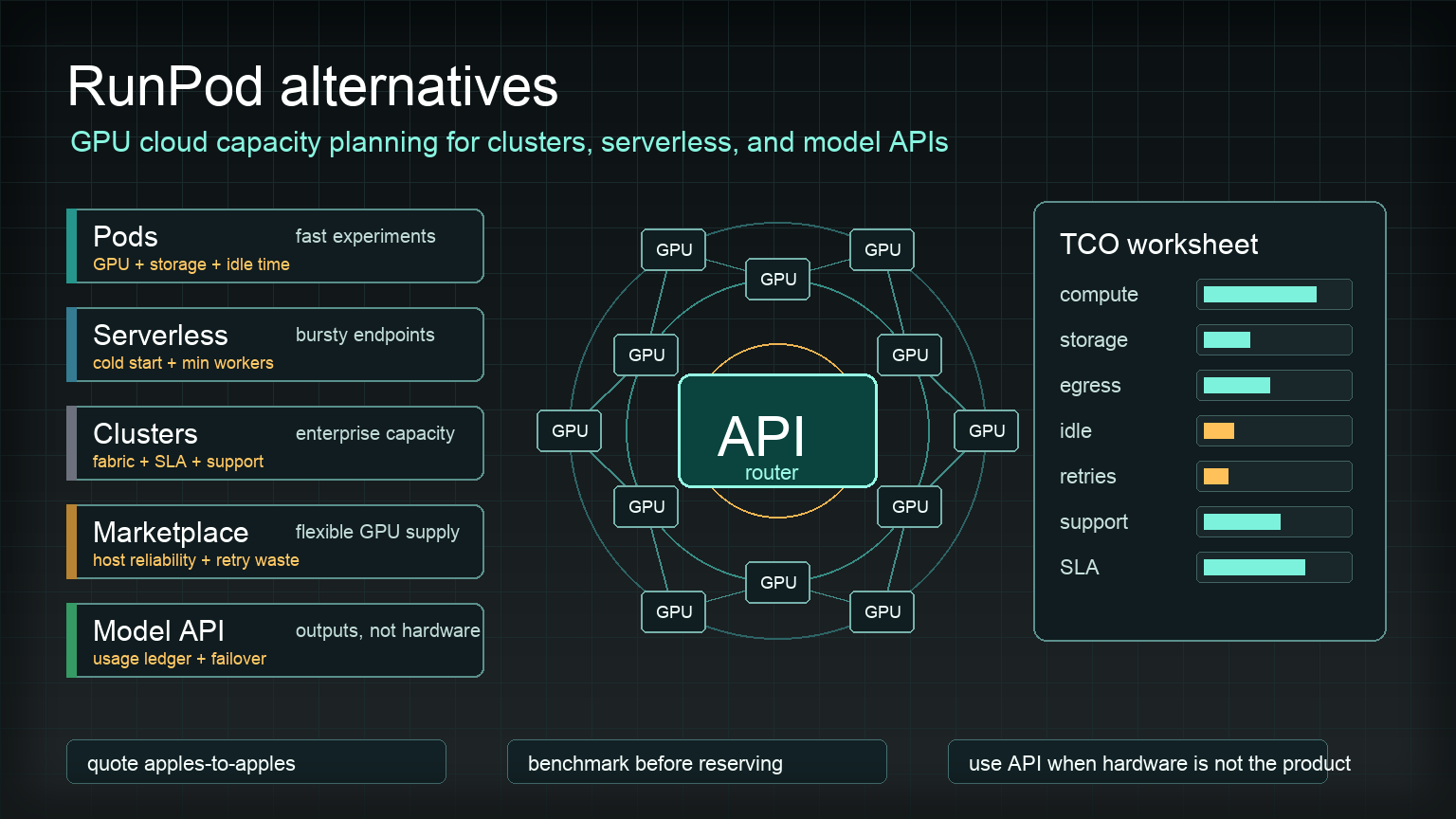
The answer depends on what you are replacing. A RunPod pod, RunPod Serverless endpoint, secure GPU instance, community GPU, and enterprise capacity conversation are different buying motions. The right RunPod alternatives for a weekend ComfyUI batch are not the same as the right alternatives for a private H100 cluster, multi-node training job, or customer-facing inference service.
This guide compares RunPod alternatives for developers and small-to-mid AI teams that need more than a cheap GPU hour. It covers GPU cloud providers, marketplaces, hyperscalers, managed inference platforms, and model API routes, then gives you a worksheet for comparing total cost of ownership instead of headline hourly rates. If you need the broader pricing model first, start with Flatkey's guide to GPU rental prices.
The quick answer: best RunPod alternatives by workload
Use this table to build the first shortlist. Treat it as a decision map, not a universal ranking.
| Workload | Strong RunPod alternatives to evaluate | Why they fit | What to verify before switching |
|---|---|---|---|
| ComfyUI experiments and image batches | Vast.ai, TensorDock, Hyperstack, Paperspace/DigitalOcean, RunPod Community Cloud if staying | Fast GPU access, marketplace or self-serve economics, good fit for flexible batch work | Persistent storage, startup time, host reliability, bandwidth, restart workflow, whether the GPU is suitable for production data |
| Stable single-node inference | Lambda Cloud, Hyperstack, Massed Compute, Nebius, Vultr, AWS/GCP/Azure GPU VMs | Cleaner instance model, broader procurement paths, more predictable infrastructure controls | GPU availability, region, support, disk/network cost, quota, observability, autoscaling |
| Dedicated GPU clusters | Lambda reserved clusters, CoreWeave, Crusoe Cloud, Massed Compute, Nebius, AWS Capacity Blocks, Google Cloud reservations, Azure ND-series | Better fit for committed capacity, support, private networking, and multi-node cluster planning | Network fabric, placement guarantee, support SLA, term length, upgrade path, utilization break-even |
| Serverless inference endpoints | Replicate, Together AI dedicated endpoints, Modal-style platforms, cloud functions with GPU support, RunPod Serverless if staying | Good when you need deployed inference behavior more than raw VM control | Cold starts, minimum workers, per-request pricing, model packaging limits, logs, data policy |
| Frontier model or multi-model API use | Flatkey, OpenRouter-style routers, first-party model APIs | Avoids GPU operations when the value is the output, not hardware control | Model availability, official endpoints, fallback behavior, usage ledger, budget controls, data policy |
For most teams, the best RunPod alternatives are not one provider. They are a split architecture:
- Use marketplace GPUs for experiments and bursty media batches.
- Use a specialist GPU cloud or hyperscaler for stable production capacity.
- Use a model API/router when the product does not need direct control over weights, kernels, or GPU placement.
That split prevents one workload from forcing the wrong infrastructure model onto every other workload.
When RunPod is still a good fit
This is not a "RunPod is bad" article. RunPod is popular because it compresses setup time. Developers can launch GPU pods, run notebooks and containers, experiment with community or secure capacity, and use serverless endpoints without starting from a hyperscaler procurement process.
RunPod is often still a good fit when:
- You need fast GPU access for experiments.
- You are testing ComfyUI, Stable Diffusion, LoRA workflows, or batch media generation.
- You want simple pod-based development before designing a production cluster.
- You can tolerate some infrastructure variance while you are still exploring.
- Your workload can be restarted or rebuilt without a serious customer incident.
The switch usually becomes worth evaluating when the workload becomes expensive, constant, security-sensitive, latency-sensitive, or procurement-visible. At that point, you should compare RunPod alternatives on workload fit, not brand familiarity.
RunPod alternatives comparison framework
Start with this normalized formula:
effective cost per accepted workload =
  compute
  + storage
  + snapshots
  + bandwidth and egress
  + idle time
  + cold starts
  + failed jobs and retries
  + support
  + engineering overhead
  / accepted tokens, jobs, images, videos, fine-tunes, or customer requests
Then ask six questions before comparing providers.
| Question | Why it changes the answer |
|---|---|
| Do you need GPU control or just AI outputs? | If you only need generated text, images, embeddings, or transcriptions, an API route can be cheaper operationally than renting GPUs. |
| Is the workload interactive or batch? | Interactive inference needs p95/p99 latency and availability. Batch jobs can trade queue time for lower cost. |
| Is the job interruptible? | Marketplace and spot-style capacity can work for checkpointed jobs; they can be dangerous for long, stateful jobs. |
| Does the model fit one GPU? | Multi-GPU and multi-node workloads add topology, network, scheduler, and placement risk. |
| Is utilization predictable? | Reserved or dedicated capacity needs enough baseline utilization to beat on-demand. |
| Who owns operations? | GPU drivers, CUDA images, vLLM/SGLang, storage cleanup, observability, and incident response are part of the real cost. |
This is where many RunPod alternatives comparisons become shallow. A list of providers is not enough. You need a procurement model. For multi-node capacity, pair this article with the GPU cluster rental checklist.
GPU cloud alternatives to RunPod
Lambda Cloud
Lambda Cloud is one of the clearest RunPod alternatives when you want a specialist GPU cloud with published GPU instance options and a more conventional infrastructure-buying motion. It is worth evaluating for H100, H200, B200, A100, and other NVIDIA capacity when your workload is moving from experiments into repeatable training or inference.
Use Lambda when you want:
- Straightforward GPU cloud instances.
- A specialist AI infrastructure provider rather than a broad hyperscaler.
- A path from on-demand experiments toward reserved or committed capacity.
- A source row that procurement can understand quickly.
Verify current instance availability, exact GPU variant, local storage, region, support, and whether the quote is on-demand, reserved, or cluster-oriented. Use the official Lambda GPU Cloud page as the source checkpoint, then request a quote if you need dedicated capacity. For GPU-family tradeoffs, see Flatkey's best GPU for LLM inference guide.
CoreWeave
CoreWeave is a strong RunPod alternative for teams that have moved beyond a single pod and need cloud GPU capacity at scale. It is more relevant for production AI workloads, dedicated environments, and enterprise GPU procurement than for one-off hobby experiments.
Evaluate CoreWeave when:
- You need production GPU infrastructure instead of a simple dev pod.
- You care about Kubernetes-native operations, storage, networking, and support.
- You are planning sustained inference, training, or AI media capacity.
- You need a provider conversation around committed capacity and enterprise terms.
The tradeoff is that CoreWeave is not usually the lightest-weight path for a tiny experiment. It belongs on the shortlist when capacity planning, support, and production reliability matter more than the fastest possible first pod.
Crusoe Cloud
Crusoe Cloud is worth comparing for AI teams that want dedicated or scalable GPU infrastructure with enterprise procurement and sustainability-oriented positioning. It often belongs in the same shortlist as Lambda, CoreWeave, Nebius, and Massed Compute for capacity conversations.
Use Crusoe as a RunPod alternative when:
- You are asking for cluster capacity rather than one-off GPU rental.
- You need a provider quote with support, region, and capacity terms.
- You want a specialist cloud conversation instead of a hyperscaler quota process.
Check the exact GPU model, interconnect, storage, support scope, and whether your workload needs self-managed Kubernetes, Slurm, or a managed environment.
Massed Compute
Massed Compute is a useful comparison point for buyers who want published GPU pricing plus a path into reserved or dedicated capacity. It is a practical RunPod alternative for teams that need simple GPU cloud economics but are starting to ask enterprise questions.
Evaluate Massed Compute when:
- You need H100/A100/L40S-style capacity with a clear public starting point.
- You want to compare on-demand GPU rates against longer-term commitments.
- You are building a procurement worksheet for a dedicated cluster or baseline inference pool.
Use the official Massed Compute pricing page as a live source row, then ask what is included in support, networking, storage, and reserved terms.
Nebius AI Cloud
Nebius is a credible RunPod alternative when the buyer wants an AI-native cloud with managed infrastructure services around GPUs, not just raw servers. It is especially relevant when your team wants a cloud platform for model training, inference, data, and orchestration rather than isolated instances.
Evaluate Nebius when:
- You need a broader AI cloud environment.
- You care about Kubernetes, managed services, storage, and networking around GPU workloads.
- You want alternatives outside the default US hyperscaler shortlist.
For TCO, confirm region availability, support, storage, network egress, quota, reservation mechanics, and GPU generation availability.
Hyperstack
Hyperstack is a direct RunPod alternative for teams comparing GPU cloud providers by instance type, hourly cost, and self-serve deployment. It is useful for fast access to NVIDIA GPU instances without taking on a large cloud platform.
Use Hyperstack when:
- You want a simple GPU cloud provider for experiments, inference, or batch jobs.
- You are comparing H100, H200, A100, L40S, RTX-class, or newer GPU availability.
- You need a public pricing checkpoint before engaging sales.
Use the official Hyperstack GPU pricing page as the source checkpoint. Still verify storage, bandwidth, uptime expectations, support, and whether your exact GPU/region is available when the job starts.
Vultr Cloud GPU
Vultr belongs on the RunPod alternatives list when your team wants a familiar cloud provider with GPU options, global regions, and simpler infrastructure packaging than a pure GPU marketplace. It can be attractive for teams that already use cloud VMs and want GPU capacity without adopting a new operational model.
Evaluate Vultr when:
- Your workload is closer to a conventional VM than a complex cluster.
- You need global cloud infrastructure plus GPU acceleration.
- You want a provider that fits existing cloud operations patterns.
Check quota, GPU family, region, persistent storage, egress, support, and whether the workload needs high-end interconnect that a simple GPU VM cannot provide.
Marketplace alternatives to RunPod
Vast.ai
Vast.ai is one of the most common RunPod alternatives for developers chasing flexible GPU supply and low entry cost. It is a marketplace, so the provider comparison is not only Vast.ai versus RunPod. It is each host, GPU, location, reliability score, disk, network, and interruption profile versus your workload.
Vast.ai is often a good fit for:
- ComfyUI experiments.
- Batch image generation.
- Short research jobs.
- Flexible inference tests.
- Workloads that can checkpoint and retry.
It is weaker for workloads that need predictable support, compliance, private networking, or strict customer-facing uptime. Use the official Vast.ai pricing page as a live marketplace checkpoint, but never compare only the hourly GPU rate.
TensorDock
TensorDock is another marketplace-style RunPod alternative. Its official GPU cloud page describes a marketplace of independent hosts that compete and set pricing, which means buyers should evaluate each deployment option rather than treating TensorDock as a single fixed-rate cloud.
TensorDock can be useful when:
- You want flexible GPU VM choices.
- You need RTX-class or data-center GPU options for short projects.
- You can assess host details, storage, bandwidth, and reliability before launch.
Use the official TensorDock GPU cloud page as the source checkpoint. For production, ask whether the selected capacity has the support, isolation, and operational guarantees your customer workload needs.
Hyperscaler alternatives to RunPod
AWS, Google Cloud, and Azure are not always cheaper RunPod alternatives. They are often more operationally complete alternatives.
AWS
AWS is relevant when the workload needs enterprise identity, networking, compliance, procurement, and integration with existing AWS systems. For H100-class workloads, AWS P5 instances are the main source checkpoint, and EC2 Capacity Blocks are relevant when you need reserved ML capacity for a defined window.
AWS can fit when:
- You already run data, security, and deployment systems on AWS.
- You need enterprise procurement and support.
- You need a defined reservation model for a training or launch window.
- You can handle cloud complexity and quota management.
Check AWS P5 instances and EC2 Capacity Blocks for ML, then include EBS, data transfer, support, NAT, observability, and engineering time in the TCO. If the decision is specifically about older versus newer NVIDIA capacity, use the H100 vs A100 and H200 vs H100 comparisons as companion reads.
Google Cloud
Google Cloud is a RunPod alternative when your team wants accelerator-optimized machine families, enterprise controls, and a cloud-native environment around data, networking, and Kubernetes. It is especially relevant for organizations already using Google Cloud data infrastructure.
Use Google Cloud when:
- Your workload needs cloud data locality with BigQuery, GCS, GKE, or Vertex AI.
- You need enterprise identity, audit, and procurement controls.
- You can plan around quota, regions, disk, and network pricing.
Use Google Cloud accelerator-optimized machine documentation and Compute Engine GPU pricing as source checkpoints. Normalize GPU, machine, disk, network, and committed-use assumptions before comparing it with specialist GPU clouds.
Azure
Azure is a practical RunPod alternative for enterprises already standardized on Microsoft cloud, identity, security, procurement, or data systems. Azure's ND H100 v5 series is a key source checkpoint for H100 cluster-style workloads.
Use Azure when:
- Your company already buys through Microsoft agreements.
- You need enterprise security, compliance, and network controls.
- You need GPU VMs tied to broader Azure data or application infrastructure.
Check the Azure ND H100 v5 series, then validate regional availability, quota, InfiniBand requirements, storage, support, and deployment complexity.
Serverless and managed inference alternatives
Not every RunPod alternative should be a rented GPU. If your team wants an endpoint, not a machine, managed inference can remove a lot of operational work.
Replicate
Replicate is a strong fit when the team wants to run models through an API, deploy model versions, and avoid managing GPU hosts directly. It is especially useful for product teams that care about shipping model-backed features quickly.
Replicate can fit:
- Image, video, audio, and open-source model inference.
- Product prototypes that need an API quickly.
- Teams that prefer deployment ergonomics over low-level GPU control.
Use Replicate pricing as the source checkpoint, then verify hardware options, deployment behavior, cold starts, logs, data handling, and whether the workload needs custom kernels or private networking.
Together AI
Together AI is a RunPod alternative when the workload is closer to LLM inference and fine-tuning than general GPU VM rental. It belongs on the shortlist for teams that want managed inference, dedicated endpoints, and model-serving infrastructure without operating the full stack.
Together AI can fit:
- LLM inference endpoints.
- Fine-tuning and evaluation workflows.
- Teams that want model-serving infrastructure rather than raw pod management.
Use Together AI pricing as the live pricing checkpoint and verify whether the workload belongs on serverless inference, dedicated endpoints, batch APIs, or a custom enterprise agreement. If you will self-host, compare serving stacks separately with vLLM vs SGLang.
Model API and router alternatives
The most overlooked RunPod alternatives are model APIs and routers. If your product does not require custom weights, custom CUDA kernels, private GPU placement, or low-level serving control, renting GPUs can be the wrong abstraction.
Flatkey's positioning is useful for this decision: one key, one balance, one invoice, OpenAI-compatible routing, official model endpoints, usage ledgers, budget controls, and fallback paths across many models and tools. That does not replace a dedicated GPU cluster when you need to own the serving stack. It does replace the cluster when what you need is reliable AI output with traceable spend. For model-side budgeting, compare the GPU worksheet with AI model pricing comparison and AI API spend management.
Use a model API or router when:
- You need access to many text, image, or video models.
- Traffic is bursty and does not justify reserved GPUs.
- Model choice changes often.
- You do not need to manage weights, drivers, CUDA, or serving kernels.
- Cost visibility, fallback, and billing consolidation matter more than raw GPU control.
Use dedicated GPUs when:
- You serve private or custom weights.
- You need custom kernels, quantization, adapters, or serving logic.
- Data residency or isolation requires your own environment.
- Inference volume is stable enough to justify committed capacity.
- You can staff GPU operations.
That is the core procurement question: are you buying hardware access or accepted outputs?
RunPod alternatives for ComfyUI
Searches for runpod alternatives comfyui usually come from a practical pain: the workflow runs, but storage, startup time, image versions, and repeatability are getting annoying.
For ComfyUI, compare these options:
| Option | Best fit | Watch-outs |
|---|---|---|
| RunPod pods | Familiar path if you already have templates and volumes | Persistent volume cleanup, idle cost, image drift |
| Vast.ai or TensorDock | Flexible GPU supply for batch image jobs | Host reliability, storage, bandwidth, restarts |
| Hyperstack or Lambda | More conventional GPU cloud instance model | Availability, hourly cost, setup responsibility |
| Replicate-style APIs | Product features that need image outputs through an API | Less low-level workflow control |
| Flatkey/model API route | Multi-provider image/video model experimentation | Not a replacement for custom ComfyUI graphs that require direct node control |
For ComfyUI, do not compare only GPU model and hourly rate. Also measure:
- Time to pull images and model weights.
- Persistent storage cost.
- Whether custom nodes survive rebuilds.
- Idle time after a batch finishes.
- Output transfer cost.
- Failure rate from missing models, bad images, or host restarts.
- Whether the workflow needs a UI, API endpoint, or automated queue.
The best RunPod alternatives for ComfyUI are usually the ones that reduce rebuild time and abandoned storage, not the ones with the lowest visible GPU hour.
Dedicated GPU cluster checklist
If the reason for switching is enterprise capacity, use this checklist before signing a term sheet.
| Requirement | What to ask each provider |
|---|---|
| GPU shape | Exact GPU model, memory, PCIe/SXM/NVL, GPUs per node, CPU, RAM, local NVMe |
| Network | InfiniBand, RoCE, EFA, NVLink/NVSwitch, placement guarantee, oversubscription, NCCL test evidence |
| Storage | Local scratch, shared filesystem, object storage region, checkpoint throughput, snapshot pricing |
| Scheduler | Kubernetes, Slurm, Ray, managed service, user access, quota, idle shutdown |
| Reliability | Node replacement policy, maintenance windows, incident escalation, SLA, retry policy |
| Security | Tenant isolation, audit logs, secrets handling, private networking, data deletion |
| Cost controls | Per-team tags, usage exports, budget alerts, idle detection, chargeback |
| Contract | Minimum term, minimum spend, burst options, upgrade path, cancellation, support scope |
Run at least one acceptance test before the contract becomes hard to exit:
cluster acceptance test =
  deploy production container
  pull model weights and dataset
  run representative benchmark
  run NCCL all-reduce if multi-node
  write and restore checkpoint
  simulate one failed job
  export cost and utilization logs
If a provider cannot support a representative benchmark, treat that as a buying risk.
Replicate vs Together AI vs RunPod alternatives
The query replicate vs together ai vs runpod alternatives mixes three categories, so compare them by abstraction level.
| Platform type | You manage | Provider manages | Best fit |
|---|---|---|---|
| RunPod-style GPU cloud | Containers, images, storage, GPU lifecycle, serving stack | GPU infrastructure and platform primitives | Developers who need direct GPU control |
| Replicate-style model deployment | Model packaging and API usage | A large share of serving infrastructure and user-facing deployment ergonomics | Product teams shipping model endpoints quickly |
| Together AI-style inference platform | Model selection, endpoint choice, workload design | LLM serving infrastructure and endpoint operations | Teams focused on LLM inference/fine-tuning |
| Flatkey-style model router | API calls, budgets, model routing policy | Multi-model access layer, unified billing, usage ledger | Teams that need official model outputs, not GPU ownership |
Do not pick the cheapest line item. Pick the lowest operational risk for the job.
RunPod alternatives comparison worksheet
Use this worksheet when comparing GPU cloud providers.
| Field | Provider A | Provider B | Provider C |
|---|---|---|---|
| Product mode | Pod / VM / serverless / reserved cluster / API | ||
| GPU model and memory | H100 SXM, H100 PCIe, H200, B200, L40S, RTX 4090 | ||
| Region or host | |||
| Billing unit | second, minute, hour, monthly, capacity block | ||
| Minimum commitment | none, monthly, annual, reserved block | ||
| Storage cost | volumes, snapshots, object storage, local NVMe | ||
| Network cost | egress, private link, cross-region, public IP | ||
| Startup overhead | image pull, weight download, cold start | ||
| Idle rate | billable minutes with no useful work | ||
| Failure/retry multiplier | evictions, OOM, bad hosts, cold-start failures | ||
| Support | self-serve, ticket, dedicated support, SLA | ||
| Security | tenant isolation, audit logs, secrets, deletion | ||
| Accepted output unit | 1M tokens, image, video, fine-tune, training run | ||
| Effective cost per accepted output | computed, not guessed |
Then calculate:
effective hourly cost =
  GPU hourly cost
  + storage per hour
  + network per hour
  + support per hour
  + idle waste
  + retry waste
  + engineering overhead

cost per accepted output =
  effective hourly cost / accepted outputs per hour
This is also how you decide whether dedicated capacity beats APIs. If API cost per accepted output is lower after you include GPU operations, do not rent the cluster just because the hourly GPU rate looks attractive.
Source checklist for current pricing
Pricing and GPU availability change frequently. Before making a purchase decision, re-check the source rows and record the date. For this draft, the source checklist was verified for page availability on October 12, 2026.
| Provider/category | Source checkpoint | What to capture |
|---|---|---|
| RunPod | RunPod pricing, RunPod pod storage docs | Pod mode, serverless mode, secure/community capacity, storage, network volume, idle assumptions |
| Lambda | Lambda GPU Cloud | GPU model, instance shape, availability, reserved or cluster terms |
| Vast.ai | Vast.ai pricing | Host, reliability, GPU, storage, bandwidth, marketplace terms |
| Massed Compute | Massed Compute pricing | On-demand rates, reservation path, support and cluster terms |
| Hyperstack | Hyperstack GPU pricing | GPU SKU, region, storage, networking, support |
| TensorDock | TensorDock GPU cloud | Marketplace host, GPU, RAM/vCPU, storage, pricing at deploy time |
| Replicate | Replicate pricing | Deployment pricing, hardware, cold starts, logs, data policy |
| Together AI | Together AI pricing | Serverless, dedicated endpoints, fine-tuning, batch economics |
| AWS | EC2 P5 instances, EC2 Capacity Blocks | Region, quota, instance family, reservation window, EBS, data transfer, support |
| Google Cloud | Accelerator-optimized machines, GPU pricing | Machine family, GPU price, disk, network, committed-use discounts |
| Azure | ND H100 v5 series | VM size, region, quota, InfiniBand, support, storage |
Final recommendation
Shortlist RunPod alternatives by operating model:
- Use marketplaces such as Vast.ai or TensorDock for flexible experiments, ComfyUI batches, and retry-tolerant workloads.
- Use specialist GPU clouds such as Lambda, CoreWeave, Crusoe, Massed Compute, Nebius, Hyperstack, or Vultr when you need more predictable GPU capacity and support.
- Use hyperscalers when enterprise identity, procurement, compliance, and existing cloud data gravity matter more than simplicity.
- Use managed inference platforms such as Replicate or Together AI when endpoint behavior matters more than VM control.
- Use Flatkey or another model API router when you need official AI model outputs, usage visibility, fallback, and unified billing rather than direct GPU ownership.
The best RunPod alternatives are the ones that reduce the cost of accepted work. If a provider gives you a cheaper GPU hour but increases idle time, startup overhead, failed jobs, storage waste, or engineering load, it is not actually cheaper.
Frequently asked questions
What are some alternatives to RunPod?
Common RunPod alternatives include Lambda Cloud, CoreWeave, Crusoe Cloud, Massed Compute, Nebius AI Cloud, Hyperstack, Vultr Cloud GPU, Vast.ai, TensorDock, Replicate, Together AI, AWS, Google Cloud, Azure, and model API routers such as Flatkey. The right choice depends on whether you need pods, serverless endpoints, dedicated clusters, marketplaces, or API-level model access.
What is the best RunPod alternative for ComfyUI?
For ComfyUI experiments, Vast.ai, TensorDock, Hyperstack, Lambda, and Paperspace-style GPU clouds are common shortlists. Compare persistent storage, model weight caching, startup time, custom node management, idle shutdown, output transfer, and host reliability before comparing hourly GPU rates.
Are RunPod alternatives cheaper?
Sometimes, but only after you calculate effective cost per accepted output. A lower hourly GPU rate can lose if the workload spends more time pulling models, sitting idle, retrying failed jobs, or moving data. Compare completed images, tokens, videos, or jobs, not only GPU hours.
Should I use Replicate or Together AI instead of RunPod?
Use Replicate or Together AI when you want managed model endpoints and do not need low-level GPU control. Use RunPod-style GPU clouds when you need custom containers, custom workflows, direct GPU access, or control over the serving stack.
When should I use Flatkey instead of renting GPUs?
Use Flatkey when your team needs official model APIs, multi-model routing, one key, one balance, usage ledgers, fallback, and budget controls. Rent GPUs when custom weights, custom kernels, private placement, or stable high utilization make direct infrastructure control worth the operational cost.